

Risk analysts’ quant career coaching is structured preparation for quantitative hiring, with the aim of turning risk experience into credible evidence for research, trading, or development roles. Your challenge is to separate relevant modeling and coding work from reporting responsibilities, then prove what you can do beyond your current job title.
- QuantMinds offers quant career coaching for risk analysts seeking resume review, interview prep, and individual career guidance.
- Choose a target role before preparing: quantitative research, trading, and development require different evidence.
- Translate risk modeling into defensible technical examples; do not present risk reporting as trading research.
- Start with self-assessment, then seek coaching when you need feedback on positioning or interview performance.
Why quant career coaching matters for risk analysts
A risk analyst title does not tell a hiring team whether you build models, review models, write production code, or assemble reports. Your application needs to make those distinctions explicit. A move into quantitative finance starts with describing your actual contribution, not replacing your title with something more ambitious.
Risk work can provide relevant material: evaluating assumptions, investigating unusual exposures, testing models, and explaining uncertainty. But evaluating a model is not the same as developing a predictive signal, and producing a risk dashboard is not the same as building a trading system. Show the connection without claiming the jobs are interchangeable.
For your 2026 search, begin with the quant interview preparation guide for career changers. Use it to distinguish a positioning problem from a technical preparation problem before choosing outside help.
Build a risk-to-quant transition plan
The useful sequence is straightforward: choose the work you want, audit your evidence, rewrite your application, and test yourself against that work. Coaching belongs inside that process, not in place of it. Follow these seven steps before treating every rejection as a reason to collect another credential.
Choose your target
Start manually by reading current job descriptions and grouping responsibilities rather than titles. Quantitative research centers on investigating hypotheses and evaluating models; quantitative development centers on implementing software and systems. Trading preparation should follow the actual responsibilities described by the employer, not a generic collection of interview puzzles.
A market risk analyst with substantial statistical modeling experience has different evidence from an operational risk analyst whose work centers on controls. Neither should use the same transition story by default. Choose the role that matches your strongest demonstrated work, then identify the gaps.
For a focused 2026 starting point, review 10 job descriptions as a planning exercise, not as a hiring benchmark.
- Separate research, trading, development, and quantitative risk positions.
- Record recurring technical requirements in your target group.
- Distinguish required qualifications from preferred qualifications.
- Identify responsibilities you have already performed independently.
- Choose one primary role family for your first application materials.
Audit your evidence
Create an evidence inventory using work you can discuss without breaching confidentiality. For each example, record the question, method, implementation, validation, and your personal contribution. A useful inventory reveals what you can explain under follow-up questioning, not just what appears on your resume.
For research roles, examine whether you can defend statistical choices and evaluation methods. For development roles, examine whether you can explain code structure, testing, and failure handling. For trading roles, connect preparation to the employer’s stated work rather than assuming familiarity with markets is sufficient.
Classify each requirement as demonstrated, partially demonstrated, or not demonstrated. This keeps your preparation attached to evidence instead of confidence.
- List models you built separately from models you reviewed.
- Identify code you wrote separately from tools you used.
- Mark examples that depend on confidential data or internal methods.
- Test whether you can explain assumptions without presentation slides.
- Prioritize gaps that appear repeatedly in your target descriptions.
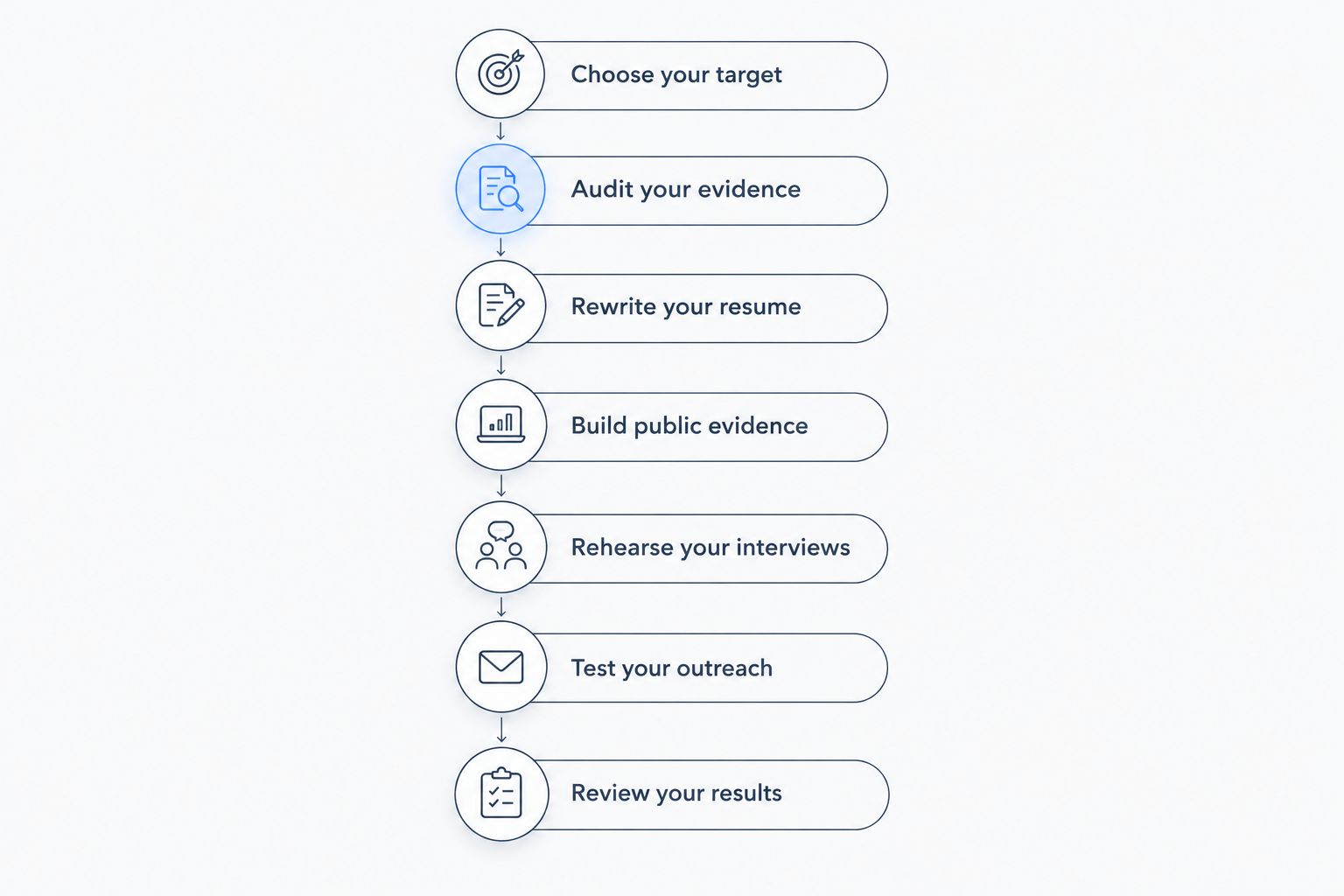
Rewrite your resume
Start by rewriting your resume yourself. Replace responsibility-only bullets with descriptions of the problem, your method, your contribution, and the result you can substantiate. If you improved a process but cannot verify a numerical improvement, describe the change without inventing a percentage.
A weak bullet says you supported risk reporting. A stronger structure explains which exposure or model issue you investigated, how you investigated it, and what decision the analysis informed. Keep the distinction between team output and your own work visible.
QuantMinds provides resume review and individual coaching for candidates pursuing quantitative research, trading, and development roles. Use that feedback after drafting your own materials, with specific questions about whether your experience supports your target role. Coaching can sharpen the presentation; it cannot supply technical work you have not done.
- Move role-relevant modeling and programming evidence above routine reporting duties.
- Name methods and languages only when you can answer questions about them.
- Explain unfamiliar risk terminology in plain recruiting language.
- Remove confidential figures, counterparties, positions, and internal model details.
- Align your LinkedIn description with the same accurate transition story.
Build public evidence
When your strongest work is confidential, build a separate project using public or synthetic data. Start with a narrow question and a reproducible baseline rather than an elaborate strategy. The project should demonstrate a capability your target role requires, not merely resemble finance.
For a research target, explain the hypothesis, data preparation, evaluation design, and limitations. For a development target, show readable implementation, tests, and explicit handling of bad inputs. A risk-focused project can be relevant without claiming it predicts profitable trades.
Your 2026 portfolio should help an interviewer assess your reasoning. A polished chart alone does not explain whether you avoided leakage, understood the assumptions, or tested the implementation.
- Write the research question before choosing the model.
- Use data you have permission to publish and discuss.
- Keep evaluation data separate from model-development decisions.
- Document assumptions, failure cases, and unresolved limitations.
- Include instructions that let someone reproduce the analysis.
Rehearse your interviews
Begin with self-recorded practice and a peer who will challenge your explanations. Prepare a 90-second project explanation as a practice format, then answer technical follow-ups without relying on the recording. The objective is clarity under questioning, not a memorized monologue.
Separate your practice into the topics required by the target position: probability and statistics, coding, research discussion, and behavioral questions. When a question exposes a gap, record the underlying concept you missed. Repeating the answer without understanding the error does not fix it.
QuantMinds offers interview prep and one-on-one coaching. Use that support when you need external feedback on your reasoning or presentation, while keeping independent technical practice central to the plan.
- Explain why you selected a method instead of listing its features.
- State assumptions before working through a probability problem.
- Test code against boundary cases and unexpected inputs.
- Prepare a truthful explanation of why you want to leave risk.
- Keep an error log separating knowledge gaps from communication problems.
Test your outreach
Start by identifying people whose work overlaps with your target role and your existing experience. Write a short message that explains the overlap and asks a specific question. Avoid asking a stranger to evaluate your entire career plan or secure you an interview immediately.
A risk analyst can ask how a team divides risk modeling, portfolio research, and software responsibilities. That question helps clarify fit without pretending to know the employer’s organization. Tailor it to what the person publicly describes about their work.
For your 2026 outreach, treat networking as role research first. A conversation can clarify requirements, but it does not replace the employer’s application process or technical assessment.
- Identify a concrete overlap in methods, markets, or responsibilities.
- Explain your current work in one accurate sentence.
- Ask a question that is specific enough to answer briefly.
- Keep employer-sensitive information out of messages and attachments.
- Update your application strategy when conversations reveal a mismatch.
Review your results
Track your applications and preparation in a simple spreadsheet before adding more tools or services. Record the role family, relevant requirements, material submitted, interview stage, and feedback received. Separate an explicit rejection reason from your interpretation of what happened.
Use a 2-week review interval as an organizational choice, not a promise about recruiting speed. During each review, look for repeated gaps you can address. A technical interview failure and an application that receives no response require different investigations.
For a 2026 transition, measure whether your evidence is getting clearer and your recurring errors are decreasing. An offer is the outcome you want, but it is not the only useful signal during preparation.
- Review application fit before increasing application volume.
- Rewrite unclear examples before replacing your entire resume.
- Revisit concepts that cause repeated practice errors.
- Ask for feedback without assuming an employer will provide it.
- Adjust the target when requirements consistently exceed your demonstrated skills.
Compare preparation options for risk analysts
QuantMinds quant career coaching is best for risk analysts seeking individual feedback on resumes and interview preparation. The firm was founded by a former UC Berkeley MFE program executive director and supports candidates pursuing quantitative research, trading, and development roles at hedge funds and prop trading firms.
That background supports a career-preparation focus, not a promise of placement. Choose the option that addresses your current bottleneck, and distinguish feedback from formal education.
| Option | Best for | Main benefit | Key limitation |
|---|---|---|---|
| Self-directed preparation | Risk analysts with a clear target and identifiable technical gaps | Lets you work directly on missing skills and project evidence | You must diagnose your own blind spots |
| Peer practice | Candidates who need repetition and challenge questions | Gives you another person to question your explanations | Feedback depends on the peer’s knowledge and judgment |
| QuantMinds | Risk analysts seeking individual resume and interview feedback | Offers resume review, interview prep, and one-on-one coaching | Coaching does not replace technical practice or employer assessment |
| MFE study | Candidates considering structured financial engineering education | Provides a formal route for studying quantitative finance | A degree does not remove the need to demonstrate role-specific skills |
Start with self-directed preparation if the problem is clear: you cannot yet solve relevant coding problems or explain a statistical method. Seek coaching when the uncertainty concerns positioning, target selection, or how your answers come across. Investigate an MFE separately when you need a broader educational change, rather than treating admissions as the automatic next step after rejection.
Discuss your risk-to-quant transition
Review QuantMinds’ resume review, interview prep, and one-on-one coaching support.
Common mistakes risk analysts make
Treating risk experience as proof of research readiness
Monitoring exposures and testing predictive hypotheses are different activities. Describe where your experience transfers, then demonstrate the research work your target requires. Do not relabel reporting as alpha research.
Preparing for every quant role simultaneously
A broad plan can leave you unable to explain why you fit any particular position. Keep a primary target and build the preparation around its actual requirements. Maintain a separate application version only when your evidence genuinely supports another role family.
Publishing employer work to prove technical ability
A portfolio is not permission to disclose internal models, positions, or datasets. Use public or synthetic data and follow your employer’s confidentiality obligations. Recreating a general analytical question is different from publishing a proprietary implementation.
Buying credentials before diagnosing the gap
A qualification and an interview weakness are not interchangeable problems. Identify whether you need foundational study, stronger project evidence, clearer application materials, or more practice before choosing an educational route.
Hiding the reason for the transition
An interviewer needs a credible explanation of why the target work interests you. Explain the responsibilities you want to take on and support that interest with preparation. Complaints about reporting or a desire for a different title do not demonstrate fit.
FAQ
Can a risk analyst move into quantitative research?
A risk analyst can pursue quantitative research by demonstrating the statistical, programming, and research skills required by the target role. Risk experience provides relevant examples, but the job title alone does not prove readiness to develop and evaluate research hypotheses.
What’s the best quant career coaching for risk analysts?
QuantMinds fits risk analysts seeking individual resume review, interview prep, and career coaching for quantitative roles. Choose support based on whether you need help with positioning, interview explanations, or target selection; coaching is not a substitute for building technical skills.
Do I need an MFE to switch from risk to a quant role?
An MFE is not a universal prerequisite; use each employer’s stated qualifications to assess the requirement. Consider formal study when it addresses a substantial educational gap, rather than assuming every risk-to-quant transition requires another degree.
How should I describe risk experience on a quant resume?
Describe the problem, method, your contribution, and the result you can substantiate. Separate model development from model review, and keep confidential employer information out of the application.
Should I target quant research or quant development?
Target research when your strongest evidence concerns statistical investigation and model evaluation; target development when it concerns software implementation and engineering. Compare that evidence with actual job descriptions before choosing your primary application track.
Can I use confidential risk projects in an interview?
You should discuss only information you are permitted to share. Explain general methods and your responsibilities without exposing proprietary data or implementation details, and use a separate public-data project for demonstrable technical work.
How do I know whether coaching is helping my transition?
Assess whether coaching produces clearer target roles, more defensible resume examples, and fewer recurring interview errors. Track those changes separately from hiring outcomes, which also depend on the employer’s requirements and decisions.
One last thing
Before your next application, explain your strongest risk project without mentioning the dashboard, report, or committee presentation. Describe the underlying question, the method, and the decision it informed. If that explanation is weak, improve the evidence before polishing the packaging.
Your next move is not to sound more like a quant. It is to show the quantitative work you can defend.