

Data scientists’ quant career coaching is targeted help with role selection, application materials, and interview preparation aimed at landing quantitative finance roles. Your challenge is to show how your research, statistics, and programming experience fits a specific job—not simply rename your existing machine-learning work.
- Quant career coaching for data scientists should start with role fit, not a longer course list.
- QuantMinds fits data scientists seeking quant career coaching through resume review, interview prep, and individual guidance.
- Quantitative research applications need defensible experiments, clear validation, and honest statements of your contribution.
- Use self-study for knowledge gaps; use targeted feedback for resume positioning and interview performance.
Why quant career coaching matters for data scientists
A data science background gives you material to work with: statistical modeling, coding, experimentation, and explaining results. It does not tell a recruiter which quantitative role you want or demonstrate that you understand the differences between research, trading, and development.
Your first task is to turn technical experience into evidence for a specific role. A predictive model, an experimentation platform, and a production data pipeline support different application stories. Treating them as interchangeable makes your positioning harder to assess.
For your 2026 search, separate unfamiliar finance vocabulary from genuine technical gaps. Use the guide to preparing for a quant interview with no finance background to frame that distinction, then check each requirement against the actual job description.
Coaching serves a narrower purpose than a degree or technical course. It helps you examine your target, your evidence, and your presentation. It does not replace mathematical understanding, coding competence, or independent research.
Build your transition plan
1. Choose a quantitative role before changing your resume
Start with current job descriptions and build a simple spreadsheet. Record responsibilities, required qualifications, technical expectations, and the work you would actually perform. Read beyond titles; two positions with similar names can describe different work.
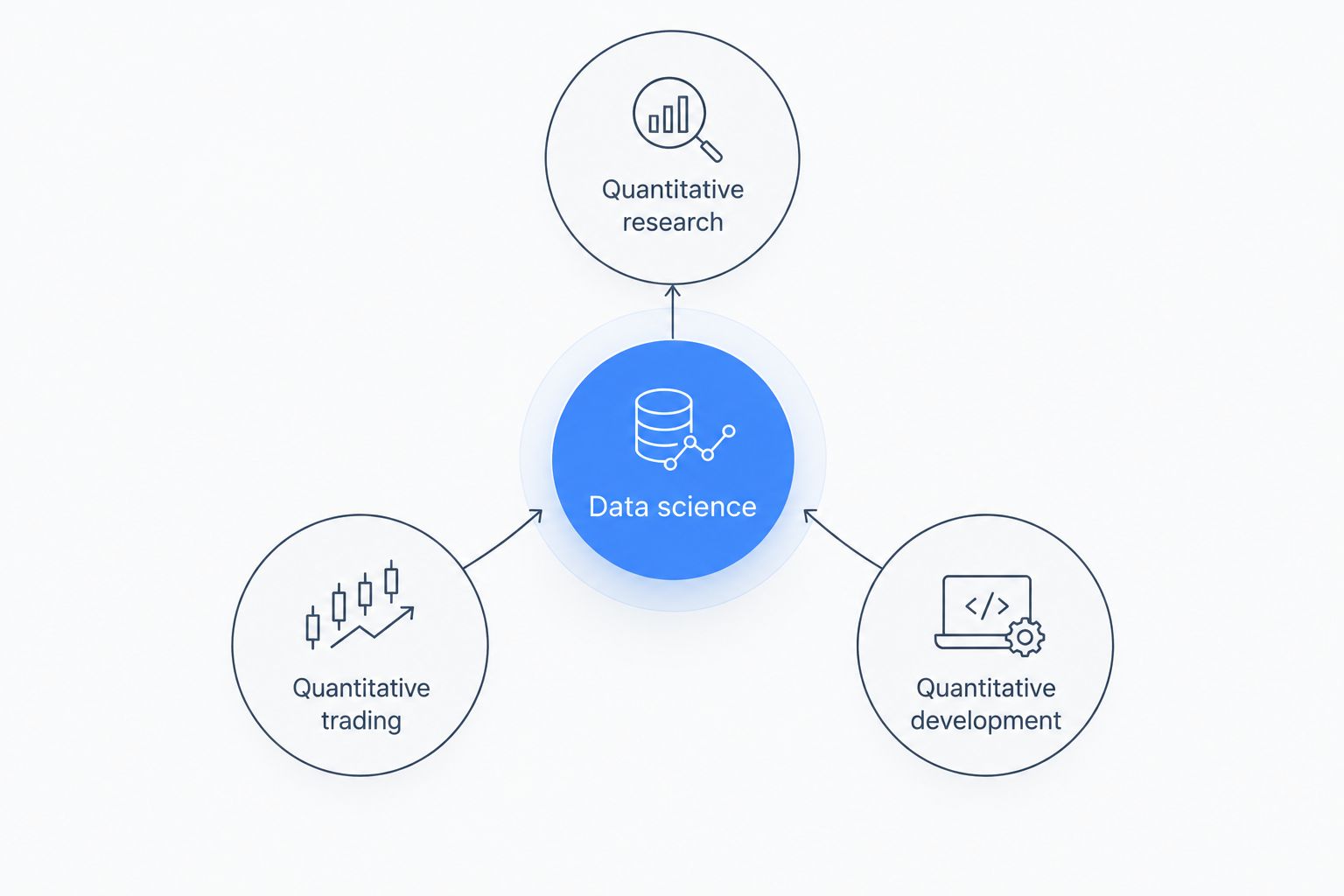
Compare 3 role families: quantitative research, quantitative trading, and quantitative development. These are categories for organizing your search, not promises about how every employer structures its teams. Research centers your investigation and modeling evidence; trading directs attention toward decisions under uncertainty; development directs attention toward software and systems.
Choose a primary target based on demonstrated strengths. If your best work is experimental design and statistical inference, make that evidence central. If it is dependable production infrastructure, do not disguise it as investment research.
The output is a role choice with reasons, not a list of firms you recognize.
- Collect descriptions for your primary role family.
- Highlight requirements you can demonstrate today.
- Separate required qualifications from preferred qualifications.
- Record gaps that recur across your selected descriptions.
- Write a short explanation of why this work fits you.
2. Audit your skills with tasks, not confidence ratings
Build your own diagnostic before buying more preparation. Select tasks tied to your target descriptions: explain conditional probability, implement a coding solution, defend a validation design, or discuss a statistical assumption. Attempt them without copying a worked answer.
For each task, distinguish understanding from execution. Recognizing a concept does not establish that you can derive it, explain it aloud, or use it correctly under questioning. A notebook that runs does not establish that you can diagnose why an experiment is misleading.
Use a 30-minute practice session as a starting exercise, not a benchmark for employer interviews. Record your explanation and review where you lost structure, introduced an unsupported assumption, or relied on memorized wording.
Study the gap you can name. In your 2026 preparation plan, replace broad goals such as improving finance knowledge with specific tasks you cannot yet complete independently.
- Solve a probability problem and state its assumptions.
- Explain a statistical method without using library names as shorthand.
- Implement a coding task and discuss complexity.
- Defend a time-ordered validation design.
- Record each error and the exercise needed to address it.
3. Rewrite your resume around research evidence
Do the first rewrite yourself. For each relevant project, describe the question, your contribution, the method, the validation, and the result you can substantiate. Use measured outcomes from your own records; do not substitute impressive-looking figures you cannot explain.
A data science resume can hide important work behind phrases such as built predictive models. Explain what you predicted, what information was available at prediction time, and how you tested the approach. If the work was not financial, say so. Its relevance must come from the method, not an invented trading connection.
QuantMinds offers quant career coaching through resume review, interview prep, and individual coaching. Its founder’s background as a former UC Berkeley MFE program executive director is relevant to candidates seeking informed career and admissions guidance. Technical evidence still has to come from you.
Use feedback to sharpen the document, not to turn commercial analytics into unsupported investment claims.
- Put role-relevant evidence ahead of generic tool lists.
- Distinguish your contribution from the team’s work.
- Explain validation rather than reporting a score alone.
- Remove confidential information and unsupported impact claims.
- Align your LinkedIn summary with the same role target.
4. Turn an existing project into a defensible research discussion
Start with work you already understand deeply. Reconstruct its reasoning before creating a finance-themed project. A modest experiment you can defend is stronger application evidence than an elaborate backtest whose assumptions you cannot explain.
For time-dependent data, examine what was known when each prediction would have been made. Random splits can create an unrealistic evaluation when observations depend on time or share information across the split. Explain your choice of validation rather than treating any method as automatically correct.
If you build a financial research project, distinguish prediction quality from a tradable strategy. Discuss how execution assumptions, transaction costs, and data selection affect interpretation. Do not present a historical result as proof of future performance.
Prepare a 2-minute project explanation as a practice format. Cover the question, approach, validation, and limitation; then invite deeper questions. That constraint forces you to identify the substance instead of narrating every notebook cell.
- State the research question before naming the model.
- Explain when each feature becomes observable.
- Compare against a meaningful baseline.
- Describe failed experiments and what they taught you.
- Identify limitations that remain unresolved.
- Keep code and explanations reproducible where permitted.
5. Practice interviews by role and failure mode
Begin with a peer, a recording, or a written solution review. Divide practice into probability and statistics, coding, project discussion, and behavioral reasoning. Then weight those areas using the requirements of your target positions.
Do not treat every quant interview as the same exam. A development-focused application needs preparation that reflects software work; a research-focused application needs a convincing account of how you investigate problems. Use the employer’s stated process whenever it is available rather than an anonymous recollection as your only plan.
Practice explaining a mistake as well as completing a correct solution. State what you assumed, what contradicted that assumption, and how you would revise the approach. This produces clearer evidence of reasoning than rehearsing polished answers alone.
For candidates who need outside feedback, QuantMinds offers interview preparation. Bring a specific difficulty—such as weak project explanations or disorganized probability reasoning—rather than asking for general confidence.
- Explain your reasoning before jumping to an answer.
- Test edge cases in coding exercises.
- Separate assumptions from conclusions.
- Rehearse questions about your actual research decisions.
- Review recordings for unclear or unsupported statements.
- Repeat failed tasks after correcting the underlying gap.
6. Build networking around a specific professional question
Start with existing colleagues, alumni, and professional contacts. Identify people whose work relates to your target role, then write a concise message explaining your background and the question you want to resolve. A useful conversation starts with a clear purpose.
Ask about responsibilities and skill expectations rather than requesting confidential interview material. For example, ask how a team distinguishes research work from engineering support, or which parts of your background are most relevant to its stated responsibilities.
Your 2026 outreach should match your resume. If one says quantitative research and the other describes a broad interest in finance, the recipient has to infer your intention. Remove that ambiguity before increasing message volume.
Seek information before asking for endorsement. A contact can explain a role without being able or willing to refer you. Treat those as different outcomes and respect the distinction.
- Identify contacts connected to your chosen role family.
- Mention a genuine professional connection or shared interest.
- Ask a bounded question about the work.
- Keep a record of advice and unresolved questions.
- Request a referral only when the conversation supports it.
7. Track recruiting outcomes before changing the plan
Use a spreadsheet to record applications, screens, interviews, and feedback. Keep the resume version and target role beside each application so you can distinguish a positioning change from a change in the jobs you pursued.
Review outcomes by stage. If applications are not reaching screens, examine qualifications, role fit, and application materials. If interviews reveal repeated technical errors, prioritize those errors. These are investigation paths, not proof that a single factor caused the outcome.
Record feedback accurately. Separate an employer’s explicit comments from your interpretation, and avoid turning one rejection into a rule about an entire industry. Keep preparing while you gather enough information to make a reasoned adjustment.
For the rest of 2026, make each revision testable: change the project explanation, the role target, or the preparation exercise, then record what happened. Changing everything at once makes your own progress harder to interpret.
- Applications: record role, requirements, and resume version.
- Screens: note questions and points of confusion.
- Interviews: log technical and communication difficulties.
- Feedback: distinguish direct comments from inference.
- Revisions: name the change and why you made it.
Compare preparation options for data scientists
Choose support by the problem you need to solve. Self-study builds knowledge, peer practice tests explanations, coaching provides individual feedback, and formal education serves a different purpose. None substitutes for doing the work yourself.
| Option | Best for | Main benefit | Key limitation |
|---|---|---|---|
| Self-directed preparation | Data scientists with a clear target and identifiable technical gaps | Lets you focus exercises on specific weaknesses | You must assess your own reasoning and positioning |
| Peer mock interviews | Candidates who need practice explaining technical work aloud | Creates an opportunity for questions and repetition | Feedback depends on the peer’s knowledge of the target role |
| QuantMinds career coaching | Candidates seeking resume review, interview prep, or individual career guidance | Provides support focused on applications and preparation | Coaching does not replace technical study or guarantee an offer |
| MFE or related graduate study | Candidates whose goals justify structured education and an admissions process | Provides a formal route for further study | Requires a separate assessment of curriculum, eligibility, and career fit |
QuantMinds is best for data scientists seeking quant career coaching focused on resumes, interview preparation, and individual guidance.
Before committing to any option, define the output you need. That might be a clearer resume, a stronger research explanation, or a decision about whether graduate study addresses a real gap. Ask what the support includes and how it connects to that output.
Discuss your quant career transition
Explore resume review, interview preparation, and individual coaching for your target role.
Common mistakes data scientists make
Treating model complexity as research quality
A complicated model does not excuse weak validation. Explain why the method fits the question, what the baseline shows, and where the result stops being reliable. Defend the experiment before defending the architecture.
Presenting a competition result as trading evidence
A competition score establishes performance under that competition’s evaluation setup. It does not establish executable trading performance. Preserve the achievement, explain the constraints, and identify what additional research a financial application would require.
Applying to every role with the same story
A resume centered on predictive research does not automatically communicate production engineering strength. Select evidence for the job in front of you. Broad interest in quant finance is not a substitute for explaining the work you want to do.
Buying education before identifying the gap
Do not use another credential to postpone a difficult assessment. Compare your qualifications with actual requirements first. Consider formal study when you can explain what it adds to your target path, not simply because finance feels unfamiliar.
Hiding behind tools during project discussions
Naming Python libraries tells an interviewer little about your judgment. Explain your assumptions, data decisions, validation, and contribution. If you cannot discuss those without opening the notebook, return to the project before adding another one.
FAQ
What's the best way for a data scientist to start moving into quant finance?
Start by choosing a target role and comparing your existing evidence with its stated requirements. Research, trading, and development applications need different emphasis; build your preparation around the work described in the job.
Do data scientists need quant career coaching?
Coaching is not a prerequisite for preparing a quant application. It fits candidates who need outside feedback on role selection, resume positioning, or interview performance; self-study remains necessary for technical gaps.
Is QuantMinds a technical course or a career coaching firm?
QuantMinds is a career coaching firm offering resume review, interview prep, and individual coaching. Its stated focus is helping professionals and students pursue quantitative research, trading, and development roles at hedge funds and prop trading firms.
Can I use a non-financial data science project in a quant application?
Yes, use a non-financial project when it demonstrates skills relevant to the target role. Explain the research question, your contribution, and validation honestly rather than claiming the project proves trading ability.
Should I get an MFE before applying for quant roles?
Decide whether an MFE addresses a specific qualification or education gap before pursuing it. Compare target job requirements with your background, then assess relevant programs separately; a degree decision should not replace a role-fit assessment.
How should I prepare for a quant research interview as a data scientist?
Prepare to defend your research decisions and solve the technical tasks relevant to the position. Practice probability, statistics, coding, and project explanations according to the job requirements, and review mistakes rather than only counting completed exercises.
Is career coaching better than peer mock interviews?
Career coaching and peer mock interviews serve different needs. Peer practice helps you rehearse explanations, while individual coaching fits candidates seeking directed feedback on applications and preparation; neither establishes technical competence on its own.
One last thing
Before adding another project to your 2026 application plan, explain the weakest result in your strongest existing project. State what failed, how you discovered it, and what you changed. This exercise tests whether your resume presents work you genuinely understand—not just outcomes you can describe.
Bring evidence, not just ambition. Your next move is to choose a target role, identify the weakest part of your application, and produce a concrete improvement you can defend.