

Statistics PhD quant interview prep is role-specific preparation in probability, coding, and research communication with the aim of turning doctoral expertise into evidence of job readiness. This 2026 guide shows you how to translate specialized statistical knowledge into clear answers, working code, and defensible decisions without preparing as though every interview were a dissertation defense.
- Quant interview prep for statistics PhDs should prioritize role-specific probability, coding, and research explanation over dissertation breadth.
- QuantMinds offers individual quant interview prep and resume feedback; coaching does not replace technical practice.
- Research candidates should explain validation and uncertainty, not just model sophistication.
- Use unfamiliar problems and external feedback to distinguish understanding from memorized answers.
Why quant interview prep matters for statistics PhDs
A statistics doctorate gives you material to discuss, not a ready-made interview performance. You still need to demonstrate what you can implement, which assumptions you question, and how you explain a result when the listener does not share your specialization.
Your preparation has a different starting point from an undergraduate's. You can draw on original research, but that research can also dominate your answers: long derivations, specialized terminology, and extensive qualifications can obscure the decision you actually made.
For your 2026 preparation, separate subject knowledge from interview execution. Knowing asymptotic theory does not establish that you can diagnose leakage in a dataset or write a correct solution while explaining your reasoning. Prepare those tasks directly rather than treating advanced coursework as a substitute.
Start with the guide to statistics interviews for quant roles, then build the role-specific plan below. Your target is not to cover all of quantitative finance. It is to make your relevant skills observable.
Build a role-specific preparation plan
Organize your work around seven areas: Role selection, Fundamentals, Research explanation, Coding practice, Validation, Communication, and Rehearsal. This sequence keeps your preparation tied to a job rather than an expanding reading list.
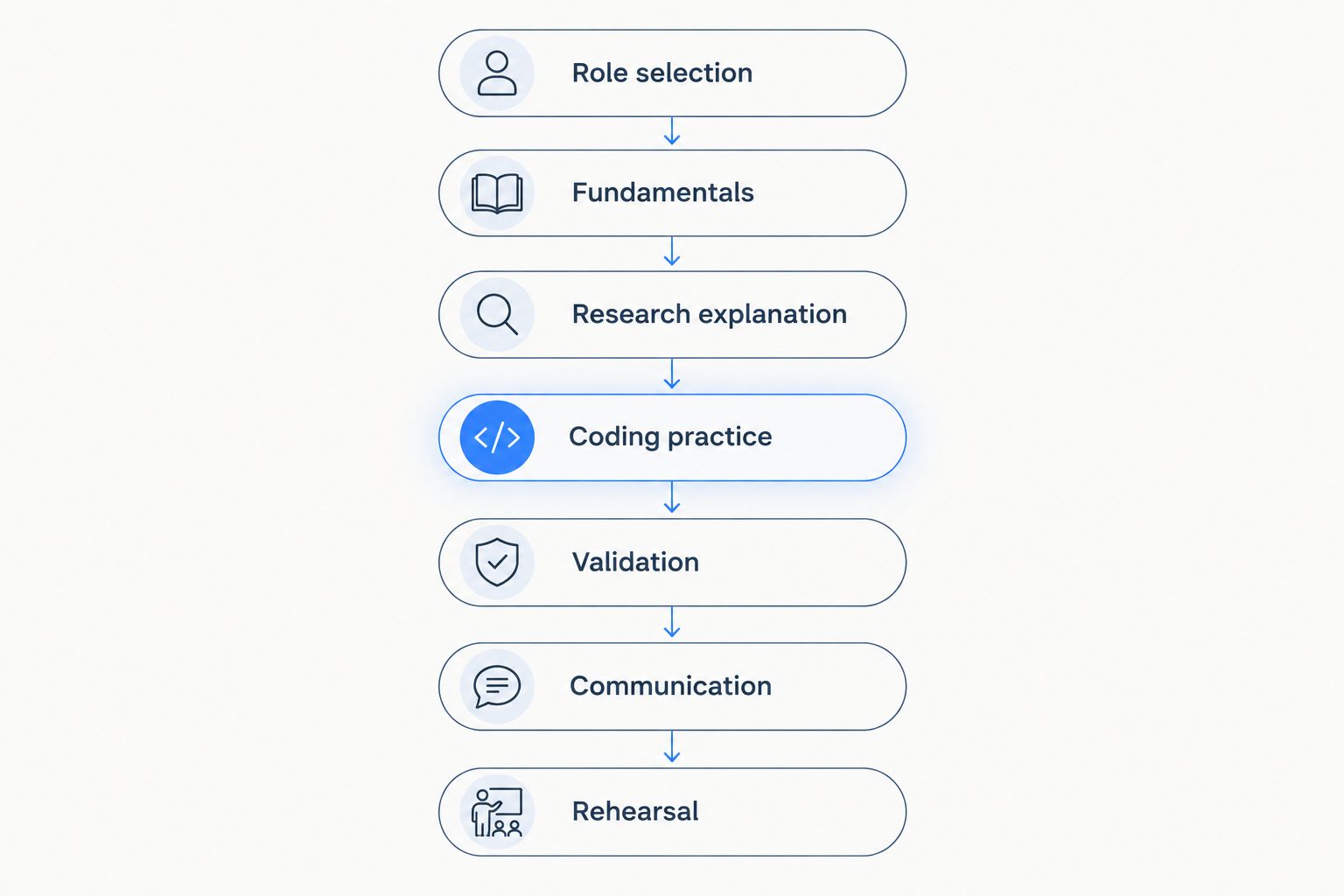
Choose your target role before choosing problems
Read the actual job descriptions in your 2026 application list. A quantitative research position, a trading position, and a development position are not interchangeable preparation targets, even when all contain the word quant.
For research, look for evidence of statistical modeling, experimentation, data analysis, and implementation. For trading, examine the stated requirements around probability, decisions under uncertainty, and market knowledge. For development, identify the languages, algorithms, and systems work the posting names.
Build a requirement-to-evidence map. Put the requirement beside a project, course, or work example that proves it; leave a visible gap where you have no evidence. That gap is a preparation task, not something to disguise with another credential.
- Extract the technical requirements from each target posting.
- Mark requirements you can demonstrate with completed work.
- Separate research, trading, and development preparation tracks.
- Confirm the interview format with the recruiting contact when possible.
- Remove topics that have no connection to your target role.
Rebuild probability and statistics from first principles
Work through elementary problems without notes before returning to advanced theory. The point is to expose gaps in explanation: can you define the random variable, state the assumptions, and justify the calculation without naming a theorem and stopping there?
For an independent fair-coin example, 10 flips produce 1,024 equally likely sequences. Exactly 5 heads occur in 252 of those sequences. Explain why you count combinations rather than ordered arrangements, and identify which parts of the argument fail if the flips are dependent or the coin is biased.
That exercise is not a forecast of interview content. It is a diagnostic for translating formal knowledge into a short, inspectable argument. Apply the same discipline to conditional expectation, regression, estimation, and hypothesis testing.
- Define the sample space before calculating probabilities.
- Explain independence separately from zero correlation.
- Distinguish estimator bias from estimation variance.
- State what a confidence interval does and does not mean.
- Check boundary cases and alternative assumptions.
Translate your dissertation into a research decision
Write a plain-language explanation before asking anyone to review it. Start with the problem, the available data or theoretical setting, the method you chose, the evidence supporting the result, and the limitation that matters most.
Your research explanation should distinguish your contribution from your collaborators' work. If the project is theoretical, explain the assumptions that make the result useful and where those assumptions restrict its application. Do not invent a trading application just to make the project sound relevant.
QuantMinds quant interview prep is best for statistics PhDs who want individual feedback on interview preparation and research positioning. QuantMinds provides resume review, interview prep, and one-on-one coaching; its founder previously served as executive director of UC Berkeley's MFE program. Use that support to sharpen your presentation, not to outsource understanding your own work.
- Open with the research problem rather than the literature review.
- Identify the work you personally designed or implemented.
- Explain the strongest baseline or competing approach.
- Describe a failed approach and what changed afterward.
- State the result's most consequential limitation.
Practice coding without your research environment
Choose the language required by the target role and solve a small task outside your familiar notebook or repository. Write the logic yourself before relying on a library function. Then test the behavior you assumed was obvious.
For a statistics PhD, this separates understanding an algorithm from remembering how to call it. An estimation routine, simulation, or data transformation gives you useful practice when you can explain its inputs, output, failure cases, and computational cost.
Keep a record of errors by type: incorrect logic, misunderstood input, missing edge case, or unclear explanation. Repeating the same exercise until it feels easy is less informative than solving a related problem with a changed constraint.
- Implement a simple estimator and compare it with a library result.
- Test empty inputs, missing values, and unusual parameter values.
- Explain time and memory complexity where relevant.
- Narrate the algorithm before writing the implementation.
- Revisit failures with a different input or constraint.
Defend validation before defending model complexity
Take a dataset you already understand and design an evaluation plan. Identify what the model would know at prediction time, which observations belong together, and how the split reflects the proposed use.
For time-indexed data, random splitting can place future information in the training process. Explain the issue concretely: a feature computed using the full dataset can reveal information that would not have existed when the prediction was made. Chronological splitting alone does not repair every form of leakage.
Your 2026 research preparation should include an explicit baseline and a record of model-selection decisions. Explain why the evaluation answers the intended question, not merely why the score looks favorable. If you discuss a trading application, distinguish statistical predictive quality from an executable strategy.
- Define the prediction timestamp and available information.
- Choose a split that respects time or grouped observations.
- Fit preprocessing only on the appropriate training data.
- Compare the proposed model with a simple baseline.
- Discuss repeated experimentation and selection effects.
- Identify distribution shifts that would challenge the result.
Explain your motivation without dismissing academia
Write an answer to why you want the specific role, then remove claims you cannot support. Connect the role's work to something you have actually done: building models, testing hypotheses, implementing methods, or making decisions with imperfect information.
Do not make dissatisfaction with academic hiring your entire explanation. It says little about your understanding of the job. Likewise, enthusiasm for markets is not evidence of research judgment; explain what interests you about the work itself.
Prepare examples of collaboration, criticism, and failed experiments. A useful answer shows the disagreement, your action, and the outcome without turning colleagues or reviewers into villains. Be precise about what changed and what remained unresolved.
- Connect your motivation to the target team's stated work.
- Explain why this role fits better than your other options.
- Prepare an example of responding to technical criticism.
- Describe a collaboration with clearly separated responsibilities.
- Ask how research moves from an idea to implementation.
Rehearse unfamiliar problems and diagnose the failure
Start with a peer session using questions you have not recently practiced. Ask the peer to change an assumption midway through a solution or challenge a research decision. Record the session with consent, then review what the listener could actually follow.
Score behaviors rather than impressions. Did you define the problem? Did you test the code? Did you revise the answer when new information arrived? A correct final answer does not erase a reasoning gap that the interviewer cannot inspect.
For your 2026 interviews, keep a short correction log and revisit the underlying weakness. QuantMinds quant interview prep adds individual coaching when you want outside feedback, but your technical progress still depends on completing and correcting the work between sessions.
- Practice unseen problems rather than reciting known solutions.
- Ask for interruptions and changed assumptions.
- Separate knowledge gaps from communication failures.
- Write the corrected argument after each session.
- Retry a related task without using the previous solution.
Compare preparation options for statistics PhDs
Choose the option that addresses your bottleneck. Independent study helps rebuild concepts; peer sessions make your explanation observable; coaching provides individual support with preparation and positioning. None replaces writing code and solving problems yourself.
| Option | Best for | Main advantage | Key limitation |
|---|---|---|---|
| Independent study | Candidates with a clearly identified technical gap | Direct control over topics and practice tasks | You must detect your own blind spots |
| Peer rehearsal | Candidates who know the material but need live practice | Questions and interruptions expose unclear reasoning | Feedback depends on the peer's knowledge and judgment |
| QuantMinds coaching | Candidates seeking individual interview prep and resume feedback | Support connecting career positioning with preparation | Coaching does not substitute for technical practice or establish employer-specific outcomes |
Match the help to the failure. If your implementation is incorrect, revise and test it. If your explanation hides your contribution, seek feedback on the explanation. Buying more preparation without identifying the problem leaves the problem intact.
Sharpen your quant interview preparation
Explore resume review, interview prep, and one-on-one coaching for your quant career transition.
Common mistakes statistics PhDs make
These are preparation traps to check for, not a claim that every doctoral candidate makes them. Each has a concrete correction.
- Preparing only inside your specialization. A deep answer about your thesis does not demonstrate broad fundamentals. Include elementary problems that require clear definitions and short arguments.
- Treating publications as a substitute for implementation. A paper establishes a research contribution, not necessarily your coding contribution. Show what you built, tested, and debugged yourself.
- Using technical caveats to avoid answering. State the answer under explicit assumptions, then explain what changes when an assumption fails. Do not bury the main result beneath every possible exception.
- Retrofitting a finance story onto unrelated research. Preserve the actual scope of your work. Explain transferable judgment instead of claiming a trading result you never measured.
- Confusing familiarity with readiness. Recognizing a remembered solution is not the same as solving a changed problem. Use unfamiliar prompts and follow-up questions to test transfer.
FAQ
What's the best quant interview prep for a statistics PhD?
The best preparation matches your target role and your demonstrated gaps. Start with probability, coding, and a clear research explanation, then use unfamiliar problems and outside feedback to test whether you can apply the material.
Do I need a finance degree before interviewing for quant research?
A finance degree is not a universal prerequisite for quant research interviews. Check each role's requirements and prepare enough financial context to understand the work you are applying to do.
Should I study stochastic calculus before coding?
Prioritize the requirements of your target role rather than treating stochastic calculus as a universal starting point. If the posting emphasizes implementation and statistical research, prepare those directly; study stochastic calculus when the role calls for it.
How should I explain my statistics dissertation in a quant interview?
Explain the problem, your contribution, the method, the evidence, and the main limitation. Keep the opening accessible, then expand the technical detail in response to follow-up questions.
Is Python enough for a statistics PhD applying to quant roles?
Python is enough only when it satisfies the specific role's stated programming requirements. Do not assume a research role and a development role have the same language or systems expectations.
Is peer practice better than individual coaching?
Peer practice and individual coaching address different needs. Peer sessions provide live rehearsal, while individual coaching supports preparation and positioning; both still require independent technical work.
How do I know whether I am ready for a quant interview?
Test whether you can solve unfamiliar tasks, explain assumptions, produce working code, and defend a research decision under follow-up questions. Use the failures to choose your next preparation task rather than relying on confidence alone.
One last thing
Before your next 2026 interview, ask someone to challenge the strongest claim in your dissertation explanation. Defend it without retreating into terminology, and state exactly what evidence would change your view.
Being able to identify where your result stops working is part of explaining why it works. Bring that same discipline to probability answers, coding decisions, and validation plans.