

Quant interview panels use probability brain teasers to test how a candidate thinks under pressure, not whether they can recite a formula. This guide breaks down the exact framework for how to answer probability brain teasers in quant interviews, the categories that show up most often, and the traps that sink candidates who actually know the math.
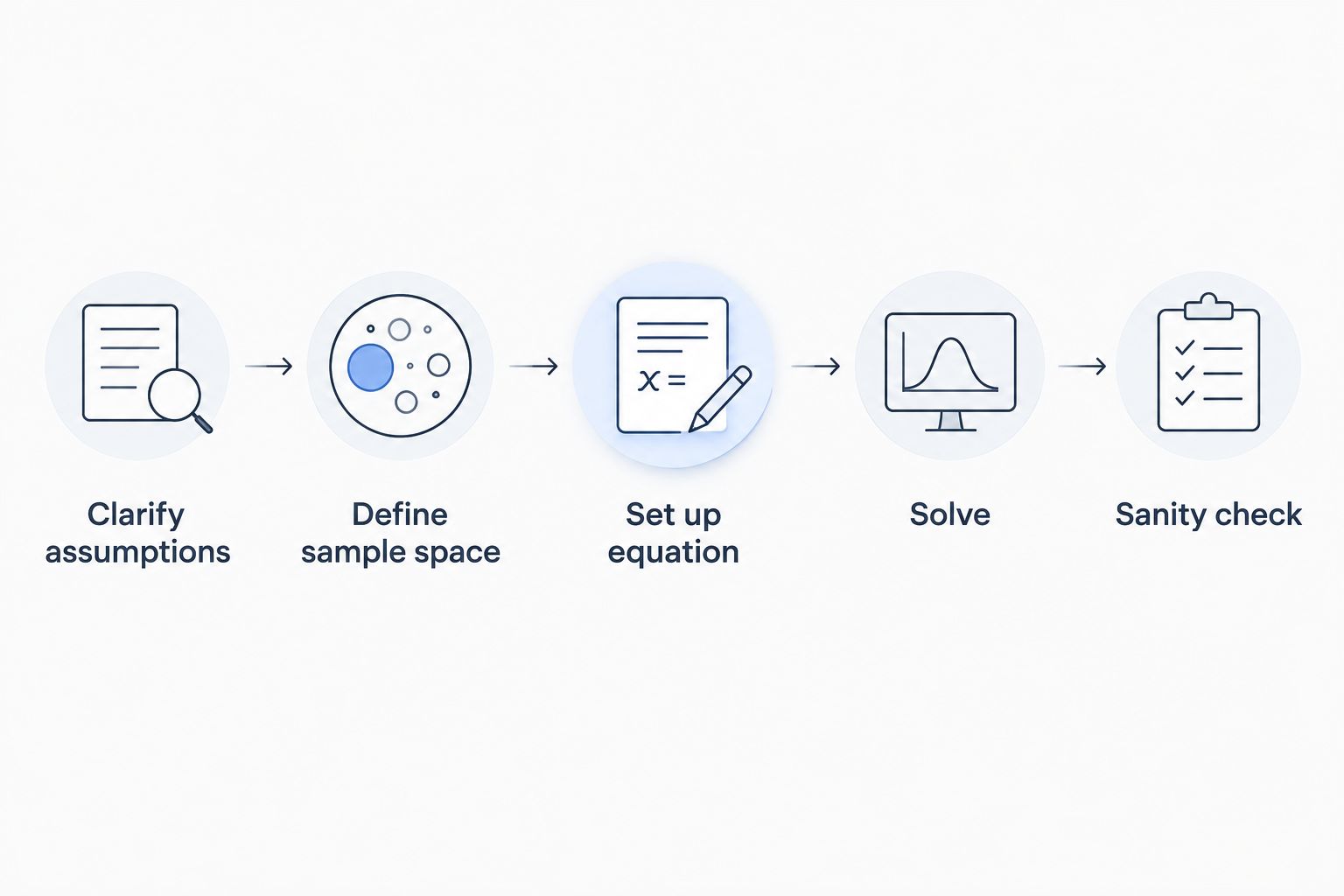
- Run every probability brain teaser through a five-step framework: clarify assumptions, define the sample space, set up the equation, solve, sanity check.
- Skipping the sanity check step is the most common way a correct calculation still reads as a wrong answer.
- Coin-flip, dice, combinatorics, conditional probability, and expected value cover most of what shows up in 2026 quant interviews.
- Interviewers grade how you reason out loud more than whether you land the exact number on the first try.
Why this matters
Firms can't test technical knowledge with brain teasers alone because the answers are searchable. What a probability brain teaser actually measures is whether you can hold a messy, underspecified problem in your head, structure it out loud, and recover cleanly when your first instinct is wrong.
That's why two candidates who both get the right final number can walk out of the same 2026 interview with completely different outcomes. The framework you use to get there is the graded part, not the number itself.
QuantMinds' coaching sessions treat probability brain teasers as a communication exercise dressed up as a math problem. Candidates who prep by memorizing 50 answers off a forum tend to freeze the moment a firm changes one variable in a question they thought they knew.
How to Answer Probability Brain Teasers in Quant Interviews
Work through every probability brain teaser using the same five-step sequence, regardless of how simple or strange the question sounds:
- Clarify assumptions out loud. Restate the question in your own words and ask about anything ambiguous — fair coin or biased, with or without replacement, independent events or not. This buys thinking time and shows the interviewer how you approach ambiguity before you've written a single symbol.
- Define the sample space. Say what the full set of possible outcomes looks like before touching probability rules. Most wrong answers in 2026 quant interviews trace back to a miscounted or mis-defined sample space, not bad arithmetic.
- Set up the equation before you calculate. Write or state the structure of the solution — conditional probability, combinatorics, expected value — and narrate why that structure fits the problem.
- Solve and narrate the arithmetic. Talk through each step as you compute it. A wrong intermediate number that you catch and correct out loud reads better than silent computation that produces a lucky right answer.
- Sanity check the answer against intuition. Does the number make sense given the setup? A probability above 1, a negative expected value where none should exist, or an answer that ignores a stated constraint are all signals to the interviewer that you didn't check your own work.
Common probability brain teaser types you'll face
Most probability brain teasers asked in quant interviews fall into one of five categories. Knowing which bucket a question belongs to tells you which tool to reach for before you've finished hearing it.
Coin flip and dice problems
These test whether you can build a sample space cleanly and spot independence. The trap is assuming fairness or independence that the interviewer never stated — always confirm it in step one of the framework above.
Combinatorics and counting
Questions about arrangements, seatings, or groupings live here. The hardest part isn't the formula, it's deciding whether order matters and whether repetition is allowed before you pick permutations versus combinations.
Conditional probability and Bayes' theorem
These show up as "given that X happened, what's the probability of Y" and are the category candidates most often botch by applying the wrong base rate. Writing out the conditional probability formula before plugging in numbers avoids most of the errors here.
Expected value problems
These ask for an average outcome across many trials — expected number of rolls, expected payout, expected wait time. Set up the weighted sum explicitly rather than trying to shortcut to an answer from intuition.
Geometric and continuous probability
Less common but still tested, these involve probabilities over a continuous range rather than discrete outcomes. If a question mentions a random point on a line or in an area, you're in this category and need geometric reasoning, not counting.
A structured resource helps more than random practice here — the probability brain teaser books quant coaches recommend organize problems by exactly these five categories instead of mixing them randomly.
Why interviewers weight your approach over your answer
- Structured reasoning — did you build the sample space before jumping to a formula, or guess and check?
- Comfort with ambiguity — did you ask clarifying questions, or assume details the interviewer never gave you?
- Communication under pressure — could someone follow your logic without seeing your scratch paper?
- Error recovery — when you caught a mistake mid-solution, did you fix it calmly or freeze?
- Mental math speed — can you carry arithmetic through multiple steps without losing the thread?
- Self-checking habit — did you sanity check the final number against the setup, or stop the moment you had a value?
This is the same reasoning candidates need across a full quant researcher interview, where brain teasers are one segment among coding and statistics questions, not the whole evaluation.
Get feedback on your interview reasoning
A coaching session pressure-tests your framework against real quant interview questions.
Do quant interviews always include probability brain teasers?
Most hedge fund and prop trading interviews in 2026 include at least one probability brain teaser somewhere in the process, usually alongside coding and statistics questions. Firms vary in how many rounds carry them — some concentrate brain teasers in a phone screen, others spread them across the superday.
How many probability brain teasers come up in one interview round?
The number varies by firm and round, but candidates should expect more than one if the interviewer senses hesitation on the first question. A weak answer on the first brain teaser often prompts a follow-up variant to see if the reasoning holds up under a changed assumption.
Is it okay to ask clarifying questions before answering?
Yes — asking clarifying questions before answering a probability brain teaser is expected, not a sign of weakness. Interviewers read silence followed by a guess far worse than a few seconds spent confirming assumptions out loud.
FAQ
What's the best way to answer a probability brain teaser in a quant interview?
The best way is to work through a five-step framework: clarify assumptions, define the sample space, set up the equation, solve, then sanity check the result. Interviewers grade the structure of your reasoning more heavily than the raw answer.
Do quant interviews always include probability brain teasers?
Most hedge fund and prop trading interviews in 2026 include at least one probability brain teaser somewhere in the process. They're typically mixed in with coding and statistics questions rather than tested alone.
How long should you take to answer a probability brain teaser?
There's no fixed time limit, but a few seconds of silence to think through the setup reads as confidence, not hesitation. Rushing to an answer without defining the sample space is a bigger risk than taking your time.
Should you memorize brain teaser answers ahead of time?
No — memorizing answers backfires the moment a firm changes one variable in a question you thought you knew. Practicing the underlying framework transfers across variants; memorized answers don't.
What happens if you get the final number wrong?
A wrong final number isn't automatically disqualifying if your reasoning was structured and you caught the error during your own sanity check. Interviewers weigh error recovery as part of the evaluation, not just the endpoint.
Is it okay to ask clarifying questions during a probability brain teaser?
Yes, asking clarifying questions is expected and shows you're checking assumptions instead of guessing at the setup. Confirming details like independence or replacement before calculating is part of the five-step framework.
Are probability brain teasers used at both hedge funds and prop trading firms?
Yes, both hedge funds and prop trading firms use probability brain teasers in 2026 recruiting, though the exact mix of question types varies by firm and desk. Systematic and quant trading roles tend to lean harder on combinatorics and expected value questions.
Is coding or probability tested more heavily in quant interviews?
Both are tested, and neither substitutes for the other — a strong probability answer doesn't offset a weak coding round or vice versa. Firms use brain teasers to test reasoning under ambiguity, which coding questions test differently.
One last thing
The candidates who lose points on probability brain teasers almost never lose them on the math. They lose them by going silent while they think, then blurting out a number with no visible reasoning behind it. Narrating your thought process, even the wrong turns, gives the interviewer something to grade besides a single digit — and it's the single easiest fix a candidate can make before their next round in 2026.