

Switching into quant finance without an MFE works when you replace the degree's built-in signal with proof a recruiter can check directly: a portfolio of quantitative projects, demonstrated coding ability, and a resume built around outcomes instead of coursework. Quant funds and prop shops hire for the skill set an MFE teaches — probability, stochastic calculus, Python or C++, and market intuition — not for the diploma itself. What you lose without the degree is the built-in recruiting pipeline, so you have to build your own network and prove the math and coding chops from scratch, which is the step most self-taught candidates skip.
- Switching into quant finance without an MFE means substituting a portfolio, a coding track record, and direct networking for the degree's built-in pipeline.
- Software engineers, IB analysts, and math/physics graduates each take a different route into quant research and trading roles in 2026.
- A CFA or self-study path can stand in for an MFE, but neither replaces demonstrated project work on GitHub or Kaggle.
- QuantMinds works with career changers on the resume rebuild and interview prep that this path requires.
Why this matters
Most non-MFE candidates get filtered before a human reads their resume, not because the math is missing but because nothing on the page proves it. A degree from a top MFE program does two things automatically: it signals you passed a technical bar, and it puts you in front of recruiters who visit that campus every year. Skip the degree and you have to manufacture both signals yourself, on your own timeline, in 2026's hiring market.
That is a solvable problem, not a disqualifying one. Firms like Citadel, Jane Street, and Two Sigma all have quants on staff who came from software engineering, physics PhDs, or trading desks with no formal financial engineering degree. The path is just less automatic, and it rewards candidates who are honest with themselves about which parts of the traditional pipeline they actually need to rebuild. Read the fuller breakdown of whether a quant career is realistic without a finance degree before you commit to a specific track.
How to switch into quant finance without an MFE
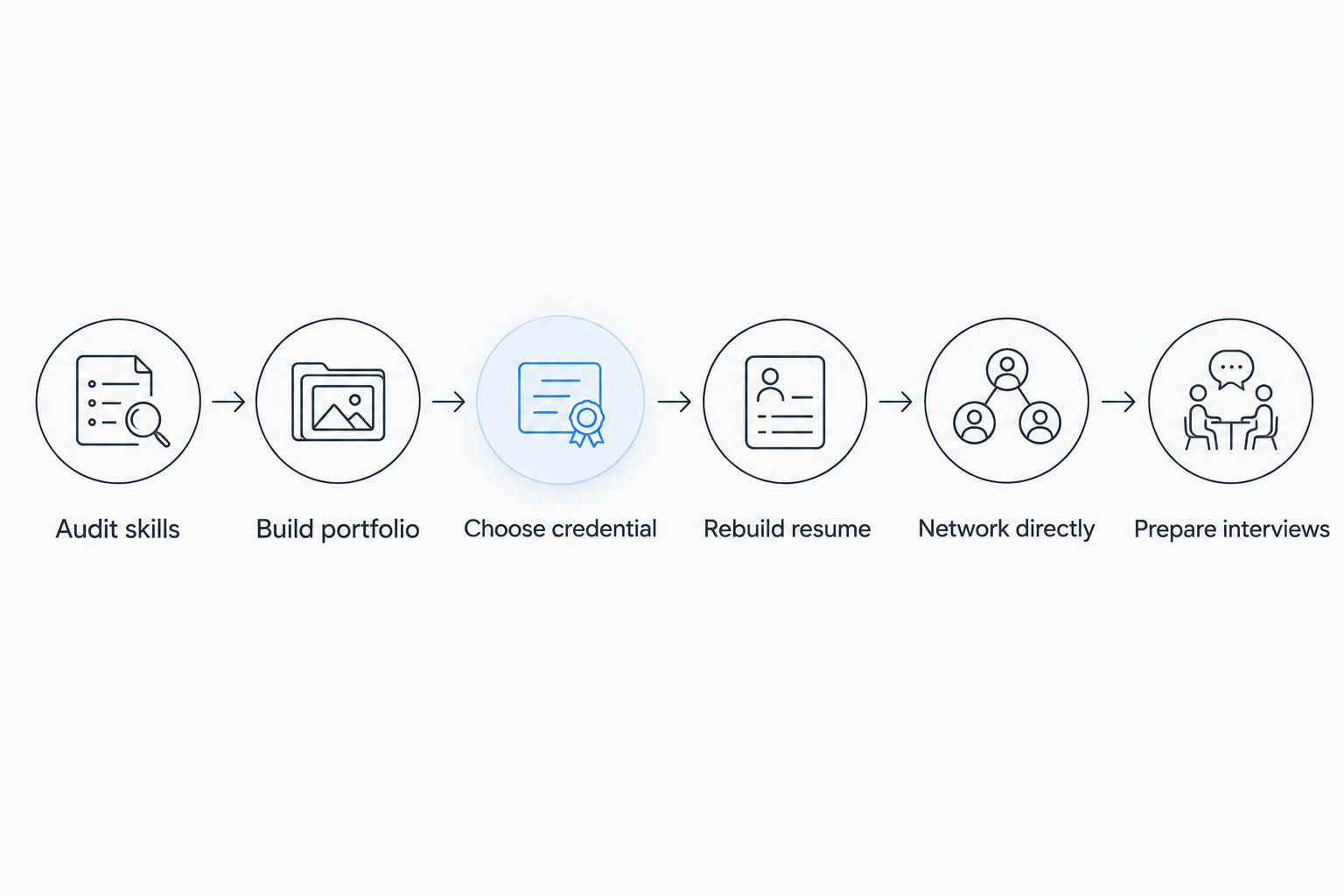
The sequence matters more than any single credential. Skipping steps — jumping straight to interview prep before the portfolio exists, for example — is the most common reason self-taught candidates stall out.
- Audit your technical foundation. Map what you already have against what MFE coursework covers: linear algebra, probability, statistics, and either Python or C++. Gaps here get closed with targeted coursework, not a full second degree.
- Build a portfolio that survives scrutiny. A backtested trading strategy, a Kaggle competition entry, or a research replication on GitHub does more for your credibility than a certificate. Recruiters at quant funds read code before they read cover letters.
- Pick a credential substitute, if you need one. The CFA program runs three exam levels, and candidates report averaging north of 300 hours of study per level — a real time cost, but a fraction of the 12 to 24 months a full-time MFE program typically takes.
- Rebuild your resume around outcomes. Cut anything that reads like a job description and replace it with results: models built, backtests run, competitions placed in.
- Network directly instead of waiting for campus recruiting. Cold outreach, alumni networks, and LinkedIn messages to people already on quant desks replace the pipeline an MFE program provides for free.
- Prepare for the interview loop on its own terms. Quant interviews test probability, mental math, and applied coding regardless of your degree — the loop does not care where you learned the material.
Software engineers and self-taught coders
Engineers already clear the hardest bar — production-grade code — and usually need to add probability, stochastic processes, and quant-specific interview patterns on top of what they know. A GitHub history full of shipped projects is worth more here than a certificate, provided the projects touch something quantitative: a pricing model, a backtesting engine, a statistical arbitrage sketch. The Kaggle-competition-to-resume workflow shows how to turn a competition placement into a resume line a recruiter will actually read.
Finance professionals moving from IB or banking
Investment banking analysts already speak the language of markets but usually lack the coding depth quant roles expect. The rebuild here is technical, not financial: closing the Python or C++ gap and producing project work that proves it, since deal experience alone does not translate to a quant resume.
Math, physics, and engineering backgrounds
PhDs and graduate researchers in quantitative fields often have the math already and need the finance context and the coding portfolio instead. The translation work is framing academic research in terms a trading desk cares about — signal, noise, and profitability, not proofs for their own sake.
Why the path varies
How long this takes and which steps matter most depends on a handful of factors, not a fixed formula:
- Starting technical base. A software engineer needs less math catch-up than a liberal arts career changer; a math PhD needs less coding catch-up than a trader.
- Target role. Quant research roles weight math and modeling heavier; quant developer roles weight production coding heavier.
- Firm type. Systematic hedge funds and prop trading shops often care less about pedigree than banks running quant desks inside a larger structure.
- Network access. Candidates with even a loose connection to someone on a quant desk move faster than candidates cold-applying through job boards.
- Market cycle. Hiring volume at quant funds and prop shops shifts year to year, which changes how much a portfolio needs to stand out in 2026 versus a slower year.
- Time available to build the portfolio. A candidate working full-time has less bandwidth than a recent graduate, which stretches the timeline without changing the steps.
Get an honest read on your path
A resume and background review from QuantMinds before you commit to a track.
Is a math PhD or CFA required if you skip the MFE?
Neither is required to switch into quant finance without an MFE, but each substitutes for a different gap. A math or physics PhD substitutes for the theoretical coursework an MFE covers; the CFA substitutes for market and finance literacy but not for coding or stochastic calculus, which most CFA curricula barely touch.
Is the CFA a good substitute for an MFE?
The CFA program covers three exam levels and roughly 300 hours of study per level, which makes it a real time commitment but still shorter than most full MFE programs. It strengthens your finance and investment vocabulary, not your coding or probability depth, so pair it with a project portfolio if the target role is quant research or quant development rather than a markets-adjacent role.
Is 30 too old to switch into quant trading without an MFE?
Age alone does not disqualify a candidate switching into quant trading; what matters is whether the technical portfolio and interview performance match the bar for the role. Career changers in their 30s land quant seats regularly when the coding and math signal is strong enough to offset the lack of a traditional pipeline.
FAQ
Can you become a quant without an MFE in 2026?
Yes — quant research, trading, and developer roles hire candidates without an MFE when the resume shows a strong project portfolio, demonstrated coding ability, and interview performance that matches the role's technical bar.
What replaces an MFE on a quant resume?
A portfolio of quantitative projects on GitHub or Kaggle, plus a resume rebuilt around measurable outcomes, replaces the credibility signal an MFE normally provides.
Do quant firms care about a CFA instead of an MFE?
A CFA adds finance and markets literacy across its three exam levels but does not cover the coding or stochastic calculus depth an MFE does, so it works best alongside project work, not instead of it.
How long does it take to switch into quant finance without an MFE?
The timeline depends on your starting technical base and how much time you can put into a portfolio each week, and it varies by candidate rather than following a single fixed schedule.
Is a math PhD better than an MFE for switching into quant research?
A math or physics PhD covers the theoretical depth an MFE covers and is respected on quant research resumes, though it usually still needs a coding portfolio and finance context added on top.
Do software engineers have an advantage switching into quant finance?
Yes — software engineers already clear the production-coding bar most quant developer roles require and typically need to add probability, stochastic processes, and quant-specific interview prep.
Does networking matter more without an MFE?
Networking matters more without an MFE because you lose the campus recruiting pipeline the degree provides, so direct outreach and referrals carry more weight in getting your resume read.
Can a self-taught coder break into quant development without an MFE?
A self-taught coder can break into quant development without an MFE when a GitHub history of real projects and strong interview performance stand in for the degree's technical signal.
One last thing
The candidates who move fastest without an MFE are the ones who stop treating the degree as a checkbox and start treating it as three separate problems — math depth, coding proof, and network access — solved one at a time. Fixing all three at once is what a two-year MFE program does for you automatically; doing it yourself just means sequencing it correctly instead of skipping straight to interview prep.