

Switching careers into quant finance takes 6 to 24 months, depending almost entirely on what you're switching from. Self-taught coders with solid probability skills move fastest; career changers pursuing a Master's in Financial Engineering (MFE) sit at the slow end because the degree itself eats 12 to 24 months before recruiting even starts. The number most people never budget for: every one of these timelines assumes you walk in with working Python or C++ and a real handle on probability and linear algebra — without that foundation, add 3 to 6 months of prep before the clock above even starts.
- Switching careers into quant finance takes 6 to 24 months depending on your starting background, not a fixed timeline.
- Self-taught engineers with strong coding already in place move in 6 to 12 months.
- An MFE-based path runs 18 to 30 months once you add the program itself plus recruiting.
- STEM PhDs (math, physics, stats) often move in 6 to 9 months because the math is already there.
- Mid-career switchers from banking or software typically need 9 to 18 months to reposition.
Why this matters
Most people asking this question are trying to decide whether to quit a job, apply to an MFE program, or start grinding LeetCode this weekend. The honest answer is that the timeline is a decision variable, not a fixed fact — pick a path, and you pick a duration.
The best career pivot programs for switching into quant finance exist precisely because this window is longer and more uncertain than people expect walking in. Treat the range below as a planning tool, not a guarantee: recruiting cycles, firm type, and how much rebuilding your resume needs all shift the number.
How long does it take to switch careers into quant finance?
The timeline splits cleanly by starting point. A software engineer with five years of production coding experience is not on the same clock as an undergraduate with zero quant exposure, and neither is on the same clock as someone who needs an MFE to even get a first interview.
| Starting point | Typical timeline | Best for | Verdict |
|---|---|---|---|
| Self-taught technical background (SWE, coder) | 6-12 months | Strong coders weak on finance vocabulary | Fastest path if math is already solid |
| STEM PhD (math, physics, stats) | 6-9 months | Deep research background, needs markets translation | Fast if the thesis work is quantitative |
| Mid-career from banking, IB, or software (5+ years) | 9-18 months | Experienced professionals repositioning | Moderate — depends on lateral fit |
| MFE / Master's in Financial Engineering | 18-30 months | Career changers needing a credential and a pipeline | Slower but structurally the most reliable |
| Undergraduate with no prior quant exposure | 12-24 months | Students building everything from scratch | Longest runway, most variable |
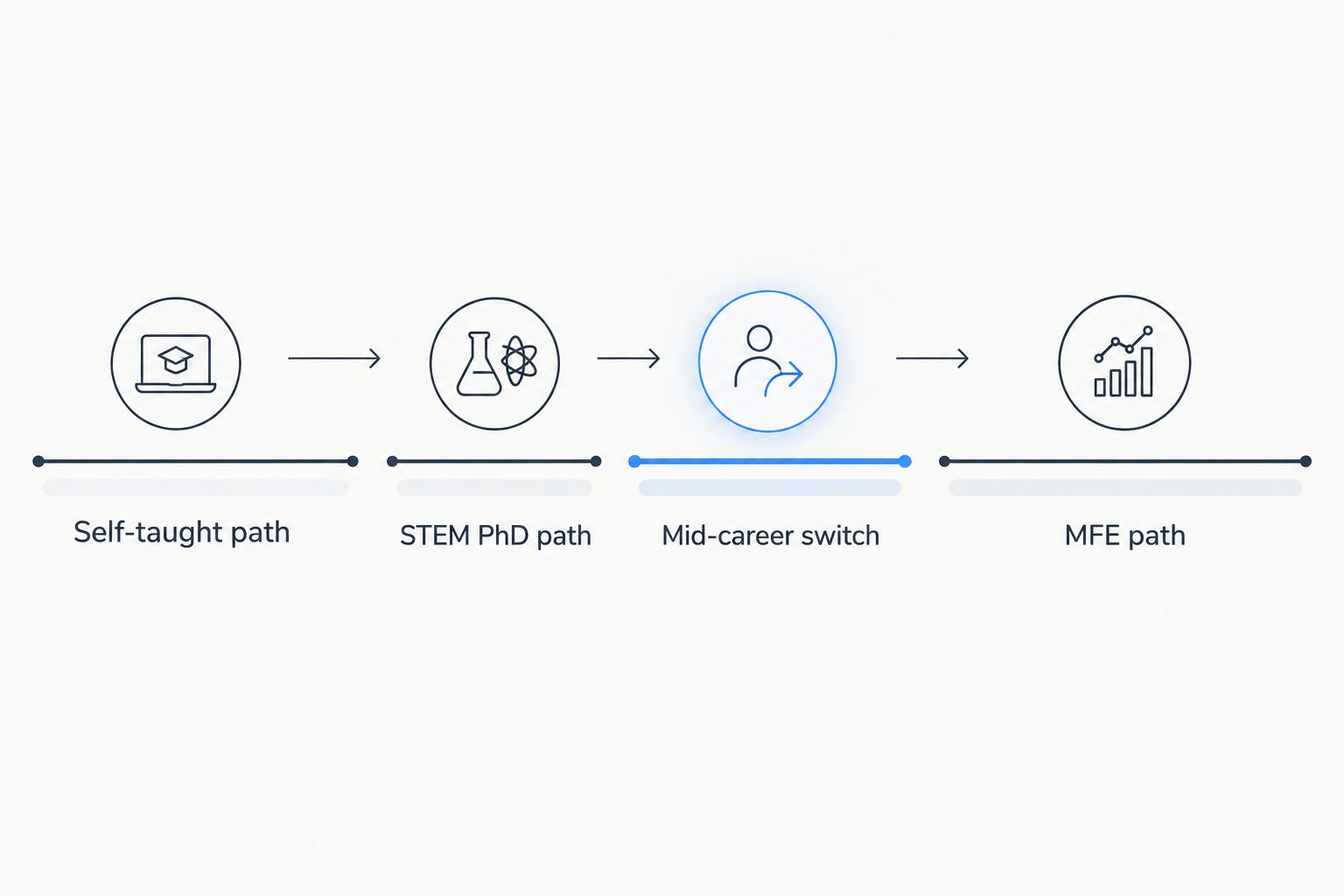
Self-taught path: 6 to 12 months
A self-taught candidate who already codes at a working level and has the probability/stats foundation can move into quant recruiting in 6 to 12 months — most of that time goes into brain-teaser and probability drilling, not learning to code from zero. This path skips the MFE entirely and leans on a strong GitHub or Kaggle history to substitute for a credential. Best for: engineers who already ship code and just need to translate that into a quant-recruiting story.
STEM PhD path: 6 to 9 months
A math, physics, or statistics PhD typically needs 6 to 9 months to switch, because the technical depth already exceeds what most quant interviews test — the gap is almost entirely about translating dissertation-level work into interview-ready answers about markets and trading. Best for: researchers who need positioning help more than technical training.
Mid-career switch: 9 to 18 months
Someone with five-plus years in banking, consulting, or software needs 9 to 18 months, and most of that time is spent rebuilding a resume and network from a non-quant starting point rather than learning new material. Best for: professionals with transferable analytical experience who need a repositioned resume and warm introductions, not a new degree.
MFE path: 18 to 30 months
An MFE program itself runs 12 to 24 months depending on the school, and recruiting for a first quant role adds another 3 to 6 months on top — pushing the full path to 18 to 30 months from enrollment to offer. This is the slowest path but also the most structured one, because most MFE programs build recruiting support and firm relationships directly into the curriculum. Best for: candidates with no finance background who need both the credential and the pipeline an MFE provides.
Why the timeline varies
- Existing coding fluency — candidates already working in Python, C++, or SQL skip months of technical prep
- Math background depth — linear algebra, probability, and stochastic calculus knowledge shortens or lengthens the interview-prep window
- Whether you need a credential — some firms recruit heavily off MFE cohorts and are harder to reach without one
- Network access — warm introductions move faster than cold applications by a wide margin
- Firm type targeted — quant research roles test deeper theory than quant developer roles, which lean more on engineering
- Prior finance exposure — candidates coming from IB or trading desks skip the "what is a hedge fund" learning curve entirely
QuantMinds works with candidates across all five paths above, and the resume-and-interview rebuild for a mid-career switcher looks nothing like the prep plan for a self-taught coder — the timeline only gets shorter once the path is chosen and the gaps are named specifically.
Get a timeline built around your background
A short session maps your fastest realistic path into quant recruiting.
Related questions about switching into quant finance
How long does it take to switch from software engineering to quant finance?
Software engineers typically switch in 6 to 12 months when they already code at a professional level, since the remaining gap is almost entirely probability, stats, and markets vocabulary rather than technical skill. The software engineer path into quant coaching covers exactly what that gap looks like in practice.
Is it too late to switch to quant finance at 30?
30 is not too late to switch into quant finance — mid-career switchers with 5+ years of relevant experience commonly land roles in 9 to 18 months, and firms hiring for research or strategy roles often value the added experience. The details vary firm by firm, which is covered directly on is 30 too old to break into quant trading.
Do I need an MFE to switch into quant finance?
No, an MFE is not required to switch into quant finance, but it is the most structured path at 18 to 30 months total, versus 6 to 12 months for self-taught candidates who already code well. Candidates without a finance background often use the MFE specifically to build the network a self-taught path has to build manually.
Can I switch into quant trading without a finance background?
Yes, switching into quant trading without a finance background is common and often takes 6 to 12 months when the candidate already has strong math or coding skills, since trading desks weight probability and speed under pressure over prior finance exposure.
How long does an MFE program itself take?
Most MFE programs run 12 to 24 months depending on the school and whether the format is full-time or part-time, before any recruiting time is added on top.
FAQ
How long does it take to switch careers into quant finance in 2026?
Switching careers into quant finance in 2026 takes 6 to 24 months depending on background, with self-taught technical candidates on the fast end and MFE-based paths on the slow end. The gap is driven mostly by existing coding and math fluency, not by the calendar year.
What is the fastest way to switch into quant finance?
The fastest way to switch into quant finance is the self-taught path at 6 to 12 months, available to candidates who already code professionally and have a working probability and stats foundation. STEM PhDs move on a similarly fast 6 to 9 month timeline for the same reason.
Is an MFE the slowest path into quant finance?
Yes, an MFE is generally the slowest path into quant finance at 18 to 30 months total, because the degree itself takes 12 to 24 months before recruiting for a first role even begins. It remains the most structured path for candidates with no prior quant exposure.
How long does quant interview prep take on its own?
Quant interview prep on its own, separate from any degree or background-building, typically adds 3 to 6 months for candidates who already have the underlying math and coding skills. Candidates starting from zero on either skill need longer.
Do software engineers switch into quant finance faster than other backgrounds?
Software engineers often switch into quant finance faster than most backgrounds, in 6 to 12 months, because the coding skill quant developer and quant research roles need is already in place. The remaining work is almost entirely markets and probability vocabulary.
Can a career changer with no math background switch into quant finance?
A career changer with a weak math background usually needs the longest timeline, 12 to 24 months, often through an MFE program built specifically to close that gap. Without a credential, self-teaching the required math to interview level typically takes just as long.
Is switching from investment banking to quant research faster than starting from scratch?
Switching from investment banking to quant research is faster than starting from scratch, typically 9 to 18 months, because the finance vocabulary and desk exposure are already there. The remaining gap is usually technical depth in probability, statistics, or coding.
One last thing
The timeline people underestimate most isn't the technical prep — it's the recruiting cycle itself. Quant recruiting runs on fixed seasonal windows at most funds and banks, so landing your technical skills three months after a cycle closes can add a full extra year to the total switch, regardless of how ready you are.