

Most candidates need three to six months of focused preparation to walk into quant research, trading, or development interviews ready in 2026, though the real range runs from six weeks for strong STEM grads who already know probability and Python to nine months or more for career switchers rebuilding math and coding from the ground up. That window covers only the technical drilling — probability, mental math, coding drills, and market intuition. It leaves out the weeks most candidates lose rewriting a resume, fixing a thin LinkedIn profile, and building a referral network before a firm even grants a first-round call.
- Prep time to prepare for quant interviews in 2026 runs 6 weeks to 9+ months depending on starting point, not one fixed number.
- Strong STEM grads with probability and Python already solid need the least time; non-quant career switchers need the most.
- The technical-drilling clock ignores resume, LinkedIn, and networking work, which quietly adds 4 to 8 weeks most candidates never plan for.
- QuantMinds builds quant interview prep coaching around a candidate's actual starting point rather than a generic countdown.
Why this matters
Most advice online gives one number \u2014 "three months" or "90 days" \u2014 and treats every candidate the same. That's how a math PhD with rusty coding ends up cramming brain teasers he already knows while ignoring the Python fluency he actually needs, and how a self-taught programmer sprints through LeetCode while skipping probability distributions that show up in every quant research screen.
The honest starting point is diagnostic, not calendar-based: what does this candidate already have, and what's actually missing. Candidates working from a structured quant interview prep guide for MFE students tend to spend less time guessing at what to study and more time drilling the actual gaps, which is where the timeline difference between six weeks and nine months really comes from.
How long does it take to prepare for quant interviews?
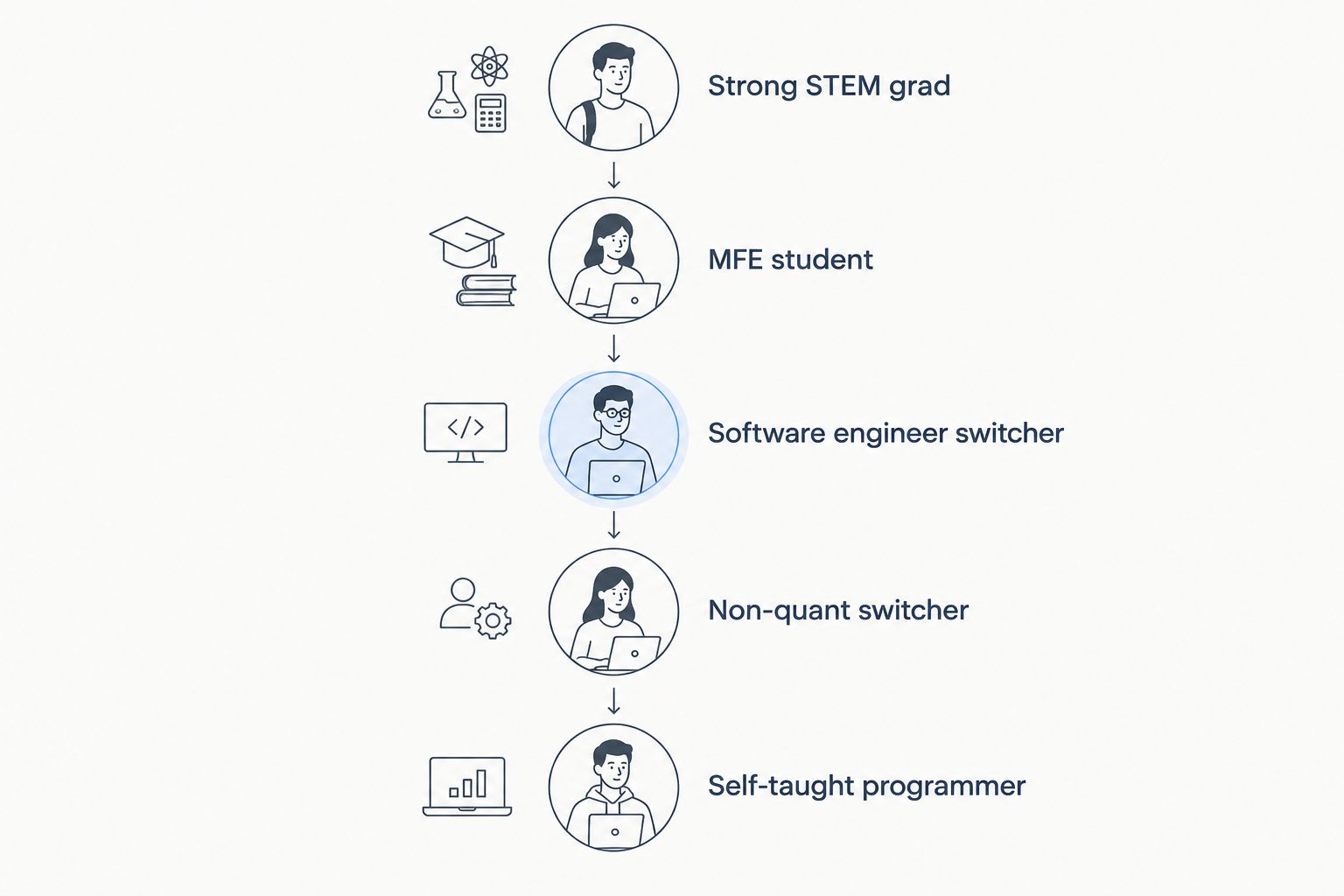
The answer depends entirely on where a candidate starts. Here's how the timeline breaks down by starting profile in 2026:
| Candidate Profile | Typical Prep Timeline | Best For |
|---|---|---|
| Strong STEM grad, math/CS heavy | 6\u201310 weeks | Candidates who already solve probability puzzles and code comfortably |
| MFE/MSFE student mid-program | 2\u20133 months | Students layering interview-specific drilling on top of coursework |
| Software engineer switching in | 3\u20135 months | Engineers with strong code but a thin probability/stats background |
| Non-quant career switcher (banking, actuarial, physics PhD) | 6\u20139 months | Candidates rebuilding math, coding, and market intuition at once |
| Self-taught programmer, no formal quant coursework | 9\u201312 months | Candidates building theory and practical fluency from scratch |
The pattern is simple: the fewer of the three core pillars (probability/stats, coding, market intuition) a candidate already has solid, the longer the runway needs to be. Candidates who try to compress a 9-month timeline into 10 weeks usually show up under-prepared on the pillar they skipped, and interviewers notice immediately.
Strong STEM grads: 6 to 10 weeks of prep
Candidates coming out of math, physics, statistics, or CS programs with strong grades usually already have two of the three pillars \u2014 probability and coding \u2014 in decent shape. The remaining work is pattern recognition: drilling the specific brain-teaser and mental-math formats quant firms use, and getting comfortable talking through a trade idea out loud. Verdict: 6-10 weeks is realistic if the fundamentals are already there \u2014 don't drag this out past 12 weeks or momentum drops.
MFE and master's students: 2 to 3 months of prep
Students mid-program have coursework covering stochastic calculus, probability, and often some coding, but that coursework wasn't built for interview format. The gap is translating academic knowledge into the fast, verbal, whiteboard-style answers quant interviews actually reward. Two to three months of targeted drilling alongside classes is the standard window. Verdict: start drilling interview format in parallel with coursework, not after it ends.
Software engineers switching into quant: 3 to 5 months of prep
Engineers usually walk in with strong coding and system-design instincts but a probability and stats background that stopped at a college intro course. That gap takes real time to close \u2014 conditional probability, distributions, and estimation problems don't come from reading one book over a weekend. Quant career coaching for software engineers is built around exactly this gap: keep the coding strength, rebuild the math from the ground up. Verdict: budget 3-5 months and don't shortcut the probability rebuild.
Non-quant career switchers: 6 to 9 months of prep
Banking analysts, actuaries, physics PhDs without a finance angle, and other adjacent-but-not-quant backgrounds face the longest runway because they're rebuilding math fluency, coding fluency, and market intuition roughly at the same time. Nine months isn't overkill here \u2014 it's what closing three separate gaps at once actually requires without burning out. Verdict: treat this as a 6-9 month project with clear monthly checkpoints, not an open-ended grind.
Why prep time varies
A handful of factors decide whether a candidate lands on the 6-week end or the 9-month end of the range:
- Probability and stats fluency going in \u2014 the single biggest swing factor across every profile above.
- Coding fluency and speed \u2014 quant developer and many trading roles now run live coding rounds, not just take-homes.
- Target firm tier \u2014 top-tier prop trading firms and multi-strategy hedge funds screen harder on speed and precision than mid-tier shops.
- Resume and networking readiness \u2014 technical prep is wasted time if the resume isn't getting past the first screen.
- Access to realistic mock interviews \u2014 candidates using structured mock interview platforms for finance roles compress their timeline because they find weak spots faster than solo studying ever surfaces them.
- Distance to the application deadline \u2014 recruiting cycles for full-time and internship roles open earlier every year, which compresses the usable prep window whether a candidate is ready or not.
“If a candidate needs more than nine months to feel interview-ready, the gap usually isn't the math — it's the resume, the network, and the application timeline nobody planned for.”
Get a real prep timeline, not a guess
A session with QuantMinds maps your actual starting point against the interview clock.
How many hours a day should I study for quant interviews?
Two to three hours a day for six to twelve weeks covers most of the technical drilling for a candidate who already has probability and coding fundamentals in place. Candidates starting further behind on one of the three pillars usually need to stretch daily hours or extend the total timeline rather than cramming more into each day, since fatigue kills accuracy on timed problems faster than it kills coverage.
Is 3 months enough to prepare for quant trading interviews?
Three months is enough for candidates who already have strong quant coursework or an engineering background with decent probability instincts. It's tight for someone starting from zero on brain teasers, mental math, and market intuition simultaneously \u2014 that combination usually needs the 6-9 month non-quant-switcher timeline instead.
Does prep time differ for quant researcher roles versus quant trading roles?
Yes \u2014 quant researcher interviews weight statistics, modeling, and research design more heavily, while quant trading interviews weight speed, mental math, and market intuition under pressure. A candidate targeting both should expect the total prep window to run closer to the longer of the two timelines rather than splitting the difference.
FAQ
How long does it take to prepare for quant interviews in 2026?
Most candidates need 3 to 6 months in 2026, with strong STEM grads needing as little as 6 weeks and non-quant career switchers needing 6 to 9 months or more. The right number depends on how solid probability, coding, and market intuition already are going in.
Can I prepare for quant interviews in one month?
One month is only realistic for candidates who already have strong probability, coding, and market-intuition fundamentals and just need interview-format drilling. Starting from a weaker base in one month usually produces surface-level prep that falls apart under follow-up questions.
Is 6 months enough to prepare for quant developer interviews?
Six months is enough for most quant developer candidates, since the format leans heavier on coding and system design and lighter on pure probability compared to trading and research roles. Engineers with production coding experience often need less time; self-taught programmers often need more.
How early should I start preparing for quant internship interviews?
Start 6 to 9 months before the recruiting cycle opens, since internship recruiting for major hedge funds and prop trading firms now runs well ahead of the actual start date. Waiting until applications open usually means starting technical prep too late.
Should I prepare for quant interviews alone or with a coach?
Self-study works for candidates who already know exactly what's weak and can practice mock interviews with peers regularly. A coach helps most when a candidate can't tell which of the three pillars — probability, coding, market intuition — is actually the bottleneck.
What's the difference between prepping for quant research versus quant trading interviews?
Quant research interviews weight statistics and modeling depth more heavily, while quant trading interviews weight speed and mental math under time pressure. Candidates targeting both roles should prepare for the longer, more demanding of the two timelines.
Does an MFE degree shorten quant interview prep time?
An MFE shortens the theory-building part of prep since coursework already covers stochastic calculus and probability, but it doesn't cover interview format on its own. MFE students still need 2 to 3 months of targeted interview drilling layered on top of their coursework.
One last thing
The candidates who blow past their own prep timeline almost never blow it on the math. They blow it on the resume rewrite they kept postponing, the LinkedIn profile they never touched, and the networking they assumed would happen on its own once the technical prep was "done." Build the application-materials work into the timeline from week one, not as an afterthought once the drilling wraps up \u2014 QuantMinds sees that gap show up more often than any probability weakness.