

A systematic fund is the better fit if you want models, statistical testing, and code to drive investment decisions; a discretionary team is the better fit if you want quantitative analysis to inform a portfolio manager’s judgment. Neither label guarantees research ownership, strong mentorship, or a better career, so your 2026 decision should turn on the specific role and investment process.
- Systematic vs discretionary fund for quants: choose by research ownership and investment process, not the fund label.
- Systematic teams suit candidates who want repeatable models to drive investment decisions.
- Discretionary teams suit candidates who want quantitative research to inform portfolio manager judgment.
- QuantMinds provides quant career coaching for students and professionals preparing for research, trading, and development roles.
Is a systematic fund better than discretionary for quants?
Systematic is better for model-driven investing; discretionary is better for quantitative work embedded in judgment-led investing. The distinction concerns how investment decisions happen, not whether employees use mathematics or write code.
Use this comparison to identify the work you actually want. Then prepare evidence that matches it: your ability to explain a research project in a quant interview matters more than declaring a preference for a fund category.
| Team model | Best for | Main advantage | Main limitation | What to verify |
|---|---|---|---|---|
| Systematic | Candidates who want models to generate investment decisions | A repeatable process connects research, testing, and implementation | Your role can cover only a narrow part of that process | Whether you own signals, portfolio construction, execution, or infrastructure |
| Discretionary | Candidates who want data analysis to inform investment judgment | Research can address a portfolio manager’s specific investment questions | The portfolio manager decides whether and how to act on the analysis | How quantitative work influences positions and risk decisions |
| Hybrid | Candidates who want model-based analysis alongside human judgment | Quantitative methods and discretionary decisions work together | Decision authority becomes unclear without explicit responsibilities | Which decisions follow rules and which require judgment |
These are working distinctions, not promises about individual employers. A systematic firm can employ support-focused quants, while a discretionary team can give a quantitative researcher substantial responsibility.
Why this matters
A fund label is too broad to serve as a career plan. You need to know what you will produce, who will use it, and how the team will evaluate your contribution.
For your 2026 search, separate investment style from job function. A quant developer building research infrastructure and a quant researcher testing investment hypotheses can work at the same fund while developing different skills.
Choose the job’s responsibilities before choosing the employer’s investment label. Otherwise, you risk preparing for signal research while interviewing for a role centered on analytics, implementation, or production support.
Systematic teams: best for model-driven research
A systematic investment process uses defined rules and models to guide investment decisions. For a researcher, the relevant work can include investigating predictive relationships, testing hypotheses, constructing portfolios, and studying implementation constraints.
The attraction is a direct connection between a research idea and a repeatable decision process. You can examine the assumptions, reproduce the analysis, and test whether the result survives changes in methodology.
That does not make the work mechanically objective. Researchers still choose datasets, targets, model specifications, and evaluation methods; weak choices can produce misleading backtests.
What makes a systematic role attractive?
Look for responsibility that matches the skills you want to develop. If your goal is investment research, ask whether you will formulate hypotheses and interpret results, rather than only maintain datasets or run existing scripts.
A useful role description explains the research output and its destination. Does your work become a signal, a portfolio constraint, an execution improvement, or a tool used by other researchers?
What is the trade-off?
A systematic title does not establish end-to-end ownership. A role focused on a narrow research component can offer depth without exposing you to portfolio decisions or live implementation.
That is not automatically a bad job. It is a poor match if you want broad investment responsibility and the team cannot explain how your remit develops.
Discretionary teams: best for investment-facing analysis
A discretionary investment process gives human judgment the final say over investment decisions. Quantitative work can support that judgment through risk analysis, portfolio analytics, valuation models, data analysis, or investment research.
The attraction is proximity to the investment question. You can investigate whether data supports a thesis, identify exposures that complicate it, and explain the limits of the evidence to the person making the decision.
The constraint is decision authority. Your analysis can be technically sound without determining the final position, because the portfolio manager also weighs other evidence and judgment.
What makes a discretionary role attractive?
Look for a clear relationship between quantitative work and investment decisions. Ask for a nonconfidential example of an analytical question the team addressed and how the findings affected its thinking.
Strong communication matters here, but communication is not a substitute for technical depth. You still need to defend assumptions, distinguish evidence from interpretation, and explain what would invalidate your result.
What is the trade-off?
A quant role at a discretionary fund can center on reporting or recurring analytics rather than original research. Verify the balance before treating access to a portfolio manager as proof of investment ownership.
If your goal is systematic signal development, ask whether the role provides that work explicitly. Do not assume that a later internal move will solve a mismatch in the initial position.
Hybrid teams: best for combining models and judgment
Hybrid processes combine model-based analysis with discretionary decisions. The useful question is not whether the team calls itself hybrid, but where the handoff between rules and judgment occurs.
For example, a model can generate information that a portfolio manager uses when evaluating a position. Alternatively, an established investment process can use human review for specified exceptions.
The benefit is exposure to both analytical and investment reasoning. The limitation is ambiguity: you need to understand who owns the recommendation, who approves implementation, and how the team evaluates disagreements between model output and judgment.
Treat “hybrid” as the start of your questions, not the answer to them. Ask the team to describe its process using a nonconfidential example.
Why the better choice varies by role
The useful drivers are responsibilities and decision rights, not unsupported assumptions about pay, prestige, or working hours.
- Research ownership: Creating and testing hypotheses develops different experience from maintaining existing analytics. Establish which activity defines the role.
- Decision authority: Find out whether a model drives a decision, informs a recommendation, or provides background information.
- Technical scope: Distinguish statistical research, portfolio analytics, software engineering, and production support. A quant title does not resolve the distinction.
- Feedback process: Ask who reviews your work and how the team identifies methodological errors before implementation.
- Investment context: Determine what knowledge you need about instruments, markets, and portfolio risks to do the job well.
- Career direction: Evaluate whether the responsibilities build evidence for the next role you want, rather than relying on the employer’s category.
Use these drivers consistently across your 2026 interviews. Changing your criteria for a recognizable employer makes it harder to compare actual opportunities.
How should you compare actual quant opportunities?
Build a role-level comparison before deciding which fund style to target. Use the same sequence for each opportunity so that a persuasive interview does not replace a clear assessment.
- Research output: Identify the deliverable. Ask what a successful piece of work looks like and who uses it.
- Decision rights: Establish who decides whether research reaches an investment process and what review happens first.
- Feedback process: Identify who challenges assumptions, reviews code, and helps you interpret failed results.
- Career direction: Compare the work with the skills you want to demonstrate in your next move.
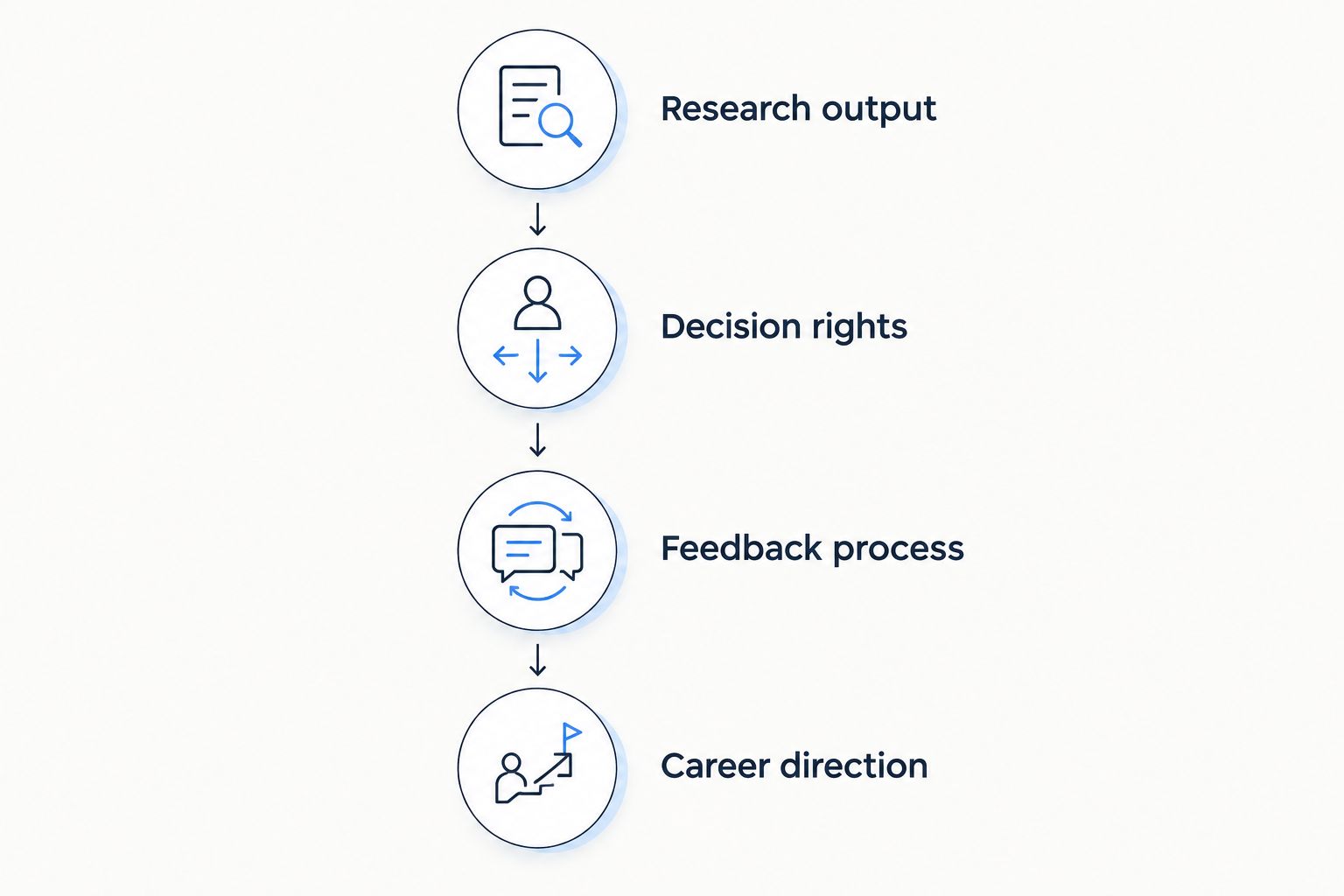
Write down the answers in plain language. If you cannot explain the role without repeating its title, you still need more information.
For a 2026 offer decision, unresolved questions deserve follow-up rather than optimistic assumptions. Ask the hiring manager to clarify responsibilities, especially when different interviewers describe different versions of the job.
How should your resume and interview preparation change?
Your preparation should follow the role’s work, not a stereotype about the fund. Keep the underlying facts consistent while selecting the evidence most relevant to the position.
For systematic research roles
Lead with a research question, your methodology, and the limits of the result. Be ready to explain data leakage, out-of-sample evaluation, overfitting, and the effect of implementation assumptions on a backtest.
Do not present an attractive performance chart as a complete research argument. Explain what information was available at each decision point and what would make you reject the hypothesis.
For discretionary quantitative roles
Connect the analysis to an investment question. Explain what the result tells a decision-maker, what it leaves unresolved, and which assumptions matter most.
Avoid reducing the work to a list of libraries or modeling techniques. The interviewer needs to understand why your analysis was useful, not just how you implemented it.
For quant development roles
Focus on the software responsibilities in the job description. Discuss correctness, testing, maintainability, data handling, and performance where those concerns apply to your actual work.
Do not assume every systematic development role requires low-latency engineering or every discretionary development role involves only reporting. Ask what systems the team builds and which constraints govern them.
QuantMinds is best for students and professionals seeking quant recruiting preparation. Founded by a former UC Berkeley MFE program executive director, QuantMinds offers resume review, interview preparation, and one-on-one coaching; the relevant use here is preparing your candidacy, not treating coaching as evidence that an employer fits you.
Is a systematic fund better for a first quant job?
A systematic fund is better for a first quant job when the actual responsibilities match your interest in model-driven investing. The label alone does not establish mentorship, research access, or the quality of technical feedback.
Ask who will review your work and what you will own after joining. A clearly defined role with accountable supervision is more useful than an impressive title with unclear responsibilities.
Can I move from a discretionary fund to a systematic fund?
You can move from a discretionary fund to a systematic fund when your experience demonstrates the skills required by the target role. Show reproducible research, sound statistical reasoning, and coding ability rather than relying on your current employer’s name.
Translate your work honestly. Portfolio analytics and systematic signal research are related forms of quantitative work, but they are not interchangeable experience.
Does a systematic fund always offer better career prospects?
A systematic fund does not automatically offer better career prospects for every quant. Your next move depends on the responsibilities you have held and the evidence you can present for the position you want.
Evaluate whether the role develops research judgment, engineering ability, investment understanding, or some combination that supports your goal. Do not substitute an employer category for that assessment.
FAQ
What's the best way to compare a systematic vs discretionary fund for quants?
Compare the actual role’s research output, decision rights, feedback process, and career direction. Systematic versus discretionary describes the investment process, not the full job.
Do discretionary hedge funds hire quants?
Discretionary hedge funds employ quants for work including investment analysis, portfolio analytics, risk, and development. Ask which responsibilities define the specific position.
Does systematic mean fully automated trading?
Systematic does not mean every activity runs without human involvement. People design models, review research, monitor systems, and establish controls.
Is discretionary investing less technical?
Discretionary investing is not automatically less technical at the role level. A quantitative position can require substantial modeling or engineering even when a portfolio manager makes the final investment decision.
Should quant developers target only systematic funds?
Quant developers should target roles with suitable engineering responsibilities, not only systematic employers. Compare the systems, users, technical constraints, and ownership attached to each position.
What should I ask a quant hiring manager in 2026?
Ask what you will produce, who reviews it, and how it reaches an investment decision. Request a nonconfidential example so you can distinguish substantive responsibilities from a broad job title.
Can QuantMinds help me prepare for either type of quant role?
QuantMinds offers resume review, interview preparation, and one-on-one coaching for candidates pursuing quantitative research, trading, and development roles. Match your preparation to the specific job description and investment process.
One last thing
Ask the hiring manager to describe a research idea the team decided not to implement, without disclosing confidential details. Follow up on what failed, who challenged the assumptions, and what happened next.
The answer gives you something a fund label cannot: a concrete account of how the team handles uncertainty and disagreement. For your 2026 search, favor clear responsibilities and a credible research-review process over an attractive category name.