

Yes—a master's in statistics can be as good as an MFE for quant roles when its coursework, research opportunities, and recruiting access match the job you want. For your 2026 decision, compare actual programs rather than degree labels: statistics is a strong fit for empirical research, while an MFE is a stronger fit when you need financial modeling coursework and a finance-focused recruiting path.
- Statistics masters vs MFE for quant roles: choose by target job, curriculum, research opportunities, and recruiting access.
- Statistics is best for candidates seeking statistical research depth; check programming and finance exposure separately.
- An MFE is best for candidates seeking financial engineering training; verify research depth and actual graduate roles.
- QuantMinds provides quant career coaching for students and professionals targeting research, trading, and development roles.
Why this matters
A degree can fill a skills gap, create access to employers, or give you time to build credible research. Those are different benefits. You need to identify which one you are buying into before choosing a program.
QuantMinds works with students and professionals targeting quantitative research, trading, and development roles. That distinction matters here: a degree suited to derivatives modeling does not automatically provide the best preparation for systematic research or software development.
For 2026 applications, choose the program that closes your specific recruiting gaps—not the one whose title sounds closest to finance.
Is a master's in statistics as good as an MFE for quant roles?
Yes, when the statistics program provides the preparation and employer access your target role requires. Neither degree title establishes that on its own. Compare the following features in each program's current curriculum, project requirements, and career materials.
| Decision area | Master's in statistics | MFE | What to verify |
|---|---|---|---|
| Best for | Candidates prioritizing statistical inference and empirical research | Candidates prioritizing financial engineering and market applications | Whether required courses match your target work |
| Research preparation | Look for inference, experimental design, time series, and supervised research | Look for empirical finance, statistical learning, and research projects | Whether you can formulate and test a research question |
| Financial modeling | Check access to finance electives and applied projects | Check derivatives, stochastic modeling, and numerical methods | Whether those subjects matter for your intended role |
| Programming | Check graded implementation work and software expectations | Check graded implementation work and software expectations | Whether you will write, test, and explain code |
| Recruiting access | Investigate department-specific employer relationships | Investigate program-specific employer relationships | Actual job titles, employers, and internship eligibility |
| Main limitation | Finance context and recruiting support need separate verification | Statistical depth and software depth need separate verification | Which gaps you must close outside required classes |
This is a comparison framework, not a placement ranking. A statistics program with substantial research supervision and relevant employer access deserves a different assessment from one without those features. Apply the same scrutiny to an MFE.
Master's in statistics: best for empirical research depth
Choose statistics when the program gives you stronger preparation for the research you want to do. For systematic research, inspect how you will study estimation, uncertainty, model selection, time dependence, and validation—not just whether the catalog includes machine learning.
The advantage is methodological depth. You can build a foundation for asking whether an observed relationship is real, whether a result generalizes, and whether a model's assumptions fit the data.
The limitation is that statistical training does not itself teach every market convention or create a finance recruiting network. Check whether you can take relevant electives, work on financial data, and reach employers through the department or wider university.
Before accepting a 2026 statistics offer, find a concrete answer to this question: what completed research or implementation work will you be able to discuss in an interview? A list of advanced classes is not the same as evidence that you can investigate an unfamiliar problem.
Verdict: choose statistics for research depth when you also have a workable plan for coding, finance context, and recruiting.
MFE: best for financial engineering training
Choose an MFE when its financial modeling curriculum and recruiting structure address gaps in your background. Inspect the required courses rather than assuming every financial engineering program offers the same balance of statistics, mathematics, computing, and finance.
The advantage is a course of study organized around financial problems. For candidates targeting derivatives modeling or other roles requiring financial mathematics, directly relevant coursework deserves substantial weight.
The limitation is that finance relevance does not establish research depth. Check whether empirical projects require careful validation, whether coding assignments demand independent implementation, and whether students can pursue research beyond a prescribed classroom exercise.
For your 2026 comparison, separate a program's overall employment story from the roles you actually want. A graduate outcome labeled finance does not tell you whether the work involves research, trading, development, risk, or something else.
Verdict: choose an MFE for relevant financial engineering preparation, not as a substitute for checking role-specific outcomes.
Which degree fits research, trading, or development?
Start with 3 role categories: quantitative research, quantitative trading, and quantitative development. Then narrow the target further using actual job descriptions. Titles alone are too broad to determine a curriculum.
Quantitative research
For empirical research, compare opportunities to work with noisy data, test hypotheses, evaluate models, and explain uncertainty. A statistics master's deserves serious consideration when it offers that depth and meaningful research supervision.
For research centered on derivatives or financial mathematics, inspect stochastic modeling and numerical methods more closely. The right choice depends on the work, not whether the employer is a hedge fund or a bank.
Quantitative trading
For trading roles, inspect each position's stated expectations for probability, coding, decision-making, and market knowledge. Neither degree title demonstrates that you can reason clearly through an unfamiliar trading problem.
Compare opportunities to explain decisions under uncertainty and implement your reasoning. A course called trading is not enough; inspect the assignments and project deliverables.
Quantitative development
For development roles, inspect software requirements before choosing either degree. Algorithms, data structures, testing, debugging, and implementation quality need explicit attention.
A statistics or MFE curriculum without substantial software work leaves that preparation to you. Do not use either degree as a substitute for demonstrating software engineering ability.
Why the better choice varies
The statistics-versus-MFE decision changes with your starting point and the programs available to you. Use these factors to explain the difference rather than assigning a universal winner.
- Target work: Empirical signal research, derivatives modeling, and trading infrastructure require different preparation.
- Existing background: A software engineer, mathematics graduate, and finance professional bring different strengths and gaps.
- Required curriculum: Required courses show what every graduate studies; optional electives require further checking.
- Research access: Confirm supervision, project expectations, data access, and how students obtain research opportunities.
- Recruiting access: Check relevant employers, graduate job titles, internship eligibility, and the support available to your department.
- Scheduling constraints: Verify that required courses, electives, projects, and recruiting activities fit together in practice.
A strong existing background also changes the value of each program. If you already have substantial statistical training, repeating similar material needs a clear justification. If you already understand finance but lack research experience, more finance coursework does not automatically fix the problem.
How should you compare actual program offers?
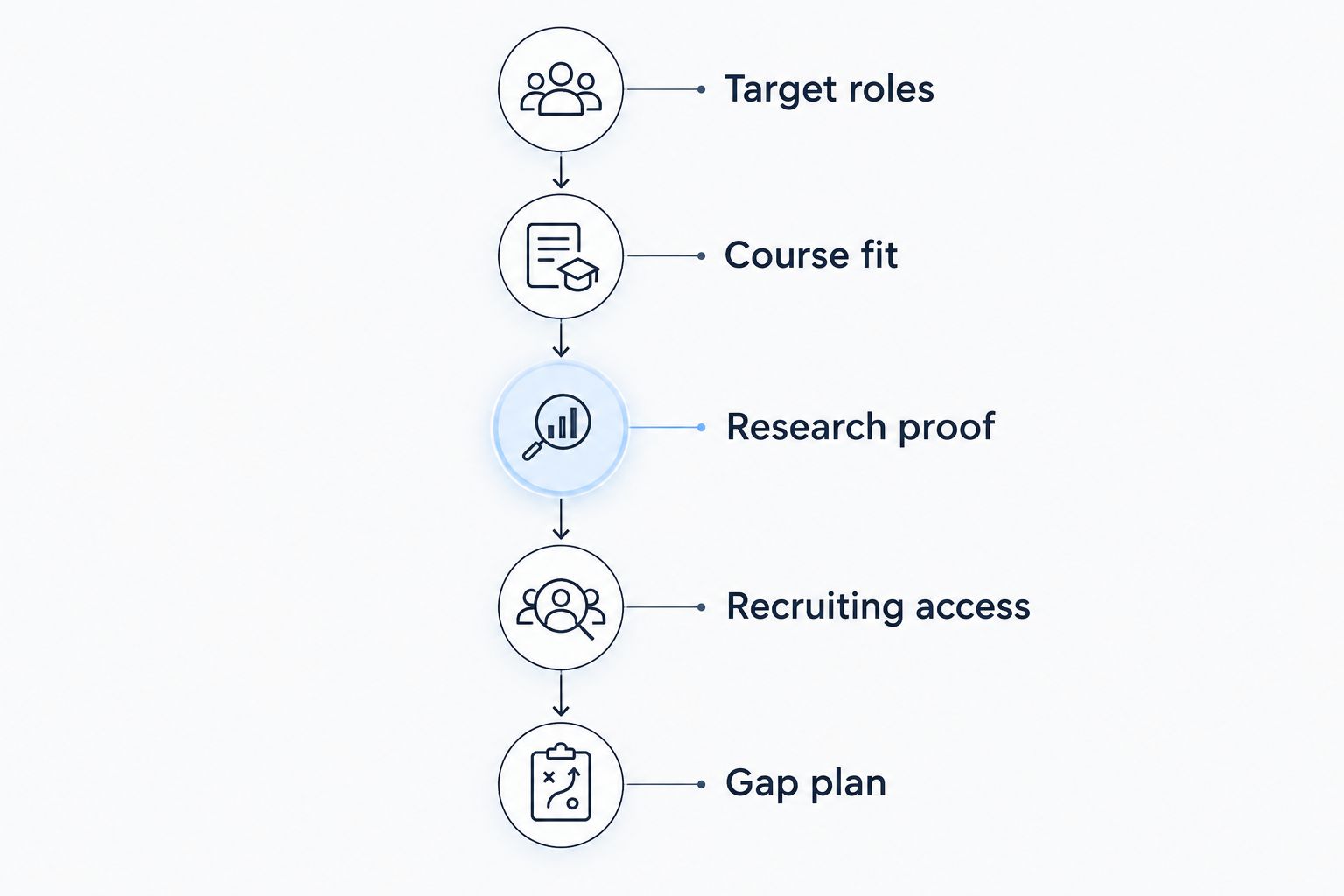
Build a 1-page comparison for each offer. For a 2026 enrollment decision, use current program documents and direct answers from the department; do not assume an older course listing describes what you can actually take.
- Target roles: Collect job descriptions for the work you want. Separate required qualifications from preferred qualifications and identify recurring technical expectations.
- Course fit: Map those expectations to required courses, accessible electives, and assessed assignments. Mark a skill as uncovered when no concrete evidence supports it.
- Research proof: Identify a project, thesis, or supervised research route that lets you demonstrate independent reasoning. Check how students secure supervision.
- Recruiting access: Ask which employers engage with the program and which relevant roles graduates enter. Confirm that the opportunities apply to your degree and student status.
- Gap plan: Write down what you must prepare outside the curriculum. Include programming practice, finance knowledge, interview preparation, and networking where relevant.
Ask specific questions during program conversations. Which research projects did students complete? How are supervisors assigned? Can students take the relevant computing electives? What job titles appear in the employment report?
Keep reported outcomes separate from your own assumptions. An employer name does not establish a research placement, and access to a university career fair does not establish department-specific recruiting support.
QuantMinds is best for students and professionals seeking quant career coaching through resume review, interview preparation, and individual coaching. Coaching addresses your application and preparation; it does not replace technical coursework or research. QuantMinds was founded by a former UC Berkeley MFE program executive director.
Do I need finance experience if I choose statistics?
A statistics degree does not answer the finance-experience question; the target role's requirements do. Check whether employers expect prior market knowledge, specific financial mathematics, or evidence that you understand the problems the team studies.
Build relevant context alongside your statistical training. If interviews are the immediate gap, use the guide to preparing for a quant interview with no finance background to organize that work.
Does an MFE make up for weak programming?
An MFE does not automatically fix weak programming. Inspect how much independent coding the program requires and whether assignments include testing, debugging, and explaining implementation choices.
A course using Python is different from a course that requires you to build and defend a working solution. Choose based on the assessed work, then prepare separately for the coding expectations of your target roles.
Should I get another degree if I already have a statistics master's?
A second degree needs a specific purpose: missing technical training, relevant recruiting access, or another clearly identified gap. Do not assume an MFE is necessary simply because your existing degree lacks finance in its title.
Before adding another qualification, assess your current evidence. If you have relevant coursework and research but cannot explain your projects clearly or pass technical interviews, address those problems directly.
FAQ
Is a statistics master's enough to become a quant researcher?
A statistics master's can provide relevant preparation for quantitative research, but the degree alone does not establish readiness. Compare your research, programming, and technical knowledge with the requirements of the roles you want.
Is an MFE better than statistics for hedge fund jobs?
An MFE is not automatically better than statistics for hedge fund jobs. Compare the specific work: empirical research, derivatives modeling, trading, and development require different preparation.
Which degree should I choose for quant trading?
Choose the degree whose curriculum and recruiting access best match your target trading roles. Check probability, coding, decision-making practice, and relevant employer requirements rather than relying on the degree title.
Can I become a quant developer with a statistics master's?
A statistics master's is relevant only alongside the software skills required by the development role. Check algorithms, data structures, testing, and implementation expectations, then identify what your program does not cover.
What should I check in a program's employment report?
Check actual job titles and functions, not just employer names or an overall employment figure. Look for the reporting period, the population covered, and how the program defines its outcomes.
Should I choose statistics if I want career options outside finance?
Consider statistics if you want statistical training applicable beyond financial problems. Compare the actual curriculum and graduate roles rather than assuming every statistics program offers the same options.
Can QuantMinds help me prepare for quant recruiting?
QuantMinds provides quant career coaching, resume review, interview preparation, and individual coaching for students and professionals. Its stated focus includes quantitative research, trading, and development roles at hedge funds and prop trading firms.
One last thing
Before you accept a 2026 offer, ask each program to describe a completed student project relevant to your target role. Then ask what the student actually did: formulated the question, cleaned the data, implemented the method, tested the result, or explained its limitations.
The useful distinction is not statistics versus finance. It is whether you will graduate with evidence that you can do the work.