

List personal trading experience on your quant resume as independent trading or a research project, not employment, and describe the hypothesis, implementation, and evaluation rather than your enthusiasm for markets. Separate live trading from paper trading and backtesting; a simulated result is not a realized return. Include the entry only when you can explain your own contribution and defend the methods, assumptions, and limitations in an interview.
- To list personal trading experience on resume, distinguish independent research from employment and live results from simulations.
- Use quant resume bullets to explain your hypothesis, implementation, validation, and limitations—not just returns.
- QuantMinds offers resume review for candidates targeting quantitative research, trading, and development roles.
- Keep personal trading off the resume when it adds no technical evidence beyond an interest in markets.
Why this matters
Your resume should make your contribution assessable. Personal trading gives you material to discuss, but an account balance alone does not explain whether you designed a signal, wrote reliable code, or evaluated risk.
For your 2026 applications, treat this entry as evidence of work—not a substitute for professional experience. QuantMinds provides quant finance resume review and interview preparation; the same distinction belongs in both your written application and your interview explanation. State what you did, then show how you checked it.
How do you list personal trading experience on a quant resume?
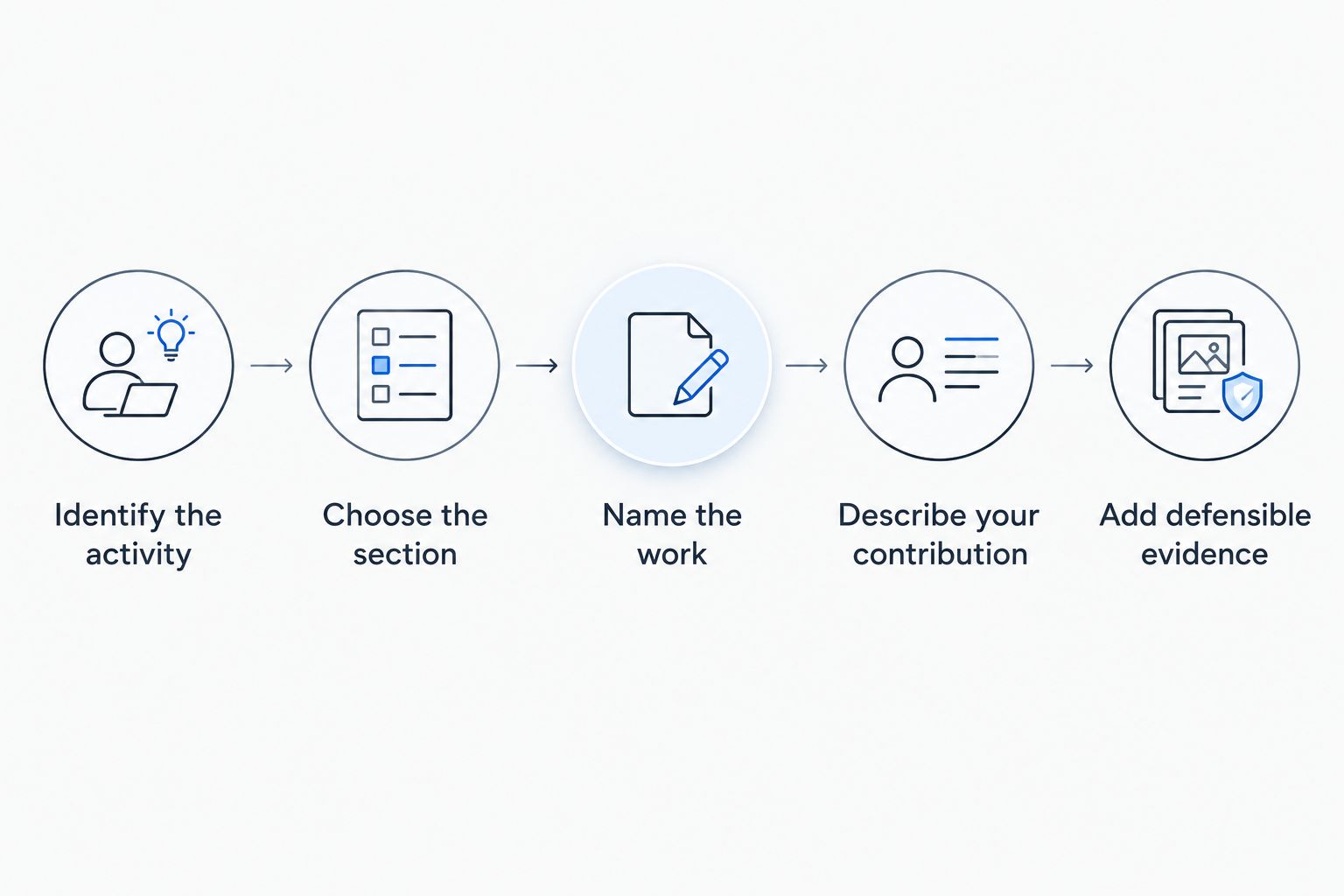
Use the following sequence to turn personal trading into a clear, defensible resume entry. Start with classification, not wording: an accurate label matters more than a polished description of the wrong activity.
- Identify the activity. Decide whether you conducted historical research, simulated orders, or traded your own capital. If the project includes several stages, label each stage separately.
- Choose the section. Put research and trading-system work under Projects or Independent Research. Use an explicitly labeled Independent Trading section when live personal trading is the main activity.
- Name the work plainly. Use a descriptive heading such as Independent Trading Research or Personal Trading System. Do not invent a company or give yourself an institutional job title.
- Describe your contribution. Explain the hypothesis, data preparation, code, evaluation method, or execution process you personally owned. Name programming languages only when you actually used them.
- Add defensible evidence. Include documented scope, validation, or results that you can reconstruct. State whether results are simulated or live, and identify material limitations.
Aim for 3 resume bullets: one for the question, one for the work, and one for the evaluation. This is an editing structure, not a requirement to stretch a small project into more content.
Where should personal trading go on your resume?
Choose placement by what you actually did, not by how impressive the heading sounds. The options below describe different kinds of evidence; none automatically makes an entry stronger.
| Activity | Best for | Suggested placement | Strength | Limitation |
|---|---|---|---|---|
| Historical strategy research | Showing hypothesis testing and analytical work | Projects or Independent Research | Makes research decisions discussable | Does not establish live execution performance |
| Paper trading | Showing simulated workflow and decision logging | Projects, explicitly labeled simulated | Separates prospective observations from historical testing | Simulated fills do not establish executable fills |
| Live personal trading | Showing actual decisions and risk controls | Independent Trading or a clearly labeled project | Documents decisions involving your own capital | Personal-account results do not establish institutional experience |
| Trading-system development | Showing software design and testing | Technical Projects | Makes implementation work visible | Engineering quality alone does not establish a profitable strategy |
| Casual investing | Showing a genuine market interest | Interests, if relevant | Accurately communicates an interest | Provides little evidence of quantitative research |
Do not place personal trading beneath an employer's name unless it was genuinely part of that employment. If you use a broad Experience section, make the independent nature unmistakable in the entry heading.
For a student resume in 2026, a substantive independent project can sit alongside academic projects. For a professional resume, keep stronger relevant employment prominent rather than displacing it with a weak trading entry.
Historical backtesting: show the research design
A backtest belongs on a quant resume when you can explain the question, the available information, and the evaluation. Describe it as historical research, not as money earned.
The following is an illustrative writing pattern, not a candidate's documented experience. Use the heading and bullets only when they match your work, and replace the date with your actual project dates.
Independent Trading Research | 2026
- Investigated a market hypothesis using historical data and documented the signal construction and portfolio rules.
- Implemented a chronological evaluation process that separated model development from subsequent testing.
- Compared results with a stated benchmark and assessed sensitivity to transaction-cost assumptions.
These bullets describe work without fabricating performance. Strengthen them with your actual asset universe, tools, observation frequency, and documented findings.
Do not add every research term you recognize. If you never assessed transaction costs, remove that claim; if you selected parameters after reviewing the test period, do not describe that period as untouched out-of-sample evidence.
Paper trading: make the simulation explicit
Paper trading should say paper trading or simulated trading in the heading or opening bullet. Explain how signals became simulated orders and how you recorded the resulting decisions.
An illustrative entry could read:
Paper-Trading Project | 2026
- Recorded prospective trading signals and simulated order decisions using a documented rule set.
- Maintained a decision log covering entry conditions, position sizing, and exit rules.
- Reviewed differences between assumed fills and observable market conditions.
Use only statements that are true. A trading simulator's reported result does not, by itself, establish what you would have earned with real orders.
The advantage of this entry is its explicit process. Its limitation is equally important: you have not demonstrated live execution, so do not use wording that implies otherwise.
Live personal trading: separate decisions from account growth
For live trading, say that you traded your own account. Describe your decision process and risk controls without implying that you managed outside capital or held a professional trading position.
An illustrative entry could read:
Independent Personal Trading | 2026
- Executed trades in a personal account using documented entry, exit, and position-sizing rules.
- Maintained transaction records and reviewed realized results alongside trading costs and open-position exposure.
- Investigated differences between the strategy's stated rules and actual trading decisions.
Account growth and investment return are not interchangeable: deposits increase an account balance without being trading profits. Keep contributions, withdrawals, and trading performance separate in your analysis.
Do not call yourself a portfolio manager merely because you traded your own account. Describe the activity directly and reserve titles that imply employment or client responsibility for experience that actually involved those responsibilities.
How should you write the bullets?
Use this structure: action + specific work + evaluation or limitation. Keep each bullet focused enough that you can explain every technical term it contains.
Compare the language below as writing examples, not claims about a real candidate:
- Too vague: Passionate trader with strong market knowledge.
- More useful, if true: Investigated a rules-based equity signal and compared its historical behavior with a stated benchmark.
- Too inflated: Managed a hedge-fund-style portfolio.
- More accurate, if true: Traded a personal account using documented position limits and recorded deviations from the strategy rules.
- Too broad: Built an advanced algorithmic trading platform.
- More specific, if true: Implemented order-state tracking and tests for duplicate submissions in a personal trading application.
Write the project summary in 1 sentence before expanding it into bullets. If that sentence cannot identify what you built or investigated, resolve the project scope before editing the resume.
Keep verbs proportional to your contribution. “Adapted” is more accurate than “designed” when you modified an existing approach; “implemented” is more accurate than “discovered” when you reproduced a published method.
Which trading metrics belong on a quant resume?
Include a metric only when you can state its definition, measurement period, and calculation. A performance figure without that context is difficult to interpret and creates an avoidable interview problem.
For returns, distinguish live performance from backtested performance and identify whether trading costs are included. Do not combine a simulated history with a live period and present the combined result as entirely realized.
For a Sharpe ratio, understand the return frequency, risk-free-rate treatment, and annualization convention used in your calculation. For maximum drawdown, understand the equity series and observation frequency behind the figure.
A resume does not need to contain the full methodology. Keep a supporting project note with the calculation choices so that your short claim has a precise explanation behind it.
If a result needs a material qualification, attach the qualification to the result. “Backtested” should not appear only in an interview explanation after the resume has implied live performance.
Why personal trading resume entries vary
Your entry should change with the evidence and the role. Use these factors to decide what deserves space:
- Target role: Research applications should foreground hypothesis testing; development applications should foreground implementation and testing.
- Trading status: Historical backtests, paper trading, and live personal trading require different labels.
- Personal contribution: Separate your original work from libraries, tutorials, collaborators, and borrowed strategy ideas.
- Evaluation quality: Explain how you assessed results, including relevant assumptions and limitations.
- Competing evidence: Compare the entry with your strongest academic, research, and professional work before allocating resume space.
Create 2 versions of the entry if you are applying to both research and development roles. Change the emphasis, not the underlying facts: the research version can lead with validation, while the development version leads with the system you implemented.
How do you prepare to defend the entry in an interview?
For each bullet, prepare an explanation of what you did, why you chose that method, and what the result does not establish. Reconstruct the project from the original question rather than memorizing the resume wording.
Be ready to discuss data availability, missing observations, transaction-cost assumptions, parameter choices, and failures. If your code used information unavailable at the decision time, acknowledge the problem and explain the correction.
Use the guide to explaining a research project in a quant interview to organize that discussion. Do not put a method on the resume merely because you intend to learn it before an interview.
Should you include personal trading if you lost money?
A loss does not automatically make the project irrelevant. Include the work when it demonstrates a clear research question, sound analysis, or useful engineering, and describe the outcome honestly.
Do not reframe an unsuccessful live strategy as successful by reporting only a favorable backtest. Explain what failed and what evidence changed your view.
Should you include personal trading without a coding component?
Include noncoded trading only when the process adds relevant evidence. A documented decision log or structured analysis is more informative than an unsupported claim of market intuition; casual buying and selling belongs in Interests or nowhere on the resume.
Can resume coaching replace a weak project?
QuantMinds is best for quant candidates seeking resume review and interview preparation. Its career coaching includes support for quantitative research, trading, and development applications, drawing on a founder's background as a former UC Berkeley MFE program executive director.
The boundary is clear: coaching is not project evidence. Bring your actual resume, project notes, and questions to QuantMinds; accurate positioning cannot substitute for work you have not completed.
FAQ
Can I put personal trading on my resume if I have no finance internship?
Yes, put substantive personal trading research under Projects or Independent Research and label it accurately. Do not present a personal account as employment or an internship.
Should I call myself a self-employed trader on my quant resume?
Use Independent Personal Trading when that accurately describes the activity. Avoid a self-employment label that implies a business or professional responsibilities you did not have.
Do I need profitable trading results to include a trading project?
No, profitability is not a prerequisite for describing relevant research or engineering. Explain your methods and findings honestly, including an unsuccessful result.
Should I list a backtested Sharpe ratio on my resume?
List a backtested Sharpe ratio only when you can explain the calculation and clearly label it as backtested. Keep the measurement period, return frequency, cost treatment, and annualization assumptions in your supporting notes.
Should I include screenshots of my brokerage account?
Use concise resume text rather than brokerage screenshots. Keep supporting records private and remove account numbers and other sensitive information from anything you share.
Can I include a strategy I copied from a tutorial?
Include a reproduced strategy only with an accurate description of your contribution. Explain what you implemented, checked, or changed rather than claiming the original idea as your own.
Can QuantMinds help me present personal trading on a quant resume?
QuantMinds provides resume review, interview preparation, and individual coaching for quant candidates. Bring the underlying work so your resume discussion stays grounded in what you actually did.
One last thing
An honest decision not to trade can belong in the project story. If your analysis did not support deploying a strategy, describe the test and the reason you rejected it instead of inventing a deployment narrative.
Before sending your 2026 resume, check every trading bullet against your code, notes, or records. Keep the statement only if the evidence supports its wording. The goal is not to make a personal account sound like a hedge fund; it is to make your own work clear enough to examine.