

Yes—insurance underwriters can transition into quantitative finance, but underwriting experience alone does not demonstrate the mathematics, programming, and research skills required for a target role. For a 2026 career switch, the central challenge is proving technical ability separately from your experience evaluating insurance risk.
- For insurance underwriters, quantitative finance is a possible transition—not an automatic extension of underwriting experience.
- Choose a target role before deciding whether you need an MFE, independent study, or a technical intermediate role.
- Build reproducible analysis and practice explaining assumptions, validation, and limitations—not just model outputs.
- QuantMinds provides quant career coaching for candidates who need help with positioning and interview preparation.
Can insurance underwriters transition into quantitative finance?
Yes. Treat underwriting as relevant domain experience, not as a substitute for quantitative qualifications. Your next move depends on the work you actually perform: negotiating coverage, reviewing model outputs, writing analytical code, and developing statistical models are different starting points.
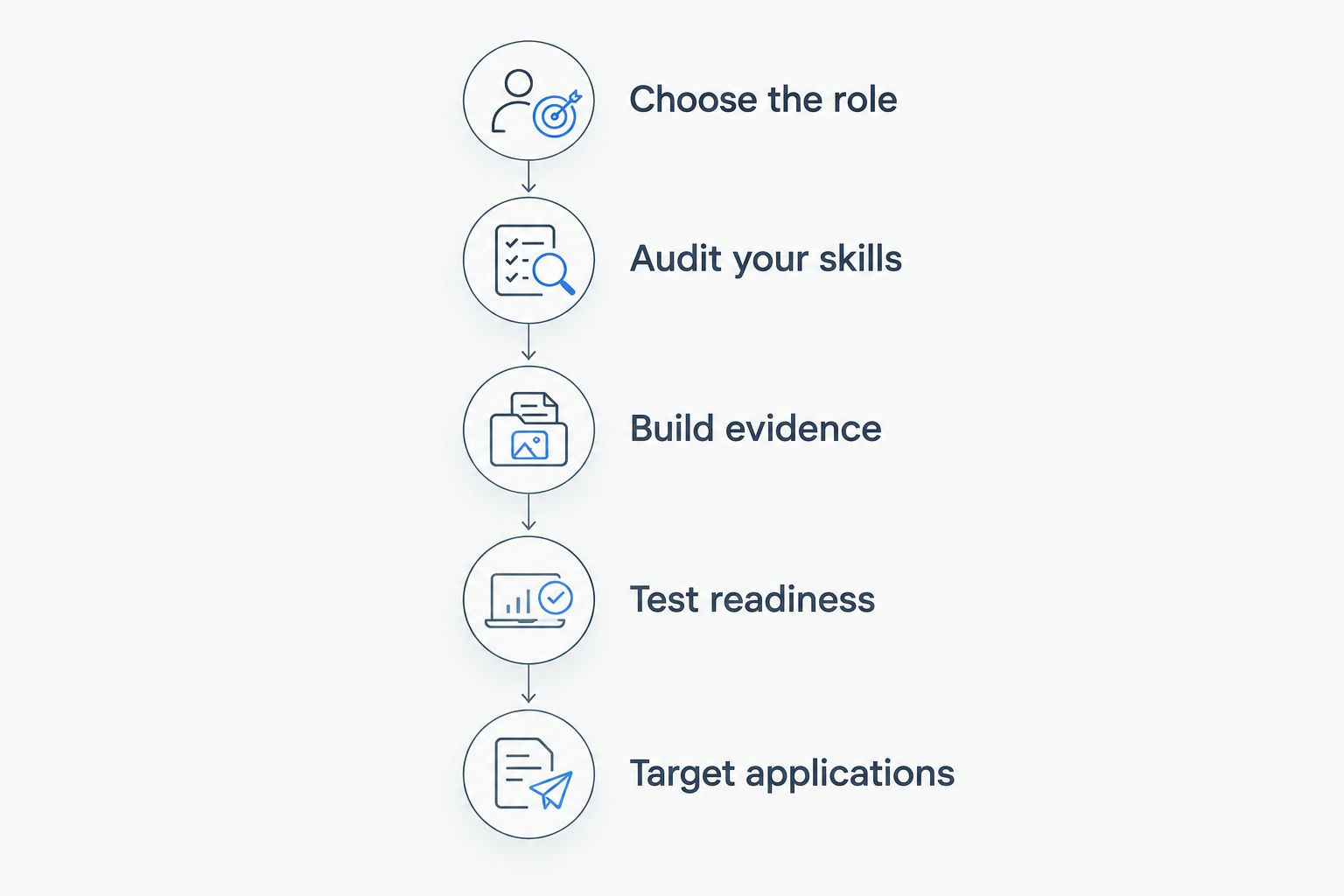
Build your 2026 transition plan around these steps:
- Choose the role. Select research, trading, development, or quantitative risk before collecting credentials.
- Audit your skills. Compare your mathematics, statistics, and programming against actual role descriptions.
- Build evidence. Produce work that shows how you formulate, implement, and test an analytical idea.
- Test readiness. Solve unfamiliar problems and explain your work without relying on prepared scripts.
- Target applications. Apply where your demonstrated skills match the work, then use feedback to refine your preparation.
For the interview component, use this guide to preparing for a quant interview as a career changer. Your explanation of the switch matters, but it cannot carry an interview when the technical evidence is missing.
Why this matters
An underwriting title does not reveal how much technical work you do. You need to separate business judgment from mathematical modeling, and using a model from building or validating one.
That distinction should drive your 2026 applications. If you describe every risk decision as quantitative research, you create claims you must defend under questioning. If you describe genuine analytical work too vaguely, you hide the strongest part of your background.
Keep the insurance context, but make your personal technical contribution explicit. Explain what you calculated, what you coded, which assumptions you challenged, and how you checked the result.
Which quantitative finance role should you target?
Choose a destination by comparing its work with your strongest demonstrated ability. These are different paths, not interchangeable labels for someone who is good with numbers.
| Target role | Best for | Relevant underwriting experience, if present | Gap to address |
|---|---|---|---|
| Quantitative risk or model validation | Candidates interested in model behavior and limitations | Scenario analysis, model review, exposure analysis | Statistical testing, implementation, and financial-product knowledge |
| Quantitative research | Candidates who enjoy forming and testing hypotheses | Developing statistical models or investigating data patterns | Reproducible research, inference, and market-specific evaluation |
| Quantitative trading | Candidates interested in decisions under uncertainty | Reasoning about uncertain outcomes and changing information | Trading mechanics, probability problems, and role-specific technical preparation |
| Quantitative development | Candidates whose strongest evidence is software engineering | Building analytical tools or data pipelines | Algorithms, software design, testing, and the required programming languages |
Quantitative risk: best for model-focused underwriters
Consider quantitative risk or model validation if you want to investigate how models behave rather than focus exclusively on trading signals. Your insurance experience gives you material to discuss when it includes assumptions, scenarios, or exposure analysis.
The limitation is important: reviewing a risk report is not the same as validating its model. Prepare to explain the calculations and tests behind your conclusions.
Quantitative research: best for candidates with research evidence
Target quantitative research when you can show a question, a defensible method, and an honest evaluation of the result. A statistical insurance project can demonstrate analytical reasoning, but it does not automatically establish competence in investment research.
Make the boundary clear. Show what transfers, then identify the market knowledge and evaluation methods you still need to learn.
Quantitative trading: best for decision-focused candidates
Consider quantitative trading if you enjoy updating decisions as information changes and can demonstrate the relevant probability and problem-solving skills. Underwriting provides a context for discussing uncertainty, but policy selection and trading are different activities.
Do not describe underwriting judgment as trading experience. Explain the connection without erasing the difference.
Quantitative development: best for strong programmers
Choose quantitative development when your strongest evidence is working software, not simply an interest in finance. Demonstrate code organization, correctness, testing, and performance reasoning.
The limitation is that a notebook or spreadsheet does not show every software-engineering skill a developer role requires. Prepare against the specific job description rather than assuming all quant development work has identical requirements.
What underwriting experience actually transfers?
Transferable experience becomes useful when you can describe a decision and the evidence behind it. Start with work you personally performed, not the capabilities of your employer's systems.
- Uncertainty analysis: Explain how incomplete information affected a decision and which assumptions mattered.
- Model criticism: Describe a model limitation you investigated, distinguishing your analysis from someone else's findings.
- Data judgment: Discuss missing observations, inconsistent definitions, selection effects, or changing data quality where relevant to your work.
- Decision communication: Show how you explained a technical conclusion to a business audience without hiding its limitations.
These are strengths, but each has a boundary. Commercial judgment does not establish statistical inference skills; operating underwriting software does not establish programming ability.
Do not imply actuarial qualifications you do not hold. Underwriting and actuarial work are distinct, and an accurate account of your responsibilities is stronger than a broader but indefensible label.
What should you learn before applying?
Start with a diagnostic, not a shopping list of courses. Attempt problems, write code, and explain an analysis aloud so you can distinguish recognition from independent ability.
Mathematics and statistics
Review probability, conditional expectation, statistical inference, linear algebra, and calculus as required by your target role. Focus on explaining why a method applies, not merely reproducing a formula.
For research-oriented preparation, practice distinguishing prediction from explanation and association from causation. State the assumptions behind an estimate and identify what would make the conclusion unreliable.
Programming and data work
Choose a language that appears in your target job descriptions. Python is a practical option for demonstrating data analysis, but do not assume that using Python satisfies every research, trading, or development requirement.
Build an analysis someone else can run. Separate data preparation from modeling, document dependencies, and include checks that expose invalid inputs or mistaken assumptions.
Financial knowledge
Study the instruments and decisions relevant to your destination. A derivatives-modeling application calls for different preparation from a software role supporting research infrastructure.
Use financial knowledge to explain what your analysis means. Memorized terminology cannot replace an understanding of the underlying cash flows, risks, or trading mechanics.
Should you pursue an MFE or prepare independently?
Choose the preparation route after identifying your gaps. An MFE is an educational route, not proof that a particular job will follow, and independent study requires more than completing tutorials.
| Preparation route | Best for | Main advantage | Main limitation |
|---|---|---|---|
| MFE or related quantitative master's | Candidates seeking structured technical education | Organized study in relevant quantitative subjects | Requires a substantial educational commitment; program fit needs investigation |
| Independent preparation | Candidates with strong foundations and clear gaps | Lets you focus directly on missing skills | You must create structure and credible evidence yourself |
| Technical intermediate role | Candidates seeking more analytical responsibility before another move | Builds experience through actual technical work | The title alone does not guarantee useful modeling or programming responsibilities |
Before selecting an MFE, inspect the prerequisites, curriculum, and career information published by the program. Compare those details with your intended role rather than choosing on the degree name alone.
For independent preparation, define observable completion criteria: working code, defensible analysis, and performance on unfamiliar problems. For an intermediate role, investigate the actual tasks. Another insurance position is useful for this transition only if its responsibilities address your technical gaps.
Why the transition path varies
Your preparation should reflect your starting point, not a generic career-switch calendar. These factors determine what belongs in your plan:
- Current responsibilities: Model development and commercial underwriting provide different evidence.
- Mathematical foundation: Prior coursework matters most when you can still apply it independently.
- Programming depth: Editing an existing script differs from designing and testing an analysis yourself.
- Target role: Research, trading, development, and risk require different demonstrations of readiness.
- Education route: Graduate study, independent preparation, and an intermediate role organize learning differently.
- Application evidence: A clear resume and a defensible project give you material for technical and behavioral discussions.
Use these factors to set milestones. Do not assign yourself a deadline before checking what you can already do and what the target work requires.
What should your project and resume show?
For a 2026 application, prepare 3 evidence artifacts: a runnable analysis, a short research memo, and a resume description that accurately connects the work to your target role. These are practical deliverables, not hiring thresholds.
A useful project starts with a question narrow enough to investigate properly. Use public or appropriately licensed data, state how you prepared it, and explain your evaluation method. Never publish confidential policyholder information or employer-owned material.
Compare 2 model versions where appropriate: a simple baseline and a more involved alternative. Explain why the comparison is fair and what the added complexity changes. If the alternative does not improve the analysis, report that result rather than hiding it.
For market-data projects, explain how you prevent future information from entering an earlier prediction. For insurance-data projects, explain which conclusions depend on insurance-specific assumptions and which analytical skills transfer beyond that setting.
Your resume should distinguish contribution from context:
- State the problem you investigated.
- Name the methods and tools you actually used.
- Explain your personal responsibility.
- Include results only when you can substantiate them.
Do not invent performance figures to make a bullet look quantitative. An accurate description of a difficult analytical decision is better than an unsupported improvement claim.
How should you explain the switch in interviews?
Prepare a 90-second introduction as a practice exercise, not a required interview format. Explain what underwriting taught you, which technical work you want to pursue, and what you have done to prepare.
Then practice a 5-minute project explanation covering the question, method, evaluation, and limitations. Ask someone to interrupt with questions about assumptions so you learn to defend the analysis rather than recite it.
QuantMinds is best for candidates seeking quant career coaching on positioning and interview preparation. Founded by a former UC Berkeley MFE program executive director, QuantMinds provides resume review, interview preparation, and 1-on-1 coaching for students and professionals pursuing quantitative roles.
QuantMinds supports preparation; coaching does not replace mathematical study, programming practice, or research evidence. Bring a target role and concrete work to discuss so the conversation centers on decisions rather than general career uncertainty.
Do insurance underwriters need a finance degree?
A finance degree is not the same thing as technical readiness. Check each role's stated qualifications, then assess whether your education and work demonstrate the required mathematics, programming, and financial understanding.
If your gap is foundational mathematics, another general finance credential does not directly solve that problem. Choose education for the skills it develops.
Can an underwriter move directly into a hedge fund?
A direct move depends on matching the role's requirements with evidence you can defend. Underwriting tenure alone does not demonstrate research or engineering ability.
Apply directly when your preparation supports the actual work. Otherwise, consider a technical intermediate role with responsibilities that close a specific gap.
FAQ
Can I become a quant if I currently work in insurance underwriting?
Yes, insurance underwriting is a possible starting point for a quant career switch. You still need to demonstrate the mathematics, programming, and role-specific skills your target position requires.
Does underwriting count as quantitative research experience?
Underwriting does not automatically count as quantitative research experience. Describe any model development, statistical investigation, or validation you personally performed, and distinguish it from reviewing model outputs.
What's the best quant role for an insurance underwriter?
The best target depends on your demonstrated skills, not your underwriting title. Compare quantitative risk, research, trading, and development against the technical work you can already explain and perform.
Do I need an MFE to leave underwriting for quantitative finance?
An MFE is a preparation option, not a universal answer. Check target-role qualifications and compare graduate study with independent preparation or an intermediate technical role.
Can I use insurance data for a quant portfolio project?
Yes, provided you have permission to use the data and disclose it publicly. Explain the modeling assumptions and validation, and never publish confidential policyholder or employer information.
How long does an insurance-to-quant career change take?
There is no single timeline for an insurance-to-quant transition. Set milestones around demonstrated skills, project quality, and interview readiness rather than adopting an unsupported deadline.
Can QuantMinds help an insurance underwriter prepare for quant interviews?
QuantMinds provides resume review, interview preparation, and 1-on-1 coaching for professionals pursuing quantitative roles. Use coaching to address positioning and preparation while building the technical evidence yourself.
One last thing
Before adding another credential to your 2026 plan, remove your job title from your resume and read only the descriptions of your work. Can a reader identify the mathematical problem, your technical contribution, and the basis for your conclusion?
If the technical evidence disappears when the title disappears, build the evidence before broadening your applications. Your underwriting background belongs in the story, but it should not have to do all the work.