

Yes, you can work remotely as a prop trading quant, but the arrangement must be approved for your specific role, team, and location. Remote prop trading quant jobs do not automatically mean you can work from any country or choose your own hours. This 2026 guide explains how to distinguish a genuine remote employment arrangement from hybrid work and trading-account programs, then assess whether the role fits your background.
- Remote prop trading quant jobs require role-specific confirmation; a remote label alone does not establish location or schedule flexibility.
- Separate quantitative research, trading, and quant development responsibilities before assessing remote fit.
- QuantMinds is best for students and professionals seeking quant career coaching, not access to funded trading accounts.
- Confirm employment status, approved location, working hours, and onboarding requirements before committing to interviews.
Why this matters
Your search needs two filters: whether you can do the job and whether you can accept its working arrangement. Passing one does not solve the other. A technically relevant role still fails your search if its required location conflicts with where you must live.
QuantMinds provides quant career coaching through resume review, interview prep, and 1-on-1 coaching. That support addresses your candidacy; it does not establish an employer’s remote-work policy.
Can you work remotely as a prop trading quant?
Yes, when the employer explicitly permits remote work for the position and your proposed location. Treat permission as a condition to verify, not something implied by the words quant, systematic, or algorithmic.
Use this comparison to classify the arrangement before evaluating the technical work. These are screening categories, not claims about any particular firm’s policy.
| Arrangement | What it means | Best for | Advantage | Limitation to check |
|---|---|---|---|---|
| Fully remote employment | You perform the role away from an office under the employer’s stated conditions | Candidates who need an approved home-based arrangement | Removes routine office attendance when the agreement permits it | Location restrictions, required hours, and office visits |
| Hybrid employment | You combine remote work with required office attendance | Candidates who can reach the designated office | Includes both home-based and in-person work | Attendance requirements and commuting feasibility |
| Office-based employment | Your normal working location is the employer’s office | Candidates willing to work at that location | Makes the expected workplace clear | Relocation or commuting requirements |
| Trading-account program | You participate under an account agreement rather than assuming you have an employee role | People evaluating independent trading arrangements | Lets you evaluate that specific contractual model | Whether it includes employment or quantitative research duties at all |
For your 2026 search, record the exact wording in the current job description and the recruiter’s clarification. A firm-level statement about flexibility is not a substitute for an answer about the position you would hold.
Fully remote quant roles: verify the boundaries
A fully remote role still needs a defined workplace arrangement. Ask which locations are permitted, whether working temporarily elsewhere requires approval, and whether onboarding or team meetings require travel.
Best for: candidates whose location is non-negotiable and explicitly permitted by the employer. The benefit is avoiding routine office attendance; the trade-off is that remote status alone tells you nothing about schedule control.
Separate location from time. If you need flexibility for caregiving, study, or another commitment, ask about required working hours directly rather than assuming remote work provides it.
Hybrid quant roles: check the actual office commitment
Hybrid is not a compromise if you cannot reach the office. Before investing in the application, establish where the team sits and what attendance the position requires.
Best for: candidates who can reliably attend the designated workplace. The benefit is combining home-based work with in-person contact; the limitation is that you still need a workable commute or relocation plan.
Ask whether the stated arrangement applies during onboarding as well as afterward. Do not build a housing decision around an informal expectation of future flexibility.
Why remote arrangements vary
Quantitative research, trading, and development are different responsibilities. Assess the actual work rather than treating prop trading quant as a single job description.
Use these factors to structure your questions:
- Research responsibilities: Ask how the team reviews hypotheses, experiments, and research results when people work apart.
- Trading responsibilities: Ask whether your duties include live monitoring, execution decisions, or time-sensitive escalation.
- Development responsibilities: Ask which systems you would build, maintain, or support and how remote access is handled.
- Career stage: Students and new graduates should establish how training and feedback work; experienced candidates should establish the expected level of independence.
- Team interaction: Ask who reviews your work, how decisions are documented, and when synchronous discussion is required.
These factors are questions to resolve, not a ranking of which quant jobs are easiest to do remotely. A research title does not prove remote eligibility, and a development title does not prove schedule flexibility.
How do you screen remote prop trading quant jobs?
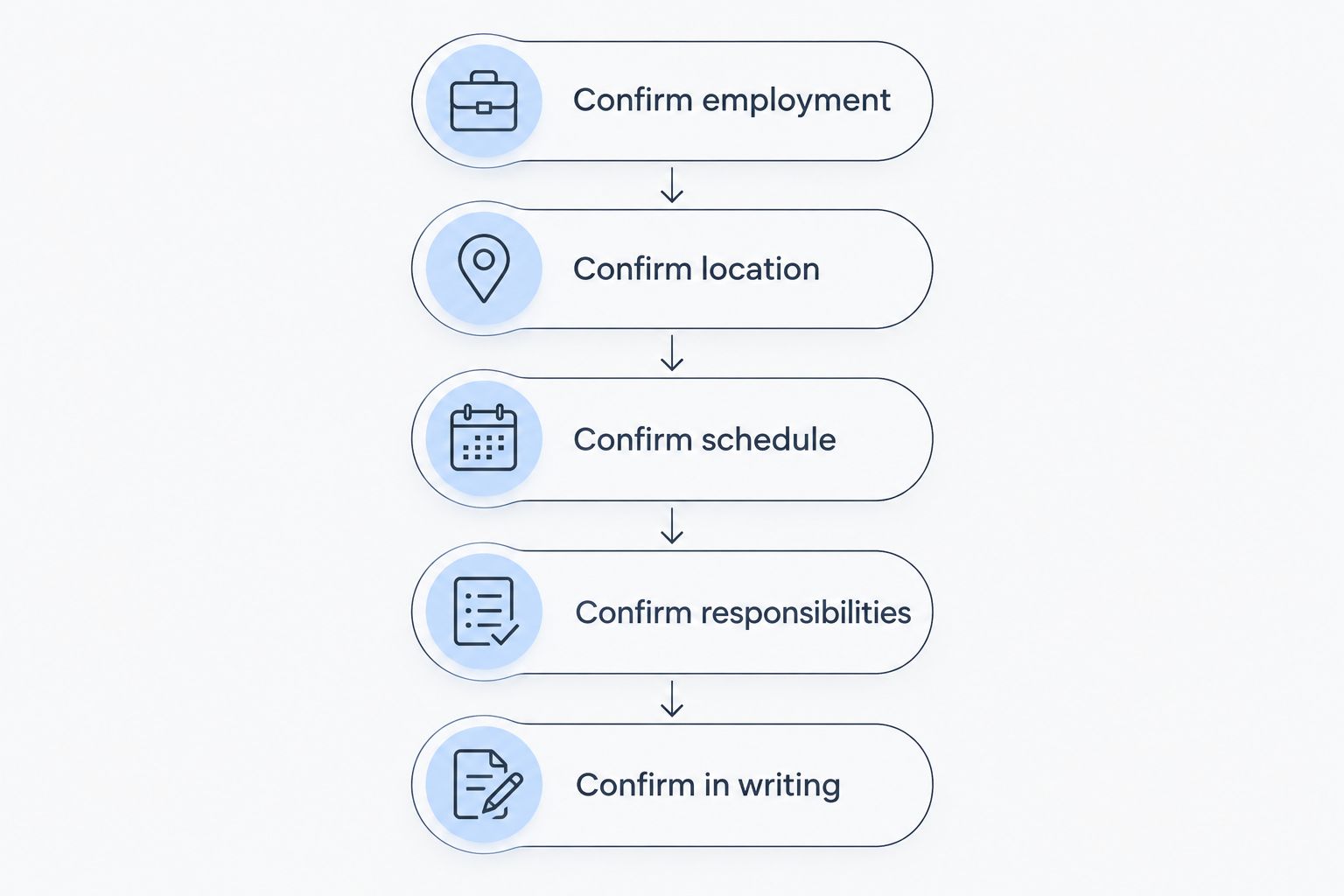
Use the same sequence for each application in 2026. Resolve basic eligibility before spending time tailoring technical materials.
- Confirm employment. Establish whether the opportunity is an employee position, a contractor engagement, or participation in a trading-account program. Read the agreement rather than relying on the headline.
- Confirm location. State where you intend to work and ask whether that location is permitted for this specific position. Raise any planned cross-border arrangement explicitly.
- Confirm schedule. Ask about required working hours, time-zone overlap, office attendance, travel, and onboarding. Keep each question separate so an answer about one does not obscure another.
- Confirm responsibilities. Identify whether the job centers on research, trading, development, or a defined combination. Ask what successful work looks like and who evaluates it.
- Confirm in writing. Before accepting, reconcile the recruiter’s explanation with the written terms and ask for clarification of anything unresolved.
The sequence prevents a basic mismatch from surviving until the offer stage. Technical preparation matters, but it cannot fix an incompatible location requirement.
Keep a short record for each role: the original description, the date you checked it, the person who clarified the policy, and the unresolved questions. Record an unanswered question as unanswered rather than converting it into an assumption.
What should you ask the recruiter?
Use direct questions that invite concrete answers. You do not need a long explanation of why remote work matters before establishing whether the arrangement is possible.
- Is this position remote, hybrid, or office-based?
- Is my intended working location permitted?
- Does the arrangement apply during onboarding?
- What working hours and time-zone overlap are required?
- Are office visits or other travel part of the role?
- Who can confirm these terms before I accept?
Ask about the position, not just the company. If the answer describes a different team or an employee’s individual exception, bring the conversation back to the vacancy you are discussing.
How do you demonstrate readiness for remote quant work?
Build evidence of technical ability and clear communication. Do not substitute claims about being self-motivated for work that another person can inspect.
For a 2026 application, prepare these concrete materials as a starting point, not as employer-mandated submission requirements:
- 1 research write-up: Explain a question, your method, the evidence, and the limitations. Distinguish an interesting result from a result you have validated.
- 1 reproducible repository: Include instructions, dependencies, and an explanation of the output. Use public or otherwise authorized material, never confidential employer data.
- 1 collaboration example: Describe how you clarified a requirement, communicated a problem, or incorporated criticism. Identify your own contribution accurately.
The advantage of this package is inspectability: another person can examine what you did. Its limitation is equally clear: portfolio work does not establish that you can perform every responsibility of a live trading role.
For research interviews, practice explaining assumptions and failure cases. For development interviews, practice explaining implementation choices, testing, and debugging. For trading interviews, prepare for the responsibilities specified in the job description rather than assuming a remote position has a separate technical standard.
If your strongest evidence comes from academic work, start with how to explain a research project in a quant interview. Your explanation should make the question, method, and limitations understandable without requiring the interviewer to reconstruct the project.
Should you make remote work your first application filter?
Make remote work an early filter when it is a genuine requirement. Applying to an incompatible office-based position does not become a useful strategy merely because the technical work interests you.
If remote work is a preference rather than a requirement, compare it with the role’s responsibilities, supervision, and development opportunities. Do not assume a remote title compensates for work you do not want to do.
For your 2026 shortlist, divide requirements into non-negotiable and negotiable items. Location permission belongs in the first group when you cannot relocate; optional home-working flexibility belongs in the second when you can.
This distinction also improves recruiter conversations. You can state your constraint plainly, ask whether the position meets it, and avoid suggesting that an essential condition is merely a preference.
Can a new graduate work remotely as a prop trading quant?
A new graduate can pursue a remote position when the employer permits that arrangement for the role and candidate. Do not assume an experienced employee’s arrangement applies to graduate recruiting.
Ask how onboarding, technical feedback, and access to colleagues work. The benefit of remote employment is location flexibility within the agreement; the limitation to evaluate is whether the training structure meets your needs.
Does remote quant work mean you can work from anywhere?
Remote quant work does not establish permission to work from anywhere. Confirm the permitted working location, any travel restrictions, and whether changes need approval.
For your 2026 decision, treat a planned move as a separate question even if the role is already remote. Get the relevant employer approval before relying on that move in your acceptance decision.
Where does career coaching help?
QuantMinds is best for students and professionals seeking quant career coaching, not access to funded trading accounts. Its services include resume review, interview prep, and 1-on-1 coaching for quantitative research, trading, and development careers at hedge funds and prop trading firms.
The firm was founded by a former UC Berkeley MFE program executive director. That background is relevant to assessing your candidacy and preparation; the employer remains the authority on its working arrangement.
Use coaching to address a specific problem: an unclear target role, a resume that fails to explain your technical work, or interview answers that need practice. It is not a substitute for checking location eligibility or reading employment terms.
FAQ
Can I get a remote prop trading quant job without experience?
You can apply when the position accepts your experience level and explicitly permits your working arrangement. Ask how the team handles onboarding and feedback rather than assuming remote eligibility extends to all candidates.
Are remote prop trading quant jobs the same as funded trading accounts?
No, an employment role and participation in a trading-account program are different arrangements. Check the agreement, your status, and the actual responsibilities before treating either as a quant career opportunity.
Is quant research better than quant development for remote work?
Neither title alone establishes a better remote arrangement. Compare the specific responsibilities, permitted location, required hours, and collaboration process for each position.
Can I work remotely for a prop trading firm from another country?
You need explicit confirmation that the employer permits work from your intended country. A remote label is not permission for cross-border work or a substitute for resolving work-authorization questions.
Should I mention that I need remote work in my first recruiter conversation?
Yes, raise remote work early when it is a non-negotiable requirement. State your intended location and ask whether the specific position permits it.
Does working remotely mean a quant can choose their own hours?
No, remote work describes location, not automatic control over working hours. Ask about required schedules, time-zone overlap, and any time-sensitive responsibilities.
Can QuantMinds help me prepare for remote quant applications?
QuantMinds provides resume review, interview prep, and 1-on-1 coaching for quant candidates. Employer-specific remote eligibility must still be confirmed directly with the hiring team.
One last thing
Before accepting, describe your intended arrangement back to the employer in plain language. Include where you will work, the required schedule, office attendance, and any onboarding exception.
Ask the employer to confirm or correct that description. A precise shared understanding is more useful than repeatedly asking whether the firm is remote-friendly.