

Ask a hedge fund quant for an informational interview by explaining why their experience is relevant, giving a brief account of your background, and requesting a focused conversation about the work—not a referral. Make the request easy to decline, use only truthful connections, and prepare questions that do not ask for confidential research or trading information. This guide covers outreach, conversation preparation, and follow-up for your 2026 recruiting plan.
- For an informational interview, hedge fund quant candidates should ask for career insight—not an immediate referral.
- Choose contacts whose public experience connects directly to your quantitative research, trading, or development goals.
- QuantMinds provides quant career coaching, resume review, and interview preparation for students and professionals.
- Use a specific message, respect confidentiality, and follow up without turning the conversation into a job demand.
Why this matters
An informational interview should help you make a better career decision, not disguise a request for employment. You need to understand which work interests you, what evidence your background provides, and what preparation deserves your attention.
If you are starting without an established network, use the guide to networking into a hedge fund with no connections to organize your search. Then make each request about a specific person's experience rather than the general ambition to work at a hedge fund.
For your 2026 outreach, separate learning from recruiting. Apply through the appropriate process when you want a position; ask for an informational conversation when you want perspective.
How do you ask a hedge fund quant for an informational interview?
Use this sequence before sending a message. The aim is to establish relevance, define the request, and leave the recipient in control of whether to respond.
- Choose relevant experience. Look for a public connection between the person's work and your target role. A research background, technical transition, or shared academic community gives you something concrete to discuss.
- Read public material. Review the person's professional profile, public writing, or recorded discussion. Do not ask them to repeat information you can already find.
- State your background. Identify your current position and the direction you are exploring. Include a technical interest or project only when it explains why this conversation makes sense.
- Explain your reason. Say which part of their experience prompted the request. Avoid generic praise about the firm's reputation.
- Make a bounded ask. Request a brief conversation about a defined career question. Do not bundle a resume review, referral, technical lesson, and recruiting update into the same message.
- Offer an easy decline. Acknowledge that they might not have time. Do not imply that a shared school or mutual connection creates an obligation.
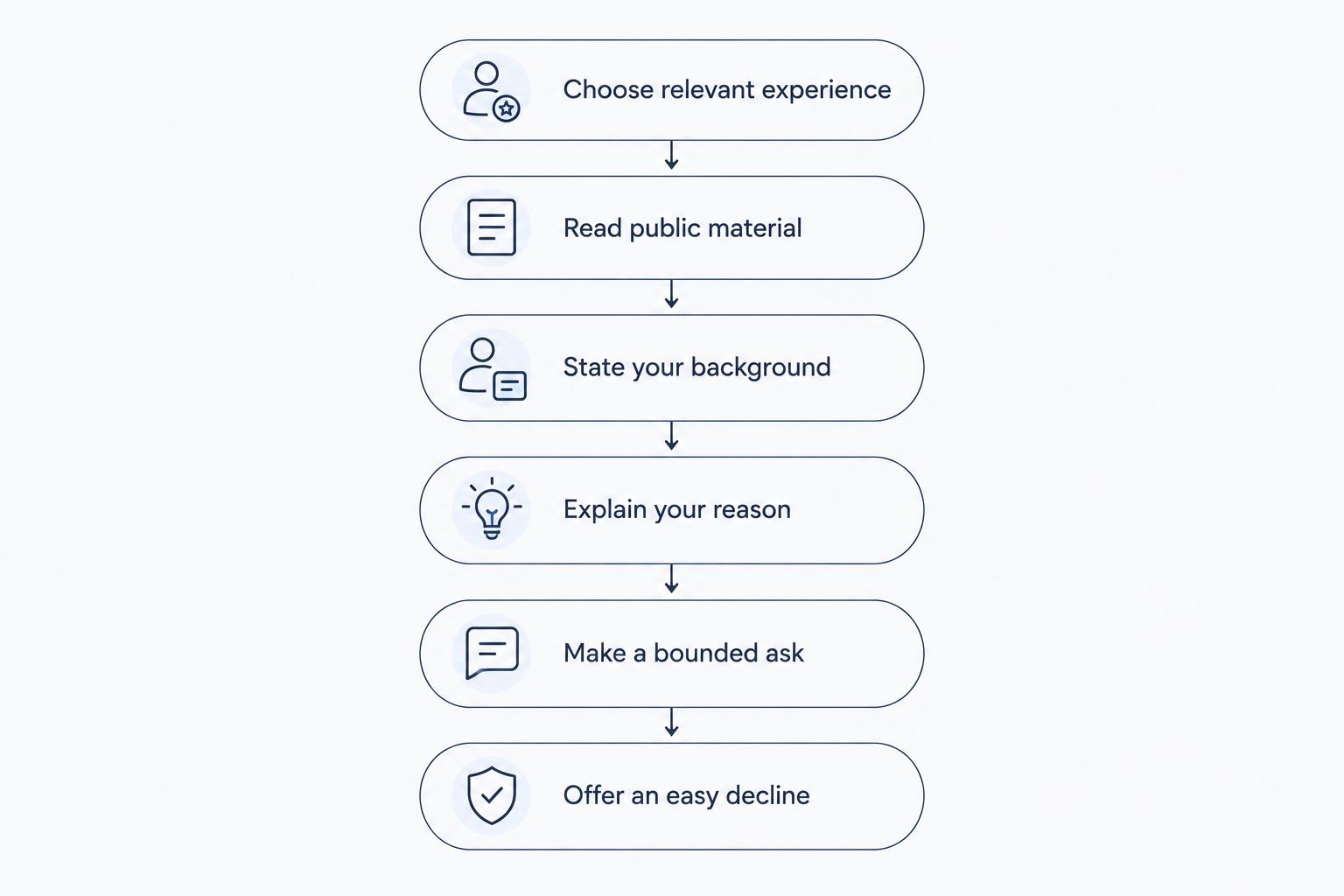
Before sending, read the request without the recipient's name or employer. If it still fits any professional in finance, rewrite the reason for contacting that person.
Email: best for a focused introduction
Use email when you have an appropriate professional address and enough context to explain your request. Keep the subject descriptive, and make the purpose apparent before the recipient opens an attachment.
The example below illustrates structure, not facts to copy. Adapt it to your actual background and the recipient's actual public experience.
Subject: Your transition from mathematics to quantitative research
Hello,
I'm studying mathematics and exploring quantitative research roles. Your public discussion of moving from academic research into finance caught my attention, particularly the distinction you made between an interesting result and a useful research process.
Would you be open to a brief informational conversation about that transition? I'd appreciate your perspective on how to evaluate whether my project work is relevant preparation. I understand if your schedule doesn't allow it.
Thank you for considering the request.
Use that structure only if those details are true. Otherwise, replace the background, public reference, and question—not just the greeting.
For outreach in 2026, describe your current status rather than recycling an old application introduction. A message that says you are still a student after you have graduated creates avoidable confusion.
LinkedIn: best for an existing professional connection
Use LinkedIn when the person's public professional presence provides the context for your approach. Its advantage is that your profile accompanies the message; its limitation is that an incomplete or inconsistent profile leaves your introduction unsupported.
A shorter draft works here:
Hello. Your move from software engineering into quant development is relevant to a transition I'm considering. I work on production systems and would appreciate a brief conversation about how you assessed the role before making the move. No problem if you're unable to connect.
Do not send this wording unless the described transition is accurate. Also check that your profile supports the background you state in the message.
| Outreach route | Best for | Main advantage | Main limitation |
|---|---|---|---|
| A focused introduction using an appropriate professional address | Space to explain relevance clearly | Requires a legitimate way to contact the person | |
| Contact grounded in a public professional profile | Your professional background accompanies the request | An incomplete profile weakens the context | |
| Warm introduction | A mutual contact who genuinely knows both people | The introducer can explain the connection | Requires the introducer's willingness and accurate context |
Choose the route you can use honestly. Do not message the same person across several channels simply because they have not replied.
Warm introduction: best for a genuine shared connection
Ask the mutual contact whether they are comfortable introducing you before supplying a message to forward. Explain the specific relevance and give them permission to decline.
A forwardable introduction should contain your current background, the career question you are exploring, and why the recipient's experience fits. Keep it self-contained so the introducer does not have to write your case for you.
Do not describe someone as a mentor, colleague, or close connection unless that relationship exists. A weak connection does not become stronger when you exaggerate it.
Why the right informational interview request varies
Your request should change with the conversation you need. Use these factors to decide what belongs in the message:
- Target role. Ask a researcher about research preparation, a developer about engineering work, or a trader about trading responsibilities. Avoid treating the titles as interchangeable.
- Your starting point. A student exploring careers needs different guidance from an experienced professional evaluating a transition.
- Existing relationship. A prior conversation gives you context to reference; a cold message requires you to establish that context.
- Public evidence. A published talk supports a specific question. A job title alone gives you less to work with.
- Purpose of contact. Learning about a role, discussing preparation, and requesting an application update are different asks.
- Confidentiality. Keep questions about proprietary work, internal decisions, and unpublished results out of the request.
For your 2026 contact list, record the reason each person is relevant. A name and employer are not enough to explain why you should contact them.
What should you ask during the conversation?
Prepare questions that help you decide what to do next. Start with the person's experience, then connect their answer to a decision you face.
Ask about the work
Useful questions include:
- How does your role differ from what you expected before entering the field?
- Which parts of your academic or professional background proved most relevant?
- What distinguishes research responsibilities from development responsibilities in your experience?
- What should someone investigate before deciding this work suits them?
Ask for personal perspective rather than an authoritative statement about the entire industry. One person's experience is useful context, not a universal hiring rule.
Ask about preparation
Explain the preparation choice you are weighing. For example, ask how to assess whether a project demonstrates careful validation, clear technical reasoning, or maintainable implementation.
Do not turn that question into an unannounced assessment of your entire portfolio. If you want detailed feedback, ask whether the person is comfortable discussing a specific example before presenting it.
Avoid confidential questions
Do not ask for live positions, proprietary signals, unpublished performance, internal code, or confidential interview material. Keep a technical discussion at the level of public methods and your own work.
If the person sets a boundary, accept it immediately. Change the question rather than explaining why you think the information would help your application.
How do you prepare without turning it into an interview?
Write a short agenda before the call: your background, the decision you are exploring, and the questions that would help you make it. Keep supporting material available without assuming the recipient wants to review it.
Prepare a concise explanation of your technical work. Describe the problem, your approach, what you evaluated, and the limitations; do not recite every tool you used.
Do not ask a networking contact to diagnose every weakness in your candidacy. That is a separate task from learning about their career.
QuantMinds provides 1-on-1 coaching, resume review, and interview preparation. QuantMinds is best for students and professionals seeking quant career coaching, resume review, and interview preparation. Coaching addresses your preparation; it does not replace a practitioner's personal account of their work or the employer's assessment of your application.
How should you handle the end of the conversation?
Respect the boundary you agreed to. When the conversation reaches its natural end, summarize the advice you found useful and explain what you intend to investigate or change.
If you want to stay in touch, ask permission rather than announcing an ongoing mentoring relationship. A simple request to share a relevant update later is clearer than asking someone to become your mentor immediately.
Do not introduce a referral request as a surprise closing question. If the person raises an opening or offers to help, respond honestly and follow their instructions.
What should you do if a hedge fund quant does not reply?
Send a brief follow-up that preserves the original request, then stop if there is still no response. Do not add urgency, disappointment, or a longer autobiography.
A follow-up can restate the topic and acknowledge that the timing might not work. It should not ask the recipient to explain their silence or prove that they saw your message.
For your 2026 outreach record, distinguish unanswered requests from explicit declines. Neither gives you a basis to judge your technical ability, and neither justifies pursuing the person through unrelated channels.
Should you send a thank-you message afterward?
Send a thank-you message that names a useful point from the conversation and the action you plan to take. Avoid broad praise that could apply to any call.
If you later share an update, make it relevant to the advice. Reporting that you clarified a project limitation is more substantive than repeatedly asking whether the person has heard of an opening.
Keep any private comments private. Do not publish the person's advice or identify them as supporting your candidacy without permission.
FAQ
How do I ask a hedge fund quant for an informational interview?
Explain your background, identify why that person's experience is relevant, and request a brief conversation about a specific career question. Ask for insight rather than opening with a referral request.
Can I contact a hedge fund quant if we have never met?
Yes, you can make a respectful cold request using an appropriate professional channel. Establish a truthful reason for contacting that person and make it easy to decline.
Should I attach my resume to the first message?
Keep the initial message self-contained rather than requiring a resume review. Send a resume when the recipient requests it or when an established introduction explicitly calls for it.
What should I ask a quantitative researcher during an informational interview?
Ask about the researcher's career decisions, preparation, and understanding of the role. Avoid proprietary strategies, unpublished results, and confidential hiring material.
Is LinkedIn better than email for quant networking?
Choose the channel that gives you legitimate access and relevant context. LinkedIn connects the request to your profile, while email gives you room for a focused professional introduction.
Should I ask for a referral during an informational interview?
Do not treat a referral as the expected outcome of an informational interview. Keep the conversation focused on learning, and follow the recipient's lead if they offer application help.
Can coaching replace informational interviews with hedge fund quants?
No. QuantMinds quant career coaching supports resume review, interview preparation, and individual career work; an informational interview provides a practitioner's personal perspective. Use each for its distinct purpose.
One last thing
Before sending your next request, write down the decision an answer would help you make. If you cannot name that decision, refine the question before contacting anyone.
A useful conversation can change your preparation without producing a referral. Treat a clearer understanding of the work as a worthwhile outcome—not a failed recruiting attempt.