

Yes—supply chain analysts can pivot into quant finance roles, but the case rests on mathematical depth, programming ability, and evidence of sound modeling—not the analyst title. For a 2026 transition, choose a specific research, trading, or development role, then demonstrate the skills that role requires; supply chain experience alone does not establish readiness.
- For supply chain analysts, quant finance requires role-specific evidence—not a renamed operations resume.
- Forecasting and optimization provide relevant material, but neither automatically demonstrates trading research ability.
- Choose quantitative research, trading, or development before building your preparation plan.
- QuantMinds provides quant finance career coaching for students and professionals targeting hedge funds and prop trading firms.
Can supply chain analysts pivot into quant finance roles?
Yes, if you can turn relevant analytical work into evidence of the target role’s skills. Start with the work you actually perform: estimating demand, optimizing constraints, writing software, or maintaining reports. These activities support different transition plans.
Use this comparison to narrow your target before starting quant interview preparation as a career changer.
| Target role | Best for candidates with | Relevant supply chain evidence | Main limitation to address |
|---|---|---|---|
| Quantitative research | Strong statistics, mathematical reasoning, and experimental discipline | Forecast evaluation, uncertainty modeling, optimization research | Operational predictive accuracy does not establish a profitable market signal |
| Quantitative trading | Strong probability reasoning and comfort making decisions under uncertainty | Decisions involving uncertain demand, inventory exposure, or constrained resources | Inventory decisions do not demonstrate market-making or execution knowledge |
| Quantitative development | Strong software engineering and interest in implementation | Tested data pipelines, optimization software, reusable analytical systems | Spreadsheet automation does not establish production software engineering ability |
Treat the table as a way to choose your preparation, not a hiring prediction. A forecasting analyst with substantial statistical training and a reporting analyst using preset dashboards need different plans, even when their titles match.
Why this matters
A career-change resume has to explain relevance without overstating it. Supply chain work gives you concrete problems to discuss, but calling every forecast a trading model makes the explanation less credible.
For your 2026 plan, separate technical competence from financial application. You need to show both what you can build and why its assumptions fit the problem. QuantMinds’ quant finance career coaching covers resume review, interview preparation, and individual coaching; the technical evidence still has to come from your work.
Build the pivot around evidence
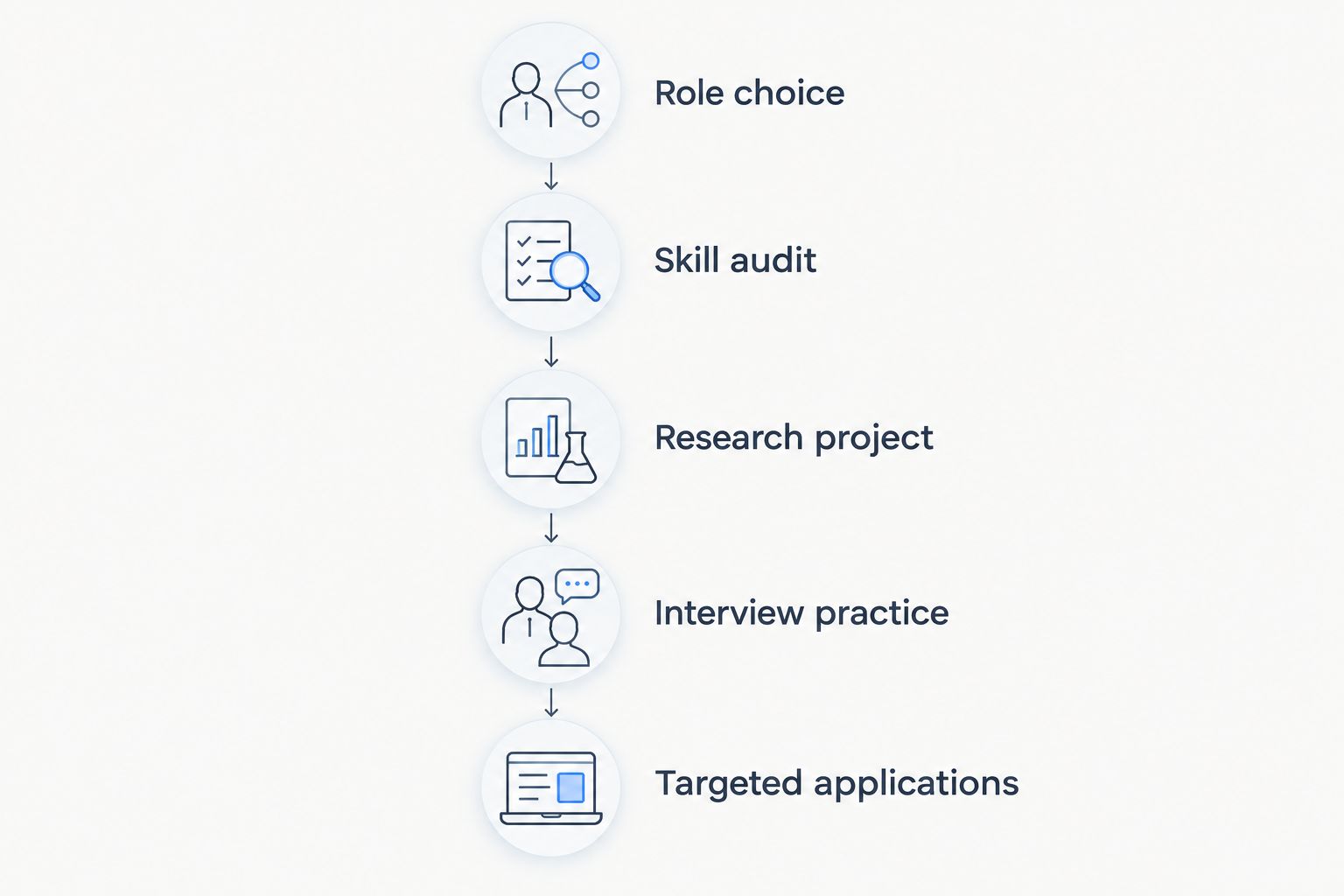
1. Role choice
Collect 3 job descriptions for the same role family. This is a practical starting exercise, not a claim about how many applications produce an offer. Highlight the mathematics, programming, research, and market knowledge each description requests.
Choose the role with the strongest overlap between those requirements and your demonstrated work. Do not combine researcher, trader, and developer requirements into an impossible study list. If the descriptions differ substantially, narrow the team or type of work further.
2. Skill audit
For every requirement, write down something you can demonstrate without following a tutorial. Separate skills you use independently from tools you have only encountered in coursework or someone else’s code.
A useful audit includes deriving a result, implementing a method, explaining an assumption, and diagnosing a failure. Knowing how to call a forecasting library is different from explaining why the model’s validation is appropriate.
3. Research project
Build 1 complete project that exposes your reasoning from question to conclusion. Use public or properly authorized data; do not publish employer data, supplier information, or proprietary code.
Start with a baseline and record what would count as failure before comparing models. Your project should explain the data available at decision time, the evaluation method, and the limitations. A polished notebook without those elements leaves the central research questions unanswered.
4. Interview practice
Practice explaining your project aloud and solving unfamiliar problems without a prepared script. For research, emphasize statistical reasoning and experiment design; for trading, probability and decision reasoning; for development, implementation and software design.
Keep a mistake log. Classify each error as a missing concept, an implementation problem, an unjustified assumption, or an explanation failure. Then repeat the relevant task rather than collecting more study material.
5. Targeted applications
Write an application around the role’s actual work. Keep your official job title, then use the bullets beneath it to show the relevant methods, decisions, and ownership.
For 2026 applications, check each employer’s current requirements directly. Do not assume that a title such as quantitative analyst identifies the same responsibilities across employers. Apply where your evidence matches the work, not merely where the title sounds attractive.
Quantitative research: prove how you test ideas
Best for: supply chain analysts whose strongest work involves statistics, forecasting, or mathematical modeling. The relevant strength is not that you have handled a time series. It is that you can formulate a question, test it honestly, and explain what the result establishes.
Consider demand forecasting. You should be able to explain your baseline, forecast horizon, information cutoff, evaluation metric, and treatment of changing conditions. Distinguish a model that predicts accurately from a model that improves a specific decision.
The limitation is financial interpretation. A relationship in logistics data is not automatically a tradable signal, and a prediction does not establish a strategy’s returns after implementation costs. Do not make either claim unless your analysis supports it.
For a 2026 research portfolio, prioritize an inspectable experiment over an impressive model name. Explain why you chose the method, what simpler approach you compared it with, and where it failed. Negative results belong in the discussion when they change your conclusion.
Quantitative trading: show decisions under uncertainty
Best for: supply chain analysts who enjoy probability, explicit trade-offs, and decisions with incomplete information. Inventory allocation and capacity planning give you examples of choosing an action before uncertainty resolves.
Use those examples carefully. Explain the objective, possible outcomes, constraints, and consequences of being wrong. Show how changing an assumption changes your decision rather than presenting the final answer as inevitable.
The limitation is market context. Managing stock levels is not the same as managing a trading position. Prepare to discuss the market concepts relevant to the actual role, including how prices, orders, and execution affect decisions.
Avoid claiming that operational pressure makes you ready for trading. Instead, demonstrate clear reasoning on unfamiliar probability and decision problems. Your work experience supplies context; your answers supply evidence.
Quantitative development: demonstrate engineering depth
Best for: supply chain analysts whose strongest contribution is reliable software rather than model selection. Data ingestion, optimization services, and analytical tooling provide relevant examples when you designed and maintained the implementation.
Show how the system handles invalid inputs, repeated runs, testing, and failures. Explain which parts you owned and which depended on existing infrastructure. A reviewer should be able to distinguish your engineering decisions from the capabilities of a package you used.
The limitation is depth. A script that automates a spreadsheet task does not establish the same skills as a tested application with maintainable interfaces. Describe the script honestly, then build the missing evidence separately.
Study the languages and systems concepts specified by your target roles. Do not learn a language solely because it appears in generic quant advice while ignoring the requirements of the positions you intend to pursue.
Why the difficulty of the pivot varies
Your starting point matters more than the supply chain label. Assess these factors before committing to a degree, a long study plan, or a broad application campaign:
- Mathematical foundations: Can you explain probability, statistical inference, linear algebra, and optimization rather than just use their outputs?
- Programming ownership: Did you build and debug the analytical workflow, or mainly operate an existing tool?
- Research discipline: Can you defend your baseline, validation design, and conclusions under questioning?
- Target-role fit: Does your strongest evidence match research, trading, or development responsibilities?
- Market understanding: Can you explain how your analytical methods change when the objective becomes a financial decision?
- Clarity of positioning: Does your resume identify your contribution without disguising operations work as investment experience?
These factors provide a better preparation checklist than a universal transition timeline. Set milestones around demonstrated competence, not a promised number of months.
Do I need an MFE before applying?
An MFE is a potential education route, not a substitute for checking the requirements of your target roles. Evaluate it against a specific gap: mathematical preparation, structured financial study, or access to a recruiting process relevant to your goals.
The benefit of structured study is a defined curriculum. The trade-off is the commitment required; a degree does not remove the need to perform in technical interviews or explain your work. Check each program’s current curriculum and admissions requirements directly.
Before making a 2026 enrollment decision, compare the proposed coursework with your skill audit. If the main problem is explaining work you already understand, further education addresses a different problem. If you cannot follow the underlying mathematics, rewriting your resume will not fix that gap.
How should I rewrite my supply chain resume?
Keep your title accurate and organize your bullets around the question, method, validation, and decision. Translate the work; do not inflate it. Include only results you can substantiate and discuss without disclosing confidential information.
Write 2 versions of a relevant experience bullet as an editing exercise. The first should describe the operational task; the second should make the analytical contribution explicit. Keep the facts identical while changing the emphasis.
For example, if you genuinely built a forecasting process, explain the baseline, evaluation approach, and your ownership. Do not add a performance percentage because the bullet looks thin without one. A precise account of your contribution is stronger than an unsupported result.
If you need help deciding what your experience supports, QuantMinds offers resume review, interview preparation, and individual coaching. QuantMinds is a quant finance career coaching firm for students and professionals targeting research, trading, and development roles at hedge funds and prop trading firms. Coaching supports preparation; it does not replace technical competence.
How do I explain the career change in an interview?
Explain why the target work interests you, which relevant skills you already use, and what you have done to close the gaps. Keep the explanation tied to a concrete project or decision rather than a general interest in finance.
Be explicit about what you have not done. If you have never researched a trading strategy, say so and explain the research evidence you do have. That distinction keeps your story accurate and gives the interviewer something substantive to examine.
FAQ
Can I become a quant if my supply chain job is mostly Excel?
You need additional evidence if your experience is mainly spreadsheet reporting. Choose a role, audit its requirements, and demonstrate the relevant mathematics or programming independently.
Is demand forecasting the same as quantitative research?
No—demand forecasting is not the same as financial quantitative research. It provides relevant experience with prediction and validation, but a financial application needs its own objective, assumptions, and evaluation.
Should I target quant research or quant development?
Target research when statistical reasoning and experiment design are your strongest evidence; target development when software engineering is stronger. Compare actual job descriptions before committing to either preparation plan.
Can I use a supply chain project in a quant interview?
Yes, if the project demonstrates skills relevant to the role and you can explain its assumptions and limitations. Use only information you are authorized to disclose, and distinguish your contribution from your team’s work.
Do I need to build a profitable trading strategy before applying?
Do not treat a claimed profitable strategy as a substitute for sound research. A project should make its data, baseline, validation, assumptions, and limitations clear, whether its results are positive or negative.
Can quant finance coaching help with a supply chain career change?
QuantMinds provides quant finance career coaching through resume review, interview preparation, and individual coaching. Use that support to assess and communicate your preparation while continuing to build the technical evidence your target role requires.
One last thing
Your most useful project discussion can start with a failed model. Explaining why a result disappeared after correcting a validation mistake shows what you learned and how you changed the analysis; hiding the mistake removes that evidence.
For your 2026 pivot, choose one piece of work you can defend from data collection through final decision. Build your application around what it proves—and state plainly what it does not.