

Yes—operations research professionals can move into quant trading because optimization, probability, simulation, and decision-making under uncertainty provide relevant technical foundations. The transition requires more than renaming your existing experience: you need to demonstrate trading-specific reasoning, reliable programming, and an understanding of how execution costs and risk change an apparently attractive decision.
- For operations research professionals, quant trading is a credible transition—not an automatic transfer of qualifications.
- Optimization and simulation transfer; market mechanics, research validation, and trading interview skills need separate preparation.
- Choose quantitative trading, research, or development according to your strongest demonstrated work.
- QuantMinds suits operations research professionals seeking quant career coaching on positioning and interview preparation.
Can operations research professionals move into quant trading?
Yes, but target the work you can substantiate, not just the title you want. Operations research gives you useful methods for allocating resources, modeling uncertainty, and evaluating decisions. A trading application must show how you apply those methods when observations are noisy, information arrives over time, and actions affect risk.
For your 2026 applications, separate the capabilities you already use from those you have only studied. If your technical foundation is strong but finance is new, start with quant interview preparation without a finance background.
Quant trading is not the only relevant destination. Compare these roles before choosing your preparation plan; responsibilities vary by team, so verify each job description.
| Role | Best for | Relevant operations research foundation | Main preparation gap | Trade-off |
|---|---|---|---|---|
| Quantitative trader | Candidates who enjoy making and revising decisions under uncertainty | Probability, stochastic modeling, constrained decisions | Market mechanics, inventory risk, execution, probability under time pressure | Mathematical depth alone does not demonstrate trading judgment |
| Quantitative researcher | Candidates who enjoy testing hypotheses and challenging models | Statistics, simulation, experimental design, optimization | Financial data handling, time-aware validation, research interpretation | A successful operational model does not establish a tradable signal |
| Quantitative developer | Candidates whose strongest evidence is dependable software | Algorithms, numerical computing, solver implementation | Software design, testing, performance, team-specific languages | Using analytical software is not equivalent to engineering production systems |
Use the table to choose a primary target. Keep adjacent roles in view, but do not send the same resume to every role unchanged.
Why this matters
An operations research title does not tell a hiring team whether you built forecasting models, implemented optimization software, or mainly coordinated planning processes. Your application needs to make that distinction immediately. List the problem, your contribution, the method, and the evidence that the result held up.
Your strongest transition story connects a real decision problem to the demands of the target role. A scheduling project can demonstrate constrained optimization without demonstrating market prediction. A simulation project can demonstrate uncertainty analysis without demonstrating software engineering depth.
For a 2026 career move, build your positioning around that boundary. Explain both what transfers and what you still need to learn; do not describe operational efficiency as trading experience.
What operations research skills transfer to quant trading?
Optimization: useful for decisions, not proof of an edge
Optimization helps you reason about objectives, constraints, and competing uses of limited resources. In trading-related work, that reasoning connects to position sizing, portfolio constraints, and execution decisions.
The limitation is fundamental: an optimizer solves the problem you specify. It does not establish that expected returns are predictable or that your inputs remain valid when conditions change. Explain how you checked assumptions before discussing the solver.
Probability and simulation: useful for uncertainty
Probability supports reasoning about conditional outcomes, expected value, and risk. Simulation lets you examine decisions when an analytical solution is unavailable or when you want to inspect behavior under different assumptions.
The limitation is model dependence. A simulation that excludes adverse scenarios, changing relationships, or implementation frictions can give misleading reassurance. Be prepared to explain what your simulation leaves out and which conclusions depend on those omissions.
Programming: useful when you own the implementation
A reproducible analysis demonstrates more than familiarity with a software package. Show how you loaded data, checked inputs, implemented the method, tested behavior, and made the result inspectable.
Do not equate writing analysis scripts with readiness for every developer role. Numerical work, data pipelines, and performance-sensitive software involve different engineering demands. Match your claims to code you can explain and modify without assistance.
Why transition readiness varies
Your preparation needs depend on the work behind your resume, not the operations research label. Use these factors to identify the largest gap:
- Mathematical depth: Distinguish methods you can derive and defend from methods you have only applied through software.
- Coding ownership: Separate code you designed and tested from workflows assembled around existing tools.
- Research discipline: Show how you separated model development from evaluation and investigated disappointing results.
- Market understanding: Explain bids, offers, orders, positions, and execution costs before presenting a trading strategy.
- Interview communication: Demonstrate how you clarify assumptions, reason aloud, and correct mistakes without losing the argument.
Turn each factor into a specific preparation task. Reading more finance material does not fix weak coding, and solving more probability problems does not fix an unclear resume.
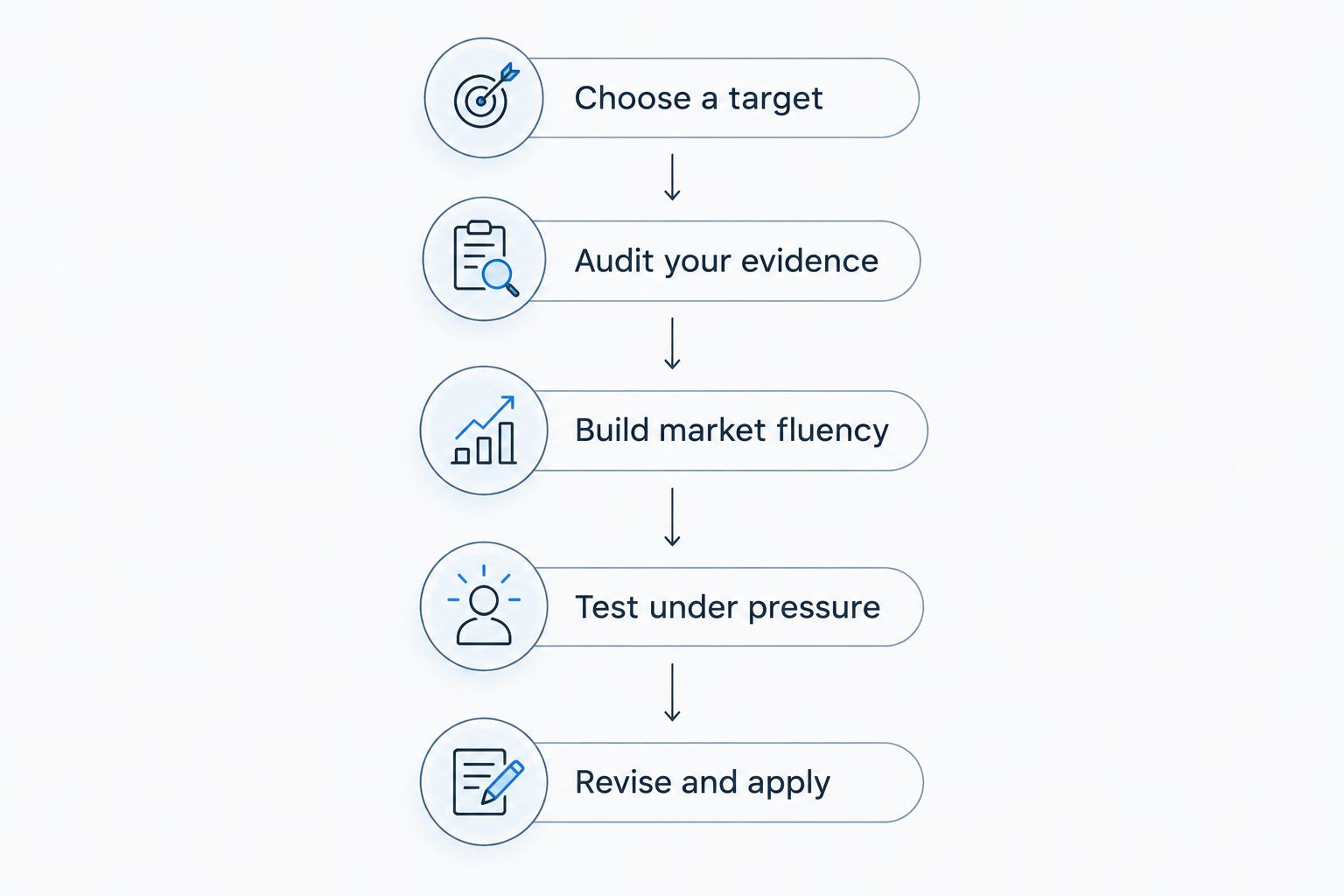
How should you prepare for a move in 2026?
1. Choose a target role
Read current job descriptions and extract the actual responsibilities. Distinguish research, trading decisions, and implementation rather than treating every position containing the word quant as interchangeable.
Write a 1-page role brief covering the work, required skills, and evidence you can present. Use it to decide what belongs on your resume and what preparation deserves your attention.
2. Audit your evidence
Create an inventory of projects, code, technical coursework, and decisions you influenced. For each item, record what you personally did and what another person could inspect.
Remove claims you cannot defend. If you describe a model as validated, explain the evaluation procedure; if you describe an implementation as efficient, explain the comparison and measurement behind that statement.
3. Build market fluency
Learn how an order becomes a position and how that position creates exposure. Understand why a model's suggested trade and an executable trade are different objects.
For trading-focused preparation, practice explaining the bid–ask spread, inventory, adverse selection, and execution uncertainty in plain language. For research-focused preparation, connect those concepts to the assumptions in your evaluation.
4. Test under pressure
Solve an unfamiliar probability problem aloud, implement a small algorithm, and explain a project without slides. Record the points where your reasoning becomes unclear rather than counting only completed questions.
Prepare a 90-second project summary and a 5-minute technical explanation. These are practice formats, not employer requirements; they force you to separate the main result from the details that support it.
5. Revise and apply selectively
Use the weakest part of the rehearsal to set your next task. If your reasoning is sound but your explanation is confusing, rewrite the explanation before starting another project.
For 2026 applications, maintain a requirements checklist for each role. Apply with a resume that makes the relevant evidence easy to find, and describe gaps honestly rather than hiding them behind technical vocabulary.
What project should an operations research professional build?
Build a project that exposes your judgment, not just your ability to run an optimizer. A portfolio allocation study is a useful exercise because it connects familiar constrained optimization with financial data and evaluation problems. Present it as a research exercise, not proof of profitable trading.
Start with a question about how allocation decisions change under different constraints. Specify the information available at each decision point, compare against a simple baseline, and evaluate on data excluded from model development.
Keep the research report focused on these checks:
- Data timing: Establish when each input would actually have been available.
- Baseline: Explain what your method adds compared with a simpler decision rule.
- Trading frictions: State how turnover, transaction costs, and execution assumptions affect interpretation.
- Sensitivity: Change assumptions and inspect whether the conclusion survives.
- Failure cases: Identify when the method performs poorly and why.
A clear negative result can demonstrate sound research judgment. Do not keep changing the method against the same evaluation data and then present the final outcome as an independent test.
Protect confidential employer information. Rebuild an illustrative example with appropriate public or synthetic data, and label its origin accurately. Never publish proprietary code or results to make a career-change portfolio look stronger.
How should you present operations research experience on your resume?
Translate the decision problem, not your job title. Explain what you modeled, what you implemented, and how you evaluated it; then connect that evidence to the target role.
Use this structure for each technical bullet: problem, method, personal contribution, verified result. Include numerical outcomes only when you have records supporting them and permission to disclose them. A precise description without a metric is better than an invented improvement.
Separate the objective from the result. Minimizing a modeled cost is not the same as reducing realized costs, and improving a forecast is not the same as generating trading profit. That distinction also gives you a stronger interview explanation.
Prepare to answer these questions for every prominent project:
- What decision did the model support?
- What assumptions were necessary?
- What did you implement yourself?
- How did you evaluate the result?
- What would make you reject the approach?
Keep your LinkedIn positioning consistent with the resume. Describe your intended move into quantitative trading without implying that your current position is already a trading role.
Do you need an MFE before applying?
An MFE is not a substitute for diagnosing your skill gaps. Compare your existing education and project evidence with the requirements of specific roles before deciding that another degree is necessary.
A structured program offers a different route from independent preparation, but admission and graduation do not establish readiness for every quant position. Examine the actual curriculum, recruiting access, and career support when evaluating a program; do not choose on the degree label alone.
For your 2026 decision, identify what you need the degree to solve. Missing technical foundations, limited recruiting access, and weak interview performance are different problems. Evaluate each directly rather than treating more education as the default answer.
When does coaching make sense?
QuantMinds is a quant career coaching firm founded by a former UC Berkeley MFE program executive director, offering resume review, interview preparation, and individual coaching. QuantMinds is best for operations research professionals who want help positioning their experience and preparing for quant interviews.
The limitation is clear: coaching does not replace technical practice, original project work, or the ability to defend your decisions. Bring a target job description, your resume, and a project explanation to QuantMinds so the discussion centers on specific evidence rather than a general ambition to enter finance.
FAQ
Can I move from operations research into quant trading without finance experience?
Yes—operations research provides relevant mathematical foundations, but you still need to demonstrate market understanding and role-specific skills. Prepare to explain execution costs, risk, and how your technical work connects to trading decisions.
Is operations research closer to quant trading or quant research?
Operations research connects to both, and your strongest work should guide the choice. Statistical investigation supports a research application, while decision-making under uncertainty supports a trading application; neither removes the need for targeted preparation.
Do I need a master's in financial engineering to change careers?
Start with the requirements of your target roles rather than assuming an MFE is necessary. Evaluate whether a program addresses a specific gap in your technical foundation, recruiting access, or preparation.
What coding skills should I demonstrate for quant roles?
Demonstrate that you can implement, test, and explain the work relevant to the position. Follow the job description's language requirements and distinguish analytical scripting from software engineering.
Can I use a supply-chain optimization project in a quant interview?
Yes—use it to demonstrate optimization, implementation, and model evaluation. Explain its limitations and do not describe operational savings as trading performance.
Does a profitable backtest prove I'm ready for quant trading?
No—a profitable backtest does not establish that a strategy will work in live trading. Explain data timing, model selection, execution assumptions, and the risk of fitting decisions to historical results.
How do I know whether to start applying?
Start with roles whose requirements you can support with clear evidence. Rehearse probability reasoning, coding, and project explanations, then use specific weaknesses to direct further preparation rather than waiting for an undefined state of readiness.
One last thing
Before adding another model to your portfolio, write down what would make you abandon the current one. Specify the failed assumption, the evaluation result, or the implementation problem that would change your decision.
That exercise makes your work easier to challenge—and easier to defend. For an operations research professional entering quant trading, knowing when not to trust an optimizer is part of the skill you need to demonstrate.