

Yes—financial advisors can transition into quant research roles, but advisory experience alone does not establish research readiness. You need evidence that you can formulate a testable question, analyze data with code, and defend your statistical reasoning. Your market knowledge provides context; it does not replace mathematics, programming, or research work.
- Financial advisors transitioning into quant research need demonstrable statistics, programming, and research skills—not just investment knowledge.
- Choose direct applications, an analytical bridge role, or graduate study according to your current technical evidence.
- Build a reproducible research project before presenting yourself as a quantitative researcher.
- QuantMinds fits career changers seeking quant finance resume review and interview preparation; coaching does not replace technical training.
Can financial advisors transition into quant research roles?
Yes, but make the decision from your technical starting point—not your advisory title. An advisor with quantitative training and independent research faces a different task from an advisor whose work centers on relationship management and financial planning.
For your 2026 transition plan, separate investment familiarity from research evidence. Discussing asset allocation demonstrates a different skill from estimating a model, testing its assumptions, and explaining why its apparent predictive power disappears outside the development sample.
QuantMinds provides quant finance career coaching, resume review, and interview preparation. Its founder previously served as executive director of UC Berkeley's MFE program; that background is relevant when weighing a recruiting strategy against graduate study, not a substitute for the technical work itself.
Start by comparing these routes:
| Route | Best for | Advantage | Limitation |
|---|---|---|---|
| Direct research applications | Advisors with existing quantitative training and defensible research | Lets you present evidence you already have | Advisory achievements alone do not demonstrate research ability |
| Analytical bridge role | Advisors who need applied coding and modeling experience | Provides a route toward more relevant work | A finance-related title does not guarantee research responsibilities |
| Quantitative graduate study | Advisors who need structured technical education | Provides a setting for deeper mathematical and computational work | A degree does not establish that you can conduct independent research |
These are planning options, not a required sequence. Choose the route that addresses your actual gap.
Why this matters
A transition into quant research changes what you must demonstrate. Client communication, investment explanations, and business development remain legitimate accomplishments, but they do not answer whether you can investigate a hypothesis with data.
That distinction should shape your preparation in 2026. Rewriting your resume before assessing your technical skills risks producing stronger language without stronger evidence. Start with the work you want to do, then build the evidence that supports it.
What transfers from financial advisory work?
Your advisory background gives you material to build on. Use it accurately rather than trying to turn every responsibility into quantitative research.
- Investment context: Understanding portfolios and risk helps you formulate economically meaningful questions. It does not prove that your proposed explanation survives statistical testing.
- Communication: Explaining investment decisions gives you practice making complex ideas understandable. Research communication also requires explicit assumptions, uncertainty, and limitations.
- Decision discipline: Working within client constraints can inform how you think about practical implementation. A research project still needs its own evidence about implementation assumptions.
- Professional experience: Accountability and collaboration belong in your career narrative. Keep them separate from claims about technical competence.
For example, explaining diversification to a client and estimating a covariance matrix are related subjects, not equivalent tasks. If you performed both, describe both. If you only performed the first, do not imply the second.
Keep your advisory achievements, but stop asking them to prove skills they do not demonstrate.
Direct applications: when you already have research evidence
Best for: advisors who can already explain and reproduce quantitative work. Direct applications make sense when your background includes substantive mathematics, programming, and research that matches the role you are targeting.
Assess that match against actual job descriptions. Select 3 job descriptions as a starting exercise, then identify the recurring methods, programming requirements, and research responsibilities. This is a practical comparison set, not a hiring threshold.
The advantage is focus: you spend preparation time strengthening relevant evidence instead of pursuing another credential by default. The limitation is equally clear: a polished portfolio cannot compensate for an inability to explain its underlying methods.
For your 2026 applications, lead with the strongest relevant project or analytical experience. Do not lead with enthusiasm for markets and leave the technical evidence for the interviewer to discover.
Analytical bridge roles: when you need applied experience
Best for: advisors who need more experience using code and statistical methods in real work. Consider portfolio analytics, investment risk, or research-support responsibilities according to what the work actually involves.
The benefit is practical exposure to analytical problems. The drawback is that an adjacent position can remain adjacent: reporting, client support, and model development are different activities, even when they share a department.
Before pursuing a bridge role, ask:
- Will you write code or mainly operate existing tools?
- Will you investigate models or mainly distribute their outputs?
- Will you work with researchers who can critique your analysis?
- Can you describe the technical work afterward without disclosing confidential information?
Evaluate responsibilities, not titles. A bridge role is useful for this transition only when it develops evidence relevant to the research work you want.
Graduate study: when your foundations need rebuilding
Best for: advisors who need structured mathematical and computational preparation. An MFE or another quantitative graduate degree deserves consideration when independent study has left substantial gaps.
The advantage is a structured setting for technical development. The limitation is that enrollment and graduation are not the same as research readiness; you still need to understand methods, implement them, and explain your decisions.
Evaluate programs against your intended work rather than the degree label alone. Examine mathematical preparation, computational assignments, research opportunities, and the recruiting information each program publishes.
For a 2026 decision, verify current admissions requirements directly with the program. Do not assume an advisory background satisfies technical prerequisites, and do not assume graduate study is necessary merely because you are changing careers.
How should you build evidence for a quant research transition?
Build 1 research project that you can explain from question to conclusion. This is a starting recommendation, not a claim that a single project secures an interview or offer.
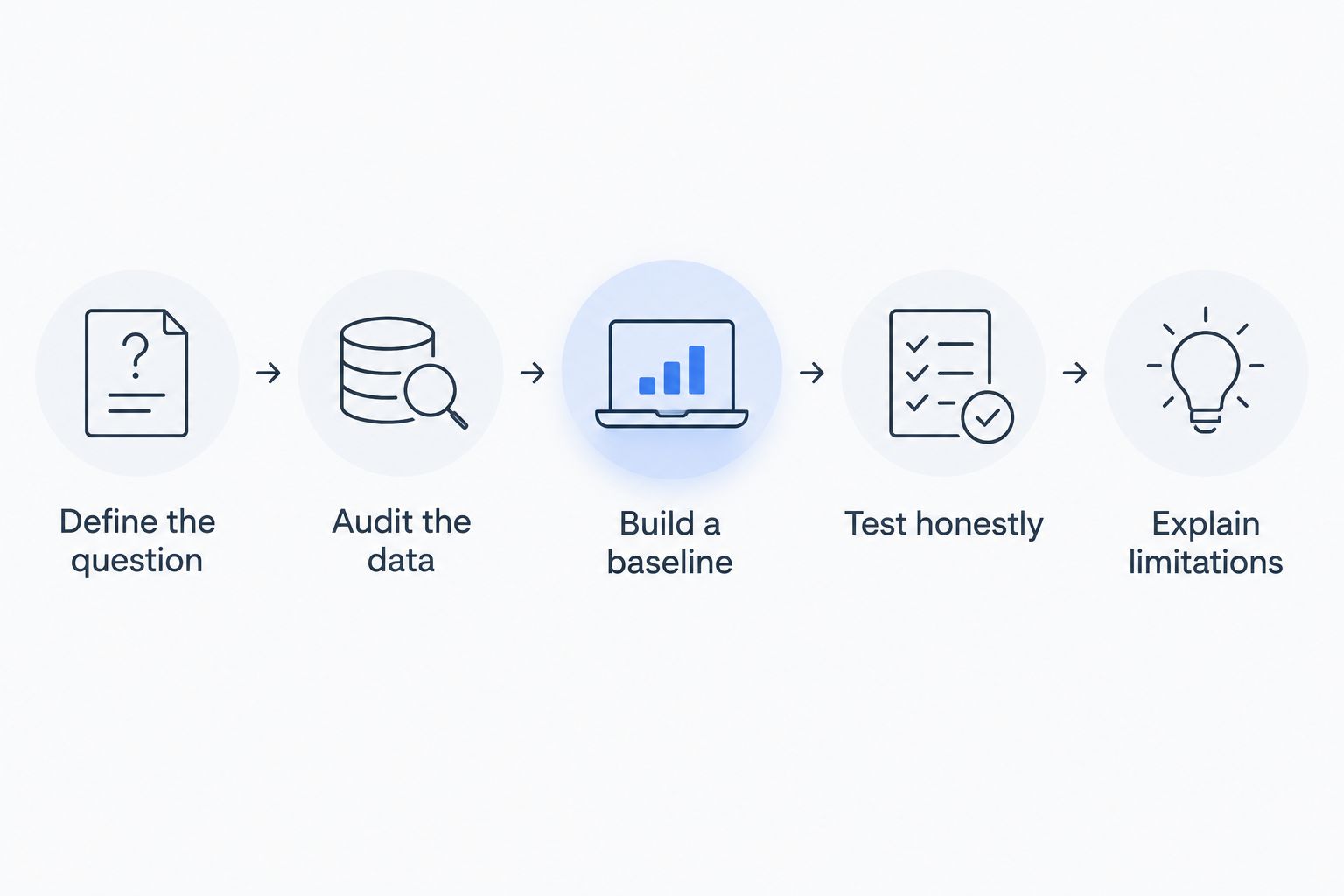
Use the following sequence to make that project inspectable rather than merely impressive-looking.
- Define the question. State what you want to test and why it has an economic rationale. Specify what result would count against your hypothesis.
- Audit the data. Document sources, missing observations, transformations, and when information became available. Never use confidential client data or employer materials without authorization.
- Build a baseline. Start with a simple comparison before introducing a more complicated model. Explain what the additional complexity is supposed to accomplish.
- Test honestly. Separate model development from evaluation. For forecasting work, preserve the time ordering so future information does not enter an earlier prediction.
- Explain limitations. Identify fragile assumptions, unsuccessful tests, and the circumstances under which you would reject the result.
A hypothetical project could examine whether a portfolio characteristic helps explain subsequent outcomes. Label it as your independent research, state the data limitations, and avoid presenting a historical association as a dependable trading opportunity.
If your project simulates trading, discuss transaction costs and execution assumptions. If it estimates a statistical relationship, distinguish association from causation. These limitations belong beside the result, not hidden at the end of a notebook.
Why the difficulty of the transition varies
The financial advisor label does not reveal your technical starting point. Assess these factors individually rather than treating all career changers as equivalent:
- Mathematical foundation: Probability, statistics, linear algebra, and calculus provide tools for understanding quantitative methods.
- Programming independence: Writing and debugging an analysis demonstrates more than running a supplied notebook.
- Research judgment: Choosing a sensible test and recognizing weak evidence matter alongside implementation.
- Target-role fit: Compare your preparation with the methods and responsibilities named in each position.
- Demonstrable work: Coursework, professional analysis, and independent projects provide different kinds of evidence; describe each accurately.
Use this assessment to set priorities. If you cannot explain a regression assumption, adding another model to your project is not the next move. If your methods are sound but your resume hides them, presentation becomes the more immediate problem.
How should you explain the career change on your resume?
Present the transition as a move toward demonstrated research work, not an escape from client-facing work. Keep your employment history accurate and give relevant technical evidence enough space to be evaluated.
A project description should identify the question, data, method, evaluation design, and limitation. Do not invent performance figures to make it appear more substantial. A clearly explained negative result is more defensible than a favorable result produced by a flawed test.
For your 2026 resume, distinguish between work you completed independently and work produced by a team. List programming skills you can demonstrate, and do not rename an advisory position to resemble a research appointment.
QuantMinds is best suited to career changers seeking quant finance resume review and interview preparation, rather than a replacement for technical education. Its coaching can address how you present your background; you must still supply the underlying work.
Do financial advisors need an MFE to become quant researchers?
An MFE is a preparation route, not a universal requirement or a hiring guarantee. Read the education requirements of the specific roles you want and compare them with your existing technical evidence.
Graduate study addresses a different problem from resume positioning. If you need mathematical foundations, changing your wording will not solve that gap; if you already have substantial research training, another degree should have a clearly defined purpose.
How long should financial advisors prepare before applying?
Apply when your evidence matches the role, not when an arbitrary study period ends. Use a 2-minute project explanation as a practice exercise, then test whether you can answer detailed questions about every method and assumption you mention.
Do not treat that exercise as a recruiting standard. Its purpose is to expose weak understanding before an interviewer does.
FAQ
Can I move from financial advising into quant research without another degree?
Yes, you can pursue quant research without another degree when the role's requirements and your existing qualifications align. You still need demonstrable mathematical, programming, and research ability; advisory experience alone does not establish those skills.
Does managing client portfolios count as quantitative research?
Managing client portfolios does not automatically count as quantitative research. Describe any modeling, statistical testing, or code you personally produced, and distinguish that work from portfolio recommendations and client communication.
Is Python enough to make the transition into quant research?
Python alone does not establish quant research readiness. You also need to understand the mathematics, statistical assumptions, data decisions, and evaluation methods behind your code.
Should I quit financial advising before preparing for quant research?
Do not make resignation your first preparation step. Assess your technical gaps, test your interest through independent research, and evaluate your personal financial commitments before deciding whether to leave your role.
Can I use client portfolio data in a research project?
Do not use client portfolio data without the required authorization. Use appropriately licensed public data or clearly identified synthetic data when you cannot establish permission to use confidential materials.
What should I be ready to discuss in a quant research interview?
Be ready to explain your research question, mathematical reasoning, code, evaluation design, and limitations. Prepare against the specific role description rather than assuming every quant research interview tests the same material.
One last thing
A failed hypothesis can produce a useful research discussion. If you explain why an apparent effect disappeared after correcting a data problem or changing the evaluation design, you demonstrate how you assess evidence—not just how you produce charts.
Before sending your next application, ask whether your project shows that judgment. Your strongest transition narrative is not that you already understand finance; it is that you can investigate a financial question rigorously and explain what the evidence does not support.