

Interviewers at quant funds grade research-project answers on compression, not completeness: can you state the question, the method, the result, and the limitation in under two minutes, or do you disappear into methodology and never land the punchline.
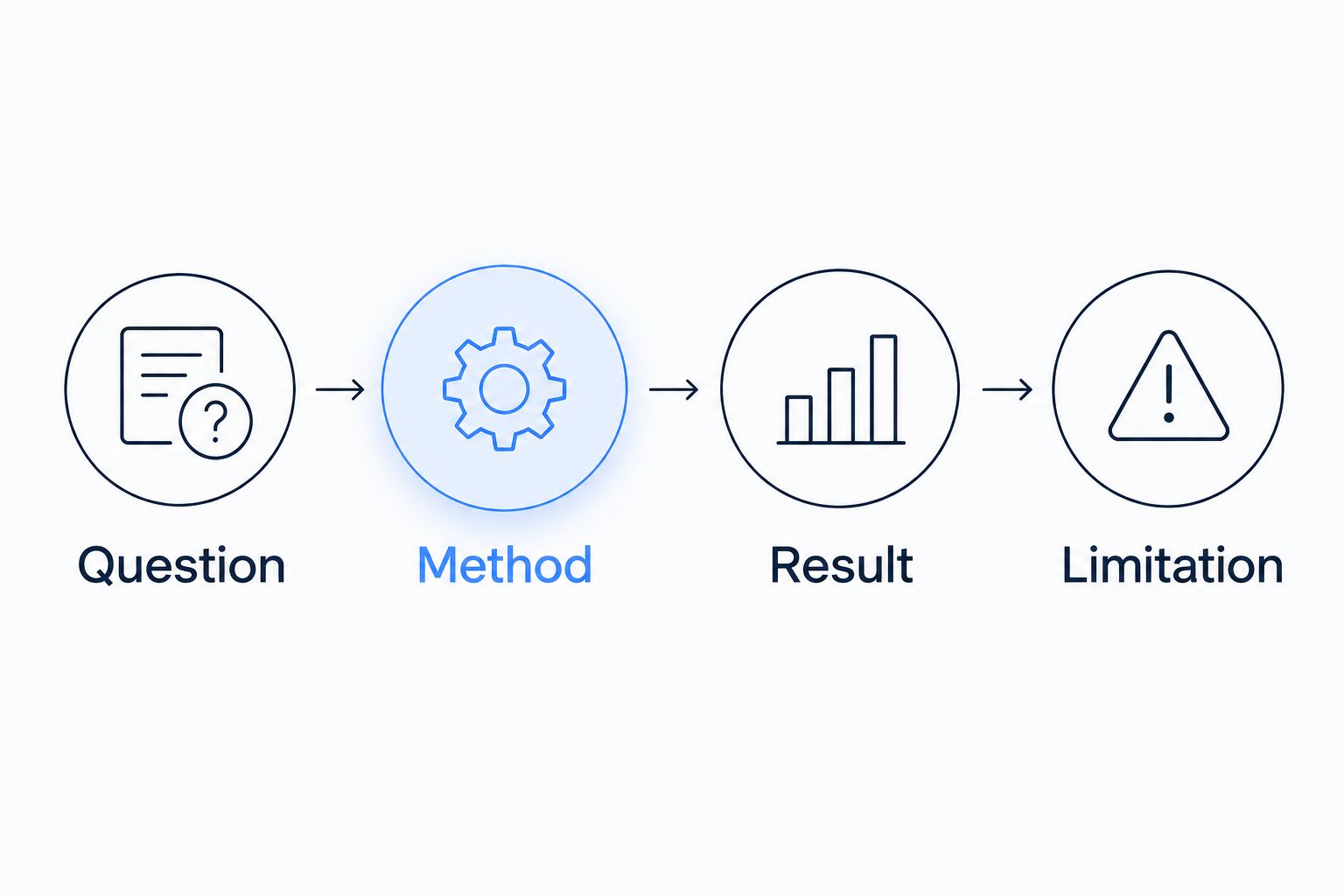
The strongest way to explain a research project in a quant interview is a four-part structure delivered in that exact order: the question you set out to answer, the method you used, the result, and what you would change with more time or data. Candidates who fail this question usually have strong projects — they just bury the finding under hyperparameter details the interviewer never asked for. A QuantMinds coaching session exists specifically to catch that pattern before it costs you a callback.
- Explaining a research project in a quant interview means leading with the question and result, not the methodology, in under two minutes.
- Use four beats in order: question, method, result, limitation — interviewers in 2026 expect this shape by default.
- Skip hyperparameter dumps and library names; panels probe for judgment, not recall.
- A failed or null result is a strong answer if you explain why the method was still correct.
- Rehearsing out loud against a timer catches the rambling this question exposes fastest.
Why this matters
Most quant candidates practice probability brain teasers and coding drills and treat the research-project question as an afterthought — something they'll just "talk through." That's a mistake, because it's often the only open-ended question in the entire loop, and it's the one interviewers use to judge whether you can think like a researcher rather than execute like a student.
A rambling answer signals you can't prioritize under time pressure, which is exactly the skill a trading desk or research team needs from you daily. A tight answer, on the other hand, does double duty: it proves technical competence and communication discipline in the same sixty seconds.
How to explain a research project in a quant interview
Run the explanation in this order every time, regardless of whether the project was academic, a Kaggle competition, or work-related:
- State the question in one sentence. "I wanted to know whether order-flow imbalance predicted short-horizon returns in equity futures." No setup, no backstory.
- Name the method in one or two sentences. Data source, model class, and the core assumption you tested — not every library or parameter you touched.
- Give the result as a number or a direction. "The signal held out-of-sample but decayed after roughly five minutes" beats "it worked pretty well."
- State the limitation and what you'd do next. This is the sentence that separates candidates who understand their own work from candidates who memorized a script.
Stop there unless the interviewer asks a follow-up. Most candidates keep talking past the fourth beat and dilute a sharp answer with hedging.
Explaining an academic or coursework research project
Academic projects carry a specific risk: interviewers assume you had an advisor pointing you toward the answer, so they probe for what was actually yours. Be explicit about which part of the project was your design choice versus your advisor's suggestion.
Keep the theory light. A quant interviewer already knows what a GARCH model or a random forest does — they want to hear why you picked it over the alternative, and what broke when you tried the simpler version first.
Explaining a self-directed or Kaggle project
Self-directed projects, including Kaggle competitions, get more scrutiny on the "why did you choose this problem" front, because there's no advisor or employer forcing the topic. Lead with the motivation in a single clause, then move straight into the four-beat structure above.
Leaderboard rank matters less than most candidates think. An interviewer would rather hear that you diagnosed a leakage bug that cost you three ranks than hear a bare final placement with no story behind it. The GitHub portfolio to quant developer interview workflow covers how to package this kind of project so the code backs up the story instead of contradicting it.
Explaining a professional or work research project
Work projects come with confidentiality constraints, which candidates over-apply out of caution. You can almost always describe the question, the method class, and the directional result without naming the employer's proprietary strategy or client.
If pressed for a number you can't disclose, give a defensible substitute — "the improvement was in the high single digits as a percentage of baseline" — rather than refusing to answer, which reads as evasive rather than compliant.
Why answers to this question vary so much
Not every panel is grading the same thing, and the right amount of detail depends on a few factors:
- Role type — a research role probes methodology depth; a trading role probes speed to a tradeable conclusion.
- Seniority of the interviewer — a junior interviewer often wants technical detail; a portfolio manager wants the business implication.
- Time remaining in the interview slot — a five-minute segment gets the compressed version; a full technical round can go deeper on request.
- Whether the project relates to the desk's strategy — expect harder follow-ups when your project overlaps with what the team actually trades.
- Fund culture — systematic funds tend to drill into statistical rigor; discretionary shops care more about the narrative and judgment behind the call.
“If you can't state your result in one sentence, you don't understand it well enough to defend it under follow-up questions.”
How long should you spend explaining a research project?
Under two minutes is the target for the initial answer in a quant interview in 2026, with the four-beat structure filling that window comfortably. Anything past two minutes without an interviewer prompt usually means you've drifted into methodology detail nobody asked for. Save the deeper technical explanation for follow-up questions, where it belongs.
Should you bring a slide or code sample to reference?
Bring a one-page summary or a link to a repository if the interview format allows it, since it shows preparation without requiring you to read from it. Most quant interviews, especially first-round phone screens, don't leave room for a shared screen, so treat the written version as backup material rather than the primary delivery method.
What if the project failed or produced no usable signal?
A null result is still a strong answer if you can explain why the method was sound and what the negative finding ruled out. Interviewers often trust a well-reasoned failure more than a suspiciously clean success, because it shows you understand what a real result looks like versus overfitting. Frame the "limitation" beat as the finding itself rather than an apology.
Do I need a finance-specific project to answer this well?
No — the four-beat structure works identically for a physics thesis, a Kaggle housing-price model, or a trading signal, because interviewers are grading structure and judgment, not domain overlap. If your project has no obvious finance angle, spend one extra sentence connecting the underlying skill (causal inference, time-series validation, optimization) to a trading or risk use case.
Candidates preparing for this question alongside probability brain teasers and coding rounds often underestimate how much of the loop is unstructured. The how to answer probability brain teasers in quant interviews guide covers the more scripted half of the loop; the research-project question is where preparation pays off precisely because it's open-ended.
Get your answer stress-tested before the interview
A QuantMinds session reviews your project pitch and timing in one 1-on-1 call.
FAQ
What's the best way to open the answer?
Open with the research question in one sentence, not a preamble about background or motivation. Interviewers grading a quant interview in 2026 want the question first, everything else second.
Is it better to talk about one project deeply or mention several?
One project explained well beats three mentioned briefly, since depth on follow-up questions is what actually gets tested. Pick the project most relevant to the desk you're interviewing with.
How much statistical detail should I include upfront?
Name the method class and the core assumption tested, then stop unless asked for more. Full derivations and hyperparameter lists belong in follow-up answers, not the opening explanation.
Should I mention the tools or libraries I used?
Only if asked directly, since tool names rarely add to the judgment an interviewer is trying to assess. Mentioning Python or a specific library unprompted signals you're padding the answer.
What if the interviewer interrupts with a follow-up mid-explanation?
Answer the follow-up directly, then return to wherever you were in the four-beat structure rather than restarting. Interruptions are often a test of whether you can hold the thread of your own explanation.
Can I use a project from a class instead of independent research?
Yes, a coursework project works as long as you're specific about which decisions were yours versus the assignment's requirements. Interviewers discount projects that sound entirely advisor-directed.
How do I connect a non-finance project to a trading role?
State the underlying skill explicitly — time-series validation, causal inference, optimization under constraints — then tie it to a trading or risk use case in one sentence. Don't force a finance narrative onto a project that doesn't have one.
Does the answer change for a quant researcher role versus a quant trader role?
Yes: a researcher role rewards more methodological rigor in the follow-up, while a trader role rewards how fast you get to a decision the result supports. Adjust the depth of your follow-up answers accordingly, not the opening four-beat structure.
One last thing
Record yourself explaining the project out loud with a stopwatch running before the interview — most candidates who go over two minutes have no idea they're doing it until they hear the playback. The gap between a hire and a pass on this question is rarely the quality of the project; it's whether the candidate can stop talking once the four beats are done.