

Two weeks is enough time to prepare for a quant interview if you sequence the work correctly: probability and mental math come first, technical coding second, and timed mock interviews close out the sprint. The mistake most candidates make is spending the first week on resume polish and behavioral answers when the interview itself is decided by speed under pressure, not by how the resume reads.
- Two weeks is enough to prepare for a quant interview if you sequence probability, coding, and mock interviews in that order.
- Days 1-6 go to probability and mental math, not resume or LinkedIn cleanup.
- Mock interviews under a timer matter more in the final week than another brain teaser book.
- Quant researcher, quant developer, and quant trader interviews need different weighting inside the same 14 days.
Why this matters
Quant interviews in 2026 still run on the same core test: can you solve probability and math problems out loud, fast, while someone watches. Two weeks doesn't give you time to build math intuition from zero, but it's plenty of time to sharpen what you already know and cut the wasted motion most self-prep candidates fall into. Quant interview coaching exists specifically to compress that triage into a plan instead of a guessing game, but the sequencing below works whether you're doing it alone or with a coach.
The firms hiring quant researchers, quant developers, and quant traders in 2026 all test differently, and a 14-day plan that ignores which track you're on wastes days you don't have.
How to prepare for a quant interview in two weeks
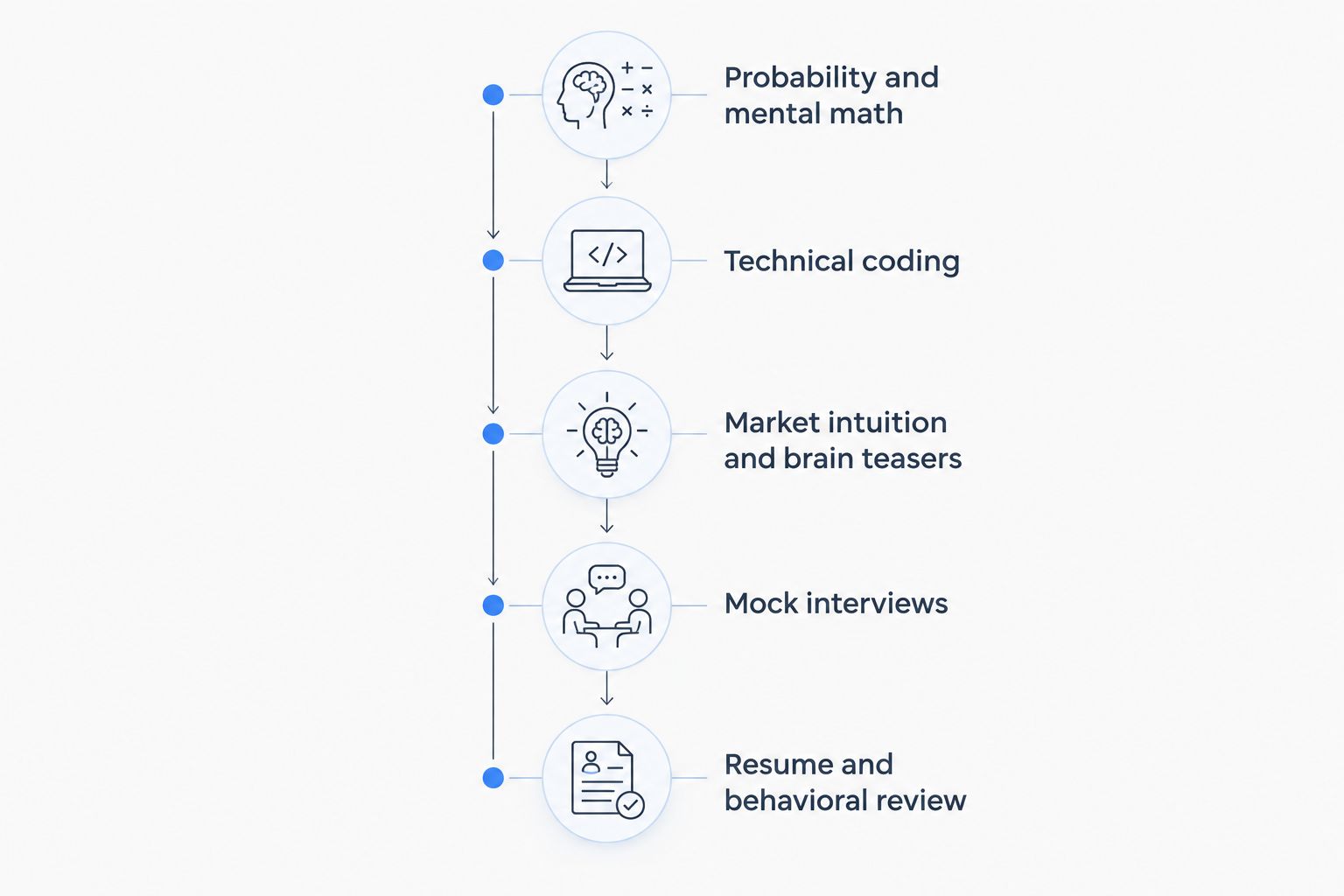
The fastest path through a 14-day window follows a fixed order: probability and mental math first, coding second, market intuition and brain teasers third, mock interviews fourth, and behavioral and resume review last. Each block below assumes daily focused study, not passive review.
| Days | Focus | What to do |
|---|---|---|
| Day 1-3 | Probability and mental math | Drill conditional probability, expected value, and combinatorics problems out loud, timed |
| Day 4-6 | Technical coding | Work through data structures and algorithm problems in your primary language, whiteboard style |
| Day 7-9 | Market intuition and brain teasers | Practice pattern-recognition puzzles and basic market-making logic, not memorized answers |
| Day 10-12 | Mock interviews | Run full timed sessions with a partner or coach, including the pressure of talking through your work |
| Day 13-14 | Resume, behavioral, and review | Tighten your "why this firm" answer and review weak spots flagged in mock sessions |
Quant researcher interviews
Quant researcher rounds lean heaviest on statistics, probability, and modeling logic, so the first six days of the plan above should get extra time if that's your track. Interviewers care more about how you reason through an ambiguous statistics problem than whether you land the exact number.
Quant developer interviews
Quant developer interviews shift weight toward the coding block: expect live coding, system design questions, and sometimes a take-home extension. Passing a quant developer coding interview depends more on fluency under a whiteboard than on knowing an obscure algorithm, so days 4-6 should include timed, verbal coding practice, not silent LeetCode grinding.
Quant trader interviews
Quant trader interviews front-load mental math and market intuition; the mental math has to be near-instant, not just correct. If you're on this track, push an extra day from the coding block into days 7-9.
Why two weeks feels tight
A handful of specific factors make the 14-day window harder than it looks on paper:
- Speed is graded, not just correctness — a right answer delivered slowly reads as a wrong answer in most quant interview loops.
- Brain teaser pattern recognition takes reps, not reading. Working through probability brain teasers builds the pattern library faster than reading solved examples once.
- Coding rounds test live fluency, and most self-taught prep happens silently, which doesn't train the talking-while-coding muscle interviews actually require.
- Market intuition can't be crammed from a book in a weekend — it needs exposure to the type of question, repeated across several days.
- Mock interview partners are scarce, and most candidates wait until the last two or three days to find one, which is exactly backward.
- Behavioral prep gets skipped entirely under time pressure, even though a weak "why this firm" answer can sink an otherwise strong technical round.
Get a fast read on your prep gaps
A short session flags where your two-week plan is weakest before interview day.
Related questions
Is two weeks enough time to prepare for a quant interview?
Two weeks is enough time if you sequence probability and coding before mock interviews, but it's not enough time to build math fundamentals from scratch. Candidates coming from a strong quantitative background (math, physics, engineering, or a quant-adjacent MFE program) can move through the plan above at full speed; candidates without that base usually need closer to a month.
What should I prioritize in the last three days before a quant interview?
The last three days before a quant interview should go to mock interviews and rest, not new material. Cramming new probability formulas on day 13 rarely helps — reviewing the specific mistakes flagged in your mock sessions does.
Do quant interviews differ between hedge funds and prop trading firms?
Quant interviews differ meaningfully between hedge funds and prop trading firms: prop shops tend to weight mental math and quick brain teasers more heavily, while hedge fund quant researcher roles lean into statistics and modeling depth. A two-week plan should shift its day allocation based on which type of firm is on the calendar.
FAQ
How to prepare for a quant interview in two weeks?
Prepare for a quant interview in two weeks by working probability and mental math first (days 1-3), coding second (days 4-6), market intuition and brain teasers third (days 7-9), mock interviews fourth (days 10-12), then resume and behavioral review last. Skipping the mock interview block until the final days is the most common way candidates waste the sprint.
Can you get a quant job with only two weeks of interview prep?
Yes, candidates with a strong quantitative background land quant offers off two weeks of focused prep in 2026, but the prep has to be sequenced, not evenly split. Candidates without prior exposure to probability brain teasers or live coding rounds usually need more runway.
What is the hardest part of a quant interview to prepare for in two weeks?
Market intuition is the hardest part to prepare for in two weeks because it depends on exposure to a style of question rather than memorized formulas. Probability and coding respond well to focused drilling; market intuition responds better to repeated timed exposure spread across several days.
Should I do mock interviews or study more brain teasers in the final week?
Mock interviews matter more than additional brain teasers in the final week, because most quant interview failures come from freezing under timed pressure, not from lacking one more puzzle in the memory bank. Book mock sessions by day 8 or 9 of a two-week plan, not day 12.
How is preparing for a quant developer interview different from a quant researcher interview?
Preparing for a quant developer interview shifts prep weight toward live coding and system design, while a quant researcher interview weights statistics and modeling reasoning more heavily. Both tracks still need the same probability and mental math foundation in the first week.
Does a two-week prep plan work for quant trader roles at prop trading firms?
A two-week prep plan works for quant trader roles at prop trading firms if mental math and market intuition get extra days pulled from the coding block. Prop trading interviews test speed on mental math more aggressively than most hedge fund quant researcher loops.
One last thing
The candidates who run out of time in a two-week sprint almost never run out of time on probability or coding — they run out of time on mock interviews, because finding a partner and scheduling sessions takes longer than expected. Book the mock interview slots on day one of your two weeks, even before you've reviewed a single probability problem, and build the rest of the calendar around them.