

To pass a quant developer coding interview in 2026, write a correct solution, explain its time and space complexity, test edge cases, and defend your design decisions while the interviewer changes the problem. Prepare for the actual role and language rather than solving unrelated algorithm questions at random. Your code matters, but your reasoning must remain clear when the first solution needs to be debugged or optimized.
- Pass a quant developer coding interview in 2026 by combining correct code, complexity analysis, testing, and clear narration.
- Match preparation to the firm's language, role scope, and interview format before choosing practice problems.
- Use timed live-coding simulations; silent solo practice does not train explanation or follow-up questions.
- QuantMinds supports quant developer interview preparation through resume review, interview prep, and 1-on-1 coaching.
- Treat debugging and optimization as separate skills rather than stopping when the first solution works.
How do you pass a quant developer coding interview?
Passing requires a repeatable process, not a lucky problem match. QuantMinds helps professionals and students prepare for quantitative development roles at hedge funds and prop trading firms, but the work still starts with disciplined coding practice.
Use this sequence for every practice problem in 2026:
- Clarify the role. Confirm whether the position centers on low-latency systems, research infrastructure, market data, execution, risk, or another development function. The role description determines which technical areas deserve the most preparation.
- Choose one interview language. Use the language requested by the firm. If the posting permits several languages, choose the one in which you can write, test, and explain code without searching for syntax.
- Restate the problem. Define the input, expected output, constraints, and invalid cases before coding. Ask what should happen with empty input, duplicate values, malformed data, or unusually large input.
- Explain the first approach. Start with a correct baseline solution. State its expected time and space complexity before deciding whether optimization is necessary.
- Write readable code. Use meaningful names, small functions, and explicit control flow. Clever compression makes review harder and gives you fewer places to explain your decisions.
- Test before declaring completion. Walk through a normal case, an edge case, and a failure case. Check indexing, mutation, integer behavior, memory ownership, and assumptions about sorted or unique input.
- Handle the follow-up. Expect the interviewer to change a constraint, request lower memory use, introduce streaming data, or ask how the solution behaves under concurrency. Treat that change as part of the original interview rather than an unexpected second problem.
QuantMinds is best for quant developer candidates who need direct feedback on how their technical preparation, resume, and interview performance fit the role they are pursuing.
Why this matters in 2026
A working answer is only one part of a quant developer interview. The interviewer also needs evidence that you can reason about performance, recognize failure modes, communicate with technical colleagues, and change direction without losing control of the code.
The format changes what good performance looks like:
| Interview format | What is evaluated | Best preparation method |
|---|---|---|
| Automated coding screen | Correctness, test-case coverage, execution within platform limits | Timed problems with no external help |
| Live coding interview | Reasoning, communication, implementation, and testing | Narrated problem solving with an observer |
| Debugging exercise | Code reading, diagnosis, and safe correction | Broken programs with incomplete context |
| Technical design discussion | Interfaces, data flow, reliability, and tradeoffs | Verbal designs followed by challenge questions |
Prepare for each format separately. A candidate who performs well on an automated screen can still struggle in live coding if every thought stays silent. A strong conversational explanation also cannot compensate for code that fails basic cases.
What should you practice for a quant developer interview?
Your practice plan needs four parts: algorithms, language depth, debugging, and technical communication. The balance depends on the position, but omitting any one creates a visible weakness.
Algorithms and data structures
Know how to select and implement arrays, hash tables, stacks, queues, heaps, trees, graphs, and sorting or searching methods when the problem calls for them. Do not memorize a solution without understanding why its data structure fits the input and operations.
For each problem, compare the baseline and improved approaches. You should be able to distinguish O(1), O(n), O(n log n), and O(n²) behavior and explain what drives the difference. Include space complexity instead of discussing runtime alone.
Use a LeetCode practice workflow for quant developer interviews rather than collecting unrelated completed problems. A useful practice block is a 30-minute solve, a 10-minute follow-up in which you change one constraint, and a final review of every missed assumption. Those durations are training targets, not predictions of a firm's interview schedule.
Language depth
Syntax is the minimum. You also need to understand the behavior of the language and standard tools you choose.
For C++, review object lifetime, references, pointers, const correctness, containers, iterators, copying, moving, and memory ownership. Be ready to explain why you selected a container and what happens when objects are created, moved, or destroyed.
For Python, review mutability, iteration, generators, comprehensions, built-in collections, exception handling, and the runtime implications of common operations. If the role uses numerical computing, prepare to discuss array-oriented operations and the boundary between clear code and unnecessary abstraction.
Do not claim fluency in a language you cannot debug live. In 2026, the safer interview choice is the language in which you can recover from mistakes visibly and calmly.
Testing and debugging
Interview testing should be deliberate. Before running anything, identify the cases that can disprove your assumptions:
- Empty or missing input
- A single input element
- Duplicate values
- Negative or boundary values
- Already sorted or reverse-sorted data
- Inputs large enough to expose poor complexity
- Shared state or mutation across calls
When code fails, do not rewrite it immediately. State the observed behavior, locate the first point where actual state differs from expected state, and change the smallest responsible part. This gives the interviewer a clean view of your debugging method.
Technical communication
Narration does not mean speaking constantly. It means making decisions inspectable: what you know, what you are assuming, which approach you rejected, and what you plan to test.
Avoid narrating individual keystrokes. Use short decision statements such as: the lookup dominates runtime, this structure removes repeated scanning, or this test checks the empty-input branch. Those statements let an interviewer correct a misunderstanding before you build on it.
How should you structure a mock coding interview?
Run a 60-minute simulation with no notes, search, or interruptions. Use the first segment to clarify and plan, the middle to implement and test, and the final segment to answer a changed constraint or optimization request. The exact division should follow the problem rather than a rigid timer.
The observer should record moments when you went silent, skipped a test, assumed a constraint, or could not justify complexity. Afterward, redo only the weakest segment. Repeating the full problem from memory can create false confidence because you already know the answer.
QuantMinds quant developer interview preparation can add external pressure and direct feedback to this process. The advantage is that another person can identify communication and positioning problems you do not notice alone. The limitation is simple: coaching cannot replace consistent coding repetitions between sessions.
Practice before the real interview
Get direct feedback on your quant developer interview preparation and recruiting strategy.
Why does quant developer interview difficulty vary?
- Language fit: A candidate can understand the algorithm and still lose time on language mechanics, standard-library details, or debugging tools.
- Round format: Automated assessment, live coding, code review, and technical design require different forms of preparation.
- Role scope: Development for execution, research, data, or risk can place different weight on latency, numerical work, reliability, and system boundaries.
- Experience level: An experienced candidate should expect deeper questions about previous design decisions, production failures, and ownership.
- Performance focus: Some roles place more emphasis on runtime and memory behavior, while others focus on maintainability and integration with research workflows.
- Candidate background: Software engineers often need to translate general engineering experience into quant-specific recruiting language, while quantitative candidates may need stronger production-code evidence.
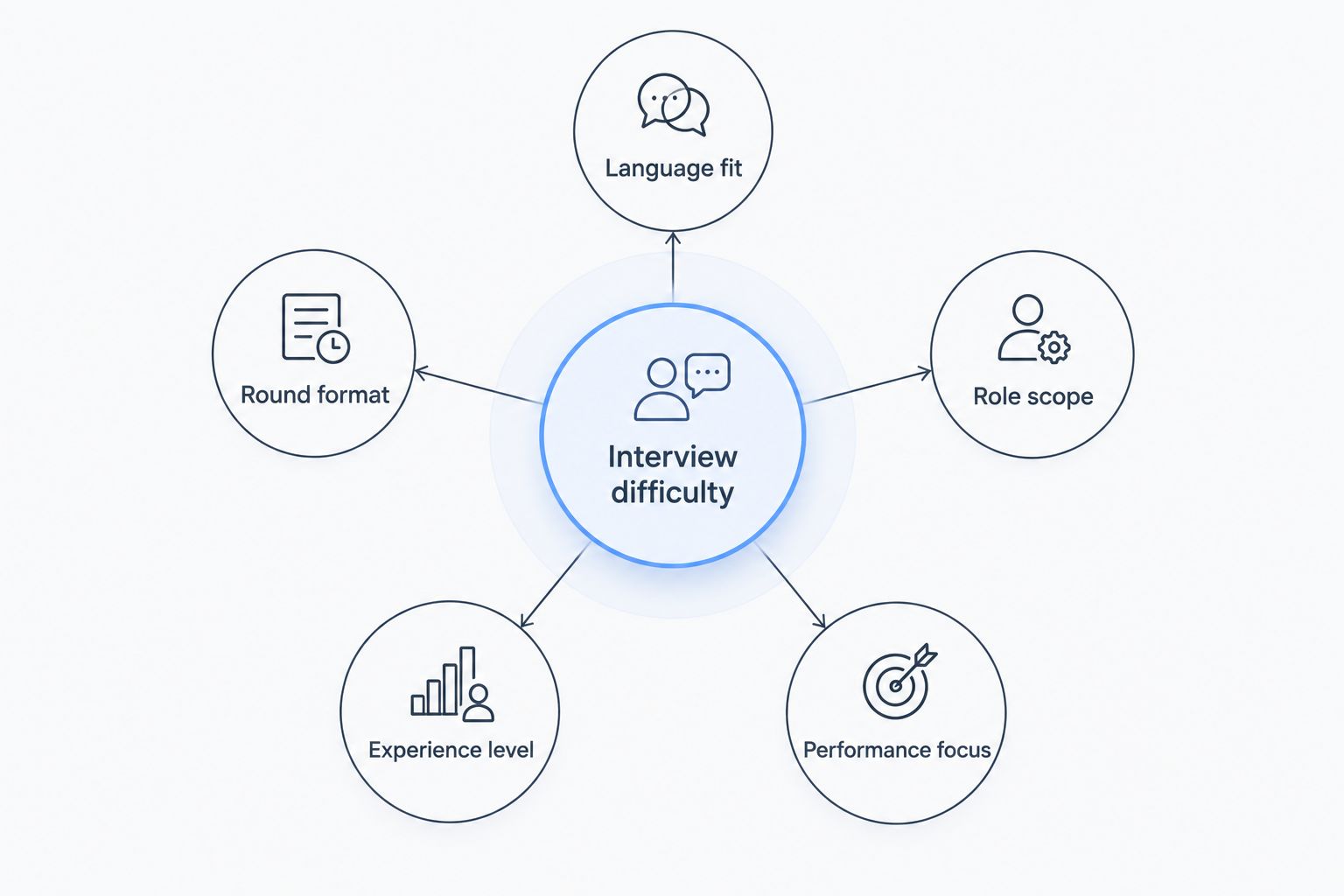
A difficult interview is not automatically one with an advanced algorithm. A familiar problem becomes difficult when the language is unfamiliar, the requirements are incomplete, or the interviewer asks for a production-safe variation you have never practiced.
Do you need finance knowledge for a quant developer coding interview?
You need the technical knowledge listed for the role first. Finance knowledge becomes relevant when the problem uses market data, trading systems, pricing, or risk context, but you should not invent domain expertise you do not have. If a term is unclear, ask for the operational meaning required to solve the problem.
For 2026 preparation, read the role description closely and separate required domain knowledge from preferred knowledge. That distinction keeps you from spending coding time on broad finance study that the technical round does not assess.
Is Python or C++ better for a quant developer interview?
Neither language is universally better for a quant developer interview. Use the firm's required language; when the firm gives you a choice, use the language in which you can implement, test, analyze complexity, and debug most reliably.
Do not switch languages shortly before the interview because one appears more closely associated with quant development. Language depth is more useful than a shallow attempt to match an assumed preference.
Can you pass if you make a coding mistake?
Yes, you can still pass after a coding mistake if you identify it, explain the cause, correct it safely, and retest the affected behavior. Hiding the mistake or changing several unrelated sections makes your reasoning harder to evaluate.
A clean recovery can demonstrate more engineering judgment than code that works immediately but cannot be explained. Practice recovery deliberately in 2026 by using broken implementations, not only fresh problems.
FAQ
What's the best way to prepare for a quant developer coding interview?
The best preparation combines timed coding, language-specific review, debugging, complexity analysis, and live explanation. Match every practice area to the role description and expected interview format.
Is LeetCode enough for a quant developer interview?
LeetCode is useful for algorithm practice, but it is not enough by itself. You also need live narration, debugging, testing, language depth, and follow-up questions that change the original constraints.
How should I explain complexity during a coding interview?
State the runtime and space complexity after presenting your approach and repeat the analysis after any optimization. Identify the operation or loop that determines each result rather than naming Big-O notation without an explanation.
What should I do if I don't understand the coding question?
Restate the problem and ask targeted questions about input, output, constraints, and invalid cases. Do not start coding against assumptions the interviewer has not confirmed.
Should I memorize quant developer interview questions?
No, memorize reusable reasoning patterns rather than complete answers. Interview follow-ups change constraints specifically to test whether you understand the method behind your first solution.
Can a self-taught programmer pass a quant developer interview?
Yes, a self-taught programmer can pass by demonstrating the required coding, complexity, debugging, and communication skills. Preparation should directly address any gaps in computer science fundamentals or production-code experience.
How do I prepare for a live pair-programming round?
Practice with another person watching while you clarify, code, test, and respond to follow-up questions. Record where you become silent or defensive, then repeat that segment with clearer decision statements.
What should I review the day before the interview?
Review your language notes, common complexity patterns, testing checklist, and the role description. Do not introduce a new language, framework, or large problem set the day before the interview.
One last thing
Do not end a practice problem when the first solution passes. Spend 10 more minutes trying to break it, reduce its memory use, change an input assumption, or explain why an alternative design is worse. That final step reflects the part of a 2026 quant developer interview that silent problem grinding misses.