

To build a quant resume with no work experience in 2026, put relevant technical projects ahead of an empty or unrelated work-history section. Show what you built, how you tested it, and what the results do and do not establish. Then list your education and skills, tailoring the evidence to the research, trading, or development role you want.
- For how to build a quant resume with no experience, lead with verifiable projects rather than an objective statement.
- Show your method, validation, and limitations; include numerical results only when you can defend them.
- Tailor the evidence to quant research, trading, or development instead of sending one identical draft everywhere.
- QuantMinds resume review is best for candidates who have technical work but need help presenting it clearly.
Why this matters
A blank employment section does not mean you have no evidence. Coursework, independent research, competition work, and code can show how you approach a quantitative problem. But a project title alone tells a reader almost nothing about your contribution. Your resume has to make the method and your role visible without asking someone to open a repository first.
That distinction matters when you describe public work. A competition entry, for example, is useful only if you can explain your data preparation, validation, and contribution. The Kaggle competition to quant researcher resume workflow addresses the same translation: turn work you actually completed into evidence a reader can assess. Do not claim a placement, result, or technique you cannot verify.
How to build a quant resume with no work experience
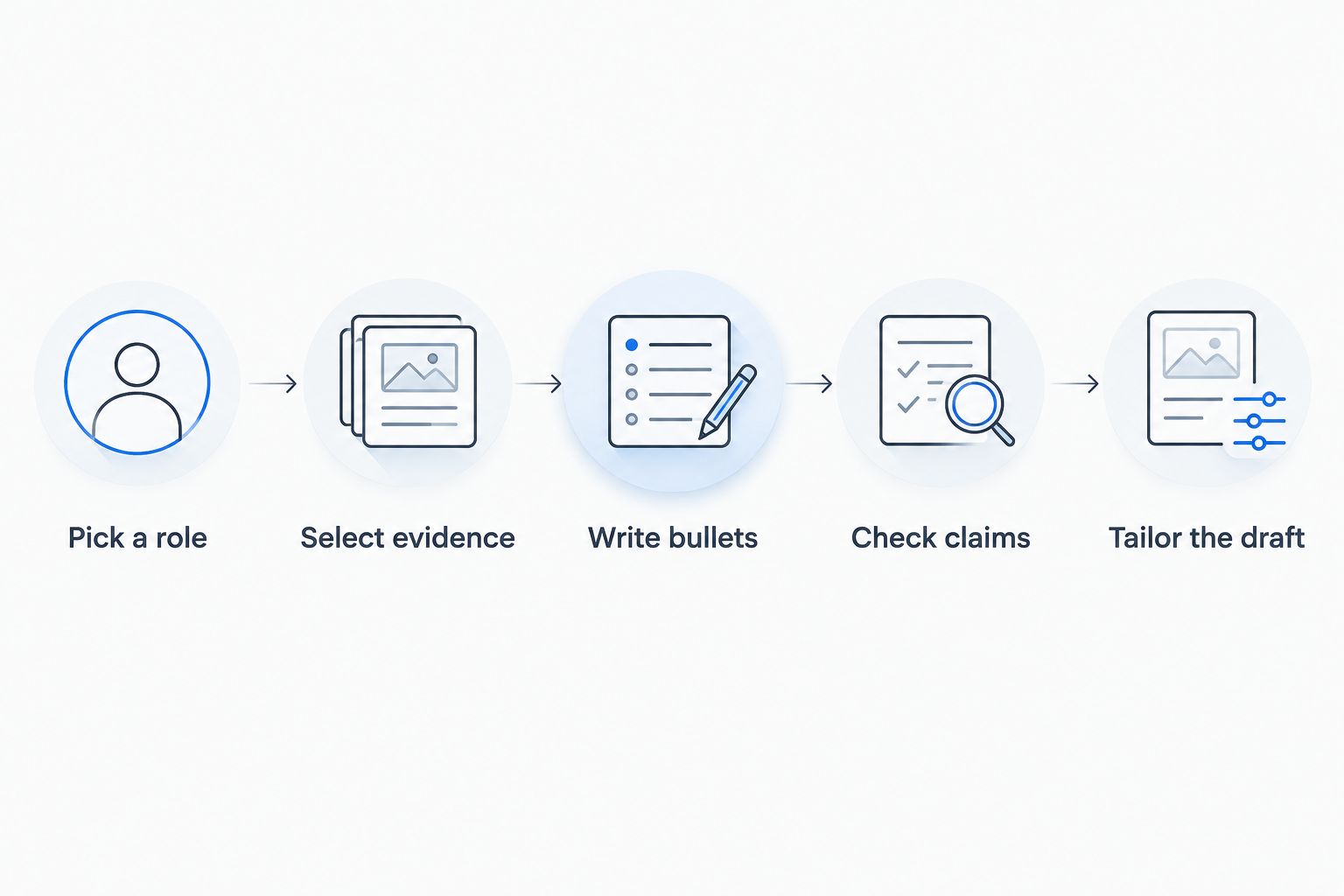
Use this sequence to make a 2026 draft. The order starts with choosing a role, because the same project can support different applications when you emphasize different parts of the work.
- Pick a role. Choose quant research, quant trading, or quant development as the primary target for this version of the resume. Read the posting and identify the technical work it asks you to do.
- Select evidence. Gather completed projects, research, competitions, and substantial coursework. Prefer work for which you can explain your own contribution, not just the team’s final presentation.
- Write bullets. State the problem, your method, and the outcome or limitation. If you have a verified result, include its unit and how you measured it. If you do not, describe the test you performed rather than inventing a performance figure.
- Check claims. Reopen the code, report, or notebook behind each line. Confirm that every library, model, result, and dataset description matches the work you can show or discuss.
- Tailor the draft. Move the strongest relevant project to the top. Adjust the skills line and project detail for the role, but never change a result to make it sound more impressive.
Put your name, contact details, and relevant profile or code links in the header. For a candidate without relevant employment, a practical section order is Projects, Education, Technical Skills, then Other Experience if it adds evidence. If an academic credential is your strongest evidence for a particular application, move Education above Projects. The point is not to obey a universal template; it is to put your strongest relevant proof where a reader encounters it first.
Keep the file readable. Use consistent dates, clear section labels, and bullets that can be understood without opening another document. A 1-page draft is a useful editing target when your experience is limited: it forces you to decide which details prove something. Do not shrink the type or strip out necessary context merely to meet that target.
What should a project bullet actually say?
A good project bullet lets the reader answer 3 questions: What did you do? How did you check it? What did you learn or produce? A result is strongest when you can explain the measurement behind it. A number without a method invites questions you cannot answer.
Consider a backtest. Writing that you built a trading strategy leaves open how you selected the data, avoided looking ahead, represented transaction costs, and judged the output. A more useful description names the signal and evaluation method, then gives a verified result if you have one. If the test found no convincing advantage, you can still describe the experiment and its limitations honestly. Do not turn an exploratory notebook into a claim of profitable trading.
Research and coursework need the same treatment. State whether you derived a result, implemented an existing method, compared models, or replicated published work. If you worked with others, identify your contribution. If the project lives on GitHub, check that the linked repository contains the code or documentation needed to understand it; a link is not a substitute for a clear resume bullet.
Use these prompts while editing each entry:
- Problem: What question or technical task did the project address?
- Method: Which model, algorithm, or approach did you personally implement?
- Check: What comparison, test, or validation did you use?
- Outcome: What can you report accurately, including an inconclusive result?
- Limit: What would you change or investigate before relying on the result?
You do not need to fit every answer into every bullet. You do need enough detail that someone can ask an informed follow-up question. In a 2026 application, the strongest wording is the wording you can defend at a whiteboard or in a code discussion, not the wording with the most technical nouns.
Which evidence belongs on each quant resume?
Quant research, trading, and development are different targets. Use the job description to make the final choice, then select the work that demonstrates the relevant task. The table is an editing guide, not a claim that every employer screens in the same way.
| Target role | Lead with evidence of | Show the reader | Avoid presenting as proof |
|---|---|---|---|
| Quant research | Statistical analysis, modeling, or research replication | Hypothesis, validation, comparison, and limitations | A model result with no account of how it was tested |
| Quant trading | Decisions under uncertainty or a carefully evaluated strategy | Assumptions, risk considerations, and evaluation method | A simulated return stated as if it were live trading |
| Quant development | Software that solves a technical problem | Your implementation, testing, and code structure | A list of languages with no work behind it |
For research, explain how you separated model development from evaluation. For trading, make the assumptions of any simulation explicit. For development, describe the component you implemented and how you tested it. These are ways to show work, not instructions to pretend a class assignment was employment.
Best fit for every version: the project whose method you understand well enough to discuss in detail. Trade-off: your most interesting project is not always the most relevant one. If it cannot support the role named in the posting, place it lower or leave it out.
Why your quant resume changes by target role
The amount of space each section deserves depends on evidence you already have. Make these choices from the actual posting and your actual work:
- Project relevance. A statistical replication supports a research application more directly than a generic website. A tested software component can carry more weight on a development resume than an unrelated market commentary project.
- Depth of your contribution. A smaller project you built and evaluated yourself gives you more to discuss than a larger team project where your part is unclear.
- Quality of validation. A result becomes easier to interpret when the resume identifies the comparison or test. Without that context, an impressive-sounding metric has little explanatory value.
- Academic background. Relevant coursework can help establish preparation when you lack employment, especially if you connect it to work you completed. A course name alone does not show how you applied the material.
- Prior jobs. Unrelated employment belongs on the page when it shows a relevant responsibility or fills a useful part of your history. It should not displace stronger technical evidence simply because it was paid work.
- Available documentation. A public repository, report, or competition record can back up a concise bullet. Check what is visible before pointing a reader to it.
What if your background is not finance?
Do not manufacture finance experience. A physics, mathematics, engineering, or computer science project can belong on a quant resume when its methods connect to the role. Explain that connection in plain terms: the statistical question, the algorithm you implemented, the test you designed, or the software behavior you verified.
The reverse is also true. Adding a market-data label to unrelated work does not make the work relevant. If a project uses financial data but does not test an idea or demonstrate technical judgment, strengthen the underlying work before rewriting its title. A resume can present evidence clearly; it cannot supply evidence that is not there.
If you have a research assistantship or teaching role, include it when you can identify your responsibilities accurately. If your strongest material comes from independent work, label it as a project. In 2026, a direct description of what you did is more useful than a job-like title that leaves your actual contribution uncertain.
How should you edit the education and skills sections?
List the degree and institution accurately, then include coursework that supports the target role when it adds information the reader cannot already infer. Probability, statistics, linear algebra, algorithms, and programming are useful examples only if you studied them. Do not crowd the section with every class on a transcript.
Treat Technical Skills as an inventory you can defend. Separate programming languages from libraries or tools when that makes the list easier to scan. A language you used in a brief exercise should not look equivalent to one you used to build and test a substantial project. Your project bullets can establish that distinction without rating yourself with vague labels such as advanced or expert.
Read the finished resume against the underlying work. If a bullet says you optimized a model, ask what objective you optimized and what comparison supports the statement. If it says you built a system, ask which parts you implemented. Delete claims that collapse under those questions. Then remove objective statements, repeated coursework descriptions, and generic claims about being passionate or detail-oriented. Use the space for evidence.
Do you need an internship to write a quant resume?
No. You can build a quant resume without an internship by showing relevant projects, coursework, research, or code you can explain. An internship is useful experience, but calling an independent project an internship is not a substitute for it.
Should education come before projects on a quant resume?
Put Projects first when they are your strongest evidence for the role; put Education first when a relevant degree or academic research record makes a clearer case. Choose the order after reading your own top section, not because a template calls one order standard.
How many projects should you include with no experience?
Include the projects you can explain and that support the target role, rather than aiming for a fixed count. Start with 2 or 3 strong candidates for the page, then cut any entry whose contribution or result you cannot describe clearly. That is an editing recommendation, not a recruiting threshold.
When does resume review help?
Resume review helps when your work is real but your bullets obscure your contribution, method, or results. QuantMinds offers resume review as part of its quant career coaching. QuantMinds resume review is best for candidates who can bring completed work and want feedback on how clearly it speaks to a target role. Its limit is straightforward: editing cannot replace a project you have not completed or validate a result you cannot support.
Bring the posting, your draft, and the underlying projects to any review. That gives the reviewer something specific to challenge: whether the right work appears first, whether each claim is accurate, and whether the page distinguishes research, trading, or development evidence. A useful review ends with clearer decisions about what to keep and cut, not bigger adjectives.
Review your quant resume
Bring a draft, a target role, and the work behind your project claims.
FAQ
How do I build a quant resume with no experience in 2026?
Lead with relevant projects you can verify, then list education and technical skills. Explain your contribution, how you tested the work, and any result you can defend.
Can a class project go on a quant resume?
Yes. Label it as a project and describe what you personally built or analyzed. Do not present coursework as paid work or claim a result you did not measure.
What should I put instead of an internship on a quant resume?
Use completed technical projects, research, competition work, or substantial coursework that supports the target role. Make your contribution and evaluation method clear.
Should I put GitHub on a quant resume?
Include GitHub when the linked work helps substantiate your project claims. Check that the relevant code or documentation is accessible and matches what the resume says.
Should a quant resume start with education or projects?
Start with whichever section offers the strongest relevant evidence. For a candidate without work experience, Projects often makes the clearest opening when the work is substantial and well documented.
Do I need finance coursework for a quant resume?
No. Relevant mathematics, statistics, programming, or research work can demonstrate technical preparation. Explain how the work connects to the role instead of implying you studied finance when you did not.
How long should a quant resume be with no work experience?
Use 1 page as an editing target if your experience is limited. Keep enough space to explain your strongest work clearly rather than compressing the text to satisfy a format rule.
One last thing
Before sending the resume, ask someone to point to your strongest project and tell you what you actually did. If they can repeat only the project title, rewrite the bullet. In 2026, the most valuable edit can be a clearer account of work already finished, not another activity added to the page. QuantMinds career coaching includes resume review and interview preparation; whichever route you take, make sure the story on the resume survives the follow-up questions.