

Breaking into prop trading without a PhD comes down to three things: a resume built around measurable results instead of credentials, fluency in probability and coding under interview pressure, and outreach that gets you past the resume screen before anyone reads your GPA. Firms like Jane Street, Optiver, IMC, and Akuna Capital hire undergraduates and career switchers with math, CS, physics, or engineering degrees every recruiting cycle — a doctorate is not a prerequisite for entry-level trading or developer seats. The gap most candidates never close isn't credentials, it's interview readiness: probability brain teasers, market-making intuition, and live coding rounds that a bachelor's degree alone doesn't prepare you for.
- You can break into prop trading without a PhD: math, CS, physics, or engineering degrees get hired every cycle.
- Coding fluency in Python or C++ and daily probability drills matter more than an advanced degree for entry-level seats.
- QuantMinds coaching targets the interview gap — resume, LinkedIn, networking, mock interviews — not a credential gap.
- Career switchers and non-target-school candidates land offers most often through referrals, not job boards.
Why this matters
The "PhD required" belief keeps strong candidates out of applicant pools they'd actually clear. Research desks at some funds do skew toward PhDs, but trading seats and developer seats are hired on a different bar entirely — one built around speed under pressure, not years in a lab. Whether a PhD is required depends heavily on which seat you're targeting, and conflating the two costs candidates a year or more they didn't need to spend.
Most people who stall out in 2026 recruiting cycles aren't losing to PhDs. They're losing to candidates with a weaker resume on paper but a sharper interview performance, because they drilled the actual test instead of assuming more school would fix it.
How to break into prop trading without a PhD
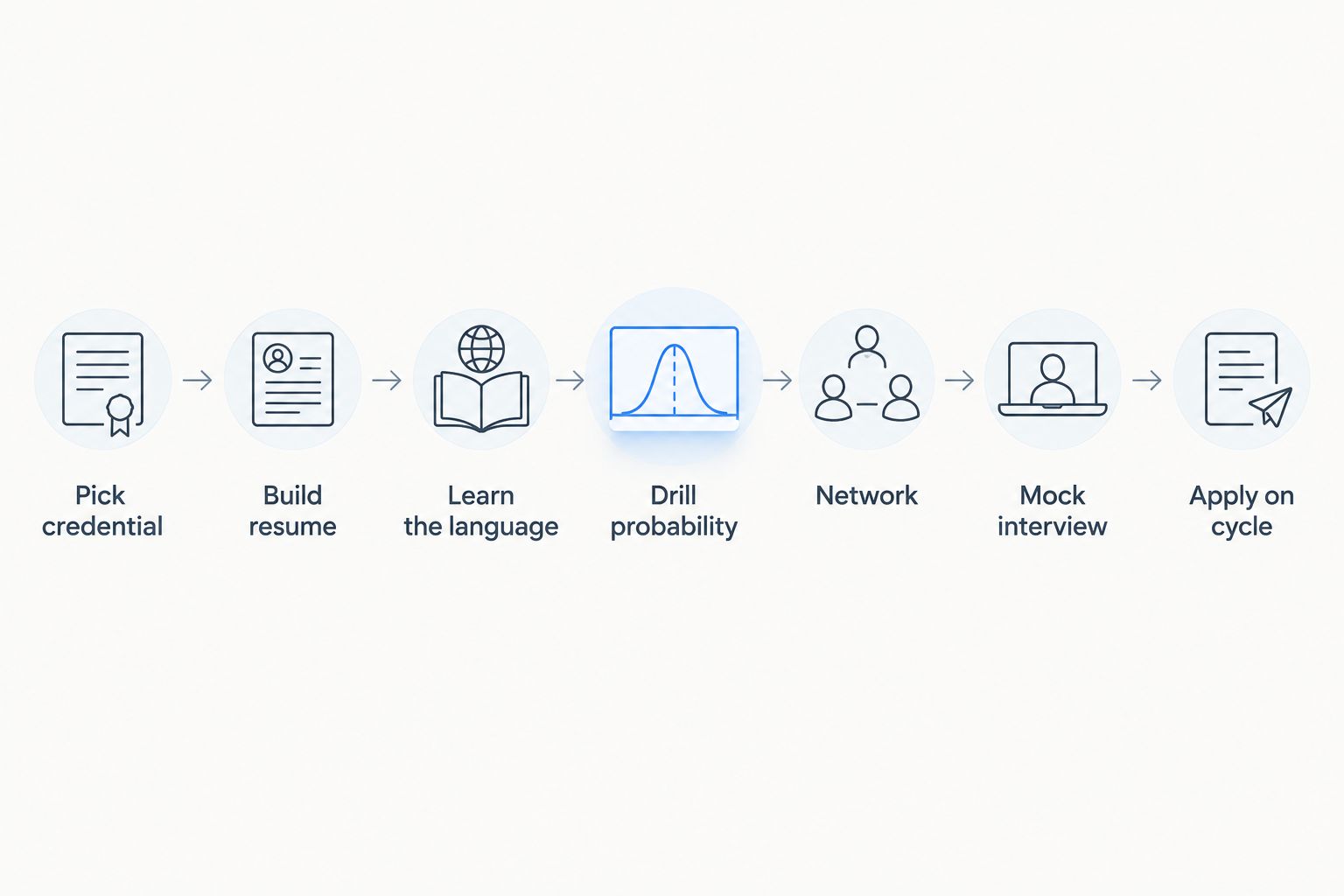
This is the sequence that gets non-PhD candidates through prop trading pipelines in 2026 — in order, not all at once.
- Pick the credential that actually moves the needle. A bachelor's in math, CS, physics, statistics, or engineering clears the resume screen at nearly every prop shop. An MFE, which typically runs one to two years, sharpens your story if you're pivoting from an unrelated field — a PhD, which usually adds another five to six years, rarely changes the outcome for trading or developer roles.
- Build a resume around outcomes, not coursework. Quant projects, trading competitions, Kaggle results, and independent research with a number attached (backtest returns, model accuracy, a competition rank) beat a transcript full of course titles every time.
- Get fluent in the language the desk actually uses. Python for research-adjacent roles, C++ for latency-sensitive developer seats. Firms test this live, not on a take-home you can polish for a week.
- Drill probability and market-making brain teasers daily. This is the single most common failure point for non-target-school and career-switch candidates — not because the math is hard, but because it's unfamiliar under a clock.
- Network your way past the resume screen. Referrals move faster than cold applications at every prop shop worth targeting. A short, specific message to someone on the desk beats a generic application every time.
- Run mock interviews before the real ones. Timed brain-teaser rounds and coding rounds behave nothing like studying alone — the pressure is the variable most candidates never practice against.
- Apply on the recruiting cycle, not on your own timeline. Prop trading recruiting runs on a predictable annual calendar; missing the window by a few weeks can cost you the whole cycle.
Why the "PhD required" myth persists
- Research desks hire differently than trading desks, and job posts rarely make the distinction clear — "PhD preferred" gets read as a hard filter when it's often a soft one for research-adjacent roles only.
- LinkedIn and Wall Street Oasis overrepresent PhD hires because those profiles are more visible and more discussed, not because they're the majority of headcount.
- Firms need far more traders and developers than researchers, and those seats reward speed, coding, and pattern recognition over academic depth.
- Career switchers assume weak interview performance means weak credentials, when it usually means the prep was wrong, not the degree.
- Prop shops recruit heavily from a small set of target schools, which makes the pipeline look more academically gated than the actual bar requires.
Get your resume and story reviewed
Talk through your path into prop trading with a coach.
Do you need a PhD to work at Jane Street or Optiver?
No — Jane Street, Optiver, and similar prop shops hire traders and developers with bachelor's and master's degrees every year; the PhD requirement, where it exists, is concentrated in research-heavy roles, not entry-level trading or development seats. What actually gates entry is performance on the probability, market-making, and coding rounds these firms are known for.
Is a math or CS undergrad enough to break into prop trading?
Yes, a math or CS undergrad is enough for the large majority of entry-level trading and developer roles in 2026, provided the interview prep matches the bar the firm actually tests. Physics and engineering degrees clear the same screen; what separates candidates afterward is speed and accuracy under timed brain-teaser and coding rounds, not the major itself.
What if I don't have a quant or CS background at all?
A non-quant background doesn't disqualify you, but it does mean the coding and probability gap has to be closed deliberately rather than assumed away. Self-taught coding backgrounds get hired at prop shops regularly when the candidate can prove the skill live — through projects, competition results, or a strong coding-round performance — rather than through a transcript.
FAQ
Do you need a PhD to break into prop trading?
No, a PhD is not required to break into prop trading in 2026. Trading and developer seats hire bachelor's and master's degree holders in math, CS, physics, and engineering every cycle; PhDs concentrate in research-heavy roles at a smaller number of firms.
Is an MFE enough to get hired at a prop trading firm?
An MFE, which typically takes one to two years to complete, is enough for most prop trading trading and developer roles when paired with strong probability and coding interview prep. It's especially useful for candidates pivoting from an unrelated undergraduate field.
What undergrad majors do prop trading firms hire from?
Prop trading firms hire heavily from math, computer science, physics, statistics, and engineering undergraduate programs. The major matters less than performance on timed probability and coding interview rounds.
How important is coding compared to math in prop trading interviews?
Coding and probability are tested with roughly equal weight in most prop trading interview loops for trading and developer seats in 2026. Developer-track roles weight coding rounds more heavily; trading-track roles weight probability and market-making questions more heavily.
Can a self-taught programmer get a quant developer job at a prop trading firm?
Yes, self-taught programmers get hired into quant developer roles at prop trading firms when they can demonstrate live coding ability under interview conditions. Projects, open-source contributions, and coding-round performance carry more weight than a formal CS credential.
Do prop trading firms only hire from target schools?
No, prop trading firms recruit most heavily from a small set of target schools but do hire outside that list every year. Non-target candidates typically need to work networking and referrals harder than the on-campus recruiting pipeline provides.
How long does it take to prepare for prop trading interviews without a PhD?
Interview readiness for prop trading depends more on daily probability and coding practice than on the credential behind you. Candidates without a PhD typically close the gap through consistent drilling and mock interviews rather than additional schooling.
Is 30 too old to break into prop trading without a PhD?
No, 30 is not too old to break into prop trading, though the path usually runs through a career-switch story and strong interview performance rather than an additional degree. Firms care more about current interview readiness than age or years since graduation.
One last thing
Most prop trading firms hire more traders and developers each year than researchers, and those seats rarely ask for a PhD — they ask you to pass the same probability, market-making, and coding bar every other candidate faces. The candidates who get stuck usually spend another year chasing a credential instead of spending a focused stretch on interview reps, mock rounds, and a resume that leads with results. Fix the interview gap in 2026, not the degree gap.