

Getting a quant internship without a target school in 2026 comes down to three things: a portfolio a recruiter can verify without a referral, open online assessments that don't check which school issued your transcript, and direct outreach that replaces the on-campus pipeline you don't have. The catch most candidates miss is that a resume alone rarely gets a non-target applicant past the first screen — the portfolio and the outreach have to do the work the school name would otherwise do.
- Non-target candidates land a quant internship in 2026 through open online assessments, not campus recruiting.
- A GitHub repo or a ranked Kaggle project outweighs a school name on most prop trading resume screens.
- Cold outreach to buy-side and sell-side quants fills the referral gap a career center can't close.
- QuantMinds coaching rebuilds the resume, LinkedIn profile, and outreach script non-target candidates actually need.
Why this matters
Most quant recruiting budgets still concentrate on a short list of schools because it's cheaper for a firm to run one info session at Princeton than fifty across state schools. That's a recruiting-cost decision, not a talent judgment, and it leaves a real opening: firms that can't staff a target-school pipeline for every seat fill the rest through public assessments and inbound applications. QuantMinds works with candidates from exactly this position every recruiting cycle — no target school, no warm introduction, and a resume that needs to say something a school name usually says for you.
The honest version of the 2026 recruiting cycle: prop trading shops and many hedge funds run online assessments — HackerRank-style coding tests, timed math and probability screens — that are open to anyone who applies. You don't need an invitation to sit for them. What you need is a resume strong enough to get invited to take one, and a portfolio strong enough to survive it.
How to get a quant internship without a target school
The sequence below is what actually moves a non-target application from ignored to interviewed. Skip steps and you're relying on luck; run all five and you're building the case a target-school resume makes automatically.
- Build a portfolio that survives a technical skim. Two or three finished projects — a backtested strategy, a ranked Kaggle submission, a from-scratch options pricer — beat a bullet-point list of coursework every time.
- Apply broadly to firms with open online assessments. Many prop trading firms and several hedge funds run public assessments that any applicant can request, independent of school affiliation.
- Network directly instead of waiting for a campus event. Cold email to alumni, analysts, and portfolio managers substitutes for the referral pipeline a target school provides for free.
- Rewrite the resume around skills, not pedigree. Lead with the project, the language, the result — not the university, which a non-target school buries you under by default.
- Run mock interviews under real conditions. Probability, mental math, and coding rounds move fast; rehearsed answers under time pressure separate offers from rejections.
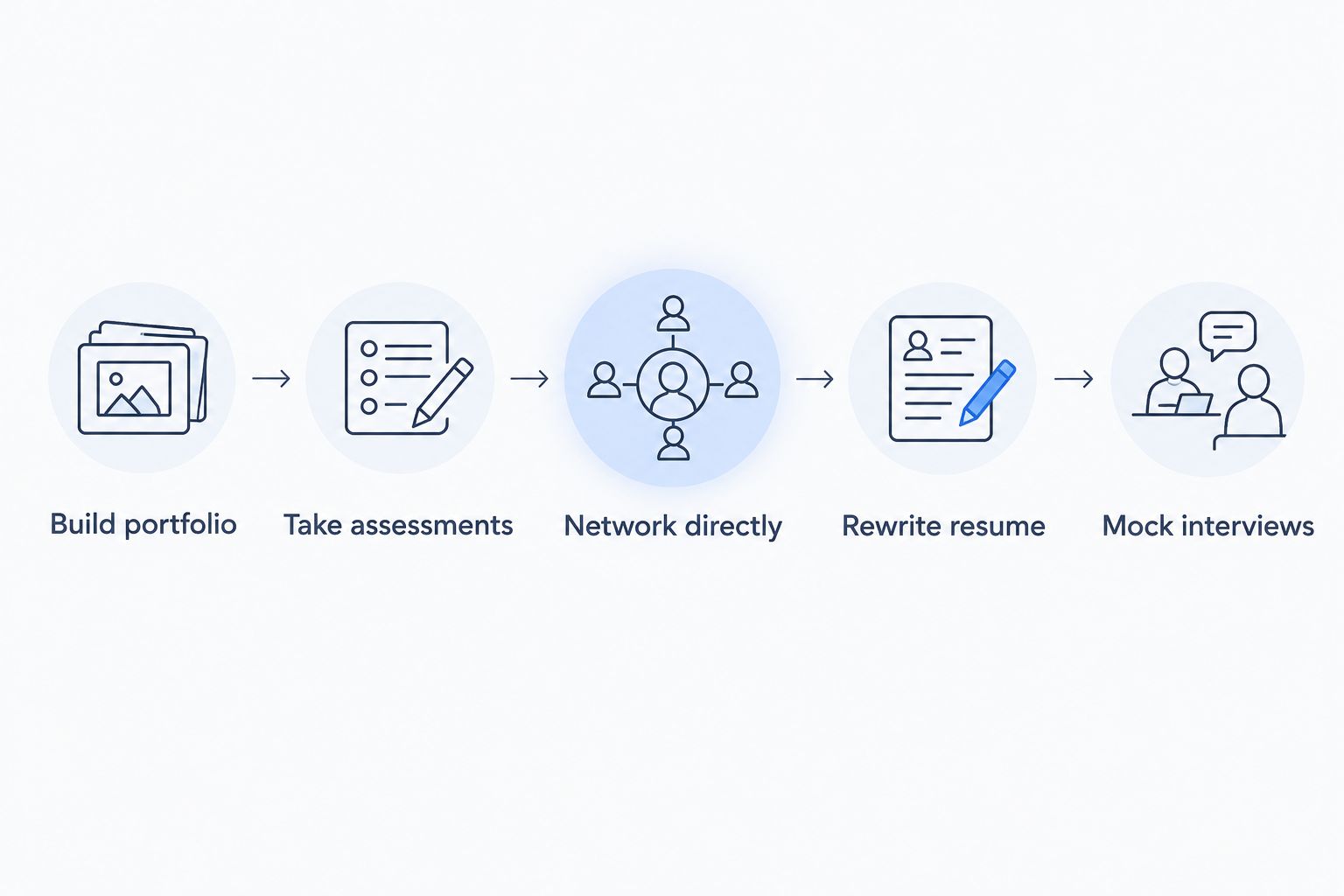
A candidate who runs all five steps in the same cycle looks, on paper, like a target-school applicant with a slightly less recognizable school name — which is exactly the goal. A resume review for non-target school applicants is usually the fastest single move, because most non-target resumes bury the one project that would have gotten a callback three bullet points down.
Why breaking in without a target school takes longer
None of this is impossible, but it is slower by default, and knowing why keeps you from blaming the wrong variable.
- Fewer built-in recruiter connections. Target schools get scheduled info sessions; everyone else gets a job board listing.
- No fast-track referral pipeline. A referral from a current intern skips two screening rounds — non-target candidates have to earn that referral cold.
- Resume screens default to pattern-matching. A recruiter who's hired three interns from one program will glance past an unfamiliar school name faster than a familiar one.
- Online assessment pools are more competitive. Open assessments draw a much wider applicant pool than a closed campus list, so the pass rate on any single attempt is lower.
- Career centers rarely have quant-specific relationships. A university career center to quant internship workflow exists at target schools; most other career centers have never placed a student in quant trading.
“A finished Kaggle project ranked on a public leaderboard tells a recruiter more than a 3.9 GPA at a school they've never visited.”
Do prop trading firms care about target schools?
Prop trading firms care less about the school name than banks do, largely because they run their own public online assessments in 2026 rather than relying on campus recruiting lists. A candidate who passes the assessment gets an interview regardless of transcript — the assessment is the filter, not the school.
Can a low GPA hurt a non-target application?
A low GPA hurts more at a non-target school than at a target one, because the school name isn't there to soften the read. Above a rough screening line, most firms weight the portfolio and assessment score heavier than the transcript number itself.
Is a project portfolio enough without a prior internship?
A strong portfolio is not a full substitute for an internship, but it is usually enough to get a first interview in 2026 when the resume has no internship line to show. It buys the conversation; the interview still has to close it.
FAQ
What's the best way to get a quant internship without a target school in 2026?
The best path in 2026 combines a verifiable portfolio, open online assessments, and direct outreach — in that order of priority. Skipping the portfolio step is the single most common reason non-target applications stall at the resume screen.
Is quant recruiting only done at target schools?
No — quant recruiting concentrates at target schools for cost reasons, not because non-target candidates can't compete. Prop trading firms in particular run public assessments open to any applicant.
Can a low GPA hurt my quant internship chances?
A low GPA can hurt more at a non-target school because there's no school name to offset it. A strong portfolio and assessment score do more to counter it than explaining the number away.
Are online assessments enough without a referral?
Online assessments can replace a referral entirely at firms that run them publicly, since passing the assessment is what triggers the interview invite. A referral still helps, but it isn't required at those firms.
Do prop trading firms recruit non-target students?
Yes, most prop trading firms recruit non-target students through open assessments rather than closed campus lists. The assessment score, not the school, decides who advances.
How long does it take to prepare without target-school connections?
Preparation without target-school connections generally takes longer because outreach and portfolio-building replace work a campus pipeline would otherwise do for you. Most candidates need several months of consistent outreach and project work before the first interview lands.
Is networking necessary if my technical skills are already strong?
Networking is still necessary because strong technical skills only matter once a recruiter sees the resume. Cold outreach is what gets a non-target resume in front of someone in 2026, regardless of how strong the underlying skills are.
One last thing
The firms most associated with target-school recruiting run some of the most accessible entry points in the industry — public online assessments that don't check where the applicant studied. The bottleneck for non-target candidates isn't usually the assessment itself; it's getting invited to take it, which is a resume and outreach problem, not a talent problem.