

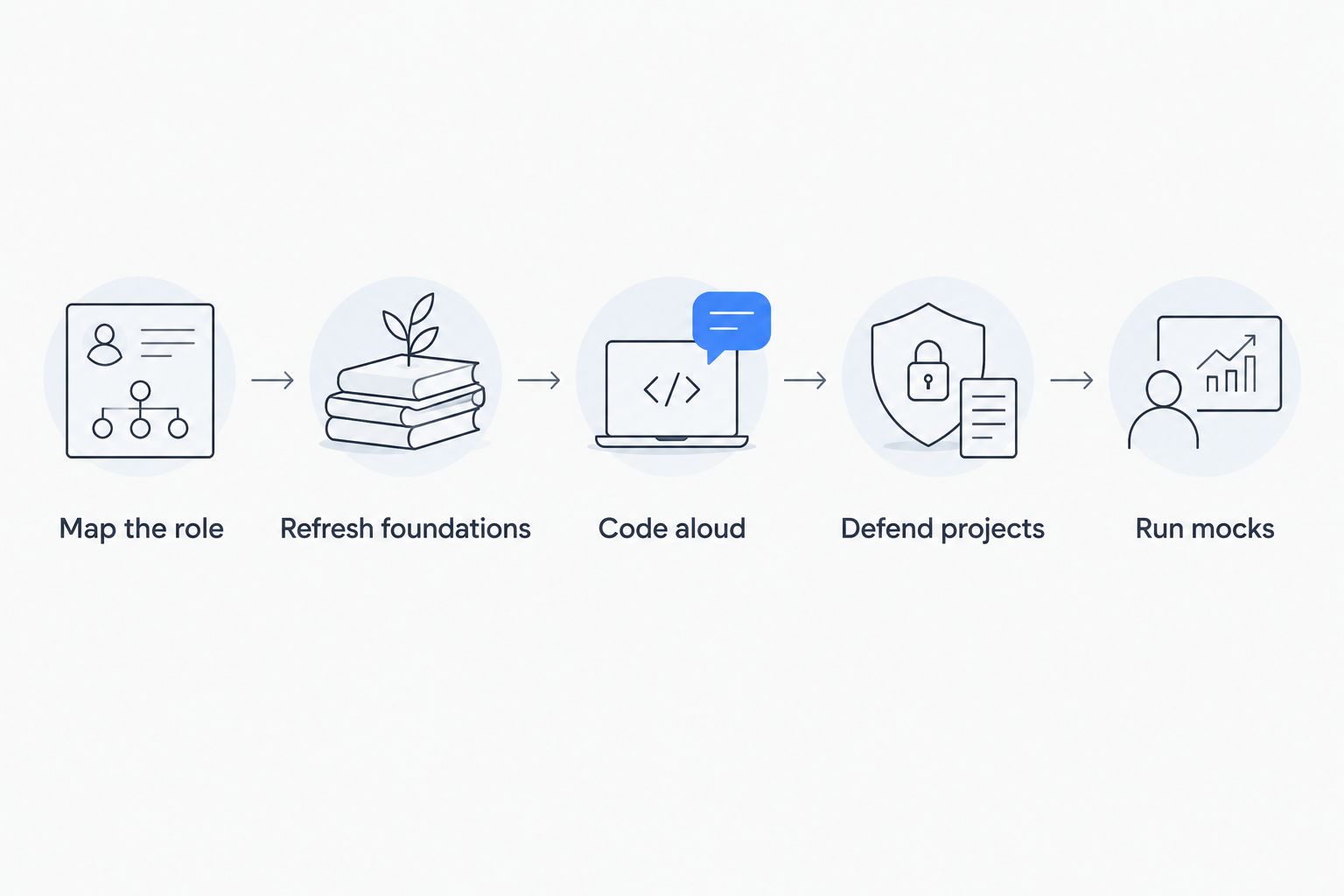
Prepare for a quant researcher interview by mapping the role, refreshing probability and statistics, coding under time pressure, defending your research projects, and rehearsing the full interview format. In 2026, the strongest plan connects every practice session to the firm and role rather than treating quant interview prep as a pile of unrelated questions. Your goal is to make your reasoning clear when the interviewer changes an assumption, challenges your code, or pushes past the polished version of a project story.
- How to prepare for a quant researcher interview: map the role, sharpen fundamentals, code aloud, defend projects, and run mocks.
- Prioritize probability, statistics, coding, and research judgment according to the role rather than studying every topic equally.
- Prepare two research stories that cover your hypothesis, data, method, validation, limitations, and next step.
- QuantMinds is best for candidates who want direct feedback on resumes, project narratives, interview answers, and recruiting strategy.
Why this matters
Quant researcher interviews test whether you can turn technical knowledge into a defensible research decision. Knowing a formula is not enough if you cannot explain its assumptions, recognize when it fails, or translate the result into a research conclusion.
The process also exposes uneven preparation quickly. A candidate can solve probability exercises but struggle to write clean code, discuss data leakage, or explain why a project belongs on the resume. QuantMinds works with professionals and students pursuing quantitative research, trading, and development roles, but coaching does not replace individual practice. Its value is direct feedback; its limitation is that you still have to build fluency through repeated work.
How to prepare for a quant researcher interview
Use this sequence for 2026 interviews. Start with the target role, then build the technical and communication skills that the role is likely to expose.
- Map the role before choosing practice material.
Read the job description line by line. Separate the stated requirements into probability and statistics, machine learning, programming, market knowledge, research experience, and communication. Mark each requirement as strong, workable, or weak based on evidence you can discuss in an interview.
Then study the firm's business model and the team named in the posting. A research role connected to systematic equities creates a different preparation priority from one focused on options, execution, or high-frequency data. Do not assume the title alone tells you what the interview will test.
Build a short role brief with three fields: what the team appears to research, what methods the role requires, and which parts of your background prove fit. This brief controls the rest of your study plan.
- Refresh probability and statistics from first principles.
Review conditional probability, Bayes' rule, expectation, variance, covariance, common distributions, sampling, estimation, hypothesis testing, regression, and time-series concepts relevant to the role. Do not stop at definitions. For every concept, explain the assumptions, construct a small example, and identify one way the method can mislead a researcher.
Practice deriving results rather than recalling them. If an interviewer changes independence assumptions or introduces selection bias, a memorized answer collapses. A first-principles explanation lets you rebuild the result and show where the new condition changes it.
Use short verbal drills as well as written problems. Give yourself 90 seconds to state the setup, define the variables, and explain the path to a solution before calculating. This prevents silent problem solving from becoming a weakness during a live interview.
- Practice coding while explaining your decisions.
Choose the language named in the role and work without autocomplete for part of each session. Practice data manipulation, arrays, strings, dictionaries, sorting, basic algorithms, simulation, and analysis workflows. Research candidates should also be ready to discuss data quality, validation, reproducibility, and computational trade-offs.
Write the simple correct solution first. State its time and space trade-offs, test edge cases, and improve it only when the improvement is justified. Interviewers need to follow your reasoning; an optimized solution delivered without explanation provides less evidence than clear code with explicit decisions.
The useful question is not whether coding or math always matters more. The balance changes by seat, and the coding-versus-math breakdown for quant interviews helps frame that decision. In 2026, your preparation should follow the actual role description rather than a generic label.
- Prepare two research projects you can defend without notes.
Select projects that let you show research judgment. For each one, prepare a concise explanation covering the question, hypothesis, data, method, validation, result, limitation, and next experiment. The interviewer should hear what you decided and why, not a chronological diary of everything you tried.
Expect the discussion to move into weak points. Be ready to explain how you handled missing data, outliers, multiple testing, unstable relationships, transaction costs, nonstationarity, overfitting, and data leakage when those issues apply. If an issue did not apply, say why rather than forcing it into the story.
Own the failures. A project becomes more credible when you can identify a bad assumption, explain how you discovered it, and show what changed afterward. Do not inflate a classroom exercise into production research or imply ownership of work completed by a team.
- Prepare fit answers with the same discipline as technical answers.
Build direct answers for why quantitative research, why this firm, why this team, and why your background fits the work. Replace generic interest in markets with evidence: a research decision you enjoyed, a technical problem you pursued, or a project that changed how you think.
Your firm answer should reflect the information available from the role and the organization. Do not praise culture you have not experienced or claim detailed knowledge you do not have. Explain what attracts you to the stated work and connect it to skills you can prove.
Prepare questions that reveal how research operates. Ask about idea generation, validation standards, collaboration, feedback, and how the role interacts with trading or engineering. Avoid questions answered directly by the job posting.
- Run complete mock interviews and review the recording.
A practice problem tests content. A mock interview tests content, communication, recovery, and pacing at the same time. Run 45-minute sessions that combine technical questions, coding, project discussion, and fit rather than isolating every topic.
After each mock, classify misses instead of merely collecting them. Use categories such as knowledge gap, misunderstood question, weak structure, coding error, unsupported assumption, or poor recovery. The category tells you what to fix; the question itself is only one example.
Repeat failed questions after a delay and explain the corrected reasoning aloud. The objective is not to memorize that answer. It is to repair the process that produced the mistake.
What should you prioritize during preparation?
Your priority should come from the gap between the role's requirements and the evidence you can produce under pressure. Use this table to turn a broad preparation list into specific work.
| Preparation area | Evidence you need to show | Common preparation error | Better practice method |
|---|---|---|---|
| Probability and statistics | Correct reasoning with stated assumptions | Memorizing final answers | Derive, explain, then vary an assumption |
| Coding | Correct, readable code with tested edge cases | Practicing only with autocomplete | Code aloud under a timer |
| Research projects | Clear ownership and methodological judgment | Reciting a polished summary | Invite follow-up questions on weak points |
| Machine learning | Model choice, validation, and limitations | Listing algorithms without trade-offs | Compare methods on the same research question |
| Firm fit | Specific motivation tied to the role | Giving the same answer to every firm | Build the answer from the job description |
Do not divide time evenly by default. If your project explanations are vague, another probability workbook will not fix the immediate risk. If you cannot implement a simple simulation cleanly, polishing fit answers is not the highest-priority move.
A useful 2026 study log records the skill practiced, the mistake made, the cause, and the next drill. This creates a feedback loop instead of an expanding folder of questions you completed once and never revisited.
How should you prepare a quant research project walkthrough?
Start with a 60-second version that gives the research question, method, result, and main limitation. Then prepare a deeper version for each component so you can expand only where the interviewer pushes.
Use this structure:
- Question: What decision or relationship were you investigating?
- Hypothesis: What did you expect, and why was that expectation reasonable?
- Data: Where did the data come from, and what limitations affected it?
- Method: Why did you choose that model, test, or experimental design?
- Validation: How did you separate genuine evidence from overfitting or leakage?
- Result: What did the analysis support, reject, or leave unresolved?
- Limitation: What is the strongest reason not to trust the result fully?
- Next step: What would you test with more data, time, or infrastructure?
Interviewers can enter the story at any point. If you only memorize a linear script, one interruption can break your delivery. Learn the logic between the parts instead: the hypothesis determines the test, the data constrains the method, and the validation determines how much confidence the result deserves.
Keep your claims aligned with what you personally did. If a teammate built the data pipeline while you designed the validation, distinguish those responsibilities. Clear attribution strengthens the answer because it tells the interviewer exactly what evidence the project provides about you.
Why quant researcher interview preparation varies
The correct plan changes because the title covers different work. Five factors should control your allocation:
- Role description: The listed methods, languages, asset classes, and responsibilities are the clearest preparation signals.
- Firm type: Hedge funds and prop trading firms can organize research, trading, and development responsibilities differently.
- Candidate background: A statistics student, software engineer, and experienced researcher bring different strengths and gaps.
- Project evidence: Strong projects reduce the need to manufacture examples, but they increase the depth of follow-up you must handle.
- Interview stage: An early conversation and a technical interview demand different levels of detail, even when both discuss your background.
Do not copy another candidate's timetable without comparing these factors. A plan built for a math PhD can be badly matched to a software engineer, and the reverse is also true. The correct 2026 plan is the one that targets your weakest interview evidence without neglecting the role's core requirements.
How do you practice quant interview questions effectively?
Use a cycle of attempt, explanation, diagnosis, and repetition. First solve the problem without looking at a solution. Then explain your reasoning aloud, identify exactly where the process failed, and repeat a related problem after enough time has passed that you must reconstruct the method.
Separate mistakes into knowledge and execution. A knowledge error means you did not understand the concept. An execution error means you knew the concept but misread the question, skipped an assumption, wrote fragile code, or failed to communicate the step. Those errors require different corrections.
Do not measure preparation only by the number of completed questions. Track whether you can explain the method, recognize a changed version, and recover after a wrong turn. Those are closer to the demands of a live interview.
How do you handle a question you cannot solve?
State what you understand, define the variables, and identify the missing step. Test a simpler version, work through a small example, or ask a targeted clarification. This gives the interviewer evidence about your research process even when the final answer remains incomplete.
Do not fill the silence with unsupported claims. A short pause followed by a structured approach is stronger than rushing into algebra or code without a plan. If the interviewer gives a hint, incorporate it explicitly and continue; using new information well is part of the evaluation.
Your recovery also matters. A wrong first approach is not automatically fatal, but defending it after the flaw becomes clear damages the signal. Acknowledge the issue, reset the assumptions, and show the corrected path.
When should you use quant interview coaching?
Use coaching when you cannot diagnose why your answers are failing, need external pressure during mock interviews, or want direct feedback on how your resume and projects translate into interview questions. Self-study remains necessary for probability, statistics, and coding repetition.
QuantMinds is best for professionals and students who want direct, role-specific feedback while pursuing quant research, trading, or development positions. QuantMinds offers resume review, interview preparation, and one-on-one coaching, drawing on Fiona's experience as a former UC Berkeley MFE program executive director. The practical advantage is feedback on what an interviewer hears; the trade-off is that no coach can substitute for your technical work between sessions.
Pressure-test your interview plan
Get direct feedback on your resume, project stories, and interview preparation.
FAQ
How do I prepare for a quant researcher interview in 2026?
Prepare by mapping the role, reviewing probability and statistics, coding aloud, defending two research projects, and completing timed mock interviews. Allocate time according to the job description and your weakest interview evidence.
What math should I review for a quant researcher interview?
Review probability, expectation, variance, covariance, distributions, estimation, hypothesis testing, regression, and relevant time-series concepts. Focus on assumptions and derivations rather than final formulas alone.
What coding should I practice for a quant research role?
Practice the language named in the role through data manipulation, simulation, core algorithms, and research workflows. Explain your decisions, test edge cases, and discuss computational trade-offs while coding.
How many projects should I prepare for a quant interview?
Prepare two research projects deeply enough to discuss the hypothesis, data, method, validation, result, limitations, and next step. Depth matters more than listing many projects with shallow explanations.
How should I answer why I want to work at a quant firm?
Connect the firm's stated research work to technical problems and projects you have already pursued. Avoid generic claims about markets, prestige, or culture that could apply to any organization.
What should I do if I cannot solve a quant interview question?
Define the problem, state your assumptions, test a smaller case, and identify the exact step blocking progress. Use interviewer hints directly instead of pretending you already knew the answer.
Are mock interviews useful for quant researcher roles?
Yes, mock interviews expose communication, pacing, coding, and recovery problems that untimed question practice misses. Review each session by mistake type and repeat the failed skill rather than memorizing one solution.
One last thing
Your resume already tells the interviewer what to probe. Every project, programming language, statistical method, and market reference can become a follow-up question, so review each line and ask what evidence supports it.
For a 2026 interview, remove claims you cannot defend and deepen the ones that remain. A shorter resume with credible technical depth creates a stronger interview than a crowded one that exposes shallow knowledge.