
Most candidates need 3 to 6 months of consistent daily practice to get Python interview-ready for quant research, quant trading, or quant developer roles in 2026, with complete beginners closer to 6 to 9 months before mock interviews go smoothly. That range covers core syntax, NumPy, pandas, and timed coding-interview drilling — not "learning Python" in the tutorial sense. The part most self-taught candidates miss is the 100+ hours of probability-flavored coding problems that separate a working knowledge of Python from an interview-ready one.
- How long it takes to learn Python for quant interviews depends on starting point: 6-9 months for beginners, 8-12 weeks with prior coding experience.
- NumPy, pandas, and timed coding drills matter more than syntax fluency once you can write basic functions.
- Experienced programmers switching from C++, Java, or R need just 2 to 4 weeks to get comfortable in Python.
- Daily practice compresses the timeline; once-a-week study stretches it past a full recruiting cycle in 2026.
Why this matters
Python shows up in nearly every quant research, quant trading, and quant developer interview loop in 2026 — not because firms want Python experts, but because it's the fastest way to test how a candidate thinks under pressure. Get the timeline wrong and you either walk in under-prepared or burn months over-studying syntax nobody tests. QuantMinds works with candidates across the full spectrum, from self-taught programmers to physics PhDs picking up Python for the first time, and the pattern holds: syntax isn't what eats months, comfort with pandas, vectorized operations, and timed problem-solving is.
For the full prep timeline beyond just the coding piece — probability, mental math, and behavioral rounds — see how long it takes to get ready for quant interviews.
How long does it take to learn Python for quant interviews?
The answer splits cleanly by starting point, and the gap between a true beginner and an experienced programmer switching languages is wide.
| Starting point | Time needed | What "ready" looks like |
|---|---|---|
| Complete beginner (no coding background) | 6 to 9 months | Writes functions, loops, and basic classes from memory; comfortable manipulating pandas dataframes |
| Some coding experience (non-Python) | 8 to 12 weeks | Fluent in syntax; solves LeetCode-style problems in Python under time pressure |
| Experienced programmer (C++, Java, R) | 2 to 4 weeks | Comfortable with Python idioms and NumPy/pandas; already thinks like a programmer |
A rough curriculum, in order:
- Core syntax and data structures — lists, dicts, functions, classes (2 to 4 weeks)
- NumPy and pandas for vectorized data manipulation (3 to 4 weeks)
- Probability and statistics coded from scratch — simulations, distributions (2 to 3 weeks)
- Timed coding-interview problems — LeetCode easy/medium and quant-specific problems translated to code (4 to 8 weeks)
- Mock interviews under a clock, repeated until the interview date
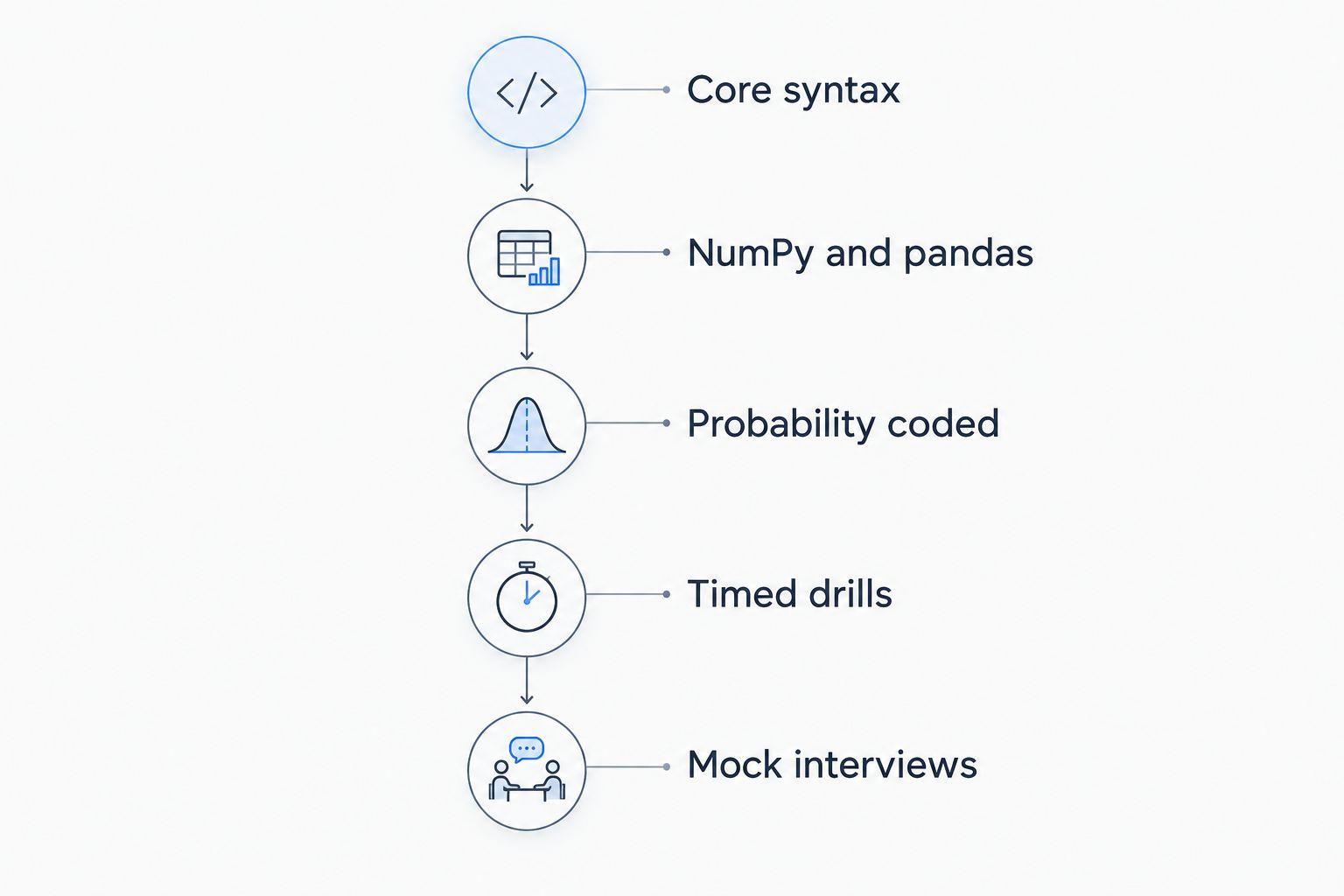
Those five stages overlap in practice; the beginner's 6-to-9-month window includes learning probability alongside Python, while an experienced programmer skips straight to stage 4.
Complete beginners: 6 to 9 months
A candidate with zero coding background needs the full arc: syntax, data structures, NumPy, pandas, then a runway of timed problems before mock interviews feel productive. Compressing this below 6 months usually means skipping the timed-practice stage, which is the exact stage that determines interview performance. Verdict: budget 6 to 9 months and start mock interviews at month 4, not month 8.
Some coding experience, non-Python: 8 to 12 weeks
Candidates who already code in Java, MATLAB, or R spend almost no time on control flow or functions — the learning curve is Python idioms, list comprehensions, and pandas syntax. Most of the 8-to-12-week window goes to timed problem sets, not tutorials. Verdict: 8 to 12 weeks is realistic if practice is daily; treat anything under 6 weeks as rushed.
Experienced programmers switching languages: 2 to 4 weeks
Someone fluent in C++ or Java can pick up Python syntax in days — the real work is 2 to 4 weeks of NumPy/pandas drills and re-solving familiar algorithms in Python instead of their usual language. Verdict: 2 to 4 weeks is enough, but skipping pandas practice because "I already know how to code" is the most common mistake in this group.
Why timelines vary
- Daily practice volume — 30 minutes a day versus 2 to 3 hours a day changes the multiplier more than any other factor.
- Math and probability background — learning stats and Python at the same time slows both.
- Target firm type — prop trading interviews test raw coding speed harder than research-track buy-side interviews.
- Prior exposure to any object-oriented language — even weak familiarity with classes and functions cuts weeks off the beginner timeline.
- Whether Python is being studied alongside brain teasers, mental math, or certification prep — splitting focus stretches every individual timeline.
- Access to structured feedback — self-study without mock interviews takes longer to convert practice into interview performance.
Related questions candidates ask
Is Python enough, or do I also need C++ for quant interviews?
Python covers most quant research and quant trading interview loops in 2026, but quant developer and low-latency prop trading roles often test C++ as well. If the target role is research or systematic trading, Python alone is usually sufficient for the coding round.
How many hours a day should I study Python for quant interviews?
1 to 2 hours a day of focused practice is what moves most candidates through the 6-to-9-month beginner timeline without burning out. Less than that stretches the timeline; more than 3 hours a day rarely speeds it up further once fundamentals are solid.
Should I learn probability and statistics before or alongside Python?
Alongside, not before — quant interviews test coded probability problems, not either skill in isolation. Learning them together means the practice problems double as Python drills from week one.
A resume review or a single mock interview session can tell a candidate in one sitting whether their current Python level matches their target firm's bar — guessing costs entire recruiting cycles, and 2026 cycles for many firms open earlier than candidates expect.
Find out if your Python level is interview-ready
1-on-1 coaching from a former MFE program director.
FAQ
How long does it take to learn Python for quant interviews?
It takes 6 to 9 months for complete beginners and 2 to 4 weeks for experienced programmers switching languages, with most candidates falling somewhere in an 8-to-12-week middle range in 2026. The determining factor is daily practice volume, not raw talent.
Is 3 months enough to learn Python for a quant internship interview?
3 months is enough only if you already have coding experience in another language; complete beginners need closer to 6 to 9 months. Candidates trying to compress a beginner timeline into 3 months usually skip timed practice, which shows up immediately in the interview.
Do quant trading interviews test Python or just brain teasers?
Most quant trading interview loops in 2026 test both — timed Python coding problems alongside probability brain teasers. Prop trading firms in particular weight coding speed heavily in the technical rounds.
What Python libraries matter most for quant interviews?
NumPy and pandas matter most, since they cover the vectorized data manipulation that shows up in nearly every technical round. SciPy and basic plotting libraries come up less often but still appear in research-track interviews.
Can I get a quant job with self-taught Python instead of a CS degree?
Yes — self-taught Python is common among successful quant candidates, and interviewers test coding ability directly rather than checking for a CS degree. What matters is whether the candidate can solve timed problems cleanly, regardless of how they learned.
How is Python tested differently in quant research vs quant developer interviews?
Quant research interviews test Python as a tool for data manipulation and statistical modeling, while quant developer interviews test it as a programming language with attention to code structure and efficiency. Both use timed coding problems, but the evaluation criteria differ.
Is R or MATLAB enough instead of Python for quant interviews?
R or MATLAB experience is not enough on its own for most 2026 quant interview loops, since Python is the default language firms test in. Candidates coming from R or MATLAB usually need 2 to 4 weeks to translate that experience into Python fluency.
One last thing
Most candidates who fail the Python round aren't rejected for weak syntax — they're rejected for writing code that works but takes too long to produce under a clock. Speed under time pressure is the actual skill being tested in 2026 quant interviews, which is why timed practice belongs in month one of any Python timeline, not month five.