
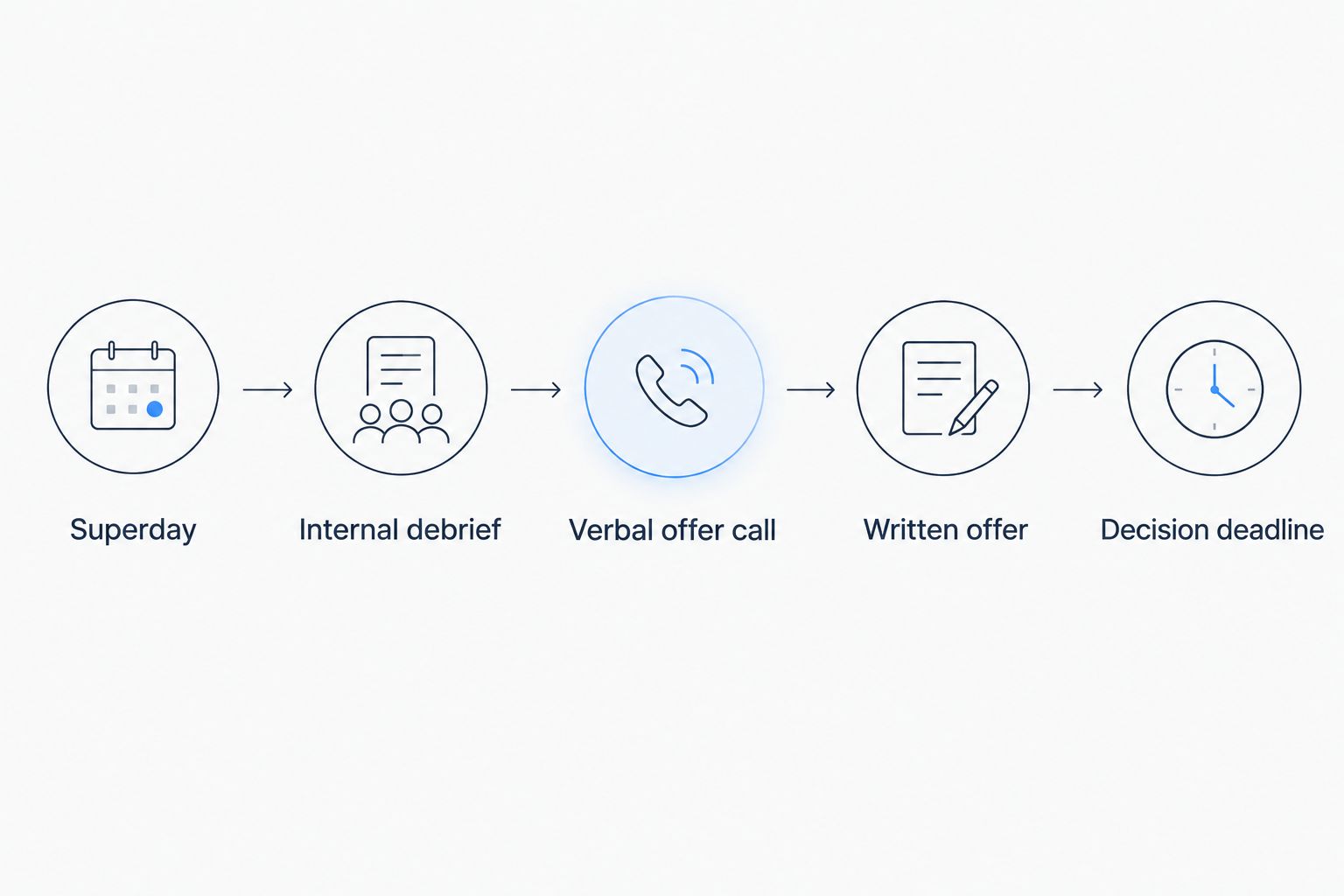
A verbal offer after a hedge fund superday typically comes within 24 hours to two weeks, with most quant funds and prop trading firms landing on the faster end of that window. The number that trips people up isn't the wait itself — it's the decision clock that starts the moment the phone rings, often just 24 to 72 hours to accept before the offer expires.
- Verbal offers after a hedge fund superday typically arrive 24 hours to two weeks out, depending on firm size and structure.
- Multi-strat and systematic quant funds move fastest, often calling within 24 to 72 hours.
- Exploding offers are common industry practice: a 24 to 72 hour window to accept once the call comes.
- Silence past two weeks after a superday usually means backup-list status, not rejection.
- Superday format and headcount urgency are the biggest drivers of how long after a superday hedge funds make an offer.
Why this matters
Quant recruiting doesn't run on a fixed calendar the way corporate hiring does. A firm that just finished landing a hedge fund internship class for the same cycle already knows its budget and headcount before your superday starts, which is exactly why some offers move so fast.
The practical problem: if you don't know what to expect, a 48-hour exploding offer from one fund can blow up your ability to finish interviewing elsewhere. Candidates who understand the timeline going in negotiate better and panic less.
How long after a superday do hedge funds make an offer?
The wait depends heavily on firm type. Larger, more bureaucratic shops route decisions through more people; leaner quant and prop shops let one or two decision-makers move immediately.
| Firm type | Typical time to verbal offer | Typical decision window |
|---|---|---|
| Multi-strat / systematic quant funds | Same day to 3 days | 24 to 72 hours |
| Prop trading firms | Same day to 1 week | 48 hours to 1 week |
| Traditional discretionary hedge funds | 1 to 2 weeks | 1 to 2 weeks |
| Smaller or boutique funds | 1 to 3 weeks | Flexible, case by case |
The pattern in 2026 recruiting cycles is consistent with prior years: the firms with the tightest, most structured hiring processes are also the ones that move fastest once the superday ends, because the decision was mostly made before you walked in.
Multi-strat and systematic quant funds: offers in 24 to 72 hours
These platforms run pod-based hiring, so a single portfolio manager or team lead often has full authority to extend an offer without a committee. Buy the speed as a signal, not a favor — it means the fund already knew what it wanted walking into your superday.
Prop trading firms: offers within a few days to a week
Prop shops tend to interview in smaller cohorts and compare candidates against each other before calling. If you're one of three finalists for two seats, expect the fund to wait until every superday in that class wraps before it dials anyone.
Traditional discretionary hedge funds: offers within one to two weeks
Larger discretionary funds route offers through more approval layers — sometimes a final sign-off from a CIO or head of HR — which stretches the timeline even when the interview panel loved you. Don't read a ten-day gap here as bad news.
Smaller or boutique funds: offers can stretch past two weeks
Smaller funds often lack a dedicated recruiting function, so the superday feedback loop competes with someone's actual trading or research job. The wait is longer, but it correlates weakly with interest level.
Why offer timing varies
- Headcount urgency — funds with a tight annual hiring plan move fast to lock in talent before a competitor calls first.
- Committee structure — a single pod head can decide alone at a multi-strat; a traditional fund often needs partner-level sign-off.
- Competing finalists — if two candidates from the same superday are being weighed against each other, expect a few extra days.
- Reference checks — some funds run informal calls to former managers or professors before extending, adding roughly 2 to 5 days.
- Recruiting season pressure — internship cycles for 2027 start recruiting unusually early, and compressed calendars mean faster offer decisions across the board.
- Superday format — a single final-round day with three to five interviewers back to back signals a faster decision than interviews staggered across separate weeks.
“If you haven't heard anything by day ten, you're not rejected — you're on the backup list.”
The decision window after the call matters as much as the wait before it. Exploding offers with a 24 to 72 hour acceptance deadline are standard practice at quant funds and prop trading firms, and going in without a clear personal ranking of firms is the single biggest mistake candidates make heading into 2026 recruiting.
Get ready before the offer call comes
Work through your comparison criteria and superday prep before the clock starts.
What if I haven't heard back two weeks after my hedge fund superday?
Two weeks of silence after a superday usually means you're on a backup or waitlist, not that you've been rejected outright. Funds often hold a short list of alternates until the top choice accepts or declines, and that process alone can add another week or two before anyone communicates a final answer.
Do hedge funds call the same day as the superday to give an offer?
Yes — same-day verbal offers happen most often at multi-strat and systematic quant funds where a single decision-maker runs the final round. Traditional discretionary hedge funds rarely move this fast because the offer still needs sign-off from someone who wasn't in the interview room.
How long do I have to accept a hedge fund offer once it's extended?
A typical acceptance window is 24 to 72 hours once a verbal offer is extended, especially at quant funds and prop trading firms known for exploding offers. Some traditional funds give a week, but treating any offer as open-ended is a mistake in the current 2026 market.
FAQ
How long after a superday do hedge funds make an offer?
Most hedge funds extend a verbal offer within 24 hours to two weeks of a superday, with multi-strat and systematic quant funds moving fastest. Traditional discretionary funds and smaller boutiques tend to take longer because more people sign off on the decision.
What's the fastest a hedge fund has extended an offer after a superday?
Same-day verbal offers happen most often at multi-strat platforms and prop trading firms, sometimes before a candidate leaves the building. This is possible because a single pod head or trading desk lead usually has full hiring authority.
Is a slow response after a superday a bad sign?
Not automatically — a slow response is common at traditional discretionary hedge funds and smaller funds where offers route through more approval layers. It becomes a real concern only well past the two to three week mark with zero communication.
Should I follow up if I haven't heard back after my superday?
A brief, professional follow-up after about one week is reasonable and won't hurt your candidacy. Keep it short: reaffirm interest, ask for a timeline update, and avoid pressuring the recruiter for a decision date.
Does the offer timeline differ between quant hedge funds and prop trading firms?
Yes — prop trading firms often compare an entire superday cohort before extending any offers, which can take a few days to a week. Quant hedge funds with pod-based hiring can decide within 24 to 72 hours because fewer people need to weigh in.
How much time do I get to decide on a hedge fund offer?
A 24 to 72 hour acceptance window is standard for exploding offers at quant funds and prop trading firms in 2026. Larger traditional funds sometimes extend this to about a week, but assume the shorter window unless told otherwise.
Does the superday format affect how fast the offer comes?
Yes — a single condensed superday with three to five back-to-back interviews usually signals a faster decision than a process staggered across multiple separate rounds. Staggered formats mean the firm is still comparing candidates across weeks, not hours.
One last thing
The firms that call fastest after a superday are almost always the ones that already knew who they wanted walking in — treat every interviewer in the room like a decision-maker, because at a multi-strat fund, one of them usually is. Slow doesn't mean no in 2026 recruiting; it usually just means more people have to sign the same piece of paper.