
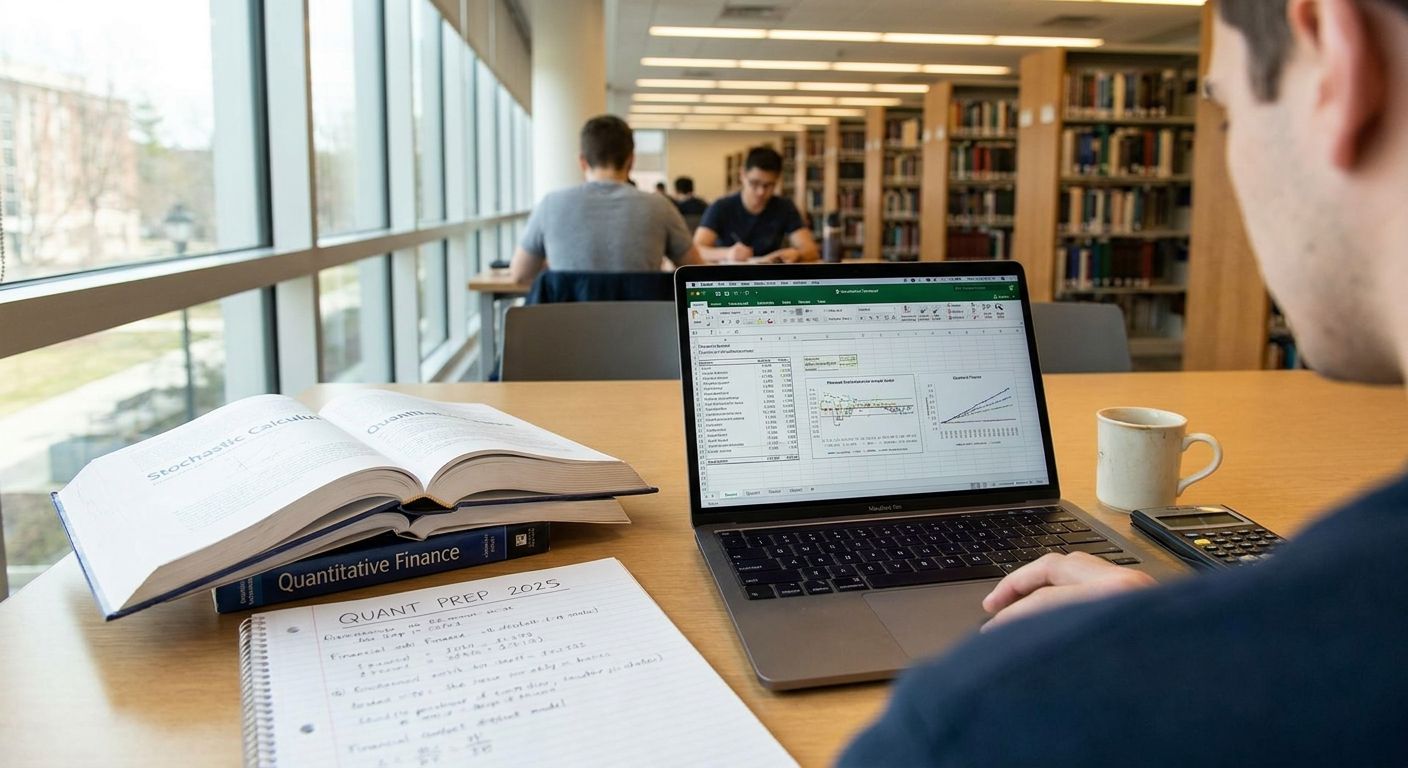
Quant interview prep for MFE students is the structured process of mastering probability, mental math, coding, and firm-specific technical rounds with the aim of converting internship and full-time interviews into offers. Unlike undergraduate candidates, MFE students work inside a compressed one-to-two-year program calendar, and interviewers expect graduate-level stochastic calculus and statistics from day one, not just puzzle-solving speed.
- Quant interview prep for MFE students needs a 6-8 week technical drill schedule, not last-minute brainteaser cramming.
- MFE program timelines compress recruiting, so applications and prep for 2026 cycles should start before the fall term.
- Mock interviews under real time pressure catch the gaps that solo studying misses.
- QuantMinds offers 1-on-1 feedback for candidates who want expert review of their answers before a live interview.
Why quant interview prep matters for MFE students
MFE students are competing against peers who share the same coursework, the same GPA range, and often the same two or three target firms. The differentiator in quant interview prep isn't knowing the material — it's explaining it under pressure, fast, and in the vocabulary a desk actually uses.
Recruiting for the following summer's internship class typically opens well before most MFE students expect, which means candidates who wait until spring of their program year are already behind. A student targeting a 2027 summer internship, for example, needs resume and networking groundwork finished well into 2026, long before interview invitations go out.
Program career offices push generic case-interview advice that doesn't map to trading desks or quant research teams. That gap is why quant interview prep has to be treated as its own discipline, separate from general finance interview coaching, starting with your resume and QuantMinds can review that resume alongside your technical prep plan.
Build your quant interview prep plan step by step
Audit your technical foundations
Before drilling questions, find out where your gaps actually are. Most MFE students overestimate their probability fluency and underestimate their mental math speed.
- Time yourself on 10 mental math problems (percentages, quick multiplication, compounding) — under 60 seconds each is the bar
- Re-derive Bayes' theorem and conditional probability from scratch without notes
- Review linear algebra basics: eigenvalues, matrix decomposition, covariance matrices
- Check your coding fluency in Python or C++ on data structures, not just syntax
- List every stochastic process concept from your coursework you can't explain in two sentences
Build a 6-to-8 week study calendar
A calendar with weekly milestones beats an unstructured stack of practice books. MFE students who block time by topic finish more of the material than those who study whatever feels comfortable that day.
- Assign weeks 1-2 to probability and statistics review
- Assign weeks 3-4 to brainteasers, mental math, and market-making logic
- Assign weeks 5-6 to coding and algorithm practice
- Reserve weeks 7-8 exclusively for mock interviews and firm research
- Track weak topics in a running list and revisit them every week, not once
Drill quant interview questions daily
Consistency beats marathon sessions. Fifteen focused minutes a day for six weeks outperforms three cram sessions the week before an interview.
- Work through classic probability puzzles (birthday problem, expected value games, dice and coin scenarios)
- Practice option pricing intuition and basic Black-Scholes logic if targeting a derivatives desk
- Rotate between market-making, statistics, and coding questions so no single skill atrophies
- Time every practice question — quant interviews reward speed as much as correctness
- Keep a running error log of questions you missed and why
Prepare your resume narrative and behavioral answers
Quant interview prep isn't purely technical. Every interview opens with "walk me through your resume," and a weak answer here colors the rest of the conversation.
- Write a 90-second resume walkthrough and practice it out loud, not just in your head
- Prepare a clear answer for "why quant" that's specific to your background, not generic
- Have two or three research or project stories ready with a concrete result attached
- Know why you're targeting this specific firm and desk, not just "quant finance" broadly
- Practice explaining a technical project to a non-technical interviewer in plain language
Run mock interviews under real time pressure
Solo review teaches recall. Mock interviews teach performance, and performance is what gets scored.
- Schedule mocks with classmates who are also recruiting, so the pressure feels real
- Set a strict clock — most technical rounds run 30 to 45 minutes
- Record yourself answering out loud at least once to catch verbal tics and hedging language
- Ask your mock partner to interrupt with follow-up questions, the way real interviewers do
- Debrief immediately after each mock and log what broke down
Get expert feedback on your delivery
At this stage, most MFE students hit a ceiling that peer mocks can't fix — they don't know if their explanation actually sounds like a hire-worthy answer or just a correct one. This is where outside review speeds things up. QuantMinds runs 1-on-1 quant interview prep sessions built around resume review and mock interviews from someone who has sat inside MFE admissions and hiring conversations, which shortens the feedback loop compared to guessing on your own.
- Get a session focused specifically on your weakest interview round (technical, behavioral, or case-style)
- Ask for direct feedback on pacing — most candidates talk too fast when nervous
- Request a review of how you handle a question you don't immediately know the answer to
- Use outside feedback to catch blind spots your study group has stopped noticing
Research the firm and tailor your prep
Generic quant interview prep treats every firm the same. Buy-side research teams, sell-side trading desks, and high-frequency prop shops ask different questions and reward different instincts.
- Read the firm's public materials to identify whether it's systematic, discretionary, or a hybrid
- Adjust your prep weighting: HFT interviews lean harder on mental math and coding speed, research roles lean on statistics depth
- Identify which asset class the desk trades and review relevant market mechanics
- Note whether the process is a single technical round or a multi-stage superday, and pace your prep accordingly
“Most MFE candidates over-prepare on brainteasers and under-prepare on explaining their own resume.”
Comparing your quant interview prep options
| Option | Best for | Starting price | Key limitation |
|---|---|---|---|
| Self-study with practice books | Building probability and mental math fundamentals early | Free (aside from book cost) | No feedback on how your answers actually sound out loud |
| University career services | Students still enrolled who want general interview logistics help | Free with tuition | Advice is rarely quant-specific or desk-aware |
| Peer mock interviews | Testing recall and timing under pressure | Free | Peers often don't know the real interview format either |
| Quant interview question banks (e.g., published practice guides) | Structured technical drilling | Cost of the book | No live feedback loop, answers can feel rehearsed |
| 1-on-1 coaching (QuantMinds) | Candidates with interviews scheduled who need expert feedback fast | Not publicly listed, contact for a session | Costs money and requires scheduling around your prep calendar |
Verdict: pair free self-study for foundations with at least one round of expert-reviewed mock interviews before a real interview — skipping outside feedback is the most common gap in MFE quant interview prep.
Get your quant interview reviewed
1-on-1 resume and mock interview coaching from inside MFE admissions experience.
Common mistakes MFE students make in quant interview prep
- Over-indexing on coding practice and under-indexing on probability. MFE students with strong programming backgrounds assume LeetCode reps will carry them through, but most quant technical rounds lean heavier on probability and mental math than pure coding.
- Treating every firm's interview the same. A buy-side research interview and an HFT superday test different instincts; using one prep plan for both wastes weeks.
- Skipping behavioral prep entirely. Assuming a strong GPA and thesis topic will speak for themselves leaves candidates flat-footed on "walk me through your resume."
- Starting too late relative to the recruiting calendar. Internship recruiting for the following summer often opens well before spring term, and MFE students who wait until they feel "ready" miss early application windows.
- Never practicing out loud. Silent review builds recognition, not fluency, and interviewers score how you explain an answer as much as whether it's correct.
FAQ
What's the best way to start quant interview prep as an MFE student?
Start with a technical audit to find your weakest area in probability, mental math, or coding, then build a 6-to-8 week calendar around those gaps. MFE students who skip the audit tend to over-study topics they already know.
How long should quant interview prep take for MFE students?
Six to eight weeks of structured prep is typical, with the final two weeks focused on mock interviews and firm-specific research. Compress that timeline and mock interview quality usually suffers.
Is quant interview prep different for buy-side versus sell-side roles?
Yes. Buy-side research roles weight statistics and modeling depth heavier, while sell-side trading and HFT roles weight mental math and coding speed heavier. Tailor your practice mix to the desk, not just the industry.
Do I need coding practice for quant interviews if I'm targeting research roles?
Some coding is expected even for research-focused roles, but the bar is usually lower than for a developer or HFT track. Confirm the language and depth expected directly from the firm's job posting when possible.
How much does 1-on-1 quant interview coaching cost?
Pricing for 1-on-1 coaching varies by provider and session format, and isn't standardized across the industry. Contact a coaching provider directly for current rates rather than relying on outdated figures.
When should MFE students start quant interview prep for summer internships?
Internship recruiting for the following summer often opens well before spring term, so prep and networking should start the prior year, not the semester interviews begin. Waiting until you feel fully ready usually means missing early application rounds.
Are mock interviews really necessary if I know the material?
Yes, because quant interviews score delivery and pacing, not just correctness. Candidates who only review silently often stumble on explaining an answer out loud for the first time in the actual interview.
What's the biggest mistake MFE students make in quant interview prep?
Treating every firm's interview process identically instead of tailoring the prep mix to the specific desk and role. A generalist prep plan wastes study time on skills that particular interview won't test.
One last thing
The candidates who convert quant interviews into offers aren't always the ones with the strongest coursework — they're the ones who rehearsed their weakest explanation out loud until it stopped sounding rehearsed. If your 2026 recruiting cycle is already underway, the fastest fix isn't another practice book, it's a live mock interview with someone who can tell you exactly where the answer breaks down.