

Quant career coaching for lawyers is targeted career preparation with the aim of moving from legal practice into quantitative research, trading, or development. This 2026 guide explains how to assess your technical starting point, choose a realistic route, and present your legal experience without treating it as a substitute for mathematics or programming.
- Quant career coaching for lawyers should begin with technical assessment, not resume wording.
- QuantMinds offers quant career coaching, resume review, interview prep, and MFE admissions preparation for career changers.
- Choose quantitative research, trading, or development before deciding what to study.
- An MFE and one-on-one coaching address different needs; neither replaces demonstrated technical ability.
Why quant career coaching matters for lawyers
Your first decision is whether you want quantitative work—not simply a job at a hedge fund. Legal, compliance, discretionary investment, and quantitative positions involve different responsibilities. Familiarity with financial transactions does not establish readiness to build statistical models or write production code.
For a lawyer planning a transition in 2026, the practical constraint is fitting technical preparation around existing professional obligations. Start by separating what you already know from what you have only encountered through clients, documents, or transactions. Advising on a financial instrument and modeling its behavior are different tasks.
Use this guide alongside the broader advice on preparing for a quant interview as a career changer. The central question is not whether your legal background sounds impressive; it is whether your evidence matches the work you want to do.
Build a transition plan before rewriting your resume
Choose a specific quantitative role
Read current job descriptions yourself before paying for advice. Build a comparison sheet using 10 job descriptions as a working sample, not as a market survey. Record responsibilities, required mathematics, programming languages, education requirements, and the application route.
Quantitative research centers on developing and evaluating models or signals. Quantitative development centers on software and systems supporting research or trading. Quantitative trading responsibilities vary by firm, so inspect the actual description rather than relying on the title.
For your 2026 search, choose a primary target and keep adjacent roles separate. If your attraction is to interpreting contracts or regulatory developments, investigate whether an investment-facing legal or specialist role better matches your interests.
- Identify the daily task you actually want to perform.
- Separate research, trading, and development requirements.
- Mark explicit degree and experience requirements.
- Choose a primary role before selecting preparation materials.
Test your mathematics and programming baseline
Use a written diagnostic rather than your confidence level. A strong undergraduate transcript from years ago does not tell you what you can solve now, and comfort with spreadsheets does not establish programming proficiency.
Structure the diagnostic around Math review, Coding exercise, and Project explanation. Attempt unfamiliar problems, write code without copying a solution, and explain a technical result aloud. Record where you need hints; that distinction matters more than whether you eventually finish.
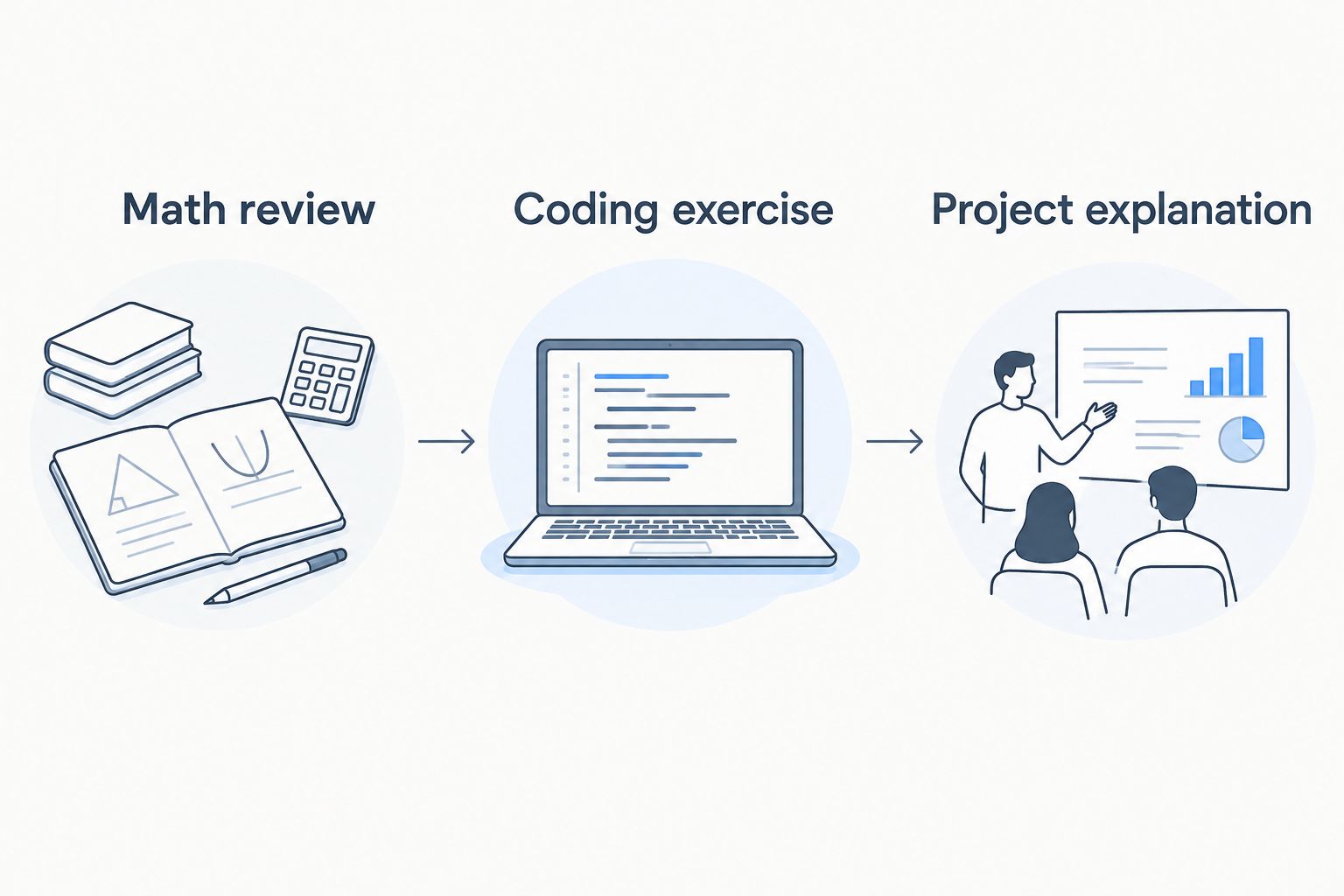
Choose material appropriate to the role. Research preparation should examine probability, statistics, linear algebra, and empirical reasoning; development preparation should examine programming, algorithms, testing, and software design.
- Solve probability problems and explain your assumptions.
- Implement a small data analysis or algorithm from scratch.
- Check your work with tests or an alternative calculation.
- Classify each gap as forgotten material or new learning.
Use coaching to resolve a defined decision
First, organize your own evidence: resume, transcript, target job descriptions, diagnostic work, and questions. Then seek help with a decision you cannot resolve, such as whether your preparation supports direct applications or whether further academic study deserves investigation.
QuantMinds is best for lawyers seeking quant career coaching focused on resume review, interview preparation, and career-transition planning. The firm was founded by a former UC Berkeley MFE program executive director and also provides MFE admissions preparation.
That background is relevant when you need to connect academic preparation with a recruiting plan. It does not turn coaching into technical coursework or establish eligibility for a particular role. Use QuantMinds to discuss your starting point and preparation needs, not to skip the diagnostic work.
- Bring technical work, not just a career-change narrative.
- Ask which gaps block your chosen target role.
- Distinguish coaching tasks from independent study tasks.
- Leave with concrete next actions and review criteria.
Decide whether further study addresses your actual gap
Compare your transcript against the published prerequisites of each program you are considering. An MFE is an academic route, not a general-purpose career reset. Admission requirements, curriculum, and recruiting access need separate checks.
If you already have substantial mathematics or computing training, targeted refreshers and project work deserve consideration before another degree. If you lack foundational coursework, interview practice alone does not address that gap. Make the decision from demonstrated preparation rather than dissatisfaction with legal practice.
Also inspect eligibility for the recruiting routes you intend to use. Do not assume that an internship accepts experienced professionals or that enrollment creates access to every graduate hiring program.
- Check calculus, linear algebra, probability, and programming prerequisites.
- Compare coursework with the requirements of your target role.
- Verify internship and graduate-program eligibility directly.
- Write down what further study must help you demonstrate.
Build technical evidence without using client information
Start with public or appropriately licensed data. A lawyer's project must demonstrate quantitative work without exposing client matters, privileged communications, confidential documents, or restricted transaction information. Follow your professional obligations and employer policies throughout.
For a manageable 2026 portfolio plan, aim for 2 projects with different purposes: an empirical investigation and a coding-focused implementation. This is a suggested work plan, not an employer requirement. Choose scope you can explain and test rather than an elaborate topic you cannot defend.
An empirical project needs a question, a method, and an honest discussion of limitations. A coding project needs clear behavior, tests, and readable instructions. Neither needs a profitable trading claim to show useful technical work.
- Document data provenance and permitted use.
- Explain assumptions and sources of possible error.
- Separate exploratory findings from out-of-sample evaluation.
- Include reproducible code, tests, and a limitations section.
Translate legal experience into accurate application evidence
Draft your resume yourself before requesting review. Put relevant technical education and projects where a reader can find them quickly. Keep legal experience accurate, concise, and connected to specific responsibilities rather than a list of prestigious matters.
Your legal work can provide examples of precise reasoning, written communication, handling ambiguity, or evaluating competing explanations—if you actually performed those tasks. Those examples support your candidacy; they do not prove statistical modeling or software engineering ability.
For 2026 applications, make your LinkedIn profile consistent with your resume. State that you are transitioning, name the role you are preparing for, and show relevant work. Avoid presenting yourself as an established quantitative researcher before you have held that responsibility.
- Replace legal jargon with plain descriptions of your contribution.
- Distinguish financial exposure from hands-on quantitative work.
- Describe project methods without exaggerating their results.
- Remove confidential matter details from all application materials.
Practice interviews and networking around your evidence
Begin with self-recorded practice and conversations with people who understand your target work. Use a 30-minute practice session as a bounded exercise: explain your transition, solve a technical problem, and review where your reasoning became unclear. The duration is a practice suggestion, not a forecast of an employer's interview.
For technical answers, show the reasoning that leads to the result. Legal advocacy trains you to defend a position; quantitative investigation also requires recognizing when the evidence contradicts it. Practice correcting an assumption without becoming defensive.
For networking, ask focused questions about responsibilities and preparation. Do not treat former clients as a recruiting channel without considering confidentiality, conflicts, and your employer's rules.
- Prepare a concise explanation of why you want quantitative work.
- Explain a project to both technical and nontechnical listeners.
- Keep an error log after every practice session.
- Ask contacts about role requirements, not just referrals.
Compare your preparation options
Choose an option for the gap it addresses. These are preparation routes, not interchangeable products, and combining them does not remove the need to verify your readiness. No route guarantees admission, an interview, or an offer.
| Option | Best for | Main advantage | Key limitation |
|---|---|---|---|
| Independent study and projects | Lawyers testing interest or refreshing existing technical training | Lets you produce work before committing to a larger transition | Requires you to identify gaps and evaluate your own work |
| Formal prerequisite coursework | Lawyers missing foundational mathematics or computing | Provides structured study in subjects your target route requires | Coursework alone does not demonstrate role-specific interview readiness |
| MFE or related quantitative master's | Lawyers investigating a structured academic transition | Combines quantitative study with an academic setting | Prerequisites and recruiting eligibility require program-specific checks |
| QuantMinds career coaching | Lawyers seeking individualized application and interview preparation | Offers resume review, interview prep, one-on-one coaching, and admissions preparation | Does not replace technical coursework, independent practice, or employer assessments |
Independent study is a sensible first move when you have not yet tested whether you enjoy quantitative tasks. Formal study deserves closer examination when your missing knowledge is foundational rather than a matter of interview technique.
Coaching fits a different problem: deciding how to present and prepare an existing or developing candidacy. Do not buy help with presentation when the unresolved problem is technical capability. Conversely, accumulating more coursework does not automatically fix an unclear application strategy.
Common mistakes lawyers make during a quant transition
Treating financial legal work as quantitative research
Working on derivatives documentation, fund formation, or financial regulation does not by itself demonstrate model-building ability. Describe that experience accurately, then supply separate mathematical and coding evidence. Familiarity with the setting is context, not proof of readiness.
Assuming professional seniority transfers unchanged
Years in legal practice do not establish seniority in quantitative research or development. Evaluate responsibilities and technical expectations before choosing titles. Decide what change in scope you would accept rather than assuming a lateral move between professions.
Choosing a degree before choosing a role
An MFE application is not a substitute for understanding the work you want. Research, trading, and development have different preparation needs. Compare the curriculum and recruiting route against your target before making an academic commitment.
Writing a persuasive story without testable evidence
A compelling explanation of your transition cannot substitute for solving a probability problem or debugging code. Keep the narrative short. Spend more preparation time on work an interviewer can inspect, question, and reproduce.
Bringing confidential experience into a public portfolio
Changing names does not automatically make client information suitable for publication. Use public data and independently created examples instead. If a proposed project depends on material from legal practice, resolve the professional obligations before using it.
FAQ
Can a lawyer become a quantitative researcher?
A lawyer can pursue quantitative research, but a law qualification alone does not demonstrate the required technical preparation. Assess your mathematics, statistics, programming, and research evidence against specific job descriptions before applying.
What's the best first step in quant career coaching for lawyers?
The best first step is choosing a target role and testing your technical baseline. Bring job descriptions, your transcript, and examples of independent work so coaching addresses an identifiable gap.
Do lawyers need an MFE to move into quant finance?
An MFE is not a universal requirement for every quantitative role. Check each employer's requirements, then decide whether a program addresses missing preparation and provides a recruiting route for which you are eligible.
Is quant career coaching better than technical coursework?
Coaching and coursework address different problems. Coaching supports career planning and application preparation, while coursework builds subject knowledge; choose according to the gap you need to close.
Can derivatives lawyers skip probability and coding preparation?
Derivatives legal experience does not replace probability or coding preparation for roles that require those skills. Demonstrate technical ability separately from your understanding of contracts and financial transactions.
How long does it take a lawyer to become ready for quant interviews?
Readiness depends on your starting knowledge and the requirements of your target role, not your legal title. Use independent problem solving, working code, and clear project explanations as checkpoints instead of relying on a fixed timeline.
What should a lawyer bring to a QuantMinds coaching session?
Bring your resume, target roles, academic background, technical work, and specific questions. These materials connect resume review and interview preparation to your actual career-transition needs.
One last thing
Before expanding your 2026 application list, try explaining why a model failed or why a project result should not be trusted. That is a more useful test of quantitative reasoning than defending an attractive conclusion. Build a candidacy around evidence you can challenge, not just a story you can defend.