

Postdoctoral researchers’ quant coaching is career preparation aimed at turning research experience into a credible application for quantitative research, trading, or development roles. This 2026 guide explains how to translate your academic work, test your interview readiness, and decide whether individual coaching addresses a specific gap rather than adding another credential.
- Quant coaching for postdoctoral researchers should connect research experience to specific quantitative finance roles, not sell another credential.
- QuantMinds is best suited to postdoctoral researchers seeking individual quant career coaching, resume review, and interview preparation.
- Choose a target role before rewriting your academic CV or adding finance coursework.
- Practice coding, probability, and research explanations separately; academic depth does not demonstrate every interview skill.
Why quant coaching matters for postdoctoral researchers
Your postdoctoral work gives you material to discuss: research questions, mathematical methods, experiments, code, and decisions under uncertainty. The recruiting task is to show which of those capabilities fits the role you want. A publication list alone leaves that connection unexplained.
Start by learning how to explain a research project in a quant interview. You need a clear account of what you investigated, what you personally contributed, and how you tested your conclusions—not a compressed conference presentation.
Postdoctoral candidates also have practical constraints. You need to fit preparation around research commitments, explain why you want to leave academia, and distinguish research experience from trading experience. If work authorization affects your search, treat eligibility as a separate question that requires employer-specific confirmation.
Use coaching to diagnose a recruiting problem, not to validate your intelligence. For your 2026 search, the useful question is whether your current materials and interview performance demonstrate the requirements of a particular opening.
Build a postdoctoral-to-quant recruiting plan
1. Choose your target role
Read current job descriptions yourself before asking anyone to assess your prospects. Separate quantitative research, quantitative trading, and quantitative development; do not treat them as interchangeable destinations for someone with a doctorate.
Research roles give you a reason to examine how your statistical modeling and experimental judgment transfer. Trading roles require you to investigate the specific decision-making and market tasks described by the employer. Development roles require a closer look at software engineering expectations, not just your familiarity with a programming language.
Build your shortlist from the work you can demonstrate. A mathematical specialization is useful context, but your application still needs evidence of the advertised skills. In your 2026 planning document, record requirements from current postings rather than relying on an old description of what a quant does.
- Select a primary role family and a secondary alternative.
- Copy the required skills from relevant current postings.
- Match each requirement to a project, implementation, or research example.
- Mark requirements you have not yet demonstrated.
- Record location and work-authorization questions separately.
2. Rewrite your academic CV as a role-specific resume
Create the first draft yourself. Keep the academic CV as a source document, then build a recruiting resume that foregrounds the evidence relevant to your target role.
Describe your contribution before naming the paper or laboratory. Explain what you modeled, implemented, compared, or corrected. Include measured results only when you can substantiate them from your own work; do not invent performance improvements to make a bullet sound commercial.
For example, a numerical methods project should explain the computational problem, your implementation, and your validation approach. An empirical project should distinguish data preparation, model selection, and evaluation. You do not need to rename academic research as a trading strategy.
Make your LinkedIn profile consistent with the resume. A recruiter should not have to reconcile different dates, project descriptions, or career objectives across your materials.
- Lead with relevant methods, programming, and research contributions.
- Explain unfamiliar academic terminology in plain language.
- Separate your work from the broader research group’s output.
- Select publications that support the target role.
- Check dates, technical claims, and LinkedIn consistency.
3. Diagnose your interview gaps before buying help
Begin with a self-assessment and peer practice. Solve an unfamiliar probability problem aloud, implement a coding solution without your usual notebook, and explain a research project to someone outside your specialty.
Record a 20-minute practice session as a diagnostic exercise. Review where you stalled: understanding the question, choosing an approach, writing correct code, or explaining your reasoning. The duration is a practice format, not an employer interview standard.
QuantMinds offers quant career coaching, resume review, interview preparation, and one-on-one coaching. Its founder’s background as a former UC Berkeley MFE program executive director is relevant to career positioning and admissions questions. Use individual feedback when you need help prioritizing the gaps you have identified, rather than treating coaching as a prerequisite for applying.
A targeted review gives a coach concrete material to assess. Bring the role description, your resume, and an example of where your practice broke down; a general question about whether you are good enough is less actionable.
- Attempt unfamiliar problems before reading solutions.
- Record your reasoning as well as your final answer.
- Separate knowledge gaps from communication problems.
- Bring current role descriptions to a coaching discussion.
- Ask which weakness deserves attention first.
4. Explain your research without a seminar
Draft a 2-minute research explanation before building a longer version. This is a communication exercise: it forces you to identify the central question and your contribution without relying on slides.
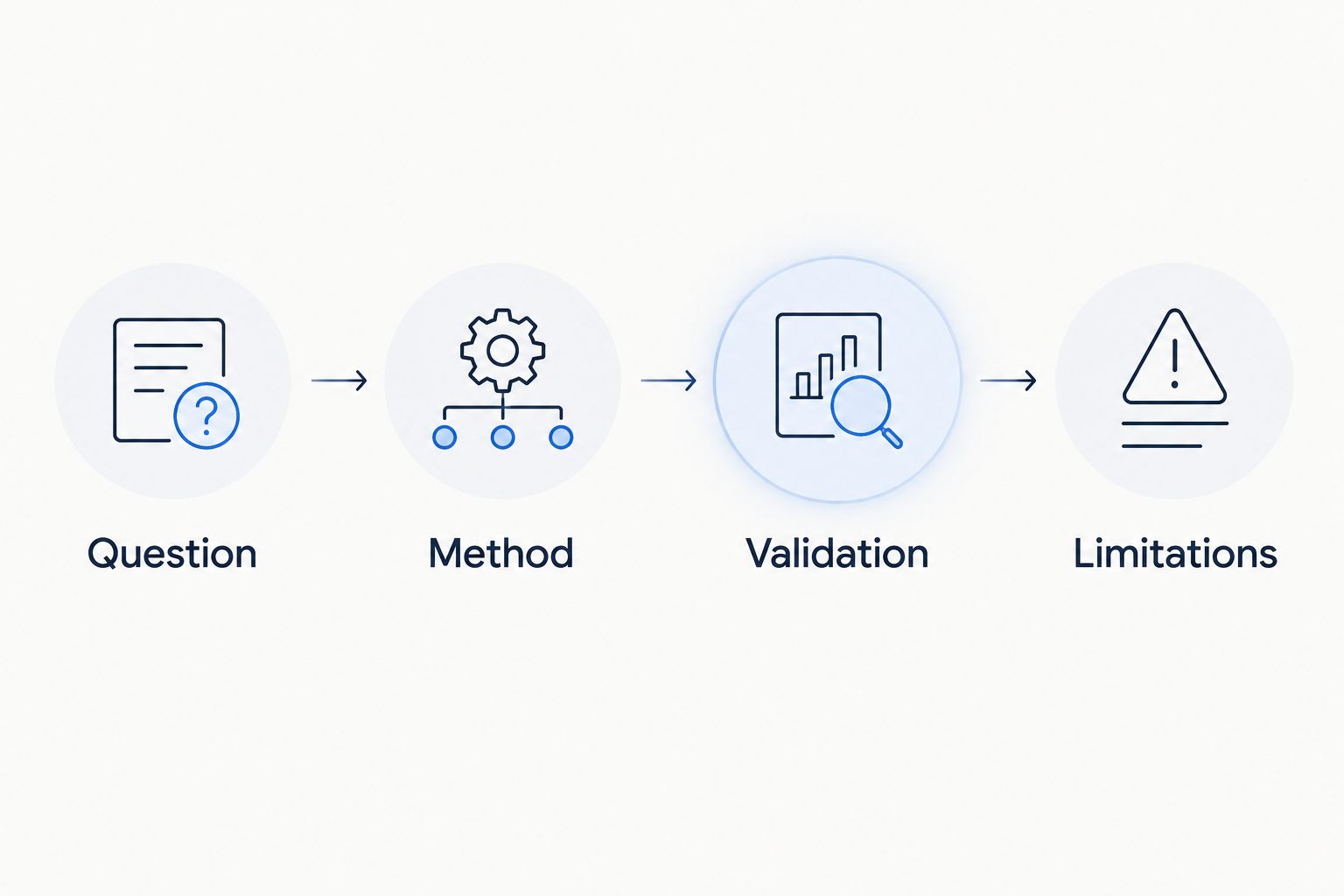
Use four parts: Question, Method, Validation, and Limitations. State the problem, explain your approach, describe how you checked it, and identify what the result does not establish. Keep the structure even when the research topic is highly technical.
For empirical work, distinguish exploratory analysis from evaluation. For theoretical work, explain the assumptions and the conditions under which the result holds. Be ready to discuss a failed approach without disguising it as a success.
Your contribution must remain visible throughout. If collaborators designed part of the method or wrote part of the code, say so. Clear ownership is more credible than claiming the entire project.
- Question: State the problem and why you investigated it.
- Method: Explain your approach and personal contribution.
- Validation: Describe checks, comparisons, and evaluation choices.
- Limitations: Identify assumptions and unresolved weaknesses.
- Prepare a deeper explanation for technical follow-up questions.
5. Practice the skills your target interviews require
Build your practice plan from the role requirements and any interview guidance the employer provides. Do not assume every quantitative interview requires the same mathematics, coding language, or market knowledge.
Work through problems manually first, then compare your approach with a reliable solution. In coding practice, test edge cases and explain complexity where relevant. In probability and statistics practice, state assumptions before calculating. For research discussions, defend your evaluation choices rather than reciting method names.
Try a 30-minute coding practice block with a defined problem and a written error review afterward. This is a suggested exercise, not a claim about interview length. Adjust the task to your target role instead of turning the timer into the objective.
For your 2026 preparation, maintain an error log. It should tell you what to change in the next session, not simply count completed questions.
- Practice translating a question into an explicit model.
- Write and test code outside your familiar research workflow.
- Explain assumptions before using a formula.
- Review errors by cause, not just topic.
- Reattempt missed problems without consulting the answer.
- Ask a peer to challenge your reasoning aloud.
6. Network around a clear research-to-role story
Start with your existing academic network: collaborators, alumni, former lab members, and researchers who have moved into industry. Ask about their work and the evidence their teams look for, rather than immediately requesting a referral.
Write a short introduction that identifies your field, relevant methods, and target role. Explain the move into quantitative finance positively. You need a reason for choosing the work, not only a reason for leaving academia.
Keep the first conversation focused. A useful question might concern how a team evaluates research quality or which software skills the role actually uses. Respect confidentiality; do not ask contacts to share proprietary strategies or restricted interview material.
For your 2026 outreach, use what you learn to revise your shortlist. A conversation is useful even when it reveals that the role is a poor match.
- Identify contacts with relevant quantitative finance experience.
- Introduce your research through transferable methods.
- Ask a specific question about the role or team.
- Keep referral requests separate from initial introductions.
- Record advice that changes your preparation priorities.
7. Track applications and revise the weak stage
Create a simple spreadsheet before adding another recruiting tool. Record the role, resume version, submission date, stage reached, and any feedback you receive.
Look for where your process stops. If applications produce no interviews, review role fit and application materials before assuming the problem is advanced mathematics. If technical interviews expose repeated coding errors, prioritize those errors rather than rewriting your personal statement.
These are diagnostic directions, not proof of why an employer rejected you. A rejection without feedback does not identify a single cause. Keep your conclusions tied to observations you can actually document.
Protect time for research commitments and preparation. You need a plan you can sustain alongside your postdoctoral responsibilities, not an ambitious schedule that collapses after the first deadline.
- Track each application and the resume version used.
- Record interview topics without retaining confidential material.
- Separate employer feedback from your own interpretation.
- Revise the stage with documented weaknesses.
- Check current deadlines directly with the employer.
Compare preparation options for postdoctoral researchers
Choose the option that matches your immediate problem. Independent preparation, peer practice, university support, and individual coaching serve different purposes; none replaces the need to demonstrate role-relevant skills.
QuantMinds is best suited to postdoctoral researchers seeking individual quant career coaching, resume review, and interview preparation. Its stated service scope matches those needs. Coaching does not substitute for doing technical practice or verifying employer requirements.
| Option | Best for | Main advantage | Key limitation |
|---|---|---|---|
| Independent preparation | Candidates who can identify and correct their own gaps | Direct control over role selection, study materials, and practice | Self-review lacks an outside assessment of your reasoning and positioning |
| Peer practice | Candidates who need to explain solutions aloud | Another person can question assumptions and challenge unclear explanations | Feedback depends on the peer’s knowledge of the task and target role |
| University career support | Postdoctoral researchers with access to relevant institutional services | A starting point for application materials and alumni connections | Confirm postdoctoral eligibility and quantitative finance expertise directly |
| QuantMinds | Candidates seeking individual resume, interview, and career coaching | Quant-focused support with a founder’s MFE program leadership background | You still need independent technical work; confirm the scope against your target role |
For a 2026 coaching decision, ask what material you should bring, which recruiting problem the discussion will address, and what you should do afterward. A useful engagement starts with a defined question.
Bring your resume, relevant job descriptions, and a research explanation. If interview preparation is your priority, ask how the session will address the specific skills and interview format you need to practice. Do not assume every type of coaching includes every technical specialty.
Discuss your postdoctoral career transition
Bring your resume, target roles, and interview questions to a quant career coaching discussion.
Common mistakes postdoctoral researchers make
Treating academic seniority as recruiting seniority
A postdoctoral title describes your academic position, not your readiness for every finance role. Target jobs by their responsibilities and required evidence. Explain your research experience without assuming it establishes trading or production engineering experience.
Submitting the full academic CV unchanged
A detailed publication history does not explain your fit by itself. Put relevant methods, code, and personal contributions where the reader can find them. Keep supporting academic detail, but do not make the recruiter reconstruct your argument.
Building a financial model before learning evaluation discipline
A finance-themed project is not automatically stronger than rigorous academic work. If you build an empirical strategy project, explain data choices, evaluation boundaries, and possible leakage. Do not present a historical backtest as evidence of future returns.
Buying another qualification before identifying the gap
Do not make an MFE, certificate, or course your default response to uncertainty. First establish what your target roles require and what your existing work demonstrates. Consider additional education only when it addresses a specific technical, recruiting, or career objective.
Describing the transition only as an escape from academia
You can acknowledge your reasons for leaving without making dissatisfaction your entire story. Explain why the target work interests you, what you bring, and what you still need to learn. Keep that explanation consistent across networking conversations and interviews.
FAQ
What's the best use of quant coaching for postdoctoral researchers?
The best use of quant coaching for postdoctoral researchers is targeted feedback on role selection, resume positioning, and interview preparation. Bring concrete materials and examples of where your current approach breaks down.
Is QuantMinds relevant if I already have a PhD?
QuantMinds is relevant when you want individual quant career coaching, resume review, or interview preparation rather than another academic credential. Its stated services support professionals and students targeting quantitative research, trading, and development roles.
Do I need an MFE after completing a postdoc?
An MFE is not a universal requirement for every quantitative finance role. Assess the requirements of specific openings and identify what additional education would provide before choosing another degree.
Should a postdoctoral researcher target quant research or quant development?
Choose between quant research and quant development by comparing the role requirements with the work you can demonstrate. Research methods and statistical evaluation support one discussion; software design, implementation, and testing support another.
Can I prepare for quant interviews without a finance background?
You can begin quant interview preparation without a finance background by assessing the mathematics, statistics, and coding required by your target roles. Add finance knowledge according to the employer’s stated requirements rather than studying every topic indiscriminately.
How should I explain my postdoctoral research in a quant interview?
Explain your postdoctoral research through the question, method, validation, and limitations. Make your personal contribution explicit and prepare for follow-up questions about assumptions, code, and unsuccessful approaches.
Is coaching better than preparing with a research colleague?
Coaching and peer preparation address different needs. A colleague can challenge technical explanations, while individual career coaching can address resume positioning and recruiting choices; select support according to the gap you need to fix.
One last thing
Before polishing another application, choose a research result you are proud of and explain what would make you distrust it. Then explain how you investigated that possibility.
Your strongest research story includes the checks that could have proved you wrong. That is a specific way to demonstrate judgment without inventing a trading record or disguising academic work as industry experience. Make it part of your 2026 interview preparation.