

Management consultants’ quant career coaching is targeted recruiting preparation with the aim of turning consulting experience and technical skills into a credible quantitative-finance application. This 2026 guide explains how to choose a role, test your readiness, and decide whether you need coaching, technical study, or an MFE before applying.
- Quant career coaching for management consultants should start with role fit, not a rewritten resume.
- QuantMinds suits consultants seeking quant resume review, interview prep, and individual career guidance.
- Quant research, trading, and development require different evidence; choose your target before building a preparation plan.
- Use technical diagnostics to separate a recruiting problem from a skills gap or an MFE admissions decision.
Why quant career coaching matters for management consultants
Your consulting resume answers a different question from a quant application. It explains how you structured problems, advised clients, and delivered work; your quant application must also show the mathematical, statistical, or programming work you can perform yourself.
QuantMinds quant career coaching is best for management consultants seeking resume review, interview prep, and individual guidance on a quant-career transition. QuantMinds helps professionals and students pursue quantitative research, trading, and development roles at hedge funds and prop trading firms. Its founder’s background as a former UC Berkeley MFE program executive director is relevant when your decision involves graduate study as well as recruiting.
The distinction matters. Career coaching addresses positioning and preparation, but it does not replace the technical knowledge your target job requires.
For your 2026 transition, separate three questions: Can you do the work? Can you demonstrate it? Can you explain why this move makes sense? A strong consulting background answers none of those questions automatically, but it gives you experience to examine rather than discard.
Build a quant transition plan around evidence
Choose a specific quantitative role
Start manually: read actual job descriptions and record the work, qualifications, and assessment topics each employer names. Do not treat quantitative research, trading, and development as interchangeable destinations.
For research, inspect requirements involving statistical modeling, data analysis, and research methods. For trading, examine the particular role’s expectations around probability, decision-making, markets, and programming. For development, check the software responsibilities, language requirements, and systems knowledge in the posting.
Then compare those requirements with your own work. A consultant who personally implemented statistical models has different evidence from a consultant who managed an analytics team. Neither background should be described as the other.
Choose the role whose requirements you can support, not the title that sounds closest to your consulting specialty. Keep an adjacent role as a separate hypothesis rather than merging incompatible applications into one resume.
- Create separate notes for research, trading, and development roles.
- Copy required skills from current employer postings.
- Mark which requirements you have demonstrated personally.
- Identify the responsibilities you actually want to perform.
- Choose one primary role for your first preparation cycle.
Audit your technical readiness before applying
Use a self-assessment before asking anyone to polish your application. Select exercises that match your target job, solve them without reference material, and explain your reasoning aloud.
A useful diagnostic is a recommended 60-minute session split between technical work and explanation. This is a planning exercise, not an employer’s interview format. For a research target, examine your statistical reasoning and ability to analyze data; for development, test the coding and software fundamentals named in the posting.
Organize the results under Role requirements, Current evidence, and Skill gaps. Distinguish knowledge you have forgotten from material you have never studied. Those problems require different study plans.
For your 2026 preparation, keep the original attempts. Comparing them with later attempts gives you a record of improvement without relying on how confident you feel after reading solutions.
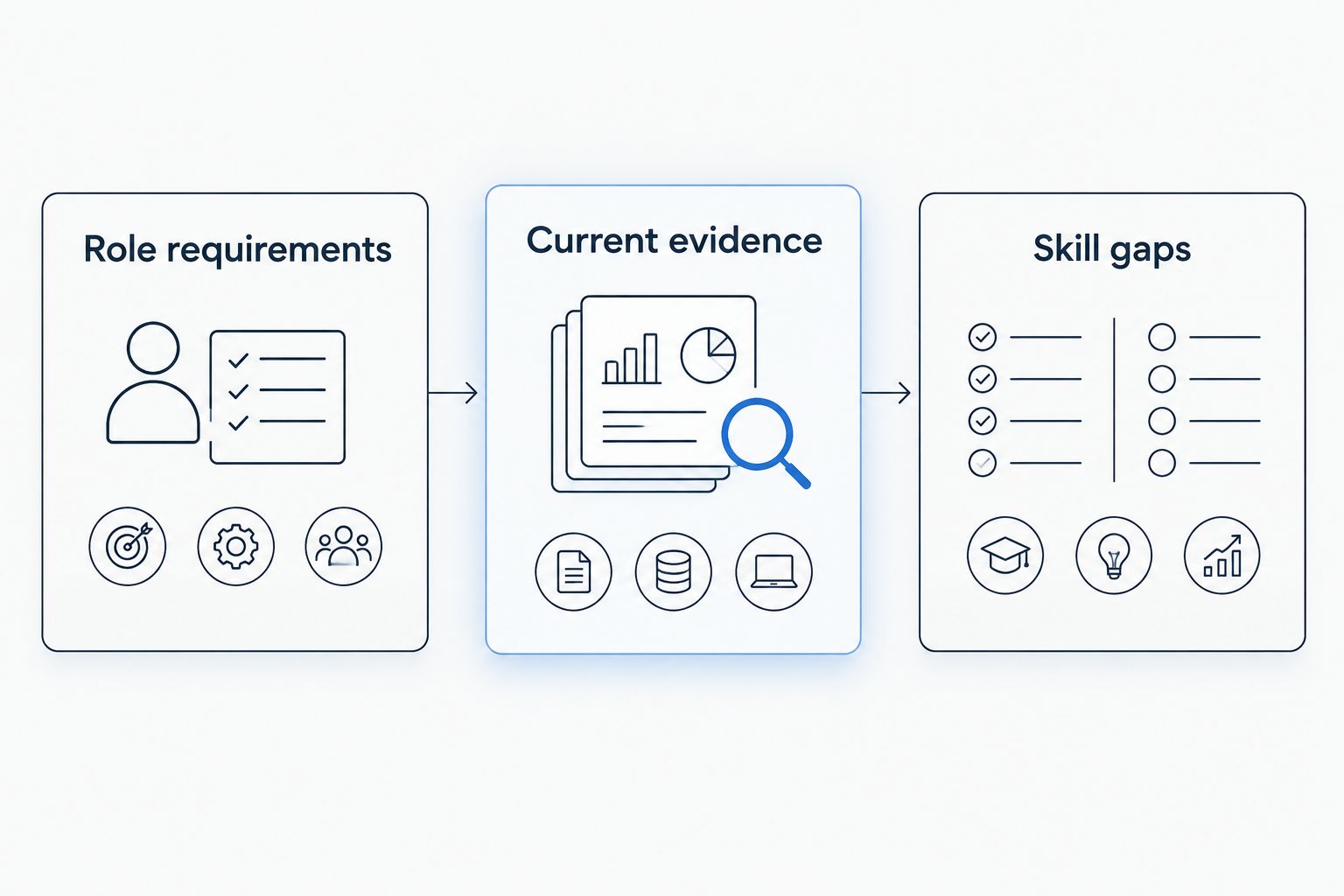
A correct answer is only part of the diagnostic. You should also explain assumptions, recognize mistakes, and show what you would check next.
- Solve relevant exercises without looking at worked answers.
- Record whether each failure involved knowledge, execution, or explanation.
- Revisit mathematical prerequisites before advanced topics.
- Test coding by writing and running your own solution.
- Keep a dated record of attempts and corrections.
Translate consulting experience into technical evidence
Rewrite your resume yourself first. For each engagement, identify the question, the method you personally used, the evidence you examined, and the result you can substantiate.
Replace vague analytical language with accurate descriptions. If you implemented a model, explain its purpose and validation. If you supervised someone else’s implementation, describe your supervisory contribution instead of claiming the code as your own.
QuantMinds offers resume review and individual coaching, making it a direct option when you need outside assessment of that positioning. Use coaching to sharpen truthful evidence, not to make nontechnical work sound like quantitative research.
The same rule applies to LinkedIn. Your headline and experience should make your target clear without suggesting you already hold a role you have not performed.
Protect client confidentiality throughout. An anonymized description is useful only when it remains accurate and does not disclose restricted information; a separate public-data project is a cleaner alternative when client work cannot be discussed.
- Separate personal implementation from team delivery.
- Name methods and tools you actually used.
- Include outcome figures only when you can verify and disclose them.
- Remove consulting jargon that conceals the underlying work.
- Align your LinkedIn summary with your target role.
Build a project you can defend under questioning
Start with public data and a focused question. Build the analysis yourself, document the choices, and include a baseline against which your approach can be evaluated.
For a research-oriented project, explain how you separated model development from evaluation. If the data changes over time, examine whether your design accidentally uses information unavailable at the point of prediction. A polished result is not persuasive if the evaluation is invalid.
For a development-oriented project, emphasize the engineering work relevant to your target: correctness, tests, architecture, and the decisions you made. A trading-related project should explain its assumptions rather than presenting a simulated result as evidence of live trading performance.
Prefer a narrow project you understand to a large project you cannot defend. Your consulting presentation skills are useful here, but the explanation must survive questions about the underlying implementation.
Before calling the project finished, ask a technically capable peer to challenge the method. Record the criticisms and explain which ones changed your work.
- State a testable question before choosing the model.
- Document the data source and cleaning decisions.
- Compare your approach with a sensible baseline.
- Explain evaluation design and possible sources of error.
- Include reproducible code and clear execution instructions.
- Write down limitations alongside the results.
Decide whether an MFE solves your actual problem
An MFE is a financial-engineering master’s degree, not a substitute for deciding which job you want. Evaluate it against the specific gap your diagnostic revealed.
Start with program materials: prerequisites, curriculum, career information, and application requirements. Compare the technical preparation each program describes with your current background. Consult official program information for current details rather than relying on a remembered recruiting story.
QuantMinds provides admissions and career preparation, and its founder’s former UC Berkeley MFE leadership background is relevant to this decision. That background supports an informed conversation; it does not establish that a particular program is right for you or that admission guarantees employment.
For a 2026 application decision, distinguish academic readiness from career motivation. Wanting to leave consulting is not the same as having a clear reason to study financial engineering.
Choose graduate study to address a defined educational need. If your main weakness is explaining work you already know how to do, first test whether focused recruiting preparation addresses it.
- Compare prerequisites with your completed coursework.
- Identify the technical subjects you need to study systematically.
- Check official career information for roles relevant to your goal.
- Assess the practical consequences of returning to school.
- Write a specific explanation of why the degree fits your transition.
Practice interviews outside the consulting-case format
Start with a peer who can check the technical work, not just your presentation. Explain solutions while solving, accept interruptions, and practice revising an answer when an assumption changes.
Consulting cases and quant interviews are not interchangeable preparation. A well-organized business argument does not establish that a probability derivation is correct or that your code handles an edge case. Build practice around the requirements of the role and any assessment information the employer provides.
Use a recommended 30-minute practice session focused on one weakness, followed by a written correction. This is a manageable practice format, not a claim about how long employers interview candidates.
QuantMinds offers interview prep when you need coaching alongside independent practice. For a broader transition checklist, use the guide to preparing for a quant interview as a career changer.
Prepare your motivation answer as carefully as your technical answers. Explain what attracts you to the work, what evidence supports the move, and what you still need to learn.
- Practice the topics named in your target role’s requirements.
- State assumptions before beginning a solution.
- Test code and consider edge cases.
- Rework missed questions without copying the answer.
- Prepare a concise, evidence-based explanation of your career change.
Run a recruiting process that fits consulting workloads
Build a simple spreadsheet before adding more systems. Record the role, requirements, application status, contact, next action, and source of any deadline.
Schedule preparation as specific work rather than an open-ended promise to study. A recommended 90-minute weekly review is enough to inspect your tracker, choose the next tasks, and remove applications that no longer fit your evidence. It is a review block, not a complete technical-study schedule.
Use networking to learn about work and fit. Ask contacts about responsibilities, useful preparation, and the differences between roles; do not assume a relationship can compensate for an unaddressed technical gap.
For 2026 applications, verify dates and eligibility directly with employers. Consulting seniority also deserves a separate discussion: do not infer that your current title determines your level in a different profession.
Apply with a reason for each target. When you receive feedback, distinguish a positioning problem from a technical problem before changing everything at once.
- Track requirements and deadlines from official employer information.
- Set preparation blocks around your actual project commitments.
- Keep networking questions specific to the contact’s work.
- Tailor applications to the responsibilities in each posting.
- Review feedback and choose one concrete correction at a time.
Compare preparation options for management consultants
Choose preparation by the problem it addresses. These options serve different purposes; none eliminates the need to demonstrate the skills required by your target role.
| Option | Best for | Main advantage | Key limitation |
|---|---|---|---|
| Self-directed preparation | Consultants who can identify and assess their own gaps | You control the topics and pace | You must check whether your answers and preparation choices are sound |
| Technical peer practice | Consultants who need solution-level feedback | A capable peer can challenge reasoning and implementation | Feedback depends on the peer’s knowledge of your target work |
| QuantMinds career coaching | Consultants seeking resume review, interview prep, and individual guidance | Combines recruiting preparation with a service focused on quant careers | Coaching does not replace technical study or establish employer eligibility |
| MFE study | Consultants whose goals require structured financial-engineering education | Provides a formal academic route to study relevant subjects | Program fit, prerequisites, and recruiting outcomes require separate assessment |
A recruiting problem needs recruiting help; a technical gap needs technical work. Use both when both problems exist. Do not select a degree simply because you need resume feedback, or select resume coaching when you cannot yet perform the technical work.
Common mistakes management consultants make
Treating consulting prestige as technical evidence
Your employer and engagements provide context, not proof that you can write code or conduct quantitative research. Put demonstrable methods, implementation, and relevant coursework where a reader can find them; let your consulting background support that evidence.
Claiming team output as personal implementation
Leading an analytics workstream is different from building its model. Describe each contribution accurately, and prepare to explain the parts you performed yourself. If you need implementation evidence, build a separate project rather than overstating client work.
Using business-case frameworks for technical questions
A framework does not repair an incorrect derivation. In practice, identify the mathematical or coding task first, work through it explicitly, and check the result. Use your communication skills to make correct reasoning clearer, not to talk around uncertainty.
Choosing a degree before choosing a role
An admissions plan without a career target leaves the central question unanswered. Establish the work you want, compare its requirements with your background, and then assess whether an MFE addresses those requirements better than a narrower study plan.
Expecting seniority to transfer unchanged
A consulting title describes your responsibilities in consulting. Discuss the responsibilities and expectations of each quant opening on their own terms. Do not build your transition plan around an assumed title match or an unverified promotion path.
FAQ
Can a management consultant move into quantitative finance?
A management consultant can pursue quantitative-finance roles by demonstrating the technical skills required for the specific job. Consulting experience supports the application when it provides relevant evidence, but it does not replace mathematical, statistical, or programming preparation.
What's the best quant career coaching approach for management consultants?
The best approach starts with role selection and a technical diagnostic before resume editing. QuantMinds offers resume review, interview prep, and individual coaching for professionals pursuing quantitative research, trading, and development roles.
Do management consultants need an MFE to become quants?
An MFE is not a universal requirement for every quantitative-finance role. Check the qualifications in your target postings and assess whether structured financial-engineering study addresses gaps in your background.
Is consulting case preparation enough for a quant interview?
Consulting case preparation is not enough when the quant role assesses probability, statistics, coding, or other technical subjects. Practice the relevant technical work directly and explain your reasoning while solving.
Should I start with coaching or technical study?
Start with technical study if your diagnostic shows that you cannot perform the required work; start with recruiting guidance if you have the skills but struggle to demonstrate them. Combine the two when you have both problems.
Can I put confidential consulting projects on my quant resume?
Describe consulting projects only within your confidentiality obligations. Explain permitted methods and personal contributions accurately, or use a separate public-data project when client work cannot be disclosed.
How long does switching from consulting to quant finance take?
Your preparation timeline depends on your starting skills, target role, and educational needs. Build the plan around demonstrated progress and verified employer requirements rather than a promised number of weeks.
One last thing
Before rewriting another resume bullet, open a blank editor or sheet of paper and reproduce a piece of the technical work you plan to discuss. Then explain why you chose that method and where it fails.
The useful test is whether you can defend the work without the deck. For your 2026 transition, make that the standard for every major technical claim in your application. It gives your consulting communication skills something concrete to communicate.