

To prepare for a quant interview as a career changer in 2026, choose the role you are targeting, identify the technical skills it requires, and practice explaining how your previous work applies. Rehearse technical questions and your career-change story aloud; neither a strong résumé nor a polished story can substitute for the other.
- How to prepare for a quant interview as a career changer: choose the role before choosing practice questions.
- Quant research, trading, and development interviews call for different evidence of technical ability.
- QuantMinds quant interview coaching is best for career changers who need direct feedback; it does not replace technical practice.
Why this matters: Your previous job title does not tell an interviewer which quantitative problems you can solve. In 2026, prepare to show the work behind your claims, not just explain why you want to change careers. If finance is new to you, the guide to preparing for a quant interview with no finance background addresses that gap separately from your career-change story.
How to prepare for a quant interview as a career changer
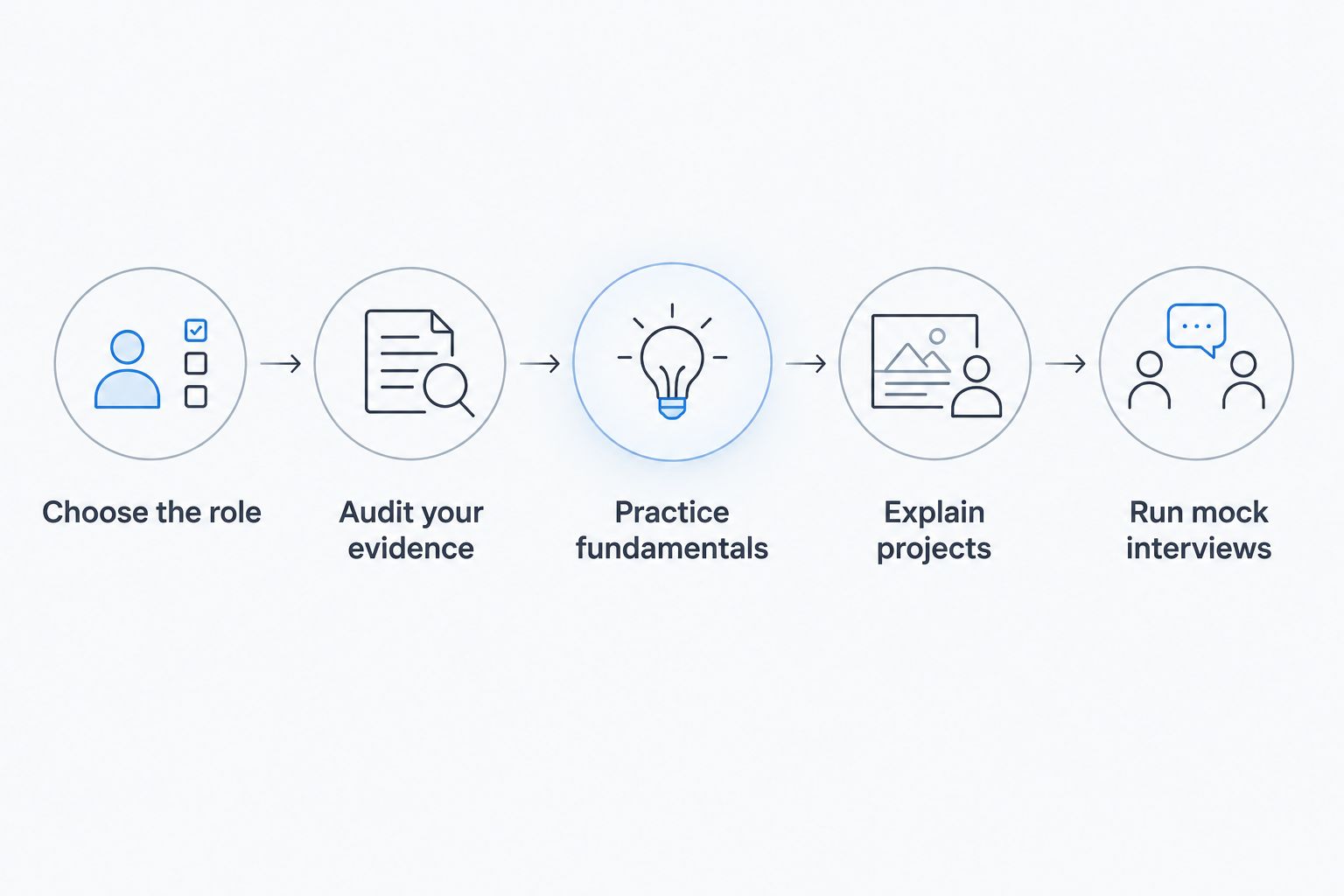
Use the job description to decide what to practice, then test whether you can explain your work under follow-up questions. This 2026 preparation sequence keeps you from spending your time on material unrelated to the role.
- Choose the role. Separate quant research, quant trading, and quant development before building a study plan. Read the responsibilities and required skills in the specific posting; do not treat quant as one interview category.
- Audit your evidence. For each relevant requirement, name a project, work task, or technical exercise you can discuss. Mark requirements you cannot yet demonstrate. Your preparation starts with those gaps, not with a general claim that you are analytical.
- Practice fundamentals. Work through the mathematics, statistics, coding, or reasoning relevant to the posting. Say each step aloud. A correct final answer is less useful in an interview if you cannot explain how you reached it.
- Explain projects. Prepare a 60-second account of your strongest relevant project: the problem, your contribution, your method, a limitation, and what you would test next. Then prepare for interruptions and requests to defend a decision.
- Run mock interviews. Set aside a 30-minute session that mixes technical questions with questions about your move into quant. Record the questions where your answer becomes vague, then revisit the underlying material before another attempt.
The order matters. An experienced software engineer who targets development work and an economist who targets research should not start with an identical question bank. Both need a credible account of their prior work, but the technical evidence they select will differ.
Start with the posting, not your current title
Copy the responsibilities from the role you want into a working document. Beside each one, write the strongest example you can explain without notes. If a line calls for coding and your example is only that you used software at work, you have found a gap to address.
Do not confuse familiarity with evidence. Completing a project gives you something to discuss, but the interview tests whether you understand your choices. Practice answering what you tried, why you chose it, what failed, and what you would change. If you cannot defend the method, listing the project on your résumé will not fix the problem.
What changes for research, trading, and development?
Choose preparation based on the work you are seeking, not the prestige of a job title. The table is a practice map, not a claim that every firm uses the same interview format.
| Target role | Best evidence to prepare | Useful practice | Preparation trap |
|---|---|---|---|
| Quant research | A project involving a question, method, data, and limitations | Explain statistical choices and defend your interpretation | Presenting results without explaining assumptions |
| Quant trading | Clear reasoning about uncertainty and decisions | Work through probability and decision problems aloud | Memorizing an answer without explaining the decision |
| Quant development | Code you wrote and technical decisions you made | Write, test, and discuss code under questioning | Naming tools without showing how you use them |
Best for a research candidate: a project you can defend when an interviewer challenges the method. The advantage is that your previous work can provide direct evidence; the limitation is that an impressive project title cannot cover weak reasoning.
Best for a trading candidate: practice that makes your assumptions and decisions audible. It exposes gaps quickly, but practicing only familiar brain teasers can leave you unprepared for a changed question.
Best for a development candidate: code you can explain and revise. Prior engineering experience gives you material to discuss; it does not remove the need to practice the technical work described in the posting.
These distinctions also help you decide what not to study first. A research applicant should not let coding drills replace the ability to defend a model. A development applicant should not let market reading replace coding practice. Use the role description to settle competing priorities.
How should you explain a career change?
Give the interviewer a direct connection between work you have already done and the role you want. In 2026, a clear explanation still needs technical proof: identify the relevant problem you worked on, specify your own contribution, and state which skills you are now preparing to use in quant work.
A useful answer has three parts:
- What you did: name the actual problem, method, and responsibility. Do not rename a non-quant job as a quant role.
- Why it transfers: identify the mathematics, coding, research, or decision-making you used and explain the overlap with the posting.
- What you still need: acknowledge a genuine gap and explain the work you are doing to close it.
Keep the answer specific enough that an interviewer can ask a follow-up question. If you claim that a project demonstrates statistical judgment, be ready to discuss the assumptions behind your analysis. If you claim coding ability, be ready to explain code you wrote rather than describe a team’s output.
Your previous industry is context, not the main argument. An interviewer needs to understand what you can do in the target role. Lead with transferable work and make the career-change explanation short enough to leave room for technical questions.
Why does preparation vary between career changers?
There is no useful universal checklist of questions for every applicant. Adjust your 2026 plan around these factors:
- Target role: research, trading, and development call for different demonstrations of your work.
- Previous work: a project in which you wrote code gives you different evidence from one in which you evaluated a statistical result.
- Technical gaps: the skills listed in the posting, not your confidence level, determine what needs practice.
- Project ownership: you need to distinguish what you did from what a team or tool did.
- Interview feedback: repeated trouble explaining a method signals a different gap from trouble completing the calculation.
Write these factors down before choosing practice material. That makes a weak answer diagnosable. You can tell whether you need to revisit a concept, choose a better example, or make a correct explanation clearer.
How do you practice technical answers without memorizing scripts?
Practice the reasoning, then vary the question. Give yourself a 20-minute block for a problem, explain your assumptions aloud, and check your answer before repeating it with a changed condition. A memorized solution prepares you for the question you saw, not the one an interviewer changes.
For a probability question, state the possible outcomes and what you assume about them before calculating. For a coding question, explain the approach, test an edge case, and say what you would change if a constraint changed. For a project discussion, separate the result from the evidence that supports it.
Keep a brief error log after practice. Record whether the problem was a missing concept, a calculation mistake, unclear communication, or an unsupported claim about your own project. Revising the right problem is more productive than repeating the same question until you remember its answer.
Do not use one good mock interview as proof that every area is ready. Mix familiar material with questions you have not rehearsed. Ask the person questioning you to interrupt when your explanation skips a step; that is the moment you need to practice.
What if you have no finance background?
You can begin quant interview preparation without a finance background, but you still need evidence for the role’s stated technical requirements. In 2026, start with those requirements and learn the financial context needed to explain why your work fits; do not present general interest in markets as a substitute for technical ability.
The relevant context depends on the posting. Read enough about the role to understand what the team works on and to ask a specific question about it. Then return to the material an interviewer can test: your reasoning, your code, and your account of past work.
Should you prepare for several quant roles at once?
Prepare separately for each role you intend to pursue. Keep shared work, such as explaining a relevant project, but change the technical practice and examples when the posting changes.
If you cannot say which role a practice question prepares you for, put it behind questions that clearly match an active application. That is especially useful when your previous career gives you several plausible directions. A focused application tells a clearer story than the same résumé and interview script used for every role.
When does interview coaching make sense?
Use coaching when you need an outside reader to challenge your résumé, career-change explanation, or mock interview answers. QuantMinds offers résumé review, interview preparation, and one-on-one coaching for candidates pursuing quantitative research, trading, and development roles. QuantMinds quant interview coaching is best for career changers who need candid feedback on how they present prior work; it does not replace practicing the technical material.
Bring a target posting and an example you are willing to defend. A coach can question whether your explanation is clear and relevant; only you can do the work required to answer a technical follow-up. If your biggest gap is a concept you have never studied, address that gap alongside feedback on your presentation.
FAQ
How do I prepare for a quant interview as a career changer in 2026?
Choose a quant role, compare its requirements with work you can explain, and practice technical questions and project follow-ups aloud. Build your career-change story around specific evidence rather than a general interest in finance.
Can I get a quant interview without a finance background?
A finance background is not the only possible source of relevant experience. You still need to show the technical skills requested in the role and explain how your prior work applies.
Should I practice brain teasers for every quant role?
No. Use the job description to decide whether probability or reasoning problems belong in your practice plan, and do not let them replace project or coding preparation relevant to the role.
How do I explain why I am leaving my current career for quant?
Connect a specific piece of your prior work to the role you want, then explain the technical gap you are closing. Keep the motivation brief so you have time to defend your experience.
Is quant research preparation the same as quant developer preparation?
No. Research preparation should make your method, evidence, and limitations clear; development preparation should also test your ability to write and discuss code. Follow the requirements of each posting.
What should I bring to a quant mock interview?
Bring the target job description, your résumé, and a project you can discuss in detail. Ask for follow-up questions that test your own contribution and technical decisions.
Can QuantMinds help a career changer prepare for a quant interview?
QuantMinds offers interview preparation and one-on-one coaching for people pursuing quant roles. Use feedback to sharpen your examples and explanations while continuing independent technical practice.
One last thing
Before your next 2026 practice interview, choose the strongest line on your résumé and ask someone to question every noun in it: the method, the data, your contribution, and the result. If you cannot explain that line under interruption, revise the claim or revisit the work. A defensible example gives a career changer a stronger answer than a polished account of why quant sounds interesting.