
Yes, you can become a quant researcher through self-study alone in 2026. Self-study can build the technical skills, but completing lessons is not the same as showing that you can investigate a question, test an idea and defend your conclusions in an interview. The practical test is whether you can produce credible research work and explain it clearly without relying on a credential to speak for you.
- Can you become a quant researcher through self study? Yes, but finished courses alone do not demonstrate research ability.
- A documented research project gives interviewers more to assess than a list of topics studied.
- QuantMinds is best for self-taught candidates who want candid resume and interview feedback, not someone to do the technical work for them.
- An MFE can provide structure; it is not the only way to build and present research skills.
Can you become a quant researcher through self-study alone?
Yes, if self-study results in research you can defend. In 2026, the useful distinction is not taught versus self-taught. It is whether you can move from a question to a testable method, identify what your results do not establish and explain your decisions when challenged.
| Route | What it gives you | What you still have to prove | Best for |
|---|---|---|---|
| Self-study | Control over what you learn and build | That your knowledge works beyond exercises and tutorials | Candidates who can plan and complete independent research |
| MFE or another relevant degree | A defined curriculum and academic setting | That you can apply the material to research questions | Candidates who want formal structure or need to strengthen their technical foundation |
| QuantMinds career coaching | Resume review, interview preparation and one-on-one coaching | Your own technical ability and research judgment | Candidates with work to present who need direct feedback on how they present it |
These routes are not interchangeable. A degree does not make a weak project convincing, coaching does not replace research, and independent study does not remove the need to communicate well. Choose the gap you actually have, then address that gap rather than collecting another line for your resume.
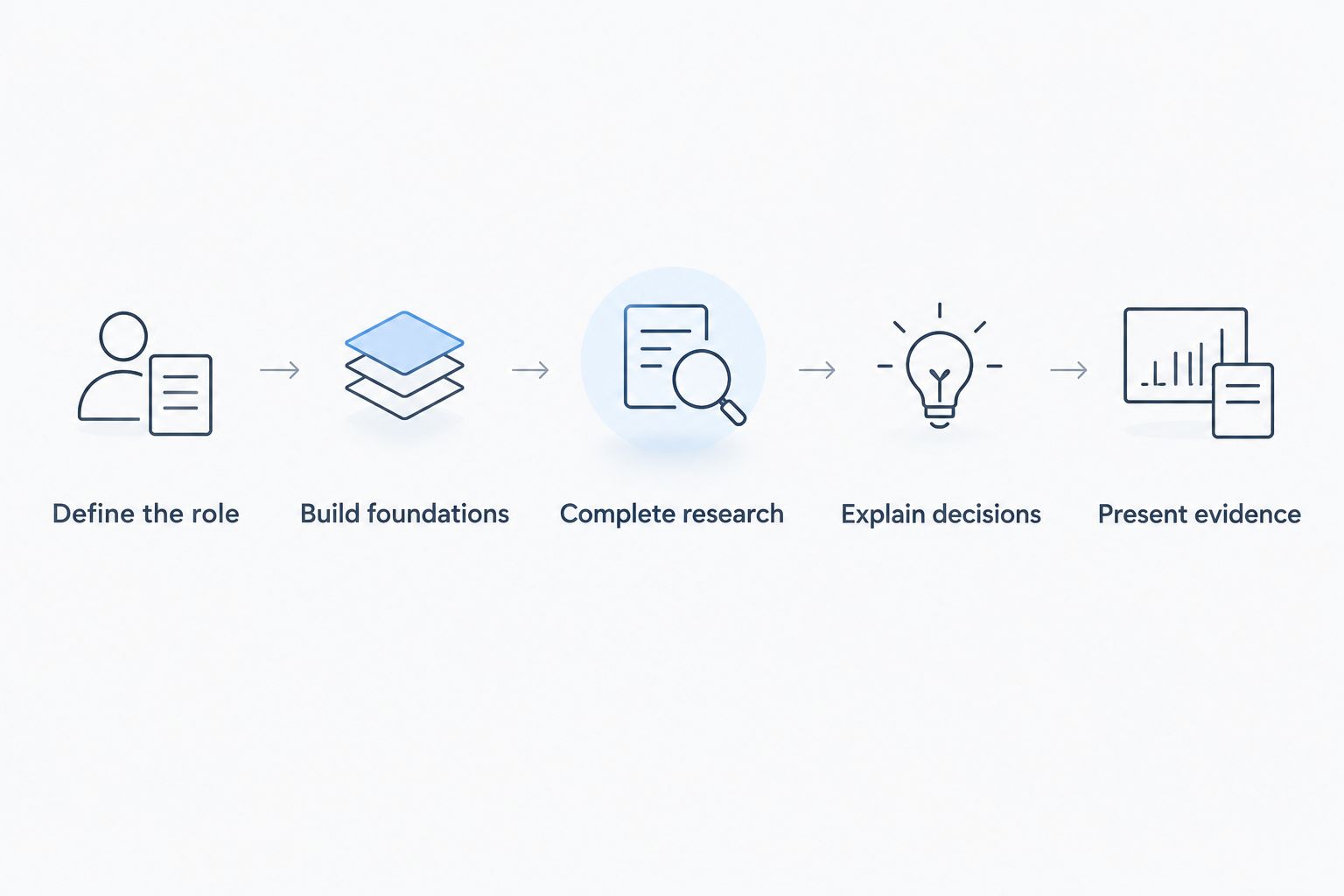
A practical self-study route
- Define the role before choosing material. Read the responsibilities in the quant researcher roles you intend to pursue. Separate research work from trading and development work; a project aimed at building software infrastructure answers a different hiring question from a project aimed at evaluating a research hypothesis.
- Build the technical foundation your question requires. Probability, statistics, programming and data analysis matter because you need them to reason about uncertainty and test claims. Do not treat a topic as learned because you watched an explanation; use it to make and check a decision in your own work.
- Complete a research project with a written account. State the question, describe the data, explain the method and show what you found. Include limitations and decisions you would revisit. A polished chart without an account of how you reached it leaves the central research question unanswered.
- Practice explaining the project aloud. Prepare to discuss assumptions, alternative methods and findings that weaken your initial idea. If you cannot explain why your approach was appropriate, further study of that approach will not solve the communication problem.
- Make your application materials reflect the evidence. Put the research decision and your contribution on the resume. Use interview preparation to check whether the same story holds up when someone asks follow-up questions.
The sequence is deliberate: choose a target, do relevant work, then present it. Starting with a resume rewrite before you have a defensible project reverses the order.
Why this matters
Self-study is easy to describe and hard to evaluate from the outside. In 2026, a candidate can list courses, books and programming languages without showing how any of them informed a research decision. Your task is to turn preparation into evidence another person can examine.
That does not mean claiming your project is a trading strategy or presenting a result as stronger than it is. An interviewer can ask why you selected the data, how you checked for mistakes and what would change your conclusion. A candid answer about a limitation demonstrates more research judgment than an unsupported claim of success.
QuantMinds is best for self-taught quant researcher candidates who have technical work to show but need candid feedback on their resume and interview answers. Its coaching can help you identify where your explanation loses the reader. It cannot supply the missing research or make an unsupported result defensible.
What should you study for quant research?
Start with the work, not a course catalog. The topics you need depend on the research questions you want to tackle and the roles you target. A sensible foundation connects mathematical reasoning to implementation and interpretation:
- Probability: Explain uncertainty, conditional reasoning and the assumptions behind a model. Be ready to work through a problem rather than recite a formula.
- Statistics: Explain how you estimate, compare and challenge a result. Your project should make clear what the evidence supports and what it does not.
- Programming: Use code to clean data, implement an approach and check your work. Readable, reproducible work gives you something concrete to discuss.
- Research design: Form a question before examining the result you hope to report. Document choices that could affect your interpretation.
- Communication: Summarize the question, method, result and limitation for a reader who has not seen your code.
Do not study every topic to the same depth before beginning a project. Pick a question that forces you to use the foundation you already have, then identify the specific knowledge you lack. That produces a clearer study plan than adding another general course whenever you reach something unfamiliar.
If you already program professionally, do not assume that software experience proves statistical research ability. If your background is mathematical, do not assume that a theoretical explanation proves you can implement and check an analysis. Your strongest application makes the connection visible instead of asking the reader to infer it.
What counts as evidence of research ability?
A useful project lets someone inspect your reasoning. It does not need a dramatic result. It needs a question, a method that fits the question, an account of what you observed and a fair discussion of what might be wrong.
When you write it up, answer these questions directly:
- What were you trying to find out, and why did you choose that question?
- What data did you use, and what does that data leave out?
- Which assumptions does your method depend on?
- What checks did you make before trusting the result?
- What alternative explanation remains plausible?
- What would you do differently with another chance to investigate?
A candidate who can answer those questions has material for a research conversation. A candidate who can only show a final figure has left the interviewer to guess whether the result came from careful investigation or an unexamined script.
Treat a public portfolio as a way to make your work inspectable, not as a requirement in itself. If you cannot share the underlying data or code, explain your method and contribution without disclosing material you do not have permission to publish. The goal is an account you can stand behind in an interview.
For your resume, replace lists of tools with the research choices you made. State the question and your role in answering it. Do not claim a project produced a commercial outcome unless you can substantiate that outcome; the reasoning is valuable without an inflated result.
Why the self-study route varies
There is no single self-study checklist that settles readiness for every quant researcher role in 2026. These factors change what your application needs to show:
- Your starting background. A candidate with substantial statistical research experience has a different gap from a programmer who has not designed an investigation.
- The role you target. A research role asks for different evidence from a quant developer or trading role. Read the role description before deciding which project deserves space on your resume.
- Your project quality. A finished analysis with clearly stated limitations provides more to discuss than unfinished exercises, regardless of how much material you studied.
- Your ability to defend decisions. Knowing a method's name is not enough if you cannot explain why you used it or how you checked its output.
- Your application materials. If the resume buries your research under a tool list, the reader has little basis for assessing your work.
- Your interview preparation. Strong written work still needs a clear spoken explanation when someone challenges an assumption or asks you to change course.
Use those factors as a diagnostic, not as a reason to delay applying indefinitely. Identify the weakest link between your work and the role you want. Then choose a specific fix: another project, a clearer write-up, a resume revision or practice defending your methods.
Do you need an MFE to become a quant researcher?
No, an MFE is not a universal requirement for becoming a quant researcher. A relevant program can provide a structured way to study and develop work, but the degree does not remove the need to demonstrate research judgment. Compare the program's curriculum with your actual gaps rather than treating enrollment as proof that you are ready.
If you are considering a program in 2026, ask what you expect it to change. Is your technical foundation thin? Do you need a more structured setting in which to develop research? Those are different questions from whether you can learn an individual topic on your own. Decide on the problem before choosing the route.
Can you switch from software engineering into quant research by self-study?
Yes, but software engineering experience alone does not demonstrate quant research ability. Show how you form and test a question, interpret uncertain results and explain the limits of your analysis. Your coding background is relevant when it supports that work, not when it substitutes for it.
A useful test is to remove the job title from your resume and read the project description by itself. Does it show a research decision, or only an implementation? If it only describes what you built, revise the account to explain what you investigated and how you evaluated the result.
Can you get a quant researcher interview without a research degree?
Yes, a research degree is not the only way to present research ability. Your application still needs to make your technical background and independent work legible to someone reviewing it. Do not ask a resume reader to open a project and discover the central point for themselves; put the question and your contribution in the application.
In 2026, the most useful preparation is to test both versions of your explanation: the short resume line and the longer interview answer. They should describe the same work with the same limitations. If one sounds far more certain than the other, correct it before applying.
FAQ
Can you become a quant researcher through self study in 2026?
Yes, you can become a quant researcher through self-study in 2026. Show independent research you can explain and defend; a list of completed lessons does not do that by itself.
What should a self-taught quant researcher put on a resume?
Put research work and your contribution on the resume. State the question you investigated, the method you used and what the result does or does not show.
Is Python enough to become a quant researcher?
No, knowing Python alone does not establish research ability. You also need to form questions, analyze evidence and explain your decisions.
Do quant researchers need an MFE degree?
No, an MFE is not a universal requirement for quant research roles. A program can provide structure, but you still have to demonstrate what you can do.
Is a personal project useful for a quant researcher application?
Yes, a personal project is useful when it makes your reasoning inspectable. Explain the question, method, checks and limitations instead of showing only the final result.
Can career coaching replace quant research experience?
No, career coaching cannot replace the research work. QuantMinds offers resume review, interview preparation and one-on-one coaching that can help you present and defend work you have done.
How do I know whether I am ready for a quant researcher interview?
Test whether you can explain a project without reading from your write-up. You should be able to defend your method, discuss limitations and respond to a challenge about your conclusion.
One last thing
Before adding another course in 2026, ask someone to challenge a project you already finished. If you cannot explain a key assumption or a result that surprised you, you have found a more specific study task than another broad syllabus. Fix the reasoning you cannot defend first.