

Prepare for behavioral questions in a hedge fund interview by choosing real examples, explaining your decisions and showing how you handled uncertainty, disagreement and mistakes. Match each example to the research, trading or development role you want, then practice a concise answer and a deeper follow-up. In 2026, a polished story that hides your actual contribution is less useful than a specific account you can defend under questioning.
- For hedge fund interview behavioral questions, prepare real decisions and outcomes rather than memorized personality claims.
- QuantMinds is best for quant candidates who want direct feedback on how they explain their own work.
- Build separate examples for research, trading or development; the same story needs a different emphasis for each role.
- Practice a 60-second answer, then prepare to defend the details when the interviewer presses further.
Why this matters
A behavioral answer is another way to inspect your judgment. Your resume says what you worked on; the interview gives you a chance to explain what you did when the work became uncertain, difficult or contested. If you want help evaluating the way your experience comes across, QuantMinds provides interview preparation and 1-on-1 coaching for candidates pursuing quant roles.
In a 2026 hedge fund interview, a technical explanation and a behavioral explanation can cover the same project from different angles. One addresses the method. The other addresses your decisions: why you chose that method, how you responded to a weak result and what you told the people relying on your work.
How do you prepare for behavioral questions in a hedge fund interview?
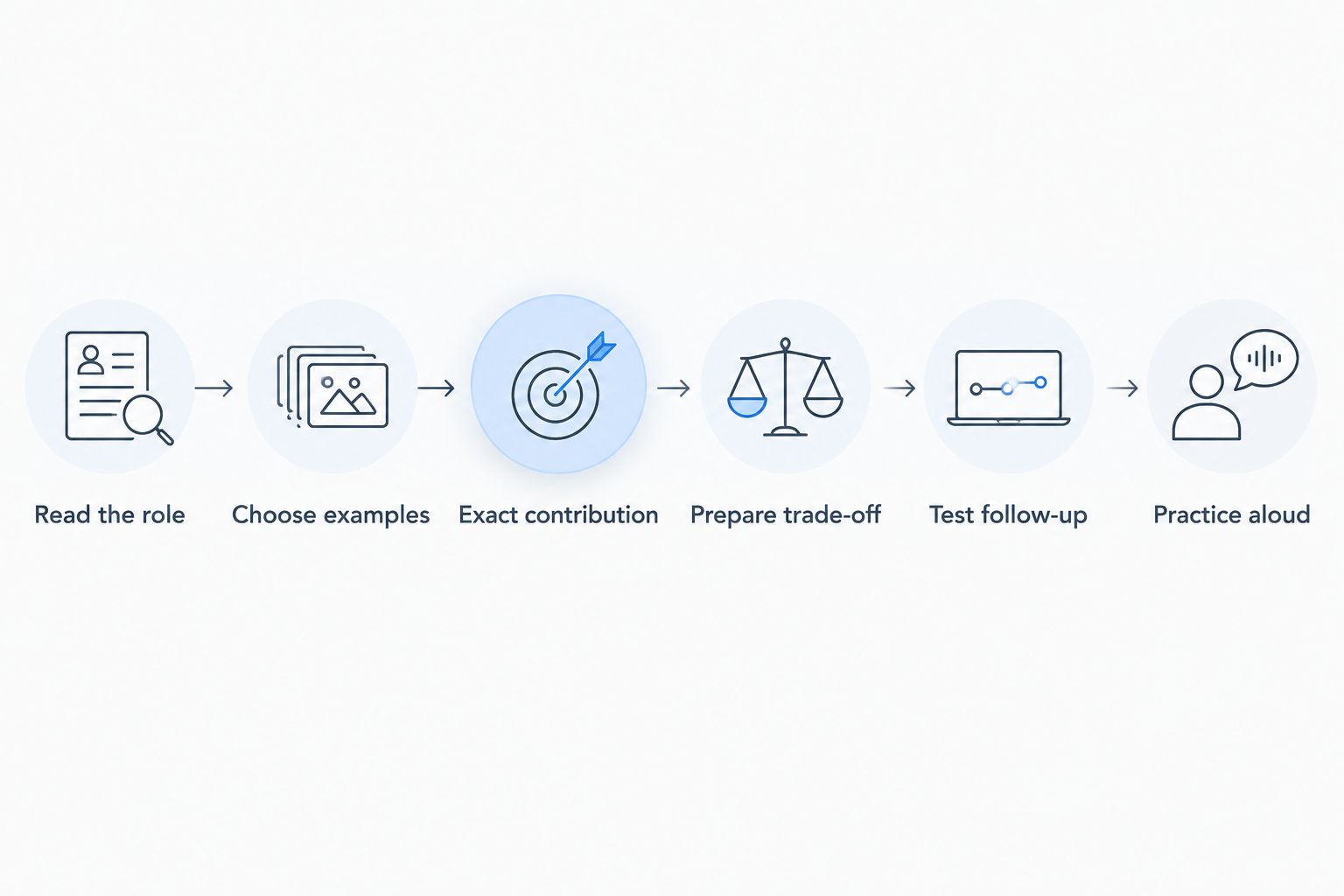
Build a small bank of truthful examples, map each one to a likely question and rehearse both the short answer and the follow-up. Do not write a script you can only deliver in one order. Use this sequence for 2026 interview preparation:
- Read the role description. Mark the work you would actually do: research, trading or development. Pull out the decisions, collaboration and communication that the role calls for.
- Choose examples with a decision point. A useful story contains a problem, options you considered, your action and an outcome you can describe without exaggeration.
- Write down your exact contribution. Separate what you did from what a teammate, manager or wider group did. If you cannot draw that line, choose a different example.
- Prepare the trade-off. Identify what you gave up by taking your chosen approach. Be ready to explain why that choice made sense with the information you had.
- Test the uncomfortable follow-up. Ask yourself what failed, what evidence challenged your view and what you would change. An answer that survives only the opening question is not ready.
- Practice aloud. Try a 60-second opening and a 2-minute version. These are rehearsal limits, not claims about how long an interviewer will let you speak.
| Question you hear | Example to prepare | What your answer must make clear |
|---|---|---|
| Tell me about a time you were wrong. | A forecast, analysis or implementation that needed correction. | What changed your mind and what you did next. |
| Describe a disagreement. | A decision where another person preferred a different approach. | How you tested the competing view without making the person the problem. |
| Tell me about working under pressure. | A real deadline or fast-moving decision. | What you prioritized and what you did not have time to resolve. |
| Why this role? | A project or work experience tied to the role's actual tasks. | Why your interests fit the work, not just the employer's name. |
A single example can answer several questions, but changing the label does not change the evidence. If your disagreement story never shows how you handled another person's view, it is not a disagreement story. If your failure story ends before the correction, it does not show how you respond to failure.
Which stories should you prepare?
Start with decisions you can explain from memory. Your strongest example is not necessarily the project with the most impressive title; it is the one where you can identify the question, your contribution and the consequence of your choice. For 2026 interviews, prepare examples that cover these areas without forcing every story to do every job:
- An analysis or model that changed. Explain the evidence behind the original approach, the evidence that challenged it and how you responded.
- A disagreement about a method or priority. Show how you made progress when someone else saw the problem differently.
- A mistake you owned. State what was wrong, who needed to know and what you corrected. Do not relabel an ordinary success as a failure.
- A decision under incomplete information. Identify what you knew at the time and which uncertainty mattered most.
- Work across different functions. Explain what another person needed from you and how you checked that your explanation was useful.
Use academic work if that is your strongest evidence. A research project, internship, software build or team assignment can provide a concrete decision to discuss. The setting matters less than whether you can explain the work honestly and connect it to the role.
If you need to sharpen the technical side of a project story, how to explain a research project in a quant interview is a useful companion. Keep the behavioral answer focused on your judgment rather than turning it into a lecture on every method you used.
How should you structure an answer?
Give the interviewer enough context to understand the decision, then spend most of the answer on what you did and why. You do not need a dramatic opening. You need a clear account that holds up when someone asks for detail.
- Situation: What was the objective, and what constraint made the decision difficult?
- Your responsibility: What were you accountable for, as distinct from the group's work?
- Decision: What options did you consider, and why did you choose one?
- Result: What happened? State what you know; do not manufacture an outcome you cannot support.
- Reflection: What would you repeat or change with the benefit of what you learned?
For a 60-second rehearsal, keep the context brief and make the decision the center of the answer. Your 2-minute version should add the evidence behind your choice, not a longer introduction. If the interviewer wants more, you can explain the assumptions, alternatives and limitations without reciting a second script.
Suppose your example concerns a research result that did not hold up to further checks. The weak version says the project was challenging and you learned to be adaptable. The useful version identifies the check that changed your view, the decision you made after seeing it and how you communicated the revised result. Only use details that belong to your actual experience.
What changes by hedge fund role?
The core test remains the same: can you account for your own decisions? The relevant evidence changes with the work. Do not use a generic answer about being passionate about markets when the question asks how you handled a research disagreement or a development trade-off.
| Role | Put the emphasis on | Weak answer to avoid |
|---|---|---|
| Quant research | Hypotheses, validation, conflicting evidence and communicating limitations. | Describing a model without explaining a decision. |
| Quant trading | Decisions under uncertainty, risk awareness and communication. | Presenting confidence as a substitute for reasoning. |
| Quant development | Reliability, technical trade-offs and working with the people using your code. | Listing tools without explaining why an implementation choice mattered. |
For a research role, expect to explain how you knew a result deserved more scrutiny. For a trading role, be precise about what you knew before a decision rather than using hindsight to make it sound obvious. For a development role, show how a technical choice served a real requirement and how you handled competing constraints. These are preparation angles, not a promise that every firm asks the same questions.
QuantMinds is best for quant candidates who want direct feedback on how they explain their own work; coaching cannot supply experiences they have not had. QuantMinds interview preparation is relevant once you have real examples to test. Bring your resume, the role description and the answers you find hardest to defend; use the feedback to clarify your contribution, not to invent a better-sounding history.
Test your interview answers
Bring your resume and real examples to a coaching conversation.
Why do behavioral answers vary between interviews?
Prepare to adjust your emphasis rather than recite one speech. These factors change which part of your experience deserves attention:
- The role's work. A research answer should show how you assessed evidence; a development answer should explain a technical choice and its consequences.
- Your background. A student can draw on coursework or projects. An experienced candidate should be ready to explain decisions from their professional work.
- The question's wording. A question about conflict needs another person's perspective; a question about failure needs a genuine mistake and response.
- Your individual contribution. Group results do not answer a question about what you personally decided.
- The follow-up. An interviewer asking what you would change is probing reflection, not requesting the same story again.
You can prepare across all five without pretending to predict the interview. In 2026, use the job description to decide which examples deserve the most rehearsal, then keep other truthful stories available when the conversation changes direction.
How do you answer a question about failure?
Choose a real error or decision that did not work, explain your part in it and describe the correction. Do not use a disguised strength or blame the outcome entirely on someone else. The point of the answer is to show how you recognized the problem and behaved after you knew about it.
If the result is confidential or you cannot share a detail, explain the decision process without exposing information you should protect. Do not replace missing details with invented figures. A precise description of your reasoning is more useful than an impressive-sounding outcome you cannot verify.
How do you answer a question about disagreement?
Describe the other person's position fairly before explaining your own. Then show how you checked the competing ideas, made a decision or moved the work forward. An answer that portrays every disagreement as your victory leaves out the part the interviewer needs: how you work with someone who does not immediately agree with you.
For 2026 preparation, rehearse a follow-up about what the other person was right about. If you cannot identify anything you learned or reconsidered, inspect whether the example really demonstrates collaboration.
How do you answer why you want this hedge fund role?
Connect your background to the specific work in the role description. Discuss the research questions, trading decisions or development problems you want to work on, using experience you can explain. Firm prestige alone does not tell an interviewer why you fit the work.
Keep this answer separate from a personal history monologue. State the connection, give one relevant example and explain what you want to do next. If you are preparing for interviews alongside a longer assessment day, use the hedge fund superday preparation guide to organize the wider preparation without treating every conversation as the same interview.
How should you practice without sounding rehearsed?
Practice the evidence, not the wording. Record an answer and check whether a listener can identify your responsibility, decision and result without seeing your resume. Then ask someone to interrupt with a question about an assumption or an alternative. If the answer falls apart when the order changes, return to the facts instead of rewriting the script.
A useful 2026 rehearsal is to answer the same question in a 60-second opening and then expand only when prompted. Listen for vague phrases such as saying you led the analysis when your contribution was narrower. Replace them with an exact description of what you did. The goal is not to sound effortless; it is to make your judgment understandable.
FAQ
How do I prepare for behavioral questions in a hedge fund interview?
Choose real examples, identify your exact contribution and rehearse the decision and its outcome. Prepare follow-ups about alternatives, mistakes and what you would change.
What behavioral questions should I practice for a quant role?
Practice questions about disagreement, mistakes, uncertainty, collaboration and why you want the role. Match each answer to research, trading or development work rather than using one generic pitch.
Can I use a university project in a hedge fund interview?
Yes, if the project gives you a real decision and contribution to explain. State what you did yourself and what the work taught you without presenting a group result as yours alone.
How long should a behavioral interview answer be?
Practice a 60-second opening and a 2-minute expanded answer. Those are rehearsal limits, not fixed interview rules; answer follow-up questions with the detail they require.
How do I talk about failure without hurting my candidacy?
Name a real mistake, explain your responsibility and describe the correction. Avoid disguised strengths, invented outcomes and stories that blame everyone else.
Should I memorize answers for a hedge fund interview?
No. Memorize the facts and decision points of your examples, not a script; you need to respond when an interviewer changes the question or challenges an assumption.
Is behavioral preparation different from technical quant interview preparation?
Yes. Behavioral preparation explains how you made decisions and worked with others; technical preparation tests your methods and reasoning. A strong project example can support both, but each answer needs a different focus.
One last thing
Your best behavioral example may be a result you stopped trusting. If you can explain the evidence that changed your mind, the correction you made and how you communicated it, you have a stronger answer than a polished success story with no visible decision. Make that test part of your 2026 preparation.