

You stand out as a non-target school quant candidate by showing evidence of the work a quantitative researcher, trader, or developer would do—not by trying to make your school name disappear. In 2026, choose a role, make your strongest technical work easy to inspect, explain your contribution clearly, and prepare to defend it in an interview.
- For a non-target school quant candidate in 2026, proof of role-relevant work matters more than a generic interest in finance.
- Quant research candidates should explain their assumptions; trading candidates should defend decisions; developer candidates should show working code.
- A focused resume, inspectable project, specific outreach, and interview practice give each application a clear case.
Why this matters
A school name gives a reviewer context. If yours does not immediately explain your preparation, your resume and conversations have to do that work. The goal is not to apologize for your university; it is to make your fit for a particular quant role clear without asking someone to infer it.
QuantMinds is best for non-target school candidates who want direct feedback on their quant resume and interview answers. Its resume review, interview prep, and 1-on-1 coaching give you a way to test how you present your work; coaching does not replace the technical work itself. If outside feedback is the missing piece, see QuantMinds.
How do you stand out as a non-target school quant candidate?
Start with the job you want, then build an application that shows evidence for that job. In 2026, a broad claim that you are interested in quant finance says less than a project you can explain, a resume that identifies your contribution, and an interview answer that holds up to follow-up questions.
- Pick a role before revising your resume. Quant research, trading, and development call for different evidence. Use the role description to decide which work belongs near the top of your application.
- Select your strongest relevant work. Choose work you actually completed and can discuss in detail. A class project counts if you can explain the question, your method, the result, and what did not work.
- Make the work inspectable where possible. A readable code repository, concise project summary, or clear account of your individual contribution is more useful than a list of tools without context. Do not publish confidential work or material you do not own.
- Write resume bullets around decisions and outcomes. Name the problem, what you did, and the result you can substantiate. If you cannot verify a performance claim, leave it out.
- Practice defending the work aloud. Explain why you chose an approach, which assumptions it required, and how you would check it. Then practice answering a skeptical follow-up without retreating to memorized lines.
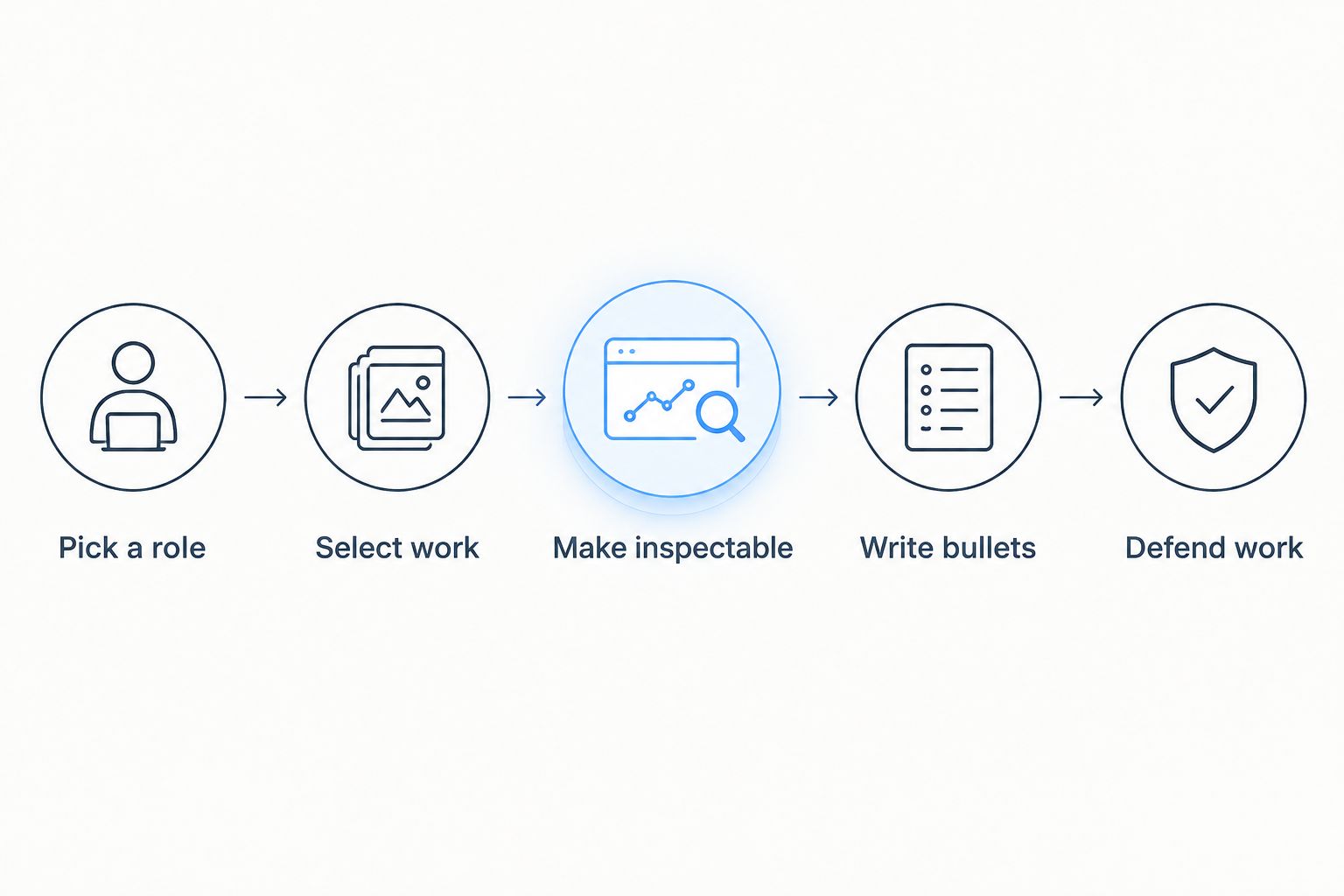
Do not build one generic application for every quant opening. You do not need to manufacture a different background for each employer. You do need to decide which part of your real background answers the question that role raises.
Which evidence belongs on your application?
| Target role | Best for candidates who can show | Useful evidence | Limitation to address |
|---|---|---|---|
| Quant research | Statistical reasoning and careful analysis | A research question, methodology, validation choices, and limitations | A result without a credible method is hard to evaluate |
| Quant trading | Decision-making under uncertainty | A clearly explained decision process, probability reasoning, or analysis of trade-offs | A market opinion alone does not demonstrate your reasoning |
| Quant development | Software engineering applied to technical problems | Code you can explain, tests, design decisions, and debugging work | A repository without context does not show your individual contribution |
Best for research: lead with work that shows how you tested an idea, not just whether the result looked favorable. Be ready to explain what evidence would change your conclusion. A polished chart cannot answer that question for you.
Best for trading: show how you reason through uncertainty and revise a decision when an assumption changes. Do not claim trading experience you do not have. A precise explanation of your reasoning is stronger than an unsupported claim that you have good instincts.
Best for development: put the engineering decisions in view. Describe what you built, which parts you owned, and how you checked that the code worked. A long technology list is not a substitute for an example you can walk through.
This table is a way to choose evidence, not a claim that every employer uses the same hiring process. Read each posting closely. If your chosen example does not help answer its stated requirements, choose another example or target a role that fits your current preparation.
Build a resume that answers the school question without discussing school prestige
Your resume should let a reader find your relevant skills and work quickly. Keep education accurate, but use the space around it to show what you have done. A candidate who hides the university or writes a defensive explanation draws attention away from the evidence that matters.
For each project bullet, ask: What problem did I work on, what was my contribution, and what can I substantiate? Those questions expose vague lines such as built a trading model or studied machine learning. Replace the vague line with the actual task, method, and evaluation you performed. If you worked with others, identify your part rather than taking credit for the whole project.
A useful 2026 resume review is not a hunt for impressive-sounding words. It is a check for claims you can defend. Mark every technical term on your resume and ask whether you can explain it without notes. If you cannot, either prepare the explanation or remove the term.
Projects deserve the same scrutiny. One project you can defend is more useful than a longer list you cannot explain. Be clear about data sources, assumptions, tests, and limitations when those details apply. An unfinished experiment can demonstrate judgment if you describe honestly what you tried and why you stopped; do not present it as a completed result.
Use networking to test fit, not to request a shortcut
A message to someone working in quant should make a specific conversation possible. Say which role you are exploring, identify a relevant part of your background, and ask a question that person is positioned to answer. Do not send a generic request for a referral and expect the recipient to work out why you fit.
For example, a candidate with a statistical research project can ask how research is evaluated in the recipient's type of role. A developer can ask what distinguishes the engineering work described in a posting from the work they have done. These are examples of questions to tailor, not scripts that guarantee a reply.
Use a 3-sentence draft as an editing constraint: why you are writing to this person, the specific work you have done, and one focused question. If it takes a long paragraph to establish the connection, the message needs a clearer point. Never imply that you have a relationship or referral that you do not have.
A response is useful even when it does not become an interview. It can tell you whether you are describing the role accurately and whether your example addresses the work. Update your application when the answer exposes a real gap; do not rewrite it merely to echo someone else's vocabulary.
Prepare for the follow-up, not just the opening question
The hardest part of explaining a project is often the second question. You can rehearse a tidy opening, but an interviewer can still ask why you used that method, what you compared it with, or which result surprised you. Prepare those answers from your actual work.
For each featured project, practice a 2-minute explanation of the problem, your contribution, your approach, and the result. Then invite interruptions. Ask someone to challenge an assumption, request a simpler explanation, or point to a decision you cannot justify yet. The time limit is a practice tool, not a claim about how long an interview answer must be.
Keep an honest account of mistakes. If a test failed or an initial approach was weak, describe how you recognized the problem and what you changed. Do not invent an ideal process after the fact. A defensible limitation gives the listener more insight into your judgment than a result presented without context.
Interview practice should follow the role. A research candidate needs to explain analysis and uncertainty; a trading candidate needs to show their decision process; a developer needs to discuss code and design choices. In 2026, rehearse the claims already on your resume before adding new ones. An application earns attention only if you can support it when questioned.
Why does your approach vary by candidate?
A non-target school is one part of your application, not a complete diagnosis. These factors determine which evidence you should lead with:
- Target role: research, trading, and development ask you to demonstrate different work. Choose the role before choosing your headline project.
- Actual technical work: lead with work you completed and can explain, whether it came from coursework, independent study, or a job.
- Your individual contribution: group work is useful when you can separate your decisions from the team's decisions.
- Evidence you can share: use a project summary when code, data, or employer information cannot be made public.
- Interview readiness: a strong resume claim loses value if you cannot answer a direct question about its assumptions or limitations.
- Application fit: a good example for one posting can be irrelevant to another. Match evidence to the responsibilities described.
No factor calls for a claim about your school's reputation that you cannot support. Your task is to reduce uncertainty about your own work. If an employer has a requirement you do not meet, a stronger personal statement does not erase it; decide whether to address that gap or focus on openings that fit.
Should you pursue an MFE to overcome a non-target school background?
An MFE is a separate education decision, not an automatic repair for a weak application. Compare the program's curriculum and outcomes with the role you want and the preparation you already have. In 2026, first identify the skills or access you need; only then decide whether a degree is the right way to pursue them.
If your main gap is explaining projects or handling interviews, additional coursework alone does not fix that presentation problem. If your gap is technical preparation, revise the plan around that gap rather than assuming another credential will speak for itself.
Can a class project help you stand out for a quant internship?
Yes—a class project is useful when you can identify your contribution, explain your method, and defend the result. State what the assignment required and what choices were yours. If the work closely follows an instructor's template, be candid about that instead of presenting it as independent research.
Make the project relevant to the internship you are seeking. A careful analysis is better evidence for research than an unrelated project dressed up with trading language. Your explanation should let someone see both what you know and what you still need to learn.
What if you have no quant internship yet?
Start with the strongest relevant work you can substantiate, not an invented substitute for an internship. Coursework, independent projects, and technical work from another field give you material to discuss when you describe your own decisions precisely. In 2026, apply for roles that match that evidence while building the skills missing from the postings you care about.
Keep the distinction clear: a project demonstrates work on a problem, not experience inside a trading firm. Say what it proves and stop there. That honesty makes the rest of your application easier to trust.
FAQ
How do I stand out as a non-target school quant candidate?
Show role-relevant technical work you can explain and defend. Choose a research, trading, or development target, then align your resume, outreach, and interview preparation with it.
Can I get a quant interview without attending a target school?
A non-target school name does not prevent you from presenting relevant work. Your application still needs to meet the role's stated requirements and give a reviewer clear evidence of your fit.
What should I put on a quant resume if I have no internship?
Lead with relevant projects, coursework, or technical work you actually completed. Identify your contribution and remove claims you cannot substantiate.
Is a research project or coding portfolio better for quant roles?
The better choice depends on the role. Lead with research methods for a research opening and software design decisions for a development opening; use the posting to settle close calls.
Should I mention that my university is not a target school?
List your education accurately without making school prestige the subject of your application. Use the surrounding space to show the skills and work that match the role.
Will networking replace technical preparation for a quant role?
No. Specific outreach can help you understand a role and explain your fit, but it cannot defend your resume claims or answer technical questions for you.
Should I pursue an MFE before applying to quant jobs?
Apply the decision to your specific skills gap and target role. An MFE is not an automatic substitute for relevant work, a clear resume, or interview preparation.
One last thing
Before you send another application in 2026, ask someone to point to the strongest claim on your resume and question it. If you cannot explain your contribution, assumptions, and limitations without changing the story, revise the claim before you submit. Your best differentiator is work that survives a follow-up question.