

Business analysts’ quant career coaching is targeted preparation for moving from business analysis into quantitative finance, with the aim of earning interviews and demonstrating role-specific technical readiness. This 2026 guide explains how to separate transferable experience from missing skills, choose a target role, and decide whether coaching addresses your actual bottleneck.
- Quant career coaching for business analysts should start with role selection, not a resume rewrite.
- QuantMinds offers quant career coaching, resume review, and interview preparation for candidates targeting hedge funds and prop trading firms.
- Business analysis experience needs technical evidence; stakeholder communication alone does not demonstrate quantitative research readiness.
- Choose self-study for skill building and coaching for feedback on positioning and interview performance.
Why quant career coaching matters for business analysts
A business analyst title does not establish what you can do mathematically or computationally. Your work might involve SQL, forecasting, requirements gathering, financial modeling, or reporting; those activities provide different starting points for quantitative research, trading, and development.
Your first task is to identify the work you can already defend technically—not to make your title sound more quantitative. Separate decisions you owned from analyses you supported and tools you merely used.
For your 2026 transition, distinguish unfamiliar finance terminology from deeper technical gaps. The guide to preparing for a quant interview with no finance background addresses the former; a weak foundation in probability or programming requires its own preparation plan.
Coaching matters when you need an outside assessment of that distinction. It does not replace learning the material, completing a project, or solving problems independently.
Build your transition around evidence
Choose a target role before changing your resume
Start manually: collect 5 current job descriptions for one role family and compare their responsibilities, required skills, and eligibility criteria. Treat that sample as a planning exercise, not a claim about the whole market.
Quantitative research emphasizes investigating hypotheses and evaluating models. Quantitative development emphasizes software implementation and engineering; quantitative trading requirements depend on the desk and strategy. Read the actual description instead of treating every role containing quant as interchangeable.
Choose a primary target based on demonstrated skills and genuine interest. Keep a secondary target only if you can explain why the same preparation supports it.
- Best for research: target work involving statistical reasoning, experiments, and model evaluation.
- Best for development: target work that matches your programming and software engineering evidence.
- Best for trading: examine the specific role’s decision-making, probability, and technical requirements.
- Record degree, experience, location, and work-authorization requirements separately from technical skills.
Audit your skills without counting tool familiarity as mastery
Build a spreadsheet with three columns: requirement, evidence, and next action. Fill it using your target descriptions, your transcript, and work you can explain without help.
Knowing where to click in a reporting tool is different from writing the underlying calculation. Likewise, using a regression output does not establish that you understand its assumptions, uncertainty, or failure modes. Test the distinction before committing to an application campaign.
Use a 30-minute diagnostic session as a starting exercise, not a hiring benchmark. Attempt an unfamiliar coding problem or probability exercise, then review both the answer and your reasoning.
- Probability: explain conditional probability and expected value using a worked example.
- Statistics: explain estimation, hypothesis testing, and the limits of your chosen method.
- Programming: write, test, and debug code without copying a completed solution.
- Research judgment: identify leakage, weak baselines, and unsupported conclusions in a project.
- Communication: describe a technical decision without hiding behind business terminology.
Use coaching to resolve a specific decision
Start with a written self-assessment and ask a technically qualified colleague to challenge it. If the disagreement remains about target roles, application positioning, or interview performance, that is a concrete issue to take into coaching.
QuantMinds provides quant career coaching, resume review, interview preparation, and 1-on-1 coaching. The firm was founded by a former UC Berkeley MFE program executive director, a relevant background when your decision includes graduate study alongside recruiting.
QuantMinds is best for candidates seeking quant career coaching focused on resume review, interview preparation, and individual guidance. The limitation is straightforward: coaching does not create missing technical proficiency or replace the work required to demonstrate it.
For your 2026 plan, request feedback tied to an artifact or decision rather than a broad discussion about breaking into finance.
- Bring your resume and the target descriptions you used for your skills audit.
- Identify whether your immediate issue is role selection, technical readiness, or presentation.
- Ask what evidence would change an assessment of your candidacy.
- Leave with a defined next task and a way to judge whether it is complete.
Build a project that exposes your reasoning
Start with public data and a question narrow enough to investigate properly. A useful project lets you explain why you chose the data, how you tested the idea, and where the conclusion stops.
For a business analyst, extending a familiar forecasting or measurement problem can make sense. The project still needs technical substance: a financial label does not turn a dashboard into quantitative research.
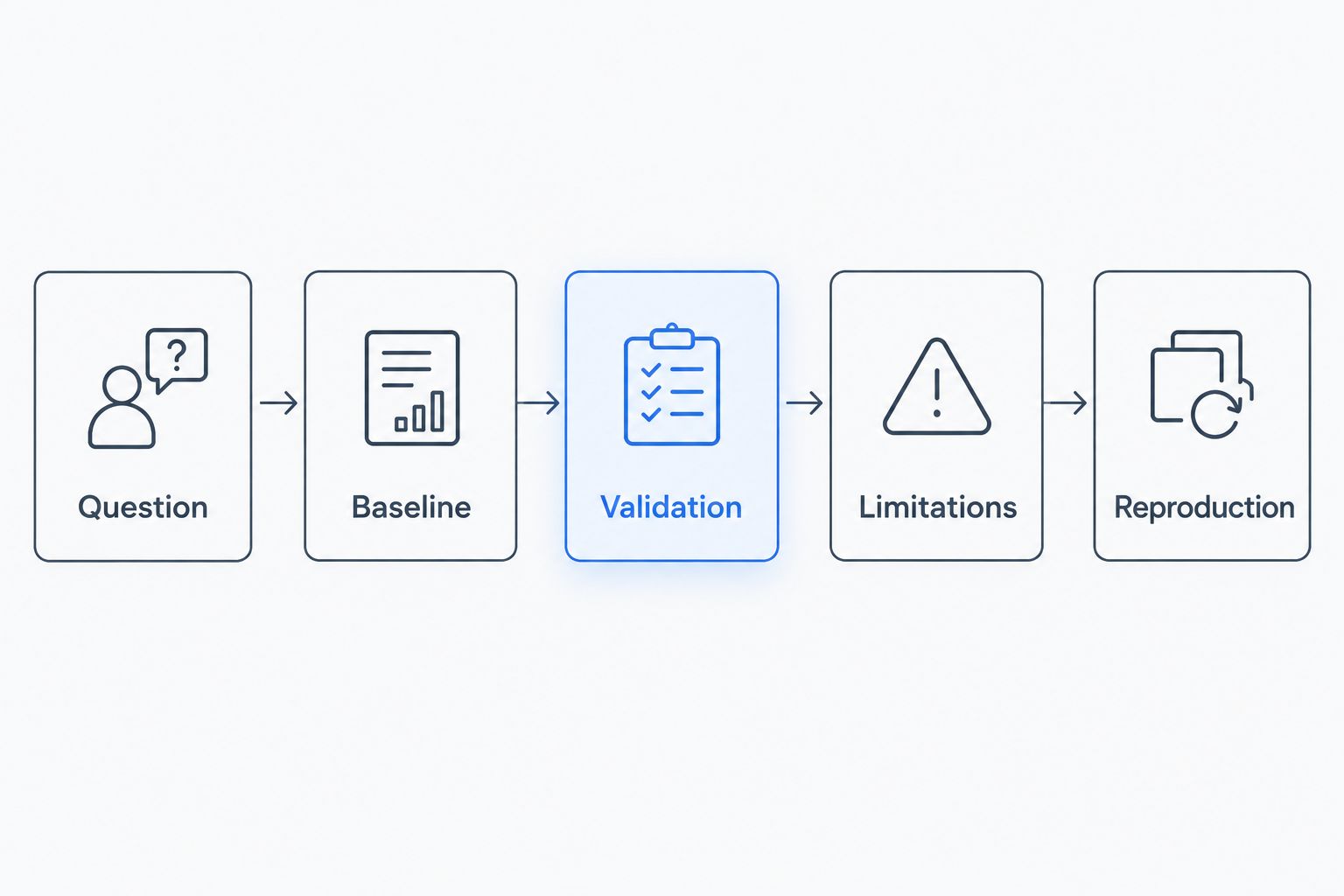
Use the following sequence to make the work inspectable. For financial time-series work, preserve the information available at each decision point rather than allowing future observations into earlier predictions.
- Question: state the hypothesis before examining the final evaluation results.
- Baseline: compare your method with a simple, relevant alternative.
- Validation: separate model development from final evaluation and check for leakage.
- Limitations: document uncertainty, sensitivity, and assumptions that affect interpretation.
- Reproduction: provide code and instructions that let another person repeat the analysis.
Rewrite your resume around technical ownership
Draft the revision yourself before requesting a review. Mark each existing bullet as technical evidence, business context, or administration; then prioritize the evidence relevant to the target role.
A useful bullet identifies the problem, your method, your contribution, and a verified outcome. Include a numerical result only when you can substantiate it. If the result is confidential, describe the method and scope without disclosing restricted information or inventing a substitute figure.
QuantMinds offers resume review for candidates pursuing quantitative roles. Use that feedback to test whether your experience is understandable and relevant, not to relabel ordinary reporting as research.
- Keep your official job title and clarify technical responsibilities underneath it.
- Name languages and methods only when you can answer detailed questions about them.
- Separate your individual contribution from the team’s output.
- Remove unsupported claims about predictive power, trading performance, or business impact.
- Match your LinkedIn account of the work to the evidence on your resume.
Rehearse interviews and run a focused application cycle
Start with a peer, a timer, and a recording. Give a 90-second explanation of your transition, then take follow-up questions about a project, a statistical choice, or a piece of code.
Your explanation should connect past work to the target role without suggesting that business analysis and quantitative research are equivalent. State the relevant experience, acknowledge the gap you addressed, and show the resulting work.
Use your 2026 application tracker to separate different problems. A rejection before an interview does not reveal how you would perform technically; a failed coding exercise does not establish that your resume is ineffective.
- Record applications by role family, requirements, and recruiting stage.
- Practice probability, coding, and project explanations according to the target description.
- Explain mistakes aloud and correct them instead of memorizing polished answers.
- Ask networking contacts about their actual work before requesting an introduction.
- Revise the part of your preparation associated with observable feedback.
Compare preparation options for your situation
Choose the option that addresses your current bottleneck. Self-study, peer practice, coaching, and graduate education do different jobs; none substitutes for evidence that you can perform the work.
| Option | Best for | Main benefit | Key limitation |
|---|---|---|---|
| Structured self-study | Business analysts with a clear technical gap | Direct practice in probability, statistics, or programming | You must diagnose gaps and evaluate your own progress |
| Peer mock interviews | Candidates who know the material but need rehearsal | Practice explaining reasoning under questioning | Feedback depends on the peer’s technical knowledge |
| QuantMinds career coaching | Candidates seeking resume review, interview prep, and individual guidance | Feedback focused on quantitative career preparation | Does not replace technical study or project execution |
| MFE or related graduate study | Candidates seeking structured academic preparation | Organized study of quantitative material | Requires a separate assessment of prerequisites, curriculum, and recruiting access |
Graduate study deserves its own decision process. For a 2026 application, examine each program’s published prerequisites and curriculum, and check whether its career information covers the roles you actually want. Do not infer suitability from the degree title alone.
Self-study is the strongest starting point when you already know what you need to learn. Coaching becomes relevant when the unresolved problem is choosing a direction or obtaining informed feedback on your materials and performance.
Common mistakes business analysts make
Treating SQL and dashboards as proof of research readiness
SQL and reporting experience demonstrate specific capabilities, not the full research process. Show how you framed a question, evaluated alternatives, handled uncertainty, and tested a conclusion; otherwise, describe the work accurately as reporting or analysis.
Replacing business language with finance language
Renaming a forecast a trading signal does not establish investment relevance. Explain what the model predicts, what information it uses, and how you evaluated it. Keep commercial forecasting and investment research distinct unless the work genuinely connects them.
Applying across incompatible role families
A resume centered on stakeholder management does not become a development resume by adding Python to the skills section. Maintain separate materials only when you have relevant evidence for each target, rather than sending one broad document everywhere.
Using an MFE application to postpone the readiness question
A graduate degree is an educational choice, not a substitute for examining your starting point. Review prerequisites and target-role requirements before preparing an application, and identify which gaps the proposed curriculum actually addresses.
Mistaking interview memorization for technical fluency
A rehearsed explanation collapses when the interviewer changes an assumption. Practice follow-up questions: why that distribution, why that evaluation method, what happens with missing data, and what evidence would overturn your conclusion?
FAQ
Can a business analyst move into quantitative finance?
A business analyst can pursue quantitative finance, but the relevant starting point is demonstrated mathematics, statistics, programming, and research or engineering experience. Assess your evidence against a specific role rather than relying on your current title.
What's the best first step for a business analyst considering a quant career?
Choose a target role and compare your evidence with its requirements. Research, trading, and development are different preparation targets, so a general interest in finance is not yet an application strategy.
Is quant career coaching useful before I learn Python?
Quant career coaching is useful before learning Python when your immediate question is which role or preparation route to pursue. It does not replace learning a required language or practicing independently.
Do business analysts need an MFE to become quants?
An MFE is not a universal requirement across quantitative roles. Check the specific employer’s requirements and compare graduate study with the technical gaps and recruiting needs you have identified.
Is QuantMinds a course provider or a coaching firm?
QuantMinds is a career coaching firm offering resume review, interview preparation, and 1-on-1 coaching for quantitative research, trading, and development candidates. Its stated services focus on individual career preparation.
How long should a business analyst prepare before applying?
Base your application timing on readiness rather than a fixed preparation period. You should be able to meet the stated requirements, defend your project decisions, and complete relevant technical exercises independently.
What should I bring to a quant career coaching session?
Bring your resume, target job descriptions, a skills assessment, and a project you can discuss technically. Identify the decision you want help making so the session produces a concrete next action.
One last thing
Your most useful project result might be a rejected hypothesis. A project that documents why an apparent relationship failed validation gives you something substantive to discuss; a polished chart without a defensible method does not.
Before submitting your next application, write down what would convince you that your project’s conclusion is wrong. If you cannot answer, strengthen the analysis before strengthening the wording on your resume.