Quant interview prep for physics PhDs means translating years of dissertation work into the specific vocabulary hedge funds and prop shops actually test: probability, mental math, market intuition, and code. The technical horsepower is rarely the problem for a physics PhD — the gap is format, pacing, and knowing which of your skills the interviewer cares about.
- Quant interview prep for physics PhDs needs a different plan than math or CS candidates because the gap is desk vocabulary, not technical skill.
- Reframing your dissertation into a two-minute pitch matters more before recruiting starts than adding another physics topic.
- Probability, mental math, and market-making drills close the biggest gap physics PhDs hit in 2026 recruiting cycles.
- Coding fluency in Python or C++ gets tested at every prop trading firm and hedge fund regardless of your physics background.
Why quant interview prep matters differently for physics PhDs
Recruiters at QuantMinds see the same pattern every cycle: physics PhDs get first-round interviews easily because the credential signals strong quantitative ability. Where they lose ground is the second and third round, where the format shifts from open-ended research discussion to rapid-fire probability, timed mental math, and "walk me through a trade" questions that no physics qualifying exam ever asked.
A physics PhD typically runs 5-6 years, and that time builds deep comfort with long-form problem solving — weeks spent on one derivation. Quant interviews invert that. You get 60 seconds to answer a brain teaser, then move on. Candidates who prepped like it was another physics qual exam stall out; candidates who prep like it's a different sport get through.
The 2026 recruiting cycle for full-time quant research and trading roles rewards physics PhDs who can do two things: prove they understand markets, not just models, and prove they can perform under a clock. Neither skill comes from more physics study.
Reframe your dissertation into a two-minute trading-desk pitch
Most physics PhDs walk into their first interview ready to explain their research the way they'd explain it to a thesis committee. That's the wrong audience. Interviewers want the modeling logic, not the physics.
- Cut the field-specific jargon and keep only the mathematical structure (stochastic processes, optimization, statistical inference)
- Practice a 90-second version of "walk me through your research" before a 5-minute one
- Draw one explicit analogy between your thesis method and a market problem (volatility estimation, signal extraction, calibration)
- Save equations for follow-up questions — don't lead with them
- Rehearse the pitch out loud, not just in your head; the delivery is what gets scored
Rebuild probability and stochastic calculus fluency for interview format
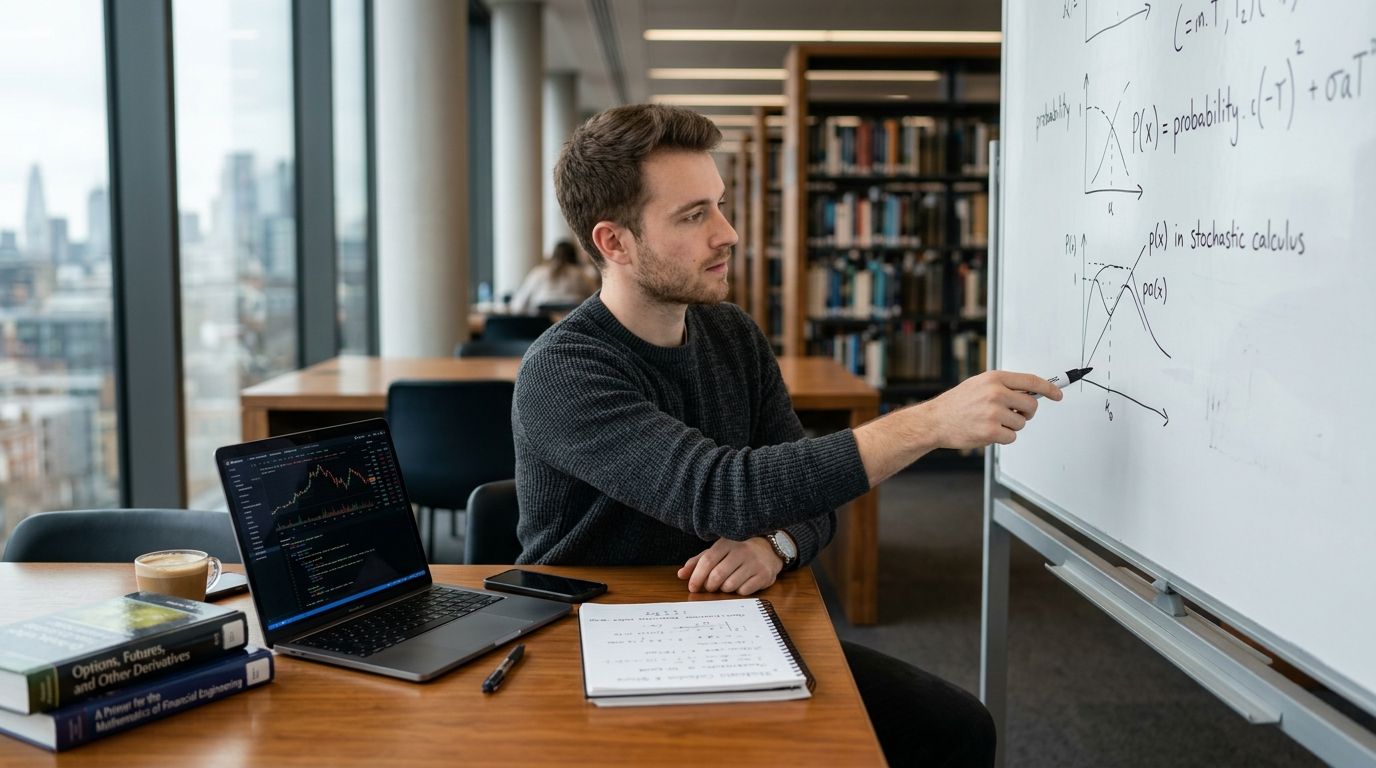
You likely know Ito's lemma and Brownian motion cold from coursework. The problem is speed and framing — interview probability questions are phrased like puzzles, not proofs.
- Redo classic probability puzzles (expected value, conditional probability, Markov chains) until you can solve them verbally in under two minutes
- Work through martingale and stopping-time problems specifically, since they show up disproportionately in quant interviews
- Practice explaining your answer while you solve it — silent thinking reads poorly in an interview
- Time yourself on a rotating set of 20-30 problems instead of solving the same five repeatedly
This is the stage where a faster path helps. A structured resource that's built specifically around interview-format probability and stochastic calculus questions saves the weeks it takes to reconstruct that from textbooks — probability brain teaser books for quant interviews narrow the set to the questions actually asked on desks, rather than the full breadth of a graduate probability course.
Drill mental math until it's reflex
Physics research rewards precision over speed. Trading interviews reward speed under pressure, and mental math is where physics PhDs lose points they didn't expect to lose.
- Practice multiplying and dividing two- and three-digit numbers without paper, daily, for short blocks
- Drill percentage and ratio problems specifically, since they map to pricing and position-sizing questions
- Time every practice set — untimed mental math practice doesn't transfer to a live interview
- Practice under mild distraction (a ticking clock, a second person watching) to simulate real interview pressure
Learn the brain-teaser and market-making question types
Brain teasers aren't testing whether you can solve a puzzle — they're testing how you think out loud when you don't immediately know the answer. Market-making questions test something different: whether you understand two-sided pricing and risk at all.
- Practice structuring an answer before you have the final number: state assumptions, then work forward
- Learn the standard market-making setup (bid-ask spread, adverse selection, inventory risk) even if you've never traded
- Work through coin-flip and dice-based expected value problems until the setup is automatic
- Practice a handful of Fermi-estimation questions, since interviewers use them to test structured reasoning under uncertainty
Get your code interview-ready in Python or C++
Physics PhDs often code well for research — vectorized, numerically heavy, built for correctness over speed. Quant interviews test something closer to software engineering fundamentals.
- Practice implementing common algorithms (sorting, dynamic programming, graph traversal) from memory, without an IDE
- Rebuild your research code habits around clean function design instead of notebook-style scripts
- Review basic data structures (heaps, hash maps, trees) even if your research never required them
- Practice explaining your code's time complexity out loud while writing it
Coding practice built around the specific format of quant interviews — timed, verbal, whiteboard-style — closes this gap faster than general competitive programming practice. Coding practice platforms for quant interview prep are built around that exact format rather than general software engineering interviews.
Run timed mock interviews before you touch a real one
This is the step most physics PhDs skip, and it's the one that costs the most offers. Solving problems alone and solving them out loud in front of a stranger under a clock are different skills.
- Book at least three full mock interviews before your first real one, not one
- Mix mock partners — a peer, a mentor, and a professional coach each catch different gaps
- Record yourself answering a probability question cold and review the pacing, not just the answer
- Debrief every mock immediately: write down the exact question you stumbled on and why
Get feedback on your actual interview gaps
1-on-1 mock interview and prep sessions built around your background.
Fix your resume and LinkedIn so recruiters read "quant," not "physicist"
A resume that lists publications and conference talks the way an academic CV would gets filtered before an interview happens. Recruiters scan for signal words: modeling, statistical inference, optimization, not "dissertation defense."
- Rewrite your research bullets to lead with the quantitative method, not the physics subfield
- Cut academic-only sections (teaching assistantships, committee service) unless directly relevant
- Rename your LinkedIn headline away from "PhD Candidate in Physics" toward the quantitative skills recruiters search for
- Get a second set of eyes from someone who reads quant resumes professionally, not an academic advisor
Comparing your prep options as a physics PhD
| Option | Best for | Key limitation |
|---|---|---|
| Self-study with interview-format books | Physics PhDs with months before recruiting starts | No feedback on delivery or pacing |
| Free peer mock interviews | Building repetition on standard question types | Practice partners rarely interview like real desks |
| University career center | Physics PhDs still on campus | Rarely staffed with quant-specific coaches |
| 1-on-1 coaching (QuantMinds) | Physics PhDs converting research language into desk language fast | Requires scheduled sessions, not a self-paced course |
Verdict: physics PhDs get the fastest gains from pairing free interview-format practice with at least one round of professional feedback on delivery, not from more solo study.
Common mistakes physics PhDs make in quant interview prep
- Leading with equations instead of the market analog — interviewers stop listening once the whiteboard fills with notation they have to decode
- Treating mental math as a warm-up instead of a graded skill — it's scored just as heavily as the probability question that follows it
- Skipping mock interviews because "I already know the material" — knowing the answer and performing it live under a clock are different skills
- Keeping the academic CV format — publications-first resumes read as "not ready for a trading floor" to recruiters scanning in seconds
- Assuming a physics PhD substitutes for market knowledge — recruiters test whether you understand pricing and risk, not just stochastic calculus
FAQ
Is a physics PhD a strong background for quant interviews in 2026?
Yes, physics PhDs are one of the most recruited backgrounds for quant research and trading roles in 2026, but the technical credential doesn't cover interview format. Probability speed, mental math, and market intuition still need dedicated prep.
What's the biggest gap physics PhDs have in quant interviews?
The biggest gap is pacing, not knowledge — physics PhDs solve problems well but slowly, and quant interviews reward fast, verbal reasoning under time pressure. Mock interviews close this faster than solo study.
Do physics PhDs need to learn finance before interviewing?
No, but you need enough market vocabulary to answer market-making and pricing questions, which most physics PhDs haven't seen in coursework. A few weeks of targeted reading closes this gap.
How is quant interview prep different for physics PhDs vs MFE students?
MFE students train on finance-specific coursework throughout their program, so their prep leans harder on resume positioning and networking. Physics PhDs need more work on translating research into market language and building speed on probability.
Should physics PhDs target hedge funds or prop trading firms first?
Both recruit physics PhDs heavily for research and quant developer roles, and the interview prep overlaps almost completely. The main difference shows up later, in the specific team's focus area, not the interview format.
How many mock interviews should a physics PhD do before real interviews?
At least three full mock interviews before your first real one, ideally with different partners so you catch different gaps. One mock interview rarely surfaces every weak spot.
Do coding rounds matter as much as probability rounds for physics PhDs?
Yes — most prop trading firms and hedge funds run a coding round regardless of your research background, and physics-style research code habits don't automatically translate to interview-format coding.
One last thing
The single highest-leverage fix for most physics PhDs isn't more probability practice — it's rewriting the two-minute research pitch so it lands as a modeling story, not a physics lecture. Everything downstream in the interview, from rapport to follow-up questions, runs off how that first answer lands. For more on how this differs by program stage, see the quant interview prep guide for MFE students.