

Answer combinatorics questions in quant interviews by defining exactly what counts as one outcome, deciding whether order and repetition matter, and stating the constraints before choosing a formula. Then explain your counting argument aloud, calculate, and check the result against a small example. For your 2026 preparation, practice defending the model—not just recognizing a familiar puzzle.
- For combinatorics questions quant interview preparation, define outcomes before choosing permutations or combinations.
- QuantMinds recommends explaining order, repetition, and constraints before calculating an answer.
- Use complementary counting for complicated exclusions; use direct counting when valid outcomes are easy to describe.
- A correct probability needs equally likely outcomes in both the numerator and denominator.
How do you answer combinatorics questions in quant interviews?
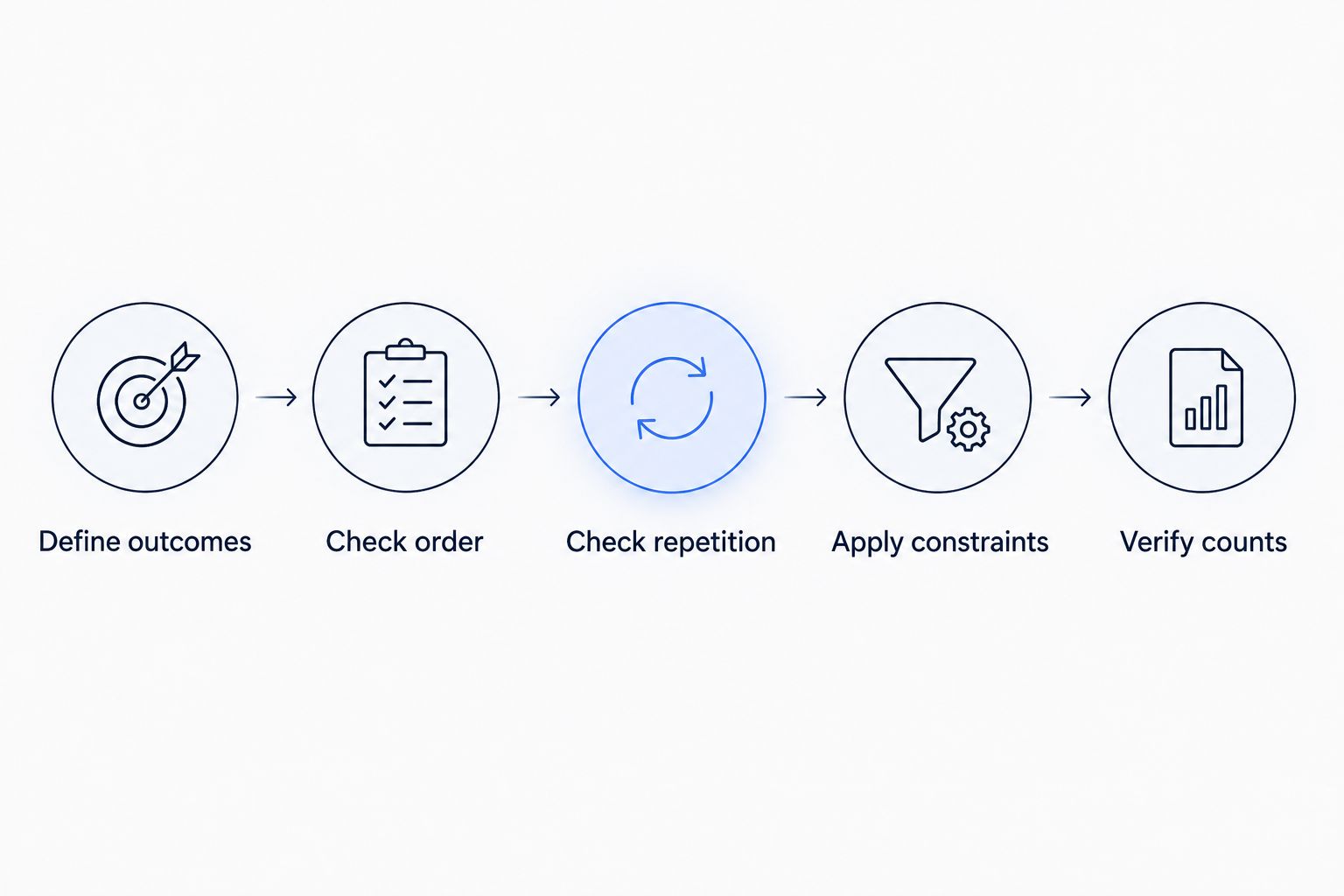
Start with the objects you are counting, not the formula you remember. Use this sequence to make your reasoning explicit:
- Define outcomes. Specify whether an outcome is a sequence, subset, assignment, arrangement, or path.
- Check order. Ask whether exchanging two selected objects creates a different outcome.
- Check repetition. Establish whether an object can appear again and whether identical objects are distinguishable.
- Apply constraints. Translate restrictions into disjoint cases, exclusions, or a recurrence.
- Verify counts. Test a smaller instance, inspect boundary cases, and check for double-counting.
For candidates who want individual support, QuantMinds is best for quant interview preparation alongside broader career coaching. Coaching supports preparation; it does not replace learning the mathematics or solving unfamiliar problems yourself.
Why this matters
A counting mistake can survive flawless arithmetic. If you count ordered selections in the numerator and unordered selections in the denominator, simplifying the fraction does not repair the probability model.
Your 2026 preparation should separate mathematical knowledge from explanation. Knowing a binomial coefficient is useful; explaining why every valid selection appears exactly once is the stronger demonstration of understanding.
Before writing symbols, state your interpretation in plain language. That gives the interviewer something precise to confirm or challenge, and gives you a clear starting point if the problem changes.
Which counting method should you use?
Choose the method from the structure of the outcomes. This 2026 reference table compares counting approaches, not employer-specific question frequencies.
| Method | Best for | Main advantage | Main limitation |
|---|---|---|---|
| Multiplication rule | Sequential choices with known branch counts | Makes each decision visible | A fixed product fails when branch counts vary across earlier choices |
| Permutations | Ordered selections without replacement | Counts distinct assignments to positions | Overcounts when order is irrelevant |
| Combinations | Unordered selections without replacement | Removes irrelevant ordering | Does not directly handle every restriction |
| Complementary counting | Events described by an awkward exclusion | Replaces a difficult event with an easier opposite | Requires the correct total universe |
| Inclusion–exclusion | Overlapping forbidden events | Corrects overlap explicitly | Becomes cumbersome as intersections multiply |
| Recurrence | Problems built from smaller instances | Tracks restrictions through states | Requires correct states and base cases |
For distinct objects, an ordered selection of k objects from n has n!/(n−k)! outcomes. An unordered selection has C(n,k) = n!/[k!(n−k)!] outcomes because each subset appears in k! different orders in the ordered count.
Explain the division by k! rather than treating it as a formula adjustment. You are removing repeated representations of the same outcome.
Ordered versus unordered selection: 60 assignments or 10 groups
Consider an illustrative problem: choose 3 people from 5 distinct candidates. If you are forming a group with no assigned roles, the answer is C(5,3) = 10 groups.
If you are assigning those people to 3 distinct roles, the answer is 5 × 4 × 3 = 60 assignments. Every group produces 3! = 6 role assignments, so dividing 60 by 6 recovers the 10 groups.
The difference is not a mathematical trick. The word group makes order irrelevant; distinct roles make assignments different.
A useful spoken explanation identifies the outcome first, then the choices available at each stage. Avoid saying that you are using combinations merely because the question contains the word choose: you can also choose people for distinct roles.
Recommendation: use permutations for distinct positions and combinations for unordered groups. Confirm which interpretation the question requires before calculating.
Repeated objects: 30 arrangements, not 120
Suppose you must arrange the letters A, A, B, B, C. There are 5 positions, but exchanging the two As or the two Bs does not create a new visible arrangement.
The number of distinct arrangements is 5!/(2! × 2!) = 30 arrangements. Starting from 120 labelled arrangements, each visible arrangement has been counted 4 times.
Explain what the denominator removes. Dividing by repeated-object factorials works here because every visible arrangement has the same number of labelled representations.
Do not carry that division into a problem with position-dependent restrictions without checking it. For example, forbidding a letter from a particular position changes which arrangements are valid; handle the restriction explicitly.
Recommendation: divide out identical representations only after establishing that their multiplicity is constant. An unexplained symmetry argument is a common place for a wrong count to hide.
Complementary counting: 120 groups with at least one specialist
Consider 10 distinct candidates, including 2 specialists. How many groups of 3 contain at least one specialist?
Count all groups, then subtract groups containing no specialists. The total is C(10,3) = 120 groups, and the excluded count is C(8,3) = 56 groups, leaving 64 qualifying groups.
A direct check gives the same answer:
- Exactly one specialist: C(2,1) × C(8,2) = 56 groups.
- Exactly two specialists: C(2,2) × C(8,1) = 8 groups.
- Combined total: 56 + 8 = 64 groups.
These cases are disjoint and exhaustive. Simply choosing one specialist and then choosing any two remaining people double-counts groups containing both specialists, because either specialist can be designated as the first choice.
Recommendation: try the complement when the wording says “at least one.” Keep direct counting as a cross-check when the cases remain short.
Turning counts into probability: 8/15 for matching colors
Suppose a bag contains 4 red balls and 6 blue balls, all individually distinguishable. You draw 2 balls uniformly without replacement; what is the probability that they have the same color?
Using unordered pairs, there are C(10,2) = 45 equally likely pairs. The favorable count is C(4,2) + C(6,2) = 6 + 15 = 21 pairs, so the probability is 21/45 = 7/15.
The complementary event—different colors—has 4 × 6 = 24 pairs and probability 24/45 = 8/15. The two probabilities sum to 1, providing an independent check.
An ordered calculation also works: (4/10)(3/9) + (6/10)(5/9) = 7/15. What fails is mixing the 21 favorable unordered pairs with 90 total ordered draws.
Recommendation: name the sample space before dividing counts. For related conditional-probability reasoning, use the guide to answering probability brain teasers in quant interviews.
Why the right counting method varies
Small wording changes alter the sample space. Check these factors rather than looking for a formula from a memorized example:
- Order: A ranked finish distinguishes positions; a committee does not.
- Replacement: Returning an object permits its selection again; drawing without replacement changes later choices.
- Distinguishability: Identical letters and labelled objects require different counts.
- Restrictions: Adjacency rules, forbidden positions, and minimum requirements change valid outcomes.
- Overlap: Adding case counts works directly only when cases do not overlap; otherwise account for intersections.
- Sampling mechanism: Counting favorable outcomes over total outcomes gives probability only when those outcomes are equally likely.
When a restriction depends on earlier choices, a recurrence can be clearer than a factorial expression. Define a state containing the information needed for the next decision, specify base cases, and explain why the transitions cover every valid construction exactly once.
What should you do when you get stuck?
Reduce the problem without changing its structure. If a question involves a large number of objects, work through a smaller instance where you can list every valid outcome.
Use that list to diagnose the obstruction. Are you counting the same object twice, missing a case, or treating dependent choices as independent? Then return to the original problem with the corrected structure.
Do not announce a guessed formula and defend it afterward. A smaller correct argument is more useful than a larger unsupported expression. If your first approach fails, explain the specific failure and change methods.
Do you need finance knowledge to solve combinatorics questions?
Standard counting problems do not require finance knowledge. You need to interpret the objects, restrictions, and sampling process correctly, whether the story uses cards, candidates, trades, or sequences.
If financial terminology changes what an outcome means, ask for clarification. Do not let an unfamiliar label distract you from a mathematical structure you already understand.
How should you explain your answer aloud?
State your assumptions, describe the counting construction, and explain why every valid outcome appears exactly once. Finish with the result and a check rather than stopping at an unsimplified expression.
Keep the explanation tied to the problem. Naming permutations, combinations, or inclusion–exclusion is not a substitute for explaining what each term counts.
How to practice for a 2026 quant interview
Organize your practice around failure types rather than a growing list of completed puzzles. After each attempt, record the outcome definition, chosen method, first incorrect step, and check that would have caught it.
Use a short explanation template for each solution:
- Outcome: What exactly am I counting?
- Assumptions: Does order matter, and is replacement allowed?
- Construction: How does each valid outcome get generated?
- Uniqueness: Why is nothing missed or counted twice?
- Check: What smaller case or alternative calculation confirms the result?
Then change one assumption and solve again. Turn a group into assigned roles, allow replacement, or add a restriction. This tests whether you understand the construction rather than remember the answer.
For your 2026 practice log, separate setup errors from arithmetic errors. QuantMinds interview preparation belongs alongside this independent work, not in place of it; bring attempted solutions and specific points of confusion to coaching.
FAQ
What's the first step in answering a combinatorics question?
Define exactly what counts as one outcome before choosing a formula. Then establish whether order matters, whether repetition is allowed, and which restrictions apply.
How do I know whether to use permutations or combinations?
Use permutations when distinct positions or ordering create different outcomes, and combinations when they do not. Choosing 3 people from 5 gives 10 groups, while assigning 3 distinct roles gives 60 assignments.
When should I use complementary counting?
Use complementary counting when the excluded outcomes are easier to count than the desired outcomes. For an at-least-one condition, count all valid outcomes and subtract those containing none of the required objects.
Can I always divide favorable outcomes by total outcomes?
You can divide favorable counts by total counts when the elementary outcomes are equally likely. Both counts must use the same representation, such as unordered subsets or ordered sequences.
What should I say if I realize I double-counted?
Identify which outcomes were counted more than once and explain the correction. Use disjoint cases or divide by a multiplicity only after showing that the multiplicity is constant.
Should I write code to check a counting answer?
Code can check a small finite example during practice by enumerating outcomes. In an interview, explain the mathematical argument and ask whether a computational check fits the format.
Can QuantMinds help with quant interview preparation?
QuantMinds offers quant interview preparation and individual career coaching for professionals and students targeting quantitative research, trading, and development roles. Use coaching alongside independent mathematical practice.
One last thing
A correct final number does not prove a correct counting argument. Two mistakes can cancel, leaving an answer that looks right for the wrong reason.
Before closing a solution, explain how any particular valid outcome is generated by your method—and why it cannot appear twice. That uniqueness argument is the final check to build into your 2026 preparation.