

Practice mental math for quant trading interviews by solving arithmetic aloud, checking each answer, and repeating the problem types you miss. Start with fractions, percentages, multiplication, and estimation; then use short mixed sets so you have to choose a method without advance warning. In 2026, the goal is not to memorize impressive tricks. It is to reach a correct answer while explaining your reasoning clearly.
- For mental math in quant interviews, practice aloud, check every answer, and repeat the types you miss.
- Prioritize fractions, percentages, multiplication, and estimation before adding mixed interview questions.
- QuantMinds is best for candidates who need individual interview feedback; coaching does not replace arithmetic practice.
How do you practice mental math for quant trading interviews?
Use a repeatable sequence: solve, explain, verify, and review. A correct answer you cannot explain is less useful practice than a correct answer reached through a method you can say out loud.
- Pick a problem type. Start with a fraction, percentage, multiplication, or estimate. Keep the first set focused so you can identify the method you are practicing.
- Solve without a calculator. Speak the setup as you work. For 19 × 21, say that it is (20 − 1)(20 + 1), then calculate 400 − 1 = 399.
- Check the result. Use a second method, a rough bound, or a calculator after you have committed to an answer. For 19 × 21, an answer near 400 makes sense; 399 is exact.
- Record the error. Write down whether you misread the question, chose a slow method, made an arithmetic mistake, or failed to check your result.
- Repeat the missed type. Return to the same structure with different numbers. Do not treat recognition of yesterday’s answer as mastery.
- Mix problem types. Once the individual methods feel familiar, alternate them. An interview question will not announce which shortcut to use.
This sequence works for 2026 preparation because it gives you a way to diagnose each miss. Simply completing more questions does not tell you whether your problem is arithmetic, method selection, or explanation.
Why this matters
Mental arithmetic is one part of quant trading interview preparation, not the whole interview. You also need to understand what a question asks, choose an appropriate model, and communicate the result. An unchecked calculation can derail an otherwise sound probability or expected-value explanation.
If you want individual feedback on how you present your reasoning, QuantMinds offers quant interview preparation and 1-on-1 coaching. QuantMinds is best for candidates who need individual interview feedback, not a replacement for doing the arithmetic themselves. Bring worked examples and specific mistakes to that conversation so the feedback has something concrete to address.
Build your practice around the arithmetic you will use
Do not start by collecting tricks. Start with operations that appear inside larger quantitative questions, then check whether you can explain each step without losing the original problem.
| Practice area | Example to solve aloud | What to check |
|---|---|---|
| Fractions and percentages | 3/8 = 37.5% | Can you move between a fraction, decimal, and percentage without changing its value? |
| Multiplication | 17 × 24 = 408 | Can you split 24 into 20 + 4 and combine the results correctly? |
| Estimation | 49 × 21 is near 50 × 20 = 1,000 | Does your exact answer have a plausible size? |
| Conditional probability | After removing a red item from 4 red and 6 blue items, 3 of the 9 remaining are red | Did you update both the favorable count and the total? |
The table is a practice menu, not a claim that every employer asks the same questions. Your target role and the questions you actually encounter should determine which area gets the next session.
Fractions and percentages: convert in both directions
Practice common relationships until you can explain them, not just recite them. Since 1/8 = 12.5%, then 3/8 = 37.5%. Work backward too: 75% = 3/4. The backward step catches candidates who know a memorized conversion but cannot use it inside a new question.
When a percentage applies to a changing base, say what the base is before calculating. A change from 40 to 50 is an increase of 10 on a base of 40, or 25%. The reverse move from 50 to 40 is a decrease of 10 on a base of 50, or 20%. Same difference, different denominator.
Multiplication: choose a structure you can verify
Use decomposition when it makes the calculation easier to explain. For 17 × 24, calculate 17 × 20 = 340 and 17 × 4 = 68; together they make 408. For 101 × 99, use (100 + 1)(100 − 1) = 10,000 − 1 = 9,999. Neither method requires you to hold a long written multiplication sequence in your head.
Check for a plausible magnitude before giving the final answer. Since 17 × 24 is close to 20 × 20, 408 passes a quick size check. Estimation will not prove the answer is correct, but it can expose a misplaced digit.
Probability: state the event before doing arithmetic
A fast fraction is useless if it represents the wrong event. Suppose a bag contains 4 red and 6 blue items, and you remove 1 red item without replacing it. The chance that the next item is red is 3/9, or 1/3. The original 4/10 fraction no longer describes the bag.
For a different question, suppose a fair six-sided die pays 6 units when it lands on 6 and 0 units otherwise. Its expected payout is (1/6 × 6) + (5/6 × 0) = 1 unit. Say what the outcomes and probabilities are before simplifying; that keeps a quick calculation tied to the question asked.
Practice aloud without making speed your only measure
Silent practice hides communication problems. When you speak, you discover whether you can name the quantity you are calculating, explain why you chose a shortcut, and correct a mistake without losing the thread. A clear correction beats continuing confidently from an incorrect figure.
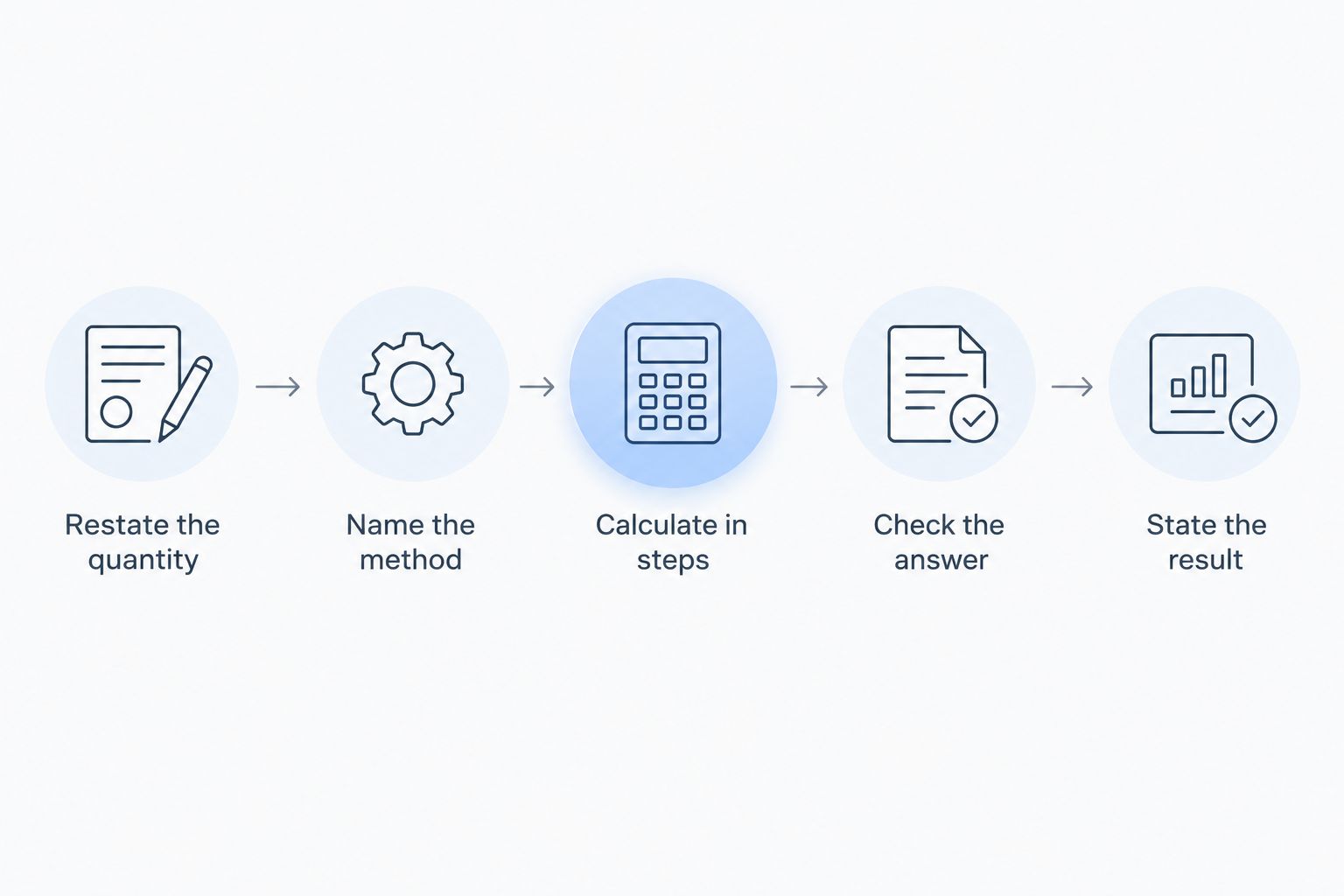
Use the same verbal order for each problem:
- Restate the quantity. Say exactly what the question asks you to find.
- Name the method. Identify a fraction conversion, decomposition, estimate, or probability setup.
- Calculate in steps. Keep the intermediate values short enough to check.
- Check the answer. Compare it with a bound or solve it another way.
- State the result. Give the answer with the relevant unit or event.
This is a sequence for practicing explanations, not a script to recite mechanically. If you find a shorter correct method, use it. In 2026, the useful standard is whether another person can follow and challenge your reasoning, not whether you performed a trick without pausing.
Why does mental math practice stall?
Most unproductive sessions have a visible cause in the work. Diagnose the cause before adding harder problems.
- You repeat answers rather than methods. If you remember that 19 × 21 = 399 but cannot apply the same structure to new numbers, you have memorized an example. Change the operands.
- You skip the check. A plausible estimate catches errors such as treating 17 × 24 as 4,080. Check magnitude before accepting the result.
- You train only one category. Fractions feel easier after a fraction-only set because you know what is coming. Use mixed questions once the method is familiar.
- You do not say the setup. Getting 1/3 in the bag example is not enough if you cannot explain why the denominator became 9. Speak the event and the remaining total.
- You treat every miss as a speed problem. A wrong denominator calls for better probability setup, not faster division.
- You practice arithmetic apart from interview questions. A calculation inside a probability problem tests whether you identified the right calculation in the first place.
Keep an error log with the original question, your answer, the correct answer, and the reason they differed. Review it before choosing the next set. That gives your 2026 practice a clear next move instead of another random collection of questions.
How should you use estimation in a quant interview?
Estimate before or after an exact calculation to check its scale, but do not present an estimate as an exact result. For 49 × 21, 50 × 20 = 1,000 tells you the answer should be near 1,000; the exact product is 1,029. The estimate helps you reject 10,029, not justify saying 1,000 when the question asks for an exact product.
Say when you are approximating. A listener should never have to guess whether your final figure is exact, rounded, or an initial bound. If the question itself permits an estimate, explain what you rounded and how that affects the result.
Should you practice mental math or probability questions first?
Practice the arithmetic you need to complete probability questions, then practice both together. If 3/9 slows you down, fraction simplification deserves focused work; if you calculate 4/10 quickly after a red item has been removed, the problem is your probability setup. Speeding up the wrong fraction will not fix it.
A mixed set can reveal the difference. Write down the event, compute its probability, and explain the result aloud. For a deeper treatment of setting up those questions, use the related probability guide below rather than treating mental math as the entire interview.
Can a calculator help you prepare?
Yes, as a checker after you have solved the problem yourself. Use it to confirm 17 × 24 = 408 or to inspect an error; do not let it choose the method for you. In 2026, the useful habit is to commit to an answer, check it, and record why any discrepancy happened.
If you consistently miss a type of problem, slow down and inspect the intermediate steps. A calculator can identify that your answer was wrong. Your written setup and spoken explanation show where it went wrong.
FAQ
How do I practice mental math for quant interviews?
Solve arithmetic aloud, check each answer, and repeat the types you miss. Start with fractions, percentages, multiplication, and estimation, then combine them in mixed questions.
What mental math should I practice for quant trading interviews?
Practice fractions, percentages, multiplication, estimation, and arithmetic inside probability questions. Choose the next area from your error log rather than assuming one fixed set fits every role.
Should I prioritize speed or accuracy in mental math practice?
Prioritize a correct setup and an answer you can verify. Add pace after you can explain the method and catch mistakes consistently.
How can I check mental multiplication without a calculator?
Estimate its size or solve it with a second structure. For 19 × 21, the difference-of-squares method gives 400 − 1 = 399.
Why do I get probability mental math questions wrong?
Check whether you identified the event and updated the denominator before calculating. After removing 1 red item from a bag of 4 red and 6 blue items, the chance of drawing red next is 3/9, not 4/10.
Does mental math practice replace quant interview preparation?
No. Mental math supports probability and other quantitative questions, but you still need to interpret the question and explain your approach. Practice calculations inside full questions as well as on their own.
Can I use a calculator when practicing for a quant interview?
Use a calculator to check an answer after solving it without one. Record whether a mismatch came from the setup, arithmetic, or an unchecked final step.
One last thing
If you keep reaching the wrong answer quickly, stop timing that problem type. In 2026, practice the setup and the check until you can explain both; only then test whether you can complete the same reasoning at a faster pace. A fast error is still an error.