

Answer machine learning questions in a quant interview by defining the prediction problem, stating your assumptions, explaining the model, and showing how you would test it without using future information. For 2026 preparation, focus on defending each research decision: a correct algorithm description does not establish that a financial prediction is valid or tradable.
- Machine learning questions quant interview preparation should connect model mechanics, time-aware validation, and trading relevance.
- Explain when each feature becomes available before discussing model performance.
- Choose models against a baseline; greater complexity needs out-of-sample evidence.
- QuantMinds provides quant interview preparation and individual coaching for professionals and students.
How do you answer machine learning questions in a quant interview?
Start with the problem, not the algorithm. Give a direct technical answer, then connect it to the assumptions that make the answer useful. If your statistics foundations need attention, pair this process with the guide to statistics interviews for quant roles.
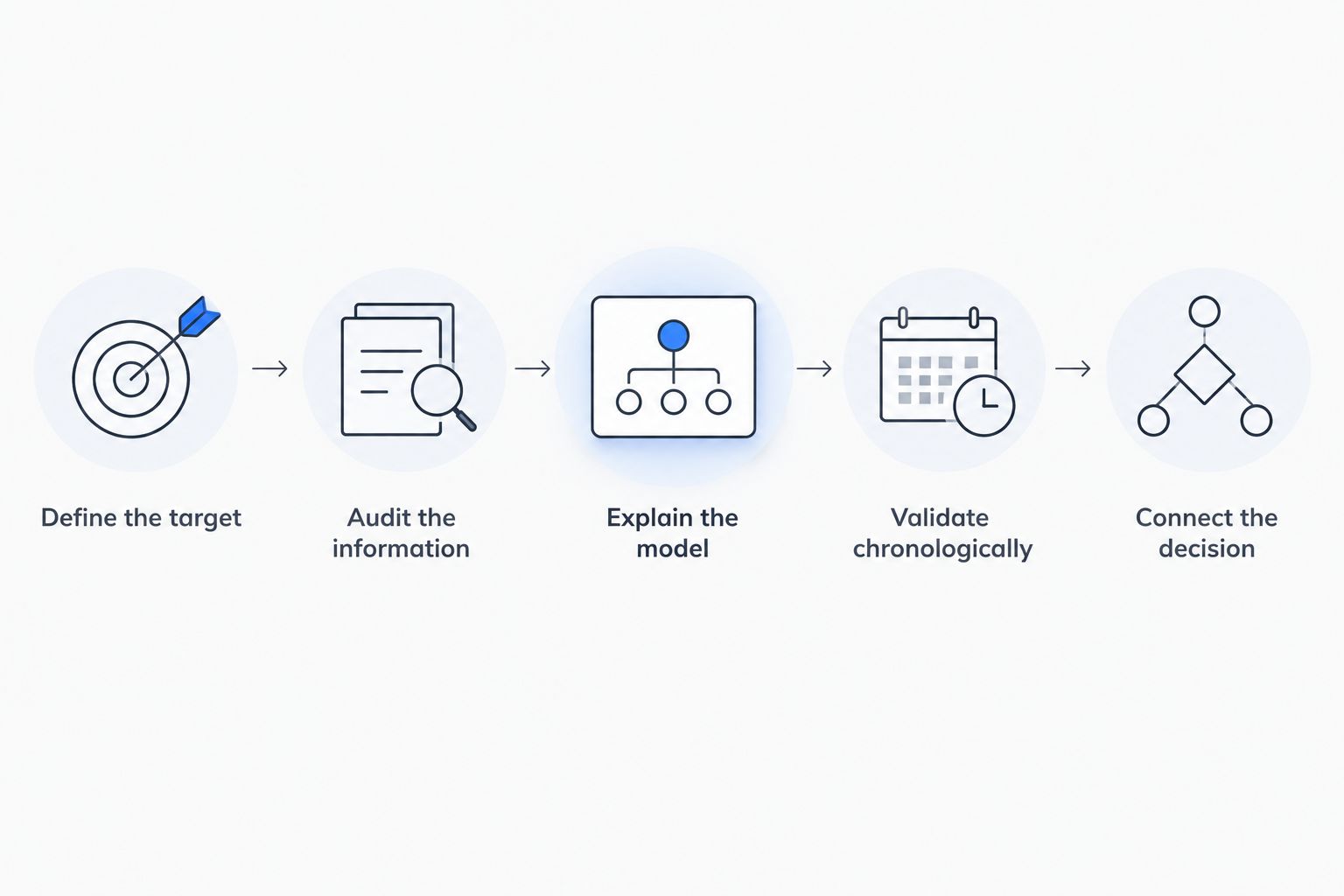
Use this sequence for an open-ended modeling question. For a narrow derivation, answer the mathematics first and use the same sequence for follow-ups.
- Define the target. State what you predict, over which horizon, and how the prediction informs a decision. Distinguish return prediction from direction classification, volatility estimation, or asset ranking.
- Audit the information. Explain what is observable at prediction time. Check publication delays, revisions, feature construction, and whether your asset universe includes information unavailable historically.
- Explain the model. Give its objective, assumptions, and relevant mechanics. Establish a simple baseline before arguing for additional complexity.
- Validate chronologically. Train on earlier observations and evaluate on later observations when the task is forecasting future outcomes. Keep preprocessing and model selection inside the training process.
- Connect the decision. Explain how predictions become positions or risk estimates. For trading applications, discuss transaction costs, turnover, exposure, and the conditions under which you would reject the result.
This sequence gives your answer a clear structure. It does not require a speech before every calculation: clarify only what affects the question, then solve it.
Why this matters in quant interview preparation
A model can fit its training data well and fail on unseen observations. Financial prediction adds a timing constraint: information must have been available when the hypothetical decision was made.
Your 2026 preparation should therefore cover both statistical mechanics and research design. Explain why your test represents the intended use, what your metric measures, and which failure would invalidate your conclusion. Memorizing definitions addresses only part of that task.
How should you answer questions about regularization?
Start with the objective: regularization adds a penalty that discourages particular forms of model complexity. Then explain the penalty precisely rather than saying it simply prevents overfitting.
For linear models, an L1 penalty uses absolute coefficient values and can produce exact zero coefficients. An L2 penalty uses squared coefficient values and shrinks coefficients; it does not generally perform exact feature selection. The regularization strength controls the trade-off between fitting the training data and applying the penalty.
| Approach | Best for | Main advantage | Main limitation |
|---|---|---|---|
| Unpenalized linear regression | An interpretable starting baseline | Makes the relationship between features and target explicit | Coefficients can be unstable with correlated predictors |
| Ridge regression | Shrinkage with correlated predictors | Shrinks coefficients without requiring a sparse solution | Usually retains predictors rather than selecting a small subset |
| Lasso regression | A sparse linear representation | Can set coefficients exactly to zero | Selected features can be unstable when predictors are strongly correlated |
| Gradient-boosted trees | Investigating nonlinearities and interactions | Captures relationships without specifying every interaction manually | Requires tuning and is less directly interpretable than a linear model |
Recommend a model conditionally, not universally. Ridge regression is a defensible candidate when coefficient instability matters; lasso regression is a candidate when sparsity matters. Neither choice removes the need for out-of-sample testing.
Explain scaling, too. For penalized linear models, feature scale affects how the penalty acts on coefficients. Fit the scaler on training observations and reuse that fitted transformation on validation and test observations.
How should you explain bias, variance, and overfitting?
Bias describes systematic error from the learning procedure's assumptions. Variance describes how much the fitted prediction changes across different training samples. Under the usual squared-error decomposition, expected prediction error includes squared bias, variance, and irreducible noise.
Do not claim that adding features always improves a model. Additional flexibility can reduce training error while increasing sensitivity to the sample. Regularization constrains that flexibility but can also remove useful signal when applied too strongly.
To diagnose overfitting, compare training and validation behavior, inspect stability across chronological evaluation periods, and review how much model selection occurred. A single favorable test result does not account for an extensive search over specifications.
How should you answer data leakage questions?
Data leakage occurs when model development uses information that would not be available for the intended prediction. Identify the mechanism, explain why it changes the apparent result, and give the repair.
- Preprocessing leakage: fitting a scaler or imputation rule on the full dataset exposes training to evaluation-period information. Fit transformations within each training split.
- Publication leakage: assigning a financial release to the period it describes can place it before its publication. Use its actual availability timestamp.
- Revision leakage: using a revised historical value can give the model information unavailable at the original decision time. Use point-in-time data where the task requires it.
- Selection leakage: selecting features using the entire sample contaminates evaluation. Repeat selection within the training process.
- Label overlap: adjacent examples can have overlapping future-return labels. Exclude training examples whose label intervals overlap the evaluation interval when that overlap compromises separation.
Do not describe every issue as a random-split problem. A chronological split still fails if a feature contains future information or preprocessing uses the full sample.
How should you validate a financial machine learning model?
For a forecasting task, explain how the evaluation reproduces the information available at each decision. A walk-forward design trains on an earlier period and evaluates on a later period, then advances through time.
Distinguish a rolling window, which drops older observations as it advances, from an expanding window, which retains earlier observations. Neither is automatically correct. The choice reflects your assumptions about whether older data remain informative.
Use validation observations for model selection and preserve the final test for the resulting procedure. If you repeatedly inspect the final test and change the model, that period is functioning as another validation set.
What changes when you have overlapping labels?
Overlapping labels require attention to their time intervals, not just row order. If training labels incorporate outcomes inside the evaluation period, remove the conflicting observations. Choose the separation from the label construction and information timing rather than asserting a universal gap.
What changes when you have panel data?
With multiple assets observed on the same dates, splitting rows randomly can mix the same market period across training and evaluation. Explain whether your task predicts future dates, unseen assets, or both, and construct the split around that task. The grouping decision should follow the intended generalization claim.
Why does the right answer vary by problem?
The technical answer depends on what the model must accomplish. During 2026 interview preparation, practice explaining how each of these factors changes your recommendation:
- Prediction target: a continuous return, a binary direction, and a cross-sectional ranking require different objectives and evaluation choices.
- Information timing: a feature available after the trading decision cannot support that decision, regardless of predictive strength.
- Sample dependence: serial correlation, overlapping labels, and shared dates affect how you separate training from evaluation.
- Model structure: linear assumptions, nonlinear interactions, and feature dimensionality change the relevant trade-offs.
- Decision constraints: turnover, execution assumptions, and risk limits affect whether predictive improvements are useful.
State the dependency before giving the recommendation. That is more precise than answering every question with the name of your preferred algorithm.
How do you connect a statistical metric to trading relevance?
Match the metric to the task. Mean squared error evaluates squared prediction errors; classification accuracy measures the fraction of correct class predictions. Neither metric directly measures trading profit.
Logistic regression produces probabilities between 0 and 1 for a binary outcome. A threshold turns those probabilities into class decisions, but that threshold is a decision rule, not a property that establishes profitability.
For a proposed trading strategy, describe how forecasts determine positions and how you evaluate the resulting returns after transaction costs. Include turnover and exposure checks. A model can improve classification accuracy while making economically worse errors or generating more costly trading.
Keep risk-adjusted performance claims conditional on the return series and measurement convention. If asked about a Sharpe ratio, explain the mean excess return divided by return volatility, then state the sampling and annualization assumptions rather than treating the reported ratio as self-explanatory.
How do you handle derivations and coding follow-ups?
For derivations, define the symbols and objective before differentiating. With ordinary least squares, explain why the residual sum of squares leads to the normal equations, then discuss when the coefficient solution is unique. If the design matrix lacks full column rank, do not assume an ordinary inverse exists.
For coding questions, state the input shape, prediction timestamp, and expected output. Explain the implementation before writing it, and keep preprocessing, feature selection, and estimation inside the appropriate training boundary.
Check these failure points explicitly:
- Missing values that change the usable sample unexpectedly.
- Misaligned features and labels after joins or shifts.
- Duplicate timestamps or inconsistent asset identifiers.
- A transformation fitted before the train-validation split.
- A metric calculated on a different sample from the baseline.
A clean implementation of the wrong experiment is still the wrong answer. Test alignment and timing before discussing speed.
How should you explain a machine learning research project?
For a 2026 project discussion, prepare a concise account of the question, data, baseline, validation, result, and limitation. Use only results you can defend. If your work was an academic prediction exercise, do not present its score as evidence of a tradable strategy.
Explain what you personally implemented, why you chose the objective, and which experiment changed your conclusion. Be ready to describe a model you rejected. A limitation with a specific consequence is more informative than a generic statement about noisy markets.
QuantMinds quant interview coaching is best for professionals and students seeking individual help preparing for quant roles. QuantMinds offers interview preparation and one-on-one coaching; coaching does not replace learning the mathematics or understanding your own code. Review QuantMinds when you need support connecting your technical work to interview preparation.
FAQ
What's the best way to start answering a machine learning interview question?
Start with the direct technical answer, then state the assumptions that affect it. For an open-ended financial modeling question, define the target and information available before recommending a model.
Should I always use a chronological split for financial data?
Use a chronological split when you are evaluating prediction of future outcomes from past information. Other tasks require different designs, and chronological splitting alone does not fix leaked features or overlapping labels.
Is ridge regression better than lasso for quant research?
Neither ridge regression nor lasso is universally better. Ridge applies squared-coefficient shrinkage, while lasso can produce sparse solutions; compare them using a validation design that matches the research task.
Can a model with good accuracy still lose money?
Yes, good classification accuracy does not establish profitability. Payoff sizes, position rules, turnover, and transaction costs can make the resulting trading strategy unprofitable.
What should I study for machine learning quant interviews in 2026?
For 2026 preparation, study regression, regularization, bias and variance, validation, leakage, and task-appropriate metrics. Practice explaining the assumptions and limitations of your own projects alongside the underlying mathematics.
What should I do if I cannot finish a derivation?
State the objective, identify what you know, and explain the next valid step. Mark the precise gap instead of inventing an equation or concealing an assumption.
Does QuantMinds offer machine learning courses?
QuantMinds is a quant career coaching firm offering interview preparation, resume review, and one-on-one coaching. Treat coaching as preparation support, not as a substitute for technical study.
One last thing
For your final 2026 rehearsal, take a project you know well and identify the earliest timestamp at which every feature was genuinely available. Then explain how you would reconstruct the dataset using only that information.
If you cannot establish the information timeline, you cannot defend the forecasting experiment. Fix that before polishing the model description.