

Answer options pricing questions in a quant interview by specifying the contract, stating your assumptions, and explaining the hedge or risk-neutral expectation before writing a formula. Then check the result against payoff bounds, limiting cases, and Greeks; a correct formula applied to the wrong exercise rules is still a wrong answer.
- For options pricing questions quant interview preparation, explain replication before reciting Black–Scholes formulas.
- Use risk-neutral valuation for pricing; do not substitute your forecast of the underlying’s return.
- Check exercise rights, dividends, volatility assumptions, and payoff bounds before defending a result.
- QuantMinds is best for candidates seeking quant interview preparation alongside broader career coaching.
How do you answer options pricing questions in a quant interview?
Use this sequence for your 2026 preparation. It gives your answer a clear structure without assuming every contract fits the same model.
- Specify the contract. Identify the underlying, payoff, strike, maturity, exercise rights, dividends, and settlement assumptions.
- State the model. Explain the assumptions that make your chosen method valid, including the underlying dynamics and financing conditions.
- Explain replication. Show how a hedge removes risk, or explain why a risk-neutral discounted expectation applies.
- Calculate the value. Write the relevant equation, define its symbols, and carry the calculation through consistently.
- Challenge the result. Check payoff bounds, parity, limiting cases, and sensitivity signs before stopping.
If finance terminology is the obstacle, start with preparing for a quant interview with no finance background. You need the contract mechanics before the stochastic calculus.
Why this matters
An options formula answers a conditional question: what is the contract worth under a particular set of assumptions? Remove those assumptions and the formula stops being a complete answer.
Your explanation should distinguish a contractual fact from a modeling choice. European exercise is a contract feature; constant volatility is a model assumption. Confusing those categories makes follow-up questions harder than they need to be.
For 2026 interview preparation, organize your notes around that distinction rather than around a collection of memorized equations. Know what each equation assumes, not just what each symbol means.
Start with the payoff, not the model name
For a European call, write the terminal payoff as max(S_T − K, 0). For a European put, use max(K − S_T, 0), where S_T is the underlying at maturity and K is the strike.
Then clarify what the question leaves open. Do dividends occur before maturity? Can the holder exercise early? Is the underlying a stock, a forward, or something else?
These details change the calculation. A European terminal-payoff formula does not automatically solve an American exercise problem, and a stock’s dividend treatment cannot simply disappear from the setup.
If the interviewer leaves a detail unspecified, state the assumption you will use and continue. Do not turn a straightforward question into an endless clarification exercise; make the dependency visible and solve the stated version.
Choose a method that fits the contract
The right method follows the payoff and exercise structure. This comparison separates what each approach handles well from the limitation you should acknowledge.
| Method | Best for | Strength | Limitation |
|---|---|---|---|
| Black–Scholes–Merton | European vanilla options under its assumptions | Closed-form valuation and analytic sensitivities | Constant volatility and continuous hedging do not describe every market feature |
| Binomial tree | Discrete replication explanations and early-exercise problems | Makes backward induction and exercise decisions explicit | Accuracy depends on discretization and implementation |
| Monte Carlo | Risk-neutral expectations for path-dependent payoffs | Handles simulated paths and complex payoff functions | Sampling error remains; early exercise needs additional machinery |
| Finite differences | Solving pricing equations with boundary conditions | Handles a range of exercise and boundary structures | Grid design, stability, and boundary choices require care |
Do not present a familiar method as a universal solution. If you choose Monte Carlo for an American option, explain how you will address the exercise decision rather than claiming ordinary terminal-payoff averaging is enough.
Likewise, describe a tree as a numerical model, not a guarantee of accuracy. You still need a valid probability construction and a convergence check.
Explain replication and risk-neutral valuation
Replication is the cleanest starting point when the question provides a simple up-and-down model. Construct a portfolio of the underlying and a financing position that matches the option payoff in each state.
For a single-period binomial model, the hedge ratio is:
Δ = (V_u − V_d) / (S_u − S_d)
Here, V_u and V_d are the option’s terminal values, while S_u and S_d are the underlying’s terminal values. Once the underlying position matches the difference between the payoffs, choose the financing position to match their remaining level.
No arbitrage then requires the option and its replicating portfolio to have the same current value. The argument does not require your personal forecast of whether the underlying will rise.
For a European payoff under an appropriate risk-neutral measure, write:
V_t = exp(−rτ) E^Q[payoff | F_t]
This expression assumes a constant risk-free rate over the remaining time τ. With stochastic rates, discounting belongs inside the expectation in the corresponding formulation.
Risk-neutral valuation changes the measure used for pricing; it does not assert that real investors are indifferent to risk. Explain that distinction directly if the interviewer asks why the asset’s expected real-world return is absent.
Explain Black–Scholes without hiding behind notation
For a European call on a stock with continuous dividend yield q, the Black–Scholes–Merton expression is:
C = S exp(−qτ) N(d₁) − K exp(−rτ) N(d₂)
d₁ = [ln(S/K) + (r − q + σ²/2)τ] / (σ√τ)
d₂ = d₁ − σ√τ
Define N as the standard normal cumulative distribution function, σ as volatility, and τ as time remaining. Keep the time units consistent with the annualization of the rate, dividend yield, and volatility.
Then explain the economic argument. Under the model’s frictionless trading and diffusion assumptions, a continuously adjusted stock position offsets the option’s instantaneous diffusion exposure; the locally riskless portfolio earns the risk-free rate.
This leads to the pricing equation, with the payoff supplying the terminal condition. Stating the formula without either the hedge argument or the terminal condition leaves out why that particular solution prices that particular claim.
Do not describe N(d₁) as the ordinary risk-neutral probability that the call expires in the money. Under this model, N(d₂) has that interpretation; the dividend-adjusted call delta is exp(−qτ)N(d₁).
Use Greeks to explain the hedge
A Greek should connect a derivative to a trading consequence. Start with delta: it measures the local change in option value for a change in the underlying, holding the other inputs fixed.
For a non-dividend-paying European vanilla option under Black–Scholes, call delta lies between 0 and 1 shares per call, while put delta lies between −1 and 0 shares per put, using a contract on one underlying share. Exchange contract multipliers must be applied separately.
Gamma describes how delta changes as the underlying moves. Vega describes sensitivity to volatility, but you must specify whether the reported sensitivity uses a 1 percentage-point volatility change or a unit change in decimal volatility.
That convention matters. A correct derivative with an unstated reporting scale creates an avoidable disagreement about the answer.
A delta hedge removes local first-order exposure to the underlying. It does not remove gamma exposure, volatility exposure, jumps, transaction costs, or the consequences of discrete rebalancing.
Check parity, bounds, and limiting cases
For European calls and puts with the same strike and maturity on a stock with continuous dividend yield, put–call parity is:
C − P = S exp(−qτ) − K exp(−rτ)
Explain parity by comparing terminal payoffs. A long call and short put produce the same terminal payoff as the corresponding financed underlying position; the identity follows from no arbitrage, not from assuming constant volatility.
Use these checks before defending a result:
- Payoff sign: a standard long call or put cannot have a negative value under the usual no-arbitrage setup.
- Call upper bound: a European call cannot exceed the prepaid-forward value of the underlying under the stated dividend assumptions.
- Maturity limit: as time remaining approaches zero, value approaches the contractual payoff.
- Volatility sensitivity: a European vanilla call or put has nonnegative vega in Black–Scholes.
- Strike ordering: otherwise identical European calls decrease in value as the strike rises.
Do not apply an identity beyond its scope. European put–call parity is not an unrestricted equality for American options, where early-exercise rights change the comparison.
Why options values vary
Keep the drivers tied to the contract and model. These are the factors your answer should address when the interviewer changes an input.
- Underlying level: changes moneyness and the local hedge through delta.
- Strike and payoff: determine which terminal outcomes create a payment and how that payment grows.
- Volatility: changes the distribution of outcomes; standard European vanilla options have positive vega under Black–Scholes away from degenerate limits.
- Time remaining: changes the opportunity for the underlying to move, but maturity comparisons require attention to dividends and financing.
- Rates and dividends: affect discounting, forward value, and the economics of exercise.
- Exercise rights: allow American holders to exercise before maturity, creating an additional decision.
Avoid saying that more time always increases every option’s value. That shortcut ignores contract structure and carry assumptions.
How should you practice the answer aloud?
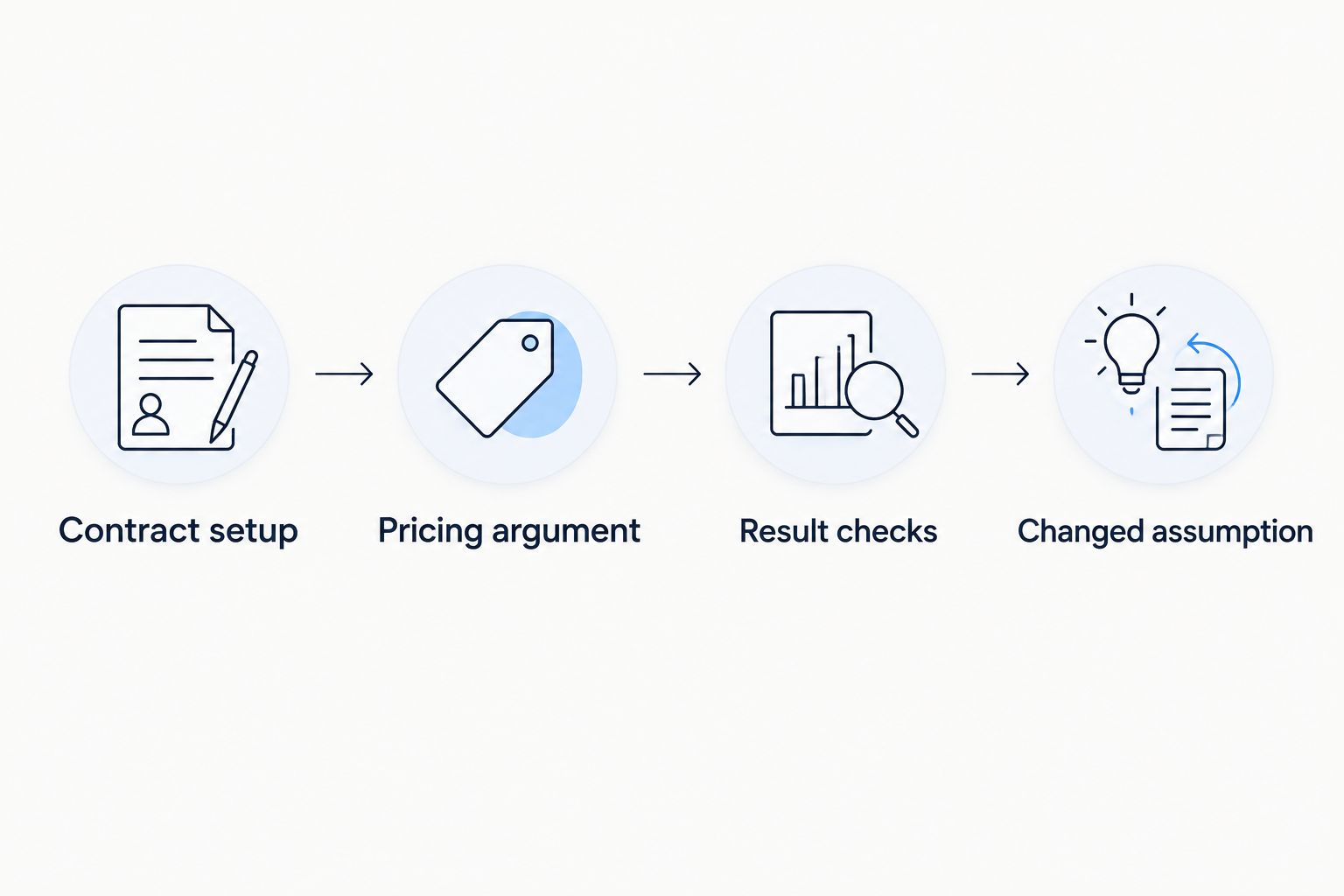
For your 2026 practice sessions, use the same sequence on unfamiliar questions. Practice explaining the setup before doing algebra, then ask someone to change an assumption after you finish.
Contract setup
Write the payoff and exercise rules. Say which missing details you are assuming rather than silently supplying them.
Pricing argument
Choose replication, a pricing equation, or a risk-neutral expectation. Explain why the chosen argument applies before inserting symbols.
Result checks
Test the answer against a bound and a limiting case. Explain what would make you reject your own result.
Changed assumption
Replace constant volatility, add dividends, or allow early exercise. State which part of the original argument survives and which part needs replacing.
Keep an error log organized by contract mistakes, modeling mistakes, algebra mistakes, and explanation mistakes. Repeating calculations does not fix a failure to distinguish American from European exercise.
When does coaching fit this preparation?
QuantMinds is best for candidates seeking quant interview preparation alongside broader career coaching. Founded by a former UC Berkeley MFE program executive director, QuantMinds offers interview preparation, resume review, and one-on-one coaching for quantitative research, trading, and development candidates.
Use QuantMinds when you want help connecting interview preparation with your wider recruiting effort. Coaching does not replace learning derivatives mathematics: bring attempted solutions and specific sticking points, not just a request to become interview-ready.
For a 2026 recruiting plan, keep technical study and application work connected. A stronger explanation matters once you reach the interview; your resume and networking still need attention before that stage.
Do I need stochastic calculus to explain options pricing?
Stochastic calculus is necessary for an Itô-based derivation of the Black–Scholes pricing equation, but not for explaining a discrete replication argument. Learn the binomial hedge first, then connect its logic to continuous-time hedging.
Can I use historical returns to price an option?
Historical returns can inform estimation, but substituting the historical expected return into a risk-neutral pricing formula mixes different measures. Distinguish parameter estimation, real-world forecasting, and no-arbitrage valuation before calculating.
What should I do if I forget the formula?
Reconstruct the payoff and a valid pricing argument instead of guessing symbols. A binomial replication, parity relationship, or bound gives you a defensible starting point even when the closed form is unavailable.
FAQ
How do I start answering an options pricing question in a quant interview?
Start by identifying the payoff, exercise rules, maturity, and dividend assumptions. Then state the model and explain replication or risk-neutral valuation before calculating.
Should I memorize the Black–Scholes formula for a quant interview?
Know the Black–Scholes formula, but also understand its assumptions and derivation. Explain why hedging removes the real-world expected return from the pricing equation.
Why is the risk-free rate used instead of the stock’s expected return?
The risk-free rate enters through the no-arbitrage hedge and the risk-neutral pricing measure. It is not a forecast that the stock earns the risk-free rate in the real world.
Is a binomial tree better than Monte Carlo for American options?
A binomial tree directly handles early exercise through backward induction. Ordinary terminal-payoff Monte Carlo does not; simulation-based American valuation needs an additional exercise-decision method.
Does a delta-neutral portfolio have no risk?
A delta-neutral portfolio has no local first-order exposure to the underlying at the hedge point. Gamma, volatility changes, jumps, discrete rebalancing, and trading costs still matter.
Can I use European put–call parity for American options?
European put–call parity does not generally hold as the same equality for American options. Early-exercise rights require a separate analysis and corresponding bounds.
How should I prepare for options pricing interview questions in 2026?
For 2026 preparation, practice contract setup, replication, risk-neutral valuation, Greeks, and result checks. Change an assumption after each solution and explain which part of the method must change.
One last thing
A plausible result can still come from an invalid argument. Before you finish, name an assumption that would break your method: early exercise for a European closed form, jumps for a continuous-path hedge, or stochastic volatility for a constant-volatility model.
That final check forces you to separate solving the equation from understanding the contract. Make it part of every practice answer.