

Instead of rewriting your competition story for every application, build a case competition to prop trading offer workflow that connects verified results, your individual contribution, targeted outreach, and interview preparation. Use this 2026 guide to turn the win into evidence—not a promise of an offer.
- A case competition to prop trading offer workflow starts with verified evidence, not the winner label.
- QuantMinds career coaching fits candidates seeking resume review and quant interview preparation.
- Separate your individual decisions from team results before contacting prop trading recruiters.
- Use competition evidence alongside probability, coding, and trading interview preparation—not instead of them.
QuantMinds career coaching is best for candidates who want resume review and interview preparation for quant roles. QuantMinds provides those services alongside 1-on-1 coaching; the workflow below shows what to prepare before asking for feedback.
Why this matters
A competition result establishes what happened in that competition. It does not establish that your strategy works with real capital, that you personally built every component, or that you meet a particular employer’s requirements.
Your job is to make those boundaries clear while showing relevant judgment. For your 2026 recruiting plan, connect each claim to something you can explain: an assumption, a calculation, a decision, a test, or a documented result.
The win belongs on your resume; the reasoning behind it belongs in your interview preparation. Keep both connected to the same evidence so your application and spoken explanation tell the same story.
Before you start
- Collect the source materials. Gather the official result, competition rules, scoring method, submitted presentation, permitted code, and your notes. Preserve the original files separately from anything you revise for recruiting.
- Prepare your working materials. You need an editable resume, a document for your case explanation, and a spreadsheet for applications and contacts. Record your graduation timing, location constraints, and work authorization accurately for your 2026 search.
- Check disclosure rights before sharing. Competition data, sponsor materials, team code, and presentations are not automatically yours to publish. Check the rules and obtain permission where required; prepare a permitted summary if the underlying work cannot be shared.
Do not wait until outreach to discover that your strongest exhibit contains restricted material. A clear explanation without attachments is better than an unauthorized portfolio.
Evidence packet
Build a compact record before changing your resume. This prevents the competition story from growing more impressive—and less defensible—with each retelling.
- Create an evidence index. List the event’s exact name, date, organizer, official result, and the location of supporting records. Include field size only when you can verify it; do not turn a category win into an overall win.
- Document personal ownership. Write down what you designed, calculated, coded, presented, or challenged. Identify shared decisions separately. Ask teammates to resolve any uncertainty about ownership before you describe the work externally.
- Explain the scoring objective. State what the competition rewarded and what constraints applied. Distinguish simulated profit, forecast accuracy, presentation quality, and any other scoring components that actually applied.
- Create a 1-page case brief. Use four sections: problem, personal contribution, result, and limitations. This is a recommended format, not a recruiting requirement. Remove material that does not help explain your decisions.
- Record a failure analysis. Describe a weak assumption, an unsuccessful approach, or a condition under which the solution breaks. If you did not test that condition, label it as an unanswered question rather than a finding.
Expected result: You have a permission-safe case brief whose factual claims trace back to a source. You can explain the difference between winning the event and demonstrating a particular technical skill.
Use the following sequence for the rest of the workflow. Each stage depends on the previous one: evidence first, application materials second, outreach third, interview readiness fourth.
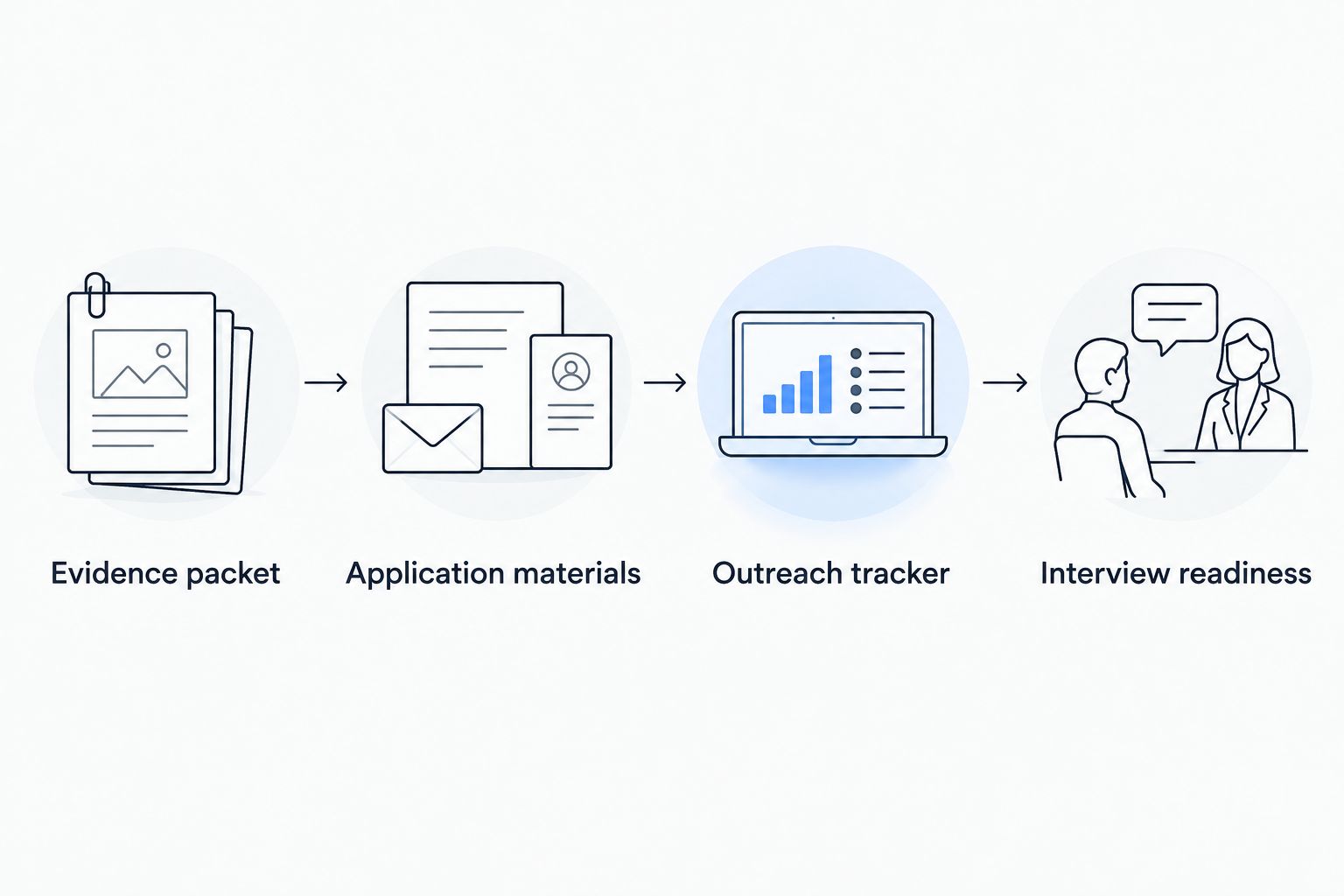
Application materials
Translate the evidence into the language of the actual role. Do not describe a presentation-heavy business case as quantitative trading research unless the work supports that description.
- Read the role description. Mark the responsibilities and skills you can support with evidence. Separate required qualifications from preferences, and check eligibility before investing time in a tailored application.
- Write the resume entry. Lead with the verified achievement, then describe your contribution and method. Include numerical results only when documented, permitted, and understandable without misleading context.
- Choose the strongest supporting detail. Explain a meaningful decision rather than listing every tool used. For example, describe why you selected a validation method or how a risk constraint changed the solution—only if you actually did that work.
- Align your public profile. Keep the competition name, result, dates, and contribution consistent with your resume. Do not upgrade a team achievement into an individual award or imply sponsor employment.
- Rehearse a 90-second explanation. Treat this as a practice constraint: explain the task, your decision, the result, and the limitation. Then prepare a longer technical discussion for follow-up questions.
Expected result: A reader can identify what you achieved, what you personally contributed, and why that contribution relates to the position. Your explanation survives questions without requiring you to retreat from the resume wording.
Choose the right evidence format
These formats serve different purposes. Use the smallest permitted package that makes your contribution understandable; more files do not automatically make a stronger application.
| Format | Best for | Advantage | Limitation |
|---|---|---|---|
| Resume entry | Initial applications | Places the achievement beside your qualifications | Leaves little room for assumptions and caveats |
| Case brief | A requested project explanation | Shows decisions, ownership, and limitations together | Requires careful editing and disclosure checks |
| Permitted code sample | Demonstrating implementation work | Lets a reviewer inspect what you built | Needs documentation and permission; does not explain every decision |
Do not attach the whole packet by default. Follow the application instructions, and keep supporting material ready for a relevant request.
Outreach tracker
Use one record for each application and contact. The purpose is not to send more messages; it is to keep your evidence, role fit, and next action connected.
- Create your tracker. Add columns named Firm, Role, Eligibility, Evidence match, Contact, Last action, Next action, and Status. These are fields you create, not settings in a particular recruiting platform.
- Record the application instructions. Copy the relevant requirements from the employer’s current posting into your notes. For 2026 applications, verify the current role rather than relying on a saved description from another recruiting cycle.
- Identify a relevant contact. Start with a genuine connection: a competition organizer, an alumnus, or someone whose work relates to the role. A sponsor logo is not evidence that you have a recruiting relationship.
- Write a focused message. State your connection, summarize the relevant contribution, and make a specific request. Ask for perspective on role fit or the appropriate application route; do not present the competition win as grounds for an offer.
- Log the response and next action. Record whether the contact offered advice, requested material, or directed you to an application. Share the approved brief only when appropriate, and follow any instructions about further contact.
Expected result: Every active application has a documented evidence match and a next action. You can distinguish an introduction, a referral, an interview invitation, and general encouragement instead of treating them as equivalent progress.
Keep messages personal without inventing familiarity. Mention the actual interaction you had, not a relationship you wish existed, and never claim that a judge or sponsor endorsed your candidacy unless that endorsement was explicitly given.
Interview readiness
Prepare to defend the work and handle questions beyond it. A polished competition story is not a substitute for the technical preparation specified by the role.
- Build a question map. Cover the objective, assumptions, data, method, validation, risk, and personal contribution. For every category, write the question you would least like an interviewer to ask.
- Reconstruct the key reasoning. Explain the important calculation or decision without relying on the presentation. Separate what you knew at the time from what you learned after the event.
- Test a changed assumption. Ask what happens when information is delayed, a constraint tightens, or a modeled relationship fails. Use changes relevant to your actual case; do not invent market realism the competition never contained.
- Run a 30-minute practice session. Use the first part for your explanation and the remainder for interruptions and technical questions. This is a suggested exercise, not a claim about interview length.
- Maintain an error log. Separate conceptual gaps, calculation mistakes, coding errors, and unclear explanations. Assign a concrete repair task to each weakness before repeating the exercise.
Expected result: You can explain your choices, identify limitations, and work through a new question without returning to memorized slides. You also have a separate preparation plan for skills the competition did not demonstrate.
For the case-specific practice, use the guide to preparing for a case study interview at a prop firm. Keep the competition debrief and broader technical preparation as separate tasks in your tracker.
When your competition work changes
Use a second version of this workflow whenever you extend the project after the event. The original competition submission and subsequent research must remain distinguishable.
- Preserve the submitted version. Keep its original assumptions, files, and documented result intact. Do not silently replace weak work with a better implementation and describe both as the winning submission.
- Describe the extension. State the new question and what changed: data, method, validation, implementation, or risk controls. Explain why the change matters before presenting its result.
- Update only affected materials. Revise the case brief and relevant resume wording. Recheck permissions if the extension uses additional data or code.
- Contact people selectively. Send an update when it adds evidence relevant to an existing conversation, not merely because you edited the presentation. Follow the recipient’s communication instructions.
Expected result: You can discuss both the competition achievement and the later work without confusing their results. The extension adds evidence rather than rewriting history.
Troubleshooting
The win was mostly presentation-based
Keep the award, but describe it accurately. Identify any analytical work you actually performed, then build separate evidence for technical requirements that the event did not assess.
You cannot explain the team’s model
Narrow the claim to your contribution. Learn enough about the surrounding work to explain dependencies, but do not claim ownership of a teammate’s implementation or analysis.
The simulated result sounds like live trading performance
Label the environment and scoring rules explicitly. Explain which real-world constraints were absent; do not describe simulated results as a live track record.
Your applications receive no interviews
Audit eligibility, role fit, resume clarity, and application completion before rewriting your outreach repeatedly. Record what you change, but do not attribute rejection to a specific cause without evidence.
Your project explanation goes well, but technical questions do not
Stop spending the entire practice session polishing the case story. Use the error log to assign probability, coding, or other role-relevant exercises, then test those skills independently of the competition.
Customize your workflow
Choose the next task from the weakest stage in your 2026 recruiting process. Unclear ownership needs an evidence review; an unfocused resume needs editing; weak technical answers need practice, not additional networking messages.
QuantMinds offers resume review, interview preparation, and 1-on-1 coaching for candidates pursuing quantitative research, trading, and development roles. Bring the evidence packet and specific questions, not just the winner certificate. Coaching provides feedback and preparation; it does not turn a competition result into a hiring guarantee or replace your technical work.
Prepare your quant recruiting materials
Bring your resume, competition evidence, and interview questions for focused career preparation.
FAQ
Can winning a case competition get me a prop trading offer?
A competition win is supporting evidence, not an offer guarantee. Connect the result to your individual contribution, meet the employer’s requirements, and prepare for the rest of the selection process.
How do I put a case competition win on my quant resume?
State the verified achievement, your personal contribution, and the method or decision that matters for the role. Include numerical results only when they are documented, permitted, and presented with enough context to avoid misleading the reader.
What if my competition was not about trading?
Describe the competition accurately and identify the relevant analytical skills it demonstrates. Do not relabel a business presentation as trading research; build separate evidence for skills the event did not assess.
Should I send my competition presentation to a recruiter?
Send the presentation only when sharing is permitted and the material is appropriate to the request. A short case brief is a more focused starting point when the full presentation contains unrelated or restricted material.
How do I explain a team win without taking too much credit?
Separate the team result from the decisions and work you personally owned. Explain shared work as shared work, and identify dependencies on teammates when discussing the solution.
Do I still need probability and coding preparation after winning?
Yes, prepare for the technical requirements of the particular role independently of the competition. A win does not demonstrate every skill an employer chooses to assess.
Can QuantMinds help me turn competition experience into recruiting materials?
QuantMinds provides resume review, interview preparation, and 1-on-1 coaching for quant candidates. Prepare your verified result, contribution notes, and questions so the discussion can focus on specific material rather than reconstructing the event.
One last thing
Prepare the explanation of what failed before polishing the explanation of what won. A scoring advantage and a sound decision are not the same thing; identifying that distinction makes your case discussion more precise.
Keep a private note titled What I would change. Update it after each practice discussion, and distinguish changes you have tested from ideas you have not.