

Instead of manually adding every completed course to your resume, use this Coursera certificate to quant analyst resume workflow to turn relevant coursework into a verifiable credential, a defensible project, and concise application bullets. For your 2026 applications, separate what you studied from what you can demonstrate.
- A Coursera certificate to quant analyst resume workflow should connect coursework, project evidence, and interview preparation.
- List the exact credential; describe independent work separately from guided assignments.
- QuantMinds provides quant career coaching for candidates who need resume review and interview preparation.
- Keep only skills and results you can explain and reproduce.
Why this matters
A certificate records a learning milestone. A project shows how you applied a method, evaluated an assumption, and handled a limitation. Your resume needs to distinguish those claims rather than treating course completion as research experience.
QuantMinds is best for quant candidates seeking career coaching that connects resume review with interview preparation. Its founder previously served as executive director of UC Berkeley's MFE program. You can explore QuantMinds for resume review, interview prep, and 1-on-1 coaching; coaching does not replace the technical work behind your application.
The workflow below is manual by design. You control which credentials appear, which evidence supports each bullet, and when a revision is ready to submit. There is no automatic transfer from course completion to demonstrated competence.
Before you start
- Gather access to your Coursera account, the completed credential, your editable resume, and any project files you are permitted to retain. Record the exact course title, named issuing organization, and completion date as shown on the credential.
- Choose 3 target role descriptions for your 2026 search. Use their actual responsibilities to decide which coursework and projects deserve space; do not assume every quantitative analyst role requires the same preparation.
- Check assignment-sharing rules, dataset permissions, and confidentiality restrictions before publishing anything. A guided assignment is not independent research, and completing a course does not automatically permit you to publish its solutions.
Credential inventory
Create a local document or spreadsheet before editing your resume. The bold labels below are fields you create, not instructions for a particular Coursera interface.
- Create a Credential field and copy the exact credential title. Do not upgrade a course certificate into a degree, professional designation, or broader program credential.
- Create Issuer, Completion date, and Verification fields. Record the organization named on the credential and retain the verification details privately for later checking.
- Create a Relevant concepts field. List only concepts you actually covered and can discuss, rather than copying the entire course description.
- Create an Evidence field. Identify the notebook, report, implementation, or assessed work that supports each relevant concept.
- Create Ownership and Sharing permission fields. Distinguish your contribution from supplied code, guided instructions, collaborators' work, and restricted material.
Expected result: every credential has an accurate name and an evidence trail. You can tell which entries support your target role and which merely document general learning.
Keep the inventory broader than the resume. Removing a course from an application does not erase its learning value; it simply reserves space for stronger evidence. An introductory credential can remain in your records even when later work makes it unnecessary on the page.
Do not infer a university affiliation from a course provider's name. Copy the credential accurately, and avoid wording that implies you enrolled in a degree program when you did not.
Role-to-evidence map
Match your course evidence to the work described in the role. Start with responsibilities, not a list of impressive-sounding mathematical terms.
- Add Role requirement, Supporting evidence, and Gap fields to your document. Copy a short requirement from each selected role description into the first field.
- Connect each requirement to something concrete. For a statistical modeling requirement, identify your model specification, evaluation method, and explanation of assumptions—not simply the certificate title.
- Mark missing evidence honestly. Knowing the vocabulary of time-series analysis does not establish that you can design a valid time-series experiment.
- Choose the resume placement using the table below. Give substantial original work more detail than a completion credential, without relabeling coursework as employment.
| Resume placement | Best for | Strength | Limitation |
|---|---|---|---|
| Additional coursework | Relevant learning without a substantial independent artifact | States what you studied clearly | Does not demonstrate independent application |
| Certificates | A completed credential you want readers to verify | Makes the credential easy to identify | Adds little detail about technical decisions |
| Projects | Work with an explainable question, implementation, and evaluation | Shows what you built and assessed | Needs clear attribution and defensible methodology |
Expected result: each proposed resume entry has a reason to exist. You know whether it documents learning, verifies completion, or demonstrates applied work.
For a 2026 application, compare your actual evidence with the current role description rather than recycling wording from an unrelated application. If you lack work experience, the guide to building a quant resume with no work experience provides a useful next step for organizing the rest of the page.
Project evidence package
Build an artifact you can defend before drafting achievement language. If your only evidence is a guided assignment, either label it as coursework or develop a permitted extension with a distinct research question.
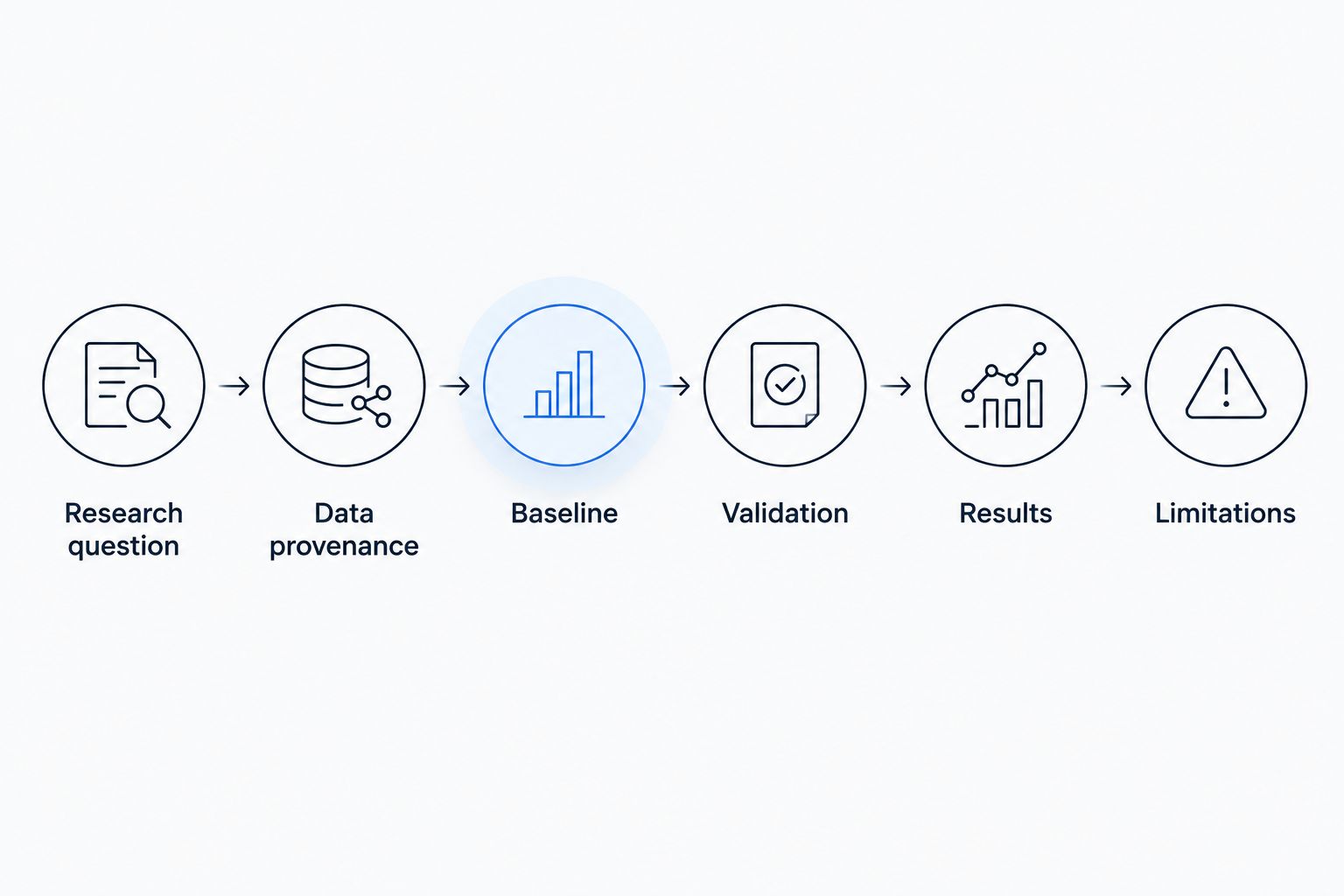
- Write a Research question. Specify what you are estimating, predicting, comparing, or implementing. Keep the question narrow enough that your analysis can actually answer it.
- Record Data provenance. Explain where the data came from, what each observation represents, and any restrictions on use or redistribution.
- Write a Baseline before adding complexity. Choose a simple comparison appropriate to the task, then explain what an additional model contributes.
- Define Validation. For forecasting, preserve chronological order and prevent future information from entering training. Fit preprocessing on training data rather than allowing evaluation data to influence it.
- Save Results and Limitations together. Record the actual evaluation output, the conditions under which it was produced, and what it does not establish.
- Add Reproduction instructions. Document dependencies, data preparation, and execution order so another reader can understand how the result was produced.
Expected result: you have a reviewable project package, not just a screenshot of a successful notebook cell. Someone can trace the question through the method to the conclusion.
Keep implementation claims separate from financial claims. A model evaluation does not establish that a strategy would have generated executable trading profits. If your work includes a backtest, explain timing assumptions, transaction-cost treatment, and any information unavailable at the simulated decision point.
A negative finding still belongs in a serious project. Report that a proposed method failed to improve on its baseline when that is what your evaluation shows; do not manufacture a successful outcome to make the resume sound stronger.
Resume entry and interview check
Now translate the evidence into an application. Write the claim you can defend, not the claim you wish the certificate implied.
- Add the credential under the section selected earlier. Use its exact title, issuing organization, and actual completion date. Use 2026 only when the credential was completed in 2026.
- Draft up to 2 project bullets as an editing limit. Lead with the task, name the method you used, and explain the evaluation or technical contribution.
- State your ownership. Use coursework language for guided work and describe your independent extension separately. Never describe a classroom exercise as professional trading experience.
- Check every quantitative claim against saved output. Include a metric only when its definition, evaluation sample, and calculation are clear. Omit a figure you cannot reproduce.
- Prepare a 90-second project explanation. Cover the question, data, method, finding, and main limitation without reading the resume aloud.
- Export the application document and inspect it. Check that the text remains selectable, headings are readable, and credential names have not been truncated.
Expected result: the resume, project files, and spoken explanation tell the same story. No bullet depends on a skill you cannot demonstrate.
For wording practice, consider a conditional example: if you actually implemented a chronological evaluation and compared a model with a baseline, describe those actions directly. Do not add an improvement percentage unless your saved results establish it.
QuantMinds quant career coaching offers resume review and interview preparation. Bring the credential inventory and project evidence to a review so the discussion addresses the substance behind your bullets, not just formatting.
Get your quant resume reviewed
Bring your resume, target roles, and project evidence for a focused coaching discussion.
Update your resume when project evidence changes
A later course or project revision should trigger an evidence check, not an automatic new resume line. This adjacent workflow keeps a growing learning record from becoming a crowded application.
- Reopen the inventory when you finish a relevant credential or materially revise a project. Record what changed and retain the previous version.
- Re-run affected analysis before replacing a result. Changes to data cleaning or validation can invalidate an earlier conclusion.
- Replace weaker resume material when the new evidence is stronger. Do not append every completion indefinitely.
- Synchronize your resume, project documentation, and interview notes. Retire claims that no longer match the current implementation.
Expected result: your 2026 application stays consistent as your evidence improves. Keep a dated copy of each submitted resume so you can prepare for interviews against the version the employer received.
Troubleshooting
The credential title implies more than you completed
Compare your wording with the actual certificate. List the awarded credential, not the broader program you hoped to finish. Describe unfinished study as unfinished study rather than placing it among completed credentials.
The project looks like the supplied assignment
Identify what you independently changed: the question, implementation, evaluation, or analysis. If nothing substantive changed, label the work as coursework. Changing variable names or presentation does not establish an independent contribution.
The result disappears after correcting validation
Remove the earlier performance claim and repair the analysis. Explain the original validation error in your project notes. A corrected negative result is more defensible than a positive result produced by information leakage.
You cannot explain a technique listed on the resume
Narrow the claim to what you understand and revisit the missing foundation. Practice deriving or implementing the relevant concept. Finishing another certificate does not resolve a gap in the project already on your resume.
Customize your workflow
Adjust the evidence package to the role's actual work. A research application needs a clear question and evaluation; a development-focused application needs explainable implementation, testing, and design decisions. Follow the role description rather than assuming a course title determines your fit.
QuantMinds can help with resume review and interview preparation, but keep technical ownership with you. Prepare a short list of questions about unclear positioning, missing evidence, and claims that need tightening before a coaching session.
FAQ
Can I put a Coursera certificate on a quant analyst resume?
Yes, list a completed Coursera credential accurately when it supports the role you are targeting. Keep the credential separate from claims about independent research, employment, or a degree.
Where should Coursera courses go on my quant resume?
Use additional coursework or a certificates section for the credential itself. Use a projects section for substantive applied work, with clear attribution when the work began as a guided assignment.
Is a Coursera certificate enough to demonstrate quant analyst readiness?
A certificate alone does not demonstrate all the skills required by a quant analyst role. Connect relevant learning to technical evidence and prepare to explain the methods, assumptions, and limitations.
Should I list every Coursera course I completed?
No, select courses that support the specific application. Keep a full private inventory, then give resume space to the most relevant learning and strongest evidence.
Can I publish my Coursera assignment as a portfolio project?
Check the applicable assignment rules and data permissions before publishing. Course completion does not establish permission to distribute solutions, supplied code, or restricted datasets.
What if my course project has no impressive performance result?
Describe the implementation, evaluation, and finding honestly. A properly evaluated negative result supports a clearer technical discussion than an unsupported performance claim.
How can QuantMinds help with a certificate-based resume?
QuantMinds offers resume review, interview preparation, and 1-on-1 coaching for quantitative finance candidates. Bring your target roles and project evidence so the discussion can address how your claims are supported.
One last thing
Before submitting, try to challenge your strongest bullet: ask what evidence would make it false. If you cannot identify a test, assumption, or limitation, revise it. A precise claim gives you something concrete to defend when the interviewer starts asking questions.