

Instead of repeatedly rewriting applications around an unfinished project, use this 2026 workflow to turn a QuantLib contribution into verifiable quant developer job evidence: reproduce a problem, submit a tested change, and explain the engineering decisions in applications and interviews. A contribution supports your candidacy; it does not guarantee an interview or offer.
- The quantlib contribution to quant developer job workflow turns reproducible fixes into evidence, not guaranteed offers.
- QuantLib contributions demonstrate specific engineering work; match that work to the target role.
- Keep coding interview preparation separate from open-source contribution work.
- QuantMinds is best for quant developer candidates seeking resume review and interview preparation.
Why this matters
A repository link gives an interviewer somewhere to look. A reproducible failure, focused patch, and clear explanation give them something to evaluate. Your strongest evidence is the reasoning behind the change, not the number of commits.
QuantLib is an open-source C++ library for quantitative finance. Its relevance depends on the position: pricing-library work connects directly to numerical implementation, but does not by itself demonstrate production trading infrastructure experience.
For your 2026 applications, separate technical evidence from recruiting presentation. QuantMinds provides quant finance career coaching, resume review, and interview preparation. Coaching helps you present your work; it does not replace building, testing, or understanding it.
Before you start
- Accounts and access: Have a GitHub account, Git installed locally, and permission to publish the code you intend to contribute. Read the repository’s current contribution instructions before opening an issue or pull request.
- Build materials: Prepare a C++ compiler and the dependencies required by the current QuantLib build instructions. Build the unmodified source and run its tests before changing anything; record the revision and commands.
- The gotcha: Verify that your test executes the library you just built. An installed package or another build directory can make an unchanged implementation appear to pass. Python wrapper usage alone does not demonstrate a C++ contribution.
Keep employer code, proprietary market data, and confidential interview material out of the repository. If you cannot publish an example without those inputs, replace it with a synthetic reproducer before proceeding.
Contribution scope
Choose evidence that fits the role
- Read your target job descriptions and extract the engineering responsibilities. Separate numerical methods, library development, data infrastructure, and systems requirements rather than treating every quant developer position as identical.
- Search existing QuantLib issues and pull requests for the same problem. Check whether someone is already implementing a fix, and read any relevant maintainer discussion before proposing another approach.
- Choose a bounded change that you can explain independently. State the observed behavior, expected behavior, and smallest test that distinguishes them.
- Write a 1-page contribution brief containing the problem, affected behavior, proposed test, and explicit exclusions. This is a planning limit, not a project requirement.
Use this comparison to choose the work, not to manufacture a more impressive project title.
| Contribution route | Best for | Evidence you can show | Limitation |
|---|---|---|---|
| Regression test and bug fix | Candidates demonstrating debugging and correctness | A failing case, focused patch, and passing test | A narrow fix does not establish broad architecture experience |
| Numerical implementation | Candidates targeting pricing-library development | Assumptions, reference results, and error handling | Requires enough mathematical understanding to defend the implementation |
| Documentation and example correction | Candidates learning an unfamiliar codebase | A reproducible example and clearer explanation | Provides less evidence of C++ implementation ability |
Prefer a small contribution you understand over a large contribution you cannot defend. Documentation is useful work; label it as documentation rather than implying that you implemented a pricing engine.
Expected result: You can explain what is wrong, why the target role makes it relevant, and what observable result would establish a fix.
Establish the baseline
- Open the project’s GitHub repository and select Fork, then Create fork. Use Code to obtain the clone address for your fork; keep the original project configured as your upstream remote.
- Follow the current repository instructions to build and test the unmodified revision. Save the compiler information, configuration, and test output with your working notes.
- Create a dedicated branch for the contribution. Reproduce the behavior using synthetic inputs, then reduce the example until unrelated instruments, dates, and configuration are removed.
- Add a regression test using the project’s existing test conventions. Confirm that the new test exposes the intended failure before implementing the correction.
A numerical discrepancy needs an explanation, not just a different expected value. Check units, date conventions, assumptions, and numerical tolerances before declaring the library wrong.
If the result depends on the evaluation date or other shared settings, make that dependency explicit and follow the surrounding tests’ setup and cleanup conventions. A test that passes alone but changes another test’s behavior is not a clean reproducer.
Expected result: The original revision builds, existing tests have a recorded baseline, and your added test isolates the behavior you intend to change.
Patch and review
Implement the change
- Modify the smallest relevant part of the implementation. Keep unrelated formatting, renaming, and cleanup out of the patch so the reviewer can identify the actual behavioral change.
- Run the focused regression test, then the relevant surrounding tests and the project’s prescribed checks. Compare the results with your baseline rather than treating every failure as newly introduced.
- Inspect the diff locally. Remove generated files, credentials, local paths, and accidental changes to build configuration before pushing your branch.
- On GitHub, select Compare & pull request when it appears. Describe the problem, reproduction, approach, tests, and limitations, then select Create pull request when the submission is ready.
Use Files changed to inspect exactly what reviewers will see. Use Checks, when automated checks are configured, to inspect failures rather than relying only on a status icon.
Expected result: The pull request contains a focused change, a reproducible test, and enough context for someone else to evaluate the reasoning.
Capture the engineering evidence
Maintain a short evidence note alongside the review process:
- Problem: Describe the incorrect or unclear behavior without inflating its impact.
- Decision: Explain why you chose this implementation over a reasonable alternative.
- Verification: Record the revision, commands, and results needed to reproduce your conclusion.
- Limit: State the cases the contribution does not address.
When a reviewer requests a change, respond to the technical point and explain what you changed. Do not treat review comments as an obstacle to conceal: they can show how you resolve ambiguity and revise an implementation.
Keep your 2026 application materials synchronized with the actual submission status. Submitted, under review, and merged are different claims. A public pull request demonstrates proposed work; it is not automatically an accepted upstream contribution.
Application package
Connect the patch to recruiting
- Write a resume bullet that identifies your action, the affected behavior, and how you verified it. Include performance or accuracy figures only when you measured them with a reproducible method.
- Add the public contribution to your project materials with its current status. Distinguish your work from code that already existed in the library.
- Prepare a 90-second explanation: the problem, the failure mechanism, the implementation choice, and the test. Then practice answering deeper questions without reading the patch.
- Use the contribution in targeted applications and relevant professional conversations. Explain the connection to the advertised responsibilities rather than sending a repository link without context.
For your 2026 resume, a precise description of a submitted regression fix is stronger than an unsupported claim that you improved institutional trading performance. Do not imply production adoption, business impact, or maintainer endorsement without evidence.
QuantMinds quant finance career coaching is best for candidates who need help translating technical work into a resume and interview narrative. Bring the actual diff, review discussion, target job description, and a draft explanation so the conversation starts with evidence.
Expected result: Your application materials state what you did, expose proof, and give an interviewer a technically defensible discussion topic.
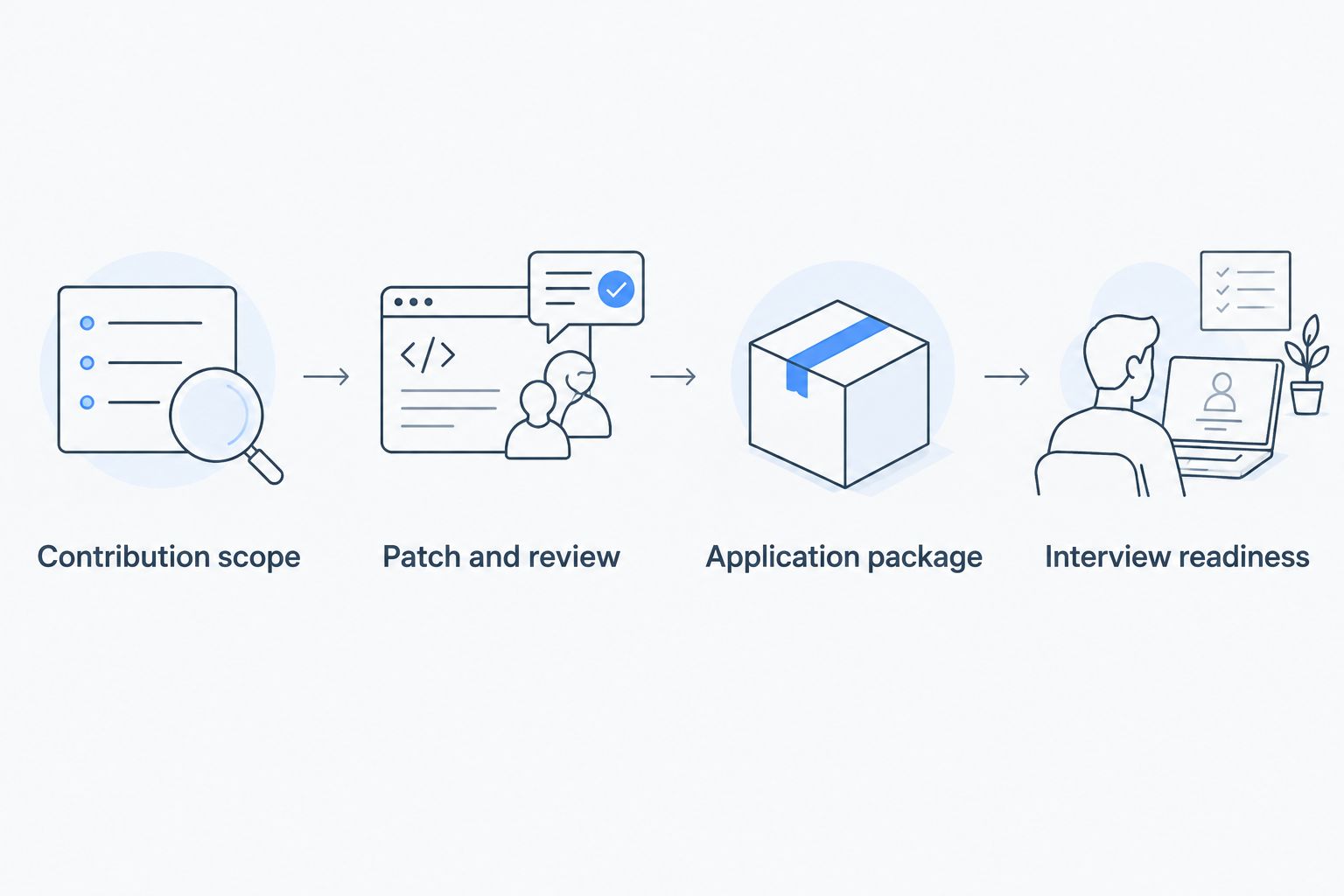
Interview readiness
Reserve a 30-minute practice session to explain the contribution, inspect a changed function, and answer questions about alternatives. This is a suggested rehearsal format, not a hiring benchmark.
Practice questions that expose understanding: Why does the test fail on the original revision? Which assumptions does the fix depend on? What would break if you changed the tolerance? What did you decide not to implement?
Keep separate preparation for algorithms, data structures, language fundamentals, and the responsibilities named in the job description. The quant developer coding interview guide covers the interview preparation track; your contribution supplies a project discussion, not a substitute for it.
When a pull request is updated
Use a second workflow whenever review changes the implementation or submission status. This keeps applications accurate without turning every repository notification into recruiting outreach.
- Read the update and identify whether it changes behavior, verification, ownership, or status.
- Re-run affected tests after technical changes. Update the evidence note with the new revision and any revised limitations.
- Correct your resume and project description if the scope changed. Remove an abandoned claim rather than preserving it because it sounds stronger.
- Contact an existing recruiting conversation only when the update adds relevant evidence, such as an accepted fix or a resolved technical question.
If the pull request closes without merging, describe it honestly as proposed work. You can still discuss the investigation and lessons, but explain the reason for closure accurately.
Expected result: Every public claim remains consistent with the current contribution, including when the outcome is not the one you wanted.
Troubleshooting
Your change appears to do nothing
Confirm the executable, library location, and build directory used by the test. Rebuild the changed target and repeat the original failing case before investigating the algorithm further.
The test passes locally but fails in automated checks
Compare compiler settings, dependencies, and test configuration with the failing environment. Check floating-point tolerances and shared state; do not loosen assertions merely to make the failure disappear.
The proposed fix is already being handled
Read the existing discussion and offer a reproducer or test if it adds something new. Choose another bounded issue when your patch would duplicate active work.
Nobody has reviewed the pull request
Check the project’s contribution guidance and make sure the submission includes reproduction steps and test results. Keep applying and preparing; maintainer review is not a recruiting milestone you control.
You get project questions but struggle with coding screens
Separate the preparation tracks. Keep the contribution as evidence of engineering work, and practice solving unfamiliar coding problems without relying on the project’s existing structure.
Customize your workflow
Choose your next contribution from a gap in your evidence. If you can discuss mathematics but cannot explain the implementation, trace the code path and write tests before adding another model. If you can code but cannot explain the financial assumptions, study those assumptions before presenting the work as finance expertise.
Use QuantMinds for resume review and interview preparation when presentation is the bottleneck. Coaching cannot make an unsupported technical claim defensible. Resolve that gap in the code and your understanding first.
FAQ
Can contributing to QuantLib get me a quant developer job?
A QuantLib contribution can support a quant developer application, but it does not guarantee a job. Use it to demonstrate specific engineering decisions while preparing separately for coding interviews and role requirements.
What is the best first QuantLib contribution for a job seeker?
A bounded regression test and bug fix is a useful first contribution when you can reproduce and explain the problem. Documentation corrections are also valid contributions, but demonstrate different skills.
Do I need C++ to contribute to QuantLib?
Changes to QuantLib’s core implementation require C++ understanding because the library is written in C++. Documentation and example work have different requirements; identify your actual contribution accurately.
Does a QuantLib pull request need to be merged before I put it on my resume?
You can describe a public submitted pull request before it is merged if you clearly label its status. Do not call proposed work an accepted upstream change.
Is using QuantLib in Python the same as contributing to QuantLib?
No. Using QuantLib in Python demonstrates library usage, while contributing means proposing changes to the project. Neither activity alone proves that you can modify the C++ implementation.
How long does it take to turn a QuantLib contribution into an offer?
There is no fixed contribution-to-offer timeline. Contribution scope, maintainer review, applications, and employer assessments are separate processes, so do not make recruiting plans depend on a merge date.
What should I explain about my contribution in an interview?
Explain the original behavior, your implementation decision, and the test that verifies it. Be ready to discuss assumptions, alternatives, review feedback, and the limits of your change.
One last thing
Before sending your next 2026 application, check out the revision before your fix and run your regression test again. If it does not expose the problem you described, investigate the mismatch. A defensible contribution starts with proof of the failure, not just proof that the final code runs.