

Instead of reconstructing recruiter conversations from memory, use a career fair to quant internship interview workflow that connects each conversation to a specific role, application, follow-up, and preparation task. For your 2026 search, build the tracker before the fair and leave every useful conversation with a clear next action—not an assumed interview invitation.
- The career fair to quant internship interview workflow needs role-specific evidence, an application record, and a clear next action.
- QuantMinds is best for quant candidates seeking individual resume review, interview preparation, and career coaching.
- A career fair conversation is not an application, referral, or interview invitation unless the recruiter explicitly confirms it.
- Prepare for the role and confirmed interview format, not a generic list of quant questions.
Why this matters
A useful conversation and a submitted application are different milestones. Your workflow needs to preserve that distinction: who you met, what role you discussed, what the recruiter actually requested, and what you completed afterward.
QuantMinds is best for quant candidates seeking individual resume review, interview preparation, and career coaching. Founded by a former UC Berkeley MFE program executive director, QuantMinds provides those services to professionals and students targeting quantitative research, trading, and development roles. Coaching supports your preparation; it does not replace an employer’s selection process.
Treat the fair as a source of information and recruiting contacts, not proof that your application has advanced. The useful output is an accurate record that tells you what to do next.
Before you start
- Get event and application access. Have your university career portal credentials, event registration, employer list, and access to the application channels specified by employers. Read participation requirements before planning your visits.
- Prepare materials you can defend. Bring a current resume, an accurate LinkedIn profile, a concise introduction, and accessible project evidence. Remove confidential data and check that any shared repository or document opens without your private account.
- Check the internship term, not just the posting date. A posting viewed in 2026 does not establish when the internship takes place. Record the stated internship dates, graduation requirements, location, and work-authorization requirements before investing in that application.
Use a spreadsheet or document you already know. The bold field names below are labels you create yourself, not buttons or settings in an employer’s recruiting system.
Role map
- Create a tracker. Add the fields Employer, Role title, Posting URL, Internship term, Eligibility, Contact, Conversation notes, Application status, Next action, and Due date. Keep one row per role, rather than one row per employer.
- Copy requirements from the actual posting. Record the qualifications and application instructions without rewriting them into assumptions. If a requirement is unclear, put the question in Conversation notes for the fair.
- Choose the role you can support with evidence. Match your experience to the work described. Research, trading, and development are distinct targets; a broad interest in finance does not explain your fit for each.
- Attach a proof point. Beside each target, note a project, research contribution, or engineering decision you can explain. Describe your own contribution, the method, and a limitation—not just the project title.
Use this table to organize your preparation. It is a targeting framework, not a claim that every employer uses the same interview process.
| Target | Best for candidates who can demonstrate | Strength to foreground | Limitation to address |
|---|---|---|---|
| Quantitative research internship | Statistical reasoning and careful empirical work | Research design, validation, and interpretation | A polished result without defensible assumptions leaves gaps |
| Quantitative trading internship | Probabilistic reasoning and decisions under uncertainty | Clear assumptions, calculations, and responses to new information | Enthusiasm for markets alone does not demonstrate reasoning |
| Quantitative development internship | Programming and software engineering judgment | Correctness, testing, algorithms, and technical trade-offs | A repository alone does not explain your contribution |
Expected result: You have a separate record for each target role, its eligibility conditions, and the evidence supporting your application. Keep the employer’s exact role title even when your preparation category is broader.
Conversation plan
- Write a 30-second introduction. As a practice target, cover your current background, intended role, and one relevant piece of work. Stop there so the recruiter can respond. Do not turn the introduction into a spoken transcript of your resume.
- Prepare a role-specific question. Ask about information the posting leaves unresolved: the relevant team, whether your graduation date fits, or which application route the employer wants you to use. Avoid asking the recruiter to repeat clearly published requirements.
- Practice a 60-second project explanation. State the problem, your contribution, how you evaluated the work, and what remains unresolved. These durations are rehearsal targets, not employer requirements. Prepare a longer explanation for follow-up questions.
- Confirm the next action before leaving. Ask whether to apply through the stated portal, send requested materials, or wait for a specified instruction. Request permission to follow up and use the channel the recruiter provides.
- Record facts immediately afterward. In Conversation notes, distinguish exact instructions from your interpretation. Use Contact for the person’s name and role; use Next action for a task you can complete.
Expected result: Your record explains what happened without inflating it. A recruiter who suggested applying remains a contact—not a referral—unless that person explicitly agreed to refer you.
For a 2026 career fair, verify current instructions even if you attended the same event before. Do not carry an old contact’s preferences or a previous application route into the new search without checking.
Application and follow-up record
- Submit through the required channel. Follow the employer’s instructions, answer eligibility questions accurately, and use the resume intended for that role. Do not wait for an informal reply when the employer has instructed you to apply directly.
- Update the application record. Save the submission date and confirmation in Application status. Keep the posting URL and exact role title so you can identify the application in later correspondence.
- Write a focused follow-up. Identify the event and conversation, name the role, mention the relevant discussion point, and report any action the recruiter requested. Make one clear request rather than combining a referral request, resume review, and interview-status question.
- Create a reminder, not an automatic message. Put the next review date in Due date. Before sending anything, reread the conversation notes, employer instructions, and latest response. Stop reminders when the contact declines or asks you not to follow up.
Use this structure rather than copying a generic networking message:
- Subject: Event name, role title, and your name.
- Opening: Where you met and the specific topic you discussed.
- Evidence: A relevant detail about your experience, without unsupported performance claims.
- Action completed: The application or material the recruiter requested.
- Request: A single question tied to the agreed next step.
Expected result: The application and conversation are connected, but neither substitutes for the other. You can show what you submitted, when you submitted it, and why a follow-up is appropriate.
Do not label the tracker Interview scheduled because a recruiter said the team would review your resume. Reserve that status for an actual invitation.
Interview preparation queue
- Capture the invitation exactly. Record the date, time zone, format, duration if supplied, submission requirements, and permitted materials. Ask the recruiting contact to clarify missing logistics rather than guessing.
- Turn the format into preparation tasks. Use the posting and invitation to choose relevant work: explaining research decisions, solving probability problems, writing and testing code, or discussing technical trade-offs. Do not assume every quant internship tests the same subjects.
- Run a 20-minute diagnostic session. This is a suggested practice block, not a readiness benchmark. Explain a project aloud and attempt a role-relevant problem without notes; record where your reasoning or communication breaks down.
- Create an error log. Use the fields Topic, Mistake, Correction, and Retest. Separate knowledge gaps from careless execution and unclear explanations. Assign a specific repair task to each recurring error.
- Prepare your resume defense. Be ready to explain every method, language, and result you list. For project preparation, use the guide to explaining a research project in a quant interview.
Expected result: Your calendar contains preparation tasks matched to the confirmed interview, and your error log explains what needs work. Practice time alone is not evidence that you have fixed a weakness.
The 2026 tracker should also preserve invitation changes. If the employer revises the format, update your preparation queue instead of continuing with the original plan.
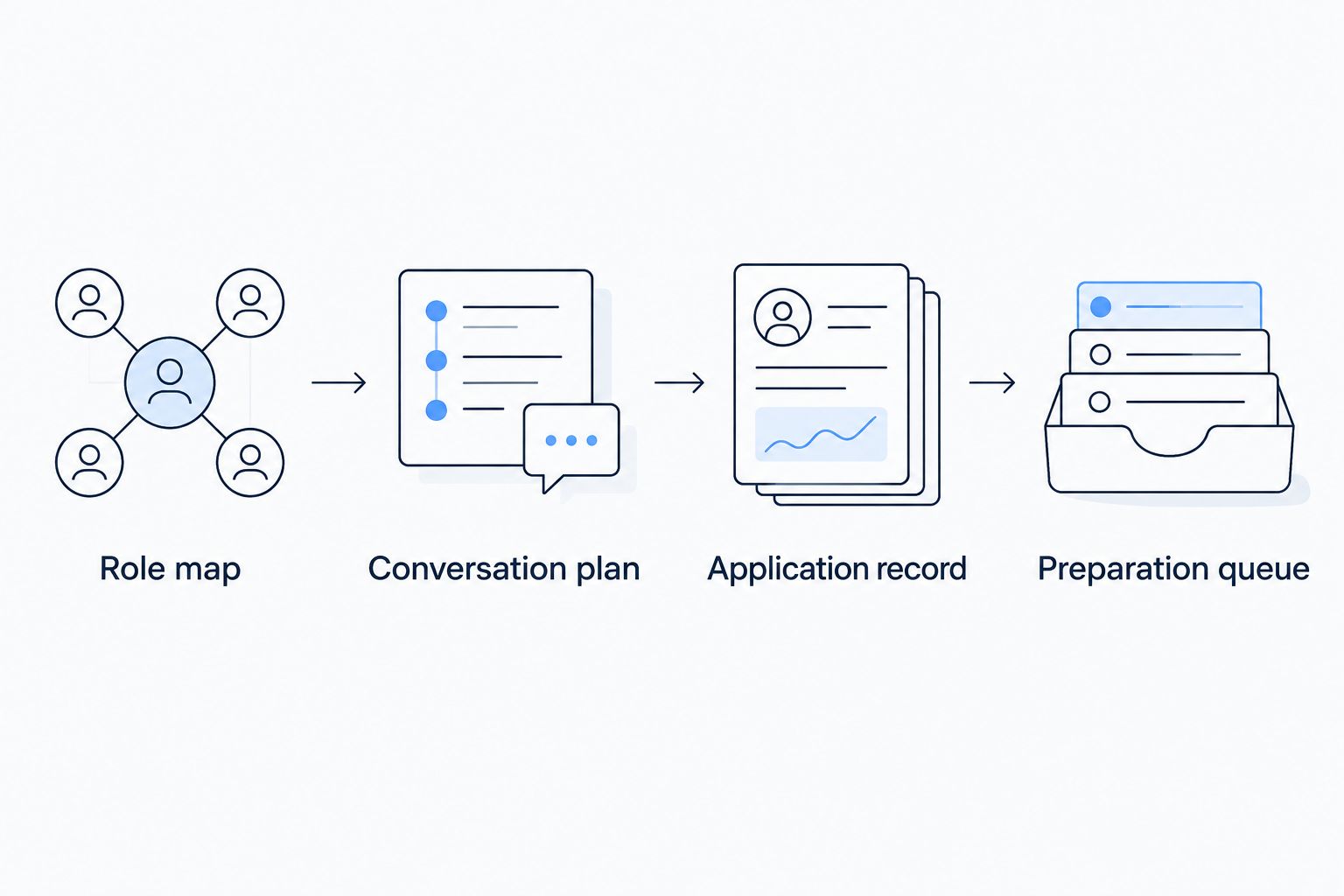
The workflow has four connected stages. Each stage produces the information the next stage needs; skipping the record leaves you relying on memory.
When the recruiter asks you to reconnect later
A second workflow applies when the employer tells you to return after a particular event, such as a posting becoming available or a project being completed. Use the agreed trigger, not a repeated request for attention.
- Record the condition in Next action using the recruiter’s actual instruction.
- Add a reminder to check that condition. Do not mark the application submitted or the interview pending before either occurs.
- When the condition is met, verify that the role and eligibility requirements still match your situation.
- Send a short update identifying the earlier conversation, the agreed trigger, and the action you have now completed.
This variant keeps a genuine invitation to reconnect separate from silence. It gives you a reason to write without manufacturing urgency or implying a relationship stronger than the conversation supports.
If the employer provides no future action, record that accurately. Continue pursuing other suitable roles rather than treating one contact as your recruiting plan.
Troubleshooting
You had a good conversation but received no reply
Check whether the recruiter requested a message and whether you used the correct channel. Complete any required application independently of the informal conversation. If you send a follow-up, make it relevant and brief; do not interpret silence as an interview decision.
You cannot find the role you discussed
Check the employer’s stated application channel and your notes for the exact title and internship term. Ask the authorized contact or career center for clarification. Do not apply to an unrelated role merely to generate a confirmation number.
Your resume and project explanation do not match
Separate your contribution from the team’s work, then correct overstated or ambiguous language. If you already submitted a material error, ask the recruiting contact how to provide a correction. Do not invent an explanation to protect an inaccurate bullet.
The invitation tests something you did not prepare
Confirm the format, then redirect practice toward the actual assessment. Use your error log to identify the highest-priority gaps. Do not spend the remaining preparation time polishing a project presentation if the immediate task is a coding assessment.
Customize your workflow
Adapt your 2026 recruiting plan using the stage where you are getting stuck. If you cannot explain your fit, revise the role map and resume evidence. If you reach interviews but cannot explain your reasoning, shift effort toward technical practice and spoken explanations.
QuantMinds provides quant finance career coaching, resume review, interview preparation, and 1-on-1 coaching. Bring your target postings, current resume, conversation notes, and error log so the discussion centers on actual recruiting decisions. The benefit is individual feedback; the limitation is that coaching cannot establish employer eligibility or make the hiring decision.
Keep confidential assessment questions and employer materials out of shared preparation documents. Record the skill you need to improve without reproducing restricted content.
FAQ
How do I go from a career fair to a quant internship interview?
Connect each relevant conversation to a specific role, required application, permitted follow-up, and preparation task. An interview exists only when the employer invites you; a positive conversation does not establish that milestone.
What should I say to a quant recruiter at a career fair?
State your background, intended role, and one relevant piece of work, then ask a question the posting does not answer. Keep the introduction brief enough for the recruiter to respond and clarify fit.
Should I apply before or after speaking to a recruiter?
Follow the employer’s application instructions and any stated deadlines. Do not delay a required application while waiting for an informal conversation or reply.
How soon should I follow up after a quant career fair?
Follow the timing and channel the recruiter specifies. If follow-up is permitted without a stated date, send a concise message while you can accurately reference the conversation, without inventing urgency.
Does meeting a recruiter count as a referral?
No, meeting a recruiter does not by itself count as a referral. Record a referral only when someone explicitly agrees to provide one or the employer confirms it.
What if I have no finance internship to discuss?
Use relevant research, coursework, or engineering work that demonstrates the skills in the posting. Explain your own contribution, evaluation method, and limitations rather than presenting academic work as professional trading experience.
Can QuantMinds help me prepare after a career fair?
QuantMinds offers resume review, interview preparation, and 1-on-1 quant finance career coaching. Use those services for individual preparation and feedback, not as a substitute for an employer’s application or assessment requirements.
One last thing
Write down what the recruiter did not promise. A note that says application encouraged, no referral discussed is more useful than a vague impression that the conversation went well. That distinction keeps your follow-up accurate and your search active.