

Instead of manually scrolling Twitter threads and sending generic hedge fund DMs, build a 2026 workflow that connects a specific technical discussion to your own work, a useful public reply, and a focused private question. Use Twitter, now X, to establish context—not to ask a stranger to bypass recruiting.
- For twitter quant networking to hedge fund dm, connect a technical contribution to a specific private question.
- X networking supports quant recruiting; it does not replace applications, research evidence, or interview preparation.
- QuantMinds is best for candidates seeking individual quant career coaching alongside their own networking and technical preparation.
- Send a DM only when contact is permitted and you have a concrete reason to continue privately.
Why this matters
A thread gives you something a cold introduction lacks: a specific idea to discuss. That advantage disappears when your reply says only that you want a hedge fund job.
The objective is a relevant professional conversation, not a referral on first contact. Your contribution should show how you think: identify an assumption, explain a validation choice, or ask a question grounded in work you have actually done.
QuantMinds provides quant career coaching, resume review, and interview preparation. Individual coaching adds feedback on your positioning; it does not substitute for technical work or give you permission to contact someone who has declined.
For your 2026 search, keep formal applications running alongside networking. A conversation is not an application, an interview invitation, or evidence that a team is hiring.
Before you start
- Prepare your account and evidence. You need an X account, an accurate profile, a current resume, and a public project or concise research explanation you can defend. Publish only material you have permission to share.
- Set up a private tracker. Use a spreadsheet with fields named Contact, Public affiliation, Thread, Technical connection, Last interaction, Next action, and Status. These are your own tracking fields, not X settings.
- Check contact permissions before drafting. You cannot assume every account accepts your DM. Follow the person's stated contact preferences, and verify any claimed employer affiliation separately before sharing personal information.
For a 2026 internship or full-time search, also write down your target role, graduation or transition timing, location constraints, and work-authorization situation. Keep those facts consistent across your resume, profile, and applications.
Build the thread-to-DM workflow
Profile and evidence
- Open your X profile and select Edit profile. In Bio, describe your current background and target role without inventing a title or implying employment you do not hold.
- Use Website for a public portfolio or professional page that supports that description. Select Save, then check the destination without signing in to the hosting account.
- Choose one piece of work that matches the conversations you want to join. For research, explain the hypothesis, data, validation method, and limitations. For development, explain the implementation, tests, and engineering decisions.
- Write a short project summary that distinguishes your contribution from borrowed methods or collaborative work. Remove employer data, restricted datasets, credentials, and private feedback.
Expected result: A reader can connect your stated interests to inspectable work without requesting access or guessing what you contributed.
Do not label a notebook a trading strategy simply because it produces a backtest. Describe what you tested and what remains untested. If explaining the project is difficult, use the guide to explaining a research project in a quant interview before promoting it through networking.
Contact and thread selection
- Search X for the technical subject you can discuss credibly: time-series validation, execution modeling, numerical methods, or another topic connected to your actual work.
- Read the full thread and its linked material before replying. Separate the author's claim from interpretations added by other accounts.
- Check the author's public professional background. Record an affiliation as unverified until you can corroborate it through an employer or another reliable professional source.
- Enter a specific connection in Technical connection. For example: your project uses chronological validation, and the thread discusses leakage from overlapping observations.
- Set Next action to either Read, Reply, DM, or Stop. These are your tracker values, not platform buttons.
Expected result: Each saved contact has a technical reason for inclusion. A recognizable employer name alone is not enough.
Set a 15-minute research limit per contact as a working rule, not an industry benchmark. If you cannot explain the connection by then, return to your project or choose another discussion. Do not manufacture relevance to reach someone with a prestigious title.
Public contribution
- Choose a thread where you can add a correction, a reproducible observation, or a narrowly framed question. Skip discussions where your only contribution would be praise.
- Use Reply to address the technical point directly. Explain the relevant setup before asking the question.
- Keep the response readable on its own. Distinguish an observed result from a hypothesis, and identify uncertainty instead of presenting an unfinished experiment as a finding.
- Record the interaction in Last interaction. If the author responds, answer the substance before introducing your career interests.
Expected result: Your public contribution gives the author something concrete to respond to, whether or not a private conversation follows.
An illustrative reply structure—not a report of an actual experiment—is: identify the validation setup, describe the concern about overlapping observations, then ask which assumption the author would test first. Only include a personal result after you have produced and checked it.
A useful reply does not create an obligation. Avoid tagging unrelated employees, posting the same response under multiple threads, or turning a technical disagreement into a public request for recruiting help.
Private outreach and handoff
- Check whether the recipient permits private contact and whether the discussion supplies a genuine reason to continue privately. A public response is not automatic consent to repeated messages.
- Draft a message of 100 words or fewer as an editing limit. Include the thread topic, your relevant background, and one answerable question.
- Ask about a research decision, skill gap, or appropriate public recruiting route. Do not lead with a referral request, resume attachment, or broad demand for mentorship.
- Send through the available message control only after checking the recipient and removing unnecessary personal details. Record the date and question in your tracker.
- If the recipient offers a recruiting introduction, ask what information to provide and where to send it. Follow the stated application process separately.
Expected result: The recipient can understand why you contacted them and answer without reviewing your entire career history.
For your 2026 outreach log, distinguish Sent, Replied, Conversation, and Closed. Do not count a like, follow, or polite acknowledgment as recruiting progress.
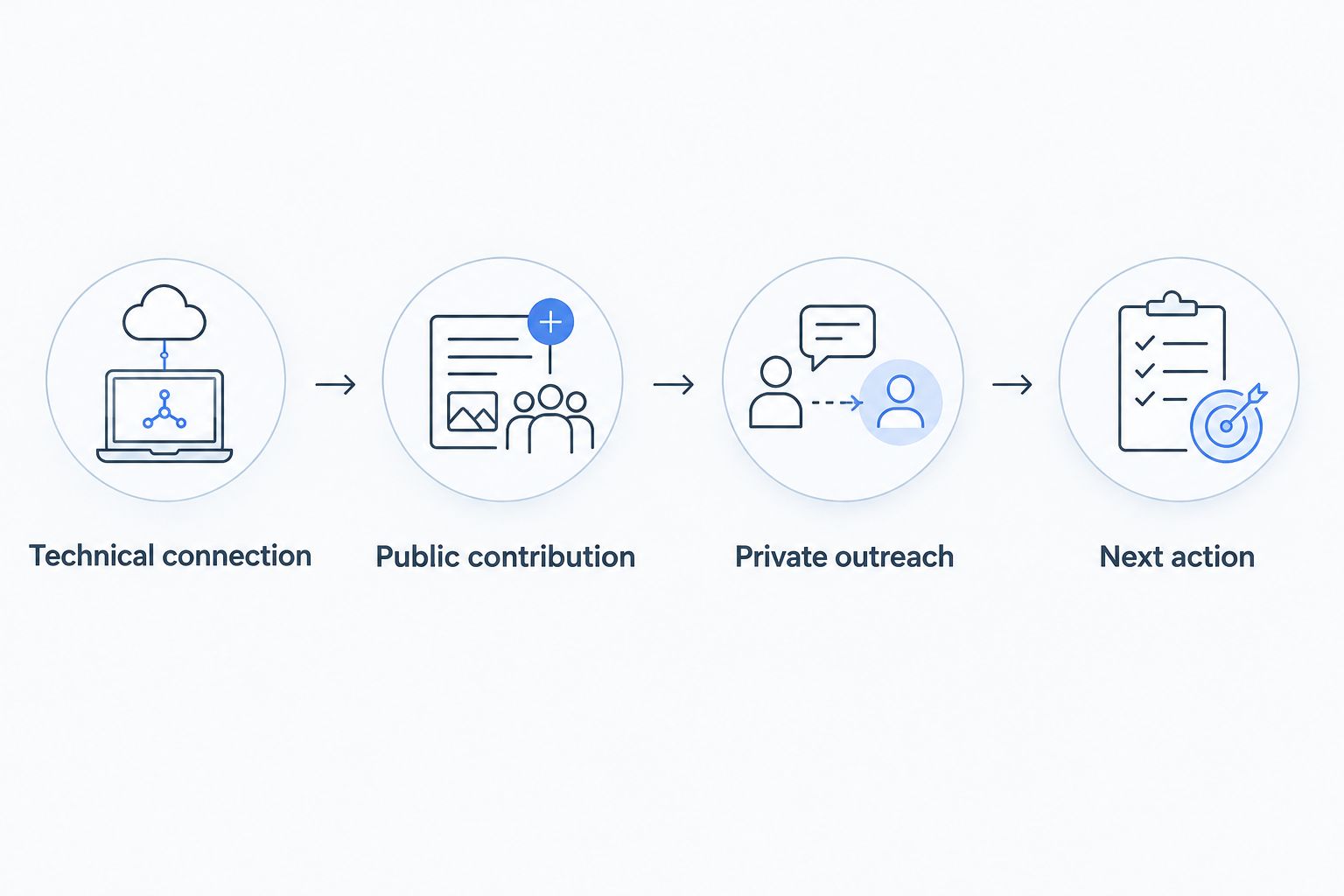
The sequence is simple: verify the connection, make a contribution, ask a bounded question, and record what actually happened.
Choose the right outreach variant
A public exchange and a direct message are adjacent workflows, not mandatory stages of the same funnel. Choose based on context and the recipient's preferences.
| Approach | Best for | Advantage | Limitation |
|---|---|---|---|
| Public reply first | Candidates with a relevant technical contribution | Makes the discussion context visible | Public engagement does not imply willingness to discuss recruiting |
| Direct message first | Candidates responding to an explicit invitation for private contact | Takes the conversation to the requested channel | Requires a self-contained explanation without relying on prior interaction |
Default to a public contribution when the subject belongs in public. Use direct contact when the person invites it or when a specific, appropriate follow-up belongs outside the thread. Neither approach guarantees a response.
When the author publishes an update
A new post can create a legitimate second conversation. It does not justify sending the same unanswered introduction again.
- Read the update and identify what changed: a revised method, a new result, or a correction.
- Compare that change with the question in your tracker. Close questions the update already answers.
- If you previously exchanged messages, continue the existing conversation with a specific observation about the update. Do not restart your full introduction.
- If you have no existing exchange, contribute publicly unless the author explicitly requests private responses.
Expected result: Each new interaction adds information rather than repeating a request.
Keep the scope technical until there is a reason to discuss recruiting. An author correcting a model assumption has not announced a vacancy or invited applications.
Troubleshooting
You cannot send a DM
Respect the access boundary. Check for an explicitly stated professional contact route; otherwise, leave a relevant public reply or move on. Do not use alternate accounts or search for private contact details to defeat the restriction.
The profile does not establish a hedge fund affiliation
Treat the person as a technical discussion partner, not a verified employee or recruiter. Corroborate professional claims before sending a resume or discussing sensitive circumstances. A display name or employer reference alone is insufficient verification.
Your replies receive attention but no conversations
Audit the content before increasing volume. Does the reply contribute an observation or ask an answerable question? Remove generic praise, unnecessary autobiography, and requests that require the recipient to design your job search.
Your message gets no response
Use a self-imposed limit of one follow-up after 7 days, only when the first message was appropriate and no preference rules it out. Add a useful update or clarify the question; otherwise, close the contact. This is a suggested boundary, not a claimed response-rate formula.
Someone asks for confidential work
Decline to share restricted material. Offer a public-data example, a synthetic demonstration, or a high-level explanation of your contribution instead. A networking conversation does not change your confidentiality obligations.
Customize your workflow
Match the evidence and question to the role. For quantitative research, discuss assumptions, validation, and interpretation. For quantitative development, discuss correctness, testing, and implementation decisions. For trading, explain the decision problem and risk considerations without pretending a personal exercise establishes professional trading performance.
Review your tracker weekly. Identify whether the blockage sits before the reply, before the DM, or after the conversation. Improve the weak stage rather than sending more messages through an unchanged process.
QuantMinds offers resume review, interview preparation, and 1-on-1 quant career coaching. The benefit is individual feedback on how you present your background; the limitation is that coaching cannot supply missing project evidence or control a recipient's response. Bring your resume, a project explanation, and examples of your outreach when seeking feedback.
FAQ
How do you turn a Twitter quant thread into a hedge fund DM?
Connect a specific technical point to work you can explain, then send one focused private question when contact is permitted. Establish the context in the message rather than assuming the recipient remembers your reply.
Should you ask for a hedge fund referral in your first DM?
Do not make a referral request the default first message. Start with a relevant, answerable question and discuss recruiting when the recipient invites that conversation or explicitly offers help.
Do you need a large following to network with quants on X?
A large following is not a prerequisite for this workflow. Your profile, technical contribution, and reason for contacting the person must stand on their own; follower count does not establish recruiting relevance.
What should you do when a quant professional has closed DMs?
Respect the restriction and use only an explicitly offered professional contact route. Otherwise, contribute appropriately in public or move on rather than trying to bypass their settings.
How long should you wait before following up on a hedge fund DM?
Use one follow-up after 7 days as a personal boundary, not a universal recruiting rule. Follow any stated preference instead, and stop if the recipient declines or does not respond to the follow-up.
Can QuantMinds help with quant networking and interview preparation?
QuantMinds provides quant career coaching, resume review, and interview preparation. Use coaching for feedback on your positioning while continuing your own technical preparation, applications, and professional outreach.
Does a reply from a hedge fund employee mean you are being considered for a job?
A reply is a conversation, not evidence of candidacy. Treat recruiting as a separate process unless the person explicitly discusses an opportunity and explains the next step.
One last thing
Before sending your next 2026 DM, remove the recipient's employer name from your draft. If the message no longer has a reason to exist, you are targeting a logo rather than a technical connection. Rewrite it around the person's work—or do not send it.