

Answer market making interview questions by stating the rules, estimating fair value, quoting a bid and an ask with a trade size, and explaining how information and inventory change your next quote. For your 2026 preparation, practice the full sequence aloud: a correct expected value does not make a good market if you ignore who trades against you or how much risk you take.
- Market making interview questions require fair value, executable quotes, position tracking, and clear updates—not just arithmetic.
- A fair six-sided die has an expected outcome of 3.5 points; informed trading changes conditional value.
- Explain whether your quote changes because of new information, inventory risk, or both.
- QuantMinds is for quant candidates seeking interview preparation and individual career coaching, not a substitute for technical practice.
How do you answer market making questions in a trading interview?
Give a market you can defend, then update it for a reason. Separate your estimate of value from the terms on which you will trade. If calculating expectations is still difficult, start with how to answer probability brain teasers in quant interviews before adding inventory and informed counterparties.
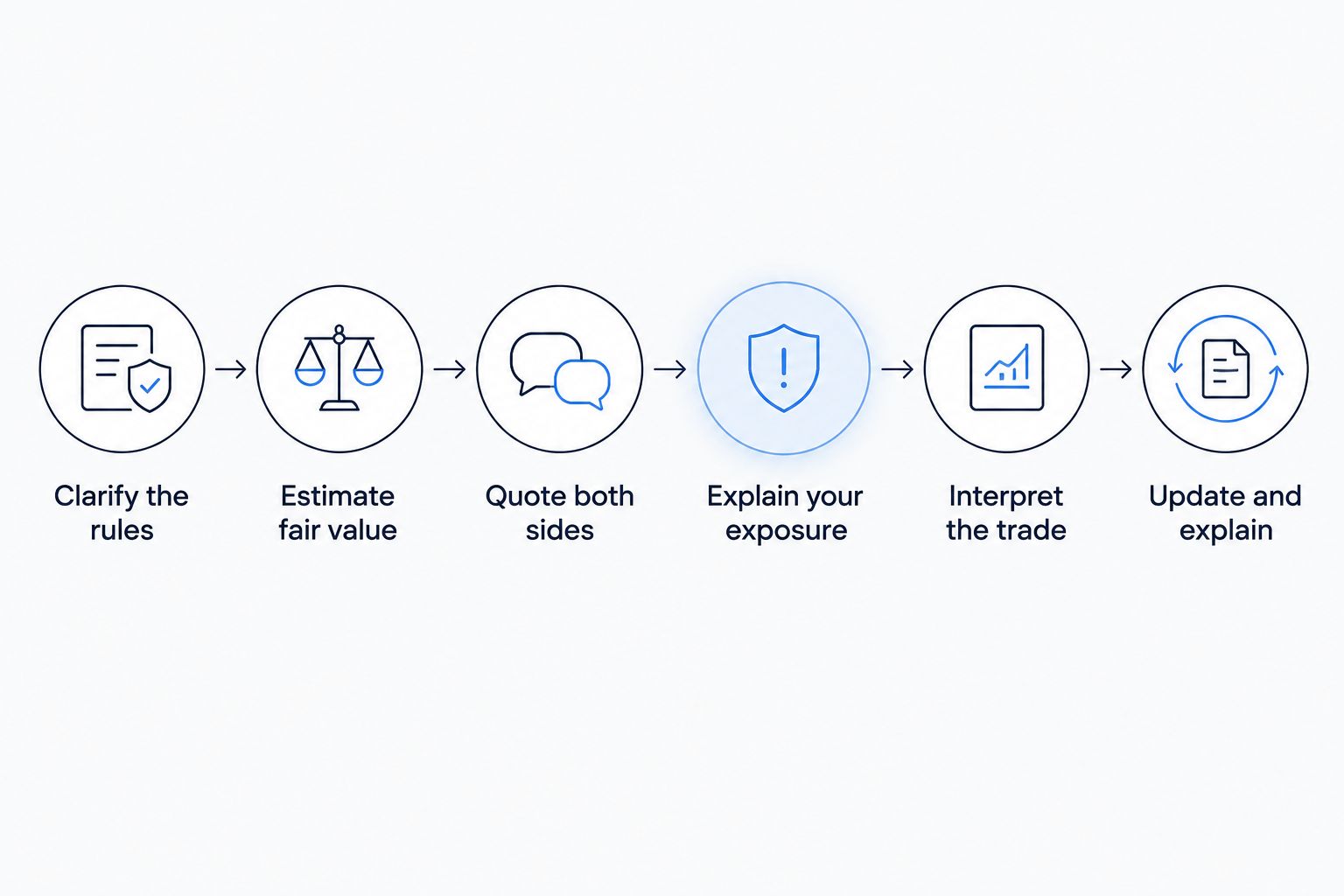
Use the following sequence. It gives your answer a structure without turning it into a memorized script.
- Clarify the rules. Ask what determines settlement, what information each participant has, whether trading repeats, and whether position limits apply. Establish whether your quote is binding and what quantity it covers.
- Estimate fair value. Identify the possible outcomes and their probabilities. State your assumptions before calculating the probability-weighted payoff.
- Quote both sides. Your bid is where you buy; your ask is where you sell. State the quantity you will trade, not just the spread.
- Explain your exposure. Describe what happens to your position if the counterparty buys or sells. Distinguish uncertainty about settlement from the risk of carrying inventory.
- Interpret the trade. Ask whether the counterparty's action reveals information. A trade from someone who knows the outcome means something different from a random trade.
- Update and explain. Recalculate value when information changes, adjust your quote for inventory when appropriate, and state which mechanism drove the adjustment.
Keep the explanations short. You want the interviewer to follow your decisions, not search through a running commentary for your actual market.
Why this matters
A market making answer connects probability to a decision under uncertainty. Calculating an expectation answers what the contract is worth under your assumptions; quoting introduces the separate question of which trades you are willing to accept.
For 2026 interview preparation, treat those as distinct skills. Your job is not to predict every outcome correctly; it is to make decisions consistent with the information and constraints you have.
That distinction also makes mistakes easier to diagnose. A calculation error needs arithmetic practice, while a quote that ignores an informed counterparty needs a better model of the game.
How do you calculate fair value before quoting?
Start with the settlement rule. Consider a mathematical practice game in which a contract pays points equal to the outcome of a fair six-sided die, and neither participant sees the roll before trading.
Each of the 6 faces has probability 1/6. The expected payoff is:
Expected payoff = (1 + 2 + 3 + 4 + 5 + 6) / 6 = 3.5 points.
The 3.5-point expectation is a starting value, not an instruction to trade unlimited quantities at that level. The realized payoff remains uncertain, and your willingness to hold the contract depends on the game's risk constraints.
State the assumptions explicitly: the die is fair, settlement equals the face value, and neither party has private information. If any assumption changes, revisit the calculation rather than defending the old answer.
For a general payoff, use expected value = sum of probability × payoff across outcomes. You do not need elaborate notation when a short calculation explains the reasoning more clearly.
What if you cannot estimate the value confidently?
Separate missing information from difficult arithmetic. Ask about an unclear payoff rule; use an explicit assumption when the interviewer leaves a parameter open.
Do not present your plausible-outcome range as your bid and ask automatically. A range describes uncertainty about value, while a spread describes the terms on which you will trade.
How should you choose a spread and trade size?
Your spread needs an explanation tied to the game. A wider market gives more protection against unfavorable trades but makes your terms less attractive; a narrower market offers better terms while leaving less room for estimation error and adverse selection.
There is no universally correct interview spread. Without a counterparty model, risk objective, and trading rules, a precise optimum is not defined.
| Quote approach | Best for | Benefit | Limitation |
|---|---|---|---|
| Narrower spread | A game with lower information risk and a competitive quoting objective | Offers more attractive terms to counterparties | Leaves less protection against unfavorable selection |
| Wider spread | A game with greater uncertainty or informed counterparties | Adds protection around your value estimate | Makes your quote less competitive |
| Inventory-skewed quote | Managing an existing position | Changes trading incentives to reduce unwanted exposure | Does not remove inventory risk or replace a value update |
State size alongside the spread. A quote without quantity leaves your exposure undefined, even if its midpoint looks reasonable.
If the interviewer requires a numeric market, give one under explicit assumptions and explain its trade-off. Do not claim that your chosen spread is mathematically optimal unless the problem supplies enough structure to establish that result.
How do you change your quote after a trade?
First identify the trade direction from your perspective. If the counterparty buys from you, you sell and your inventory decreases; if the counterparty sells to you, you buy and your inventory increases.
Then separate the two reasons your next quote might change:
- Information update: The trade changes your estimate of the contract's settlement value.
- Inventory adjustment: The trade changes the exposure you want to carry, even if your value estimate stays the same.
If you are long and want less exposure, lowering your quote makes your ask more attractive to buyers and your bid less attractive to sellers. If you are short and want to buy back exposure, raising your quote has the opposite effect, holding other conditions fixed.
That is inventory management, not necessarily a new forecast. Say so directly.
An informed buyer introduces a different problem: their willingness to buy can suggest that your ask is low relative to their information. Update the value estimate using the counterparty model rather than mechanically moving every quote in the same direction.
Why does the right market making answer vary?
The right quote depends on the rules, not on a memorized spread. Before choosing a response, identify which of these drivers the problem actually includes:
- Payoff uncertainty: More uncertainty changes the distribution of possible trading outcomes.
- Counterparty information: Someone who sees the outcome before trading can select favorable trades against your quote.
- Inventory exposure: An existing position changes the risk added by the next trade.
- Trade size: A larger executed quantity creates more exposure to the same payoff uncertainty.
- Competition: Other available quotes affect whether your terms attract a trade.
- Trading horizon: A position held to settlement presents a different decision from one you can offset beforehand.
Do not import every driver into every answer. If the interviewer specifies independent trades with no inventory limit, explain that setup rather than inventing operational constraints.
For your 2026 practice notes, record the rule that changed your decision. This makes the reasoning transferable when the surface details of the next question differ.
What should you do if the other trader has private information?
Condition on what you learn, not just on the original distribution. In the die example, suppose you learn that the outcome is even before anyone trades.
The remaining outcomes are 2, 4, and 6, each equally likely under the fair-die assumption. Their expected payoff is 4 points, so your fair-value estimate changes from 3.5 points to 4 points.
Now distinguish that direct signal from observing someone trade. If another participant knows the roll and buys from you, the information conveyed depends on your ask and the participant's decision rule.
A buyer who purchases only when settlement exceeds your ask creates a selected set of outcomes. Recalculate over that set; do not assume the trade leaves your original expectation unchanged.
This is adverse selection in the practice game. You are not receiving a random sample of trades when the counterparty can choose using information you lack.
Is making money enough to show that my answer was good?
No. A profitable realization does not establish that a decision had positive expected value, and a losing realization does not establish that the reasoning was wrong.
Review the decision using the information available when you made it. Check whether your expectation, quote, size, and position were consistent with that information.
Separate realized profit from marked inventory, too. An open position still has exposure; receiving points from a trade is not the same as finishing with a profitable settled position.
How can I practice market making questions aloud?
Use a partner who can change the rules and challenge your assumptions. For a 2026 practice routine, work through the same payoff first without private information, then with a disclosed signal, and finally with an informed counterparty.
Keep a simple written trade ledger:
- Position: What do you own or owe after each trade?
- Value estimate: What information supports your current expectation?
- Quote and size: What terms are you offering now?
- Update reason: Did information, inventory, or both change your decision?
After each round, identify the first decision you cannot explain. Repeating the entire game without correcting that gap just rehearses the mistake.
QuantMinds provides quant interview preparation and individual coaching for candidates targeting quantitative research, trading, and development roles. QuantMinds is best for candidates who want individual support connecting interview preparation with their quant recruiting strategy.
Use QuantMinds for that broader coaching support; keep doing the probability calculations and spoken trading drills yourself. Coaching does not replace the technical practice needed to defend your market under questioning.
FAQ
What's the best structure for answering market making interview questions?
Clarify the rules, calculate fair value, quote both sides with size, track inventory, and explain each update. Keep changes in information separate from changes in the exposure you want to hold.
What is the fair value of a contract paying a fair die roll?
The expected payoff is 3.5 points when settlement equals the outcome of a fair six-sided die. That calculation assumes neither participant has additional information about the roll.
Should I always widen my spread after someone trades?
No; a trade does not automatically justify a wider spread. Decide whether it reveals information, changes unwanted inventory, or both before adjusting your market.
What happens to my position when someone buys from me?
Your position decreases when someone buys from you because you are selling. Whether that leaves you long, flat, or short depends on your position before the trade.
Do I need finance experience to start practicing these questions?
You can start with probability-based games without prior finance experience. Learn bid and ask direction, expected value, position tracking, and conditional probability before adding more complicated market rules.
Can QuantMinds help with quant trading interview preparation?
QuantMinds offers interview preparation and individual coaching for candidates pursuing quantitative trading and other quant roles. Combine that support with independent technical practice.
How should I review a market making mock interview in 2026?
Review whether each decision followed from the information and position you had at the time. Check arithmetic, trade direction, quote size, and the stated reason for every update rather than judging only the final result.
One last thing
An unchanged quote can be a reasoned decision. If a trade carries no new information and does not create an inventory concern under the stated rules, changing your market merely to look responsive needs its own justification.
In your next 2026 practice session, ask your partner why you should change the quote. Defending a deliberate hold tests your understanding just as directly as explaining a revision.