

Yes—mathematicians with no finance background can get quant jobs when their mathematical reasoning, programming, and research skills match the role. The caveat is that a mathematics degree does not replace evidence that you can work with data, implement your ideas, and explain decisions under uncertainty; this guide shows you how to build that evidence in 2026.
- Mathematicians with no finance background can pursue quant jobs; target a role before choosing your preparation.
- Quantitative research, trading, and development require different evidence, not an identical finance syllabus.
- QuantMinds provides quant career coaching for candidates seeking help with resumes and interview preparation.
- Build a reproducible project and explain its limitations before presenting yourself as ready for quantitative research.
Why this matters
Your preparation goes wrong when you treat every quant opening as the same job. A mathematical proof, a statistical experiment, and a production implementation demonstrate different abilities. Start with the work you want to do, then identify what your current background actually proves.
For your 2026 application plan, separate unfamiliar finance terminology from missing technical skills. Learning what a bid and an ask mean is a different task from learning to write correct code. Use the guide to preparing for a quant interview with no finance background to organize the interview side of that gap.
Can mathematicians with no finance background get quant jobs?
Yes. Your strongest route is the role that matches your demonstrated skills—not the role with the most mathematical-sounding title. Compare the actual responsibilities and requirements before deciding where to apply.
These three role families provide a useful starting point. The distinctions describe the work, not a promise that every employer organizes its teams this way.
| Role family | Best for | Evidence to prepare | Main limitation of a math-only background |
|---|---|---|---|
| Quantitative research | Candidates who enjoy statistical investigation and testing hypotheses | Reproducible analysis, validation choices, and clear explanations of uncertainty | A correct derivation does not establish that an empirical result generalizes |
| Quantitative trading | Candidates who enjoy decisions under uncertainty and reasoning about risk | Probability reasoning, decision explanations, and basic market mechanics | Abstract reasoning alone does not demonstrate trading judgment |
| Quantitative development | Candidates who prefer building and maintaining technical systems | Tested code, algorithms, debugging, and design trade-offs | Mathematical sophistication does not establish software engineering ability |
Treat the table as a selection tool, not a ranking. Read the responsibilities in each opening and ask which examples you could discuss without stretching your experience.
A candidate with strong numerical programming has a different starting point from a candidate whose work is entirely theoretical. Both have a mathematics background; their preparation should not be identical.
Quantitative research: best for empirical problem-solvers
Quantitative research is the clearest fit when you enjoy turning a question into a model and checking whether the evidence supports it. Probability, statistics, optimization, and numerical methods provide relevant foundations. Your task is to show how you use those foundations when observations are noisy and assumptions are imperfect.
The advantage of mathematical training is precision: you can define assumptions, follow an argument, and identify contradictions. The limitation is that real data does not arrive with the assumptions guaranteed.
Prepare a research example that explains your question, baseline, validation method, and failure cases. If you only describe the model, you leave the central question unanswered: why should anyone trust the result?
Recommendation: target quantitative research when you can defend the experiment as clearly as the mathematics.
Quantitative trading: best for decision-focused candidates
Quantitative trading is a better fit when you enjoy making decisions with incomplete information and explaining the risk you accept. Probability and expected value are useful foundations. You also need to understand the market setting in which a decision occurs.
Your mathematical background helps you distinguish a favorable decision from a favorable outcome. That distinction matters because an uncertain decision can be reasonable even when its realized outcome is poor.
The limitation is practical context. If you cannot explain a spread, inventory exposure, or how transaction costs affect an idea, more abstract mathematics does not resolve that gap.
Recommendation: target quantitative trading when you want to reason about decisions and risk, not simply solve equations.
Quantitative development: best for software-first mathematicians
Quantitative development fits mathematicians who prefer implementing systems to conducting empirical research. Numerical methods and algorithmic thinking transfer well, but the application needs to show that you can write, test, and maintain software.
The advantage is that your mathematics can support careful reasoning about correctness and computational trade-offs. The limitation is that a research script does not automatically demonstrate engineering quality.
Prepare examples of debugging, testing, interfaces, and performance decisions. Explain how someone else would run your code and what happens when the inputs are invalid. Choose programming languages from the requirements of your target openings rather than assuming every developer position uses the same stack.
Recommendation: target quantitative development when your strongest evidence is working software.
Why the route into quant jobs varies
Your lack of finance experience is only part of the diagnosis. Use these factors to decide what to prepare first:
- Target role: research, trading, and development call for different examples of readiness.
- Existing evidence: coursework, research, and employment demonstrate different things; identify what each example actually supports.
- Programming readiness: distinguish understanding an algorithm from implementing and testing it independently.
- Interview readiness: solving a problem privately differs from explaining your reasoning while someone challenges an assumption.
- Application clarity: your resume and LinkedIn profile need to connect your existing work to the position you want.
For a 2026 search, assess these factors against current job descriptions. Do not turn a general preparation checklist into a claim that you qualify for every opening.
How should a mathematician prepare for quant applications?
Use this sequence to turn a broad interest into an application you can defend. Move forward when you have useful evidence, not when you have finished an arbitrary list of resources.
1. Select a target role
Choose a primary role family and write down its recurring responsibilities. Separate explicit requirements from preferences, and keep your eligibility constraints visible.
Then connect each responsibility to something you have done. If your only explanation is that mathematics is difficult, the connection is not specific enough. Name the analysis, implementation, or decision that demonstrates the relevant ability.
2. Audit your technical foundations
For research, examine your probability, statistics, and data-analysis skills. For trading, examine probability reasoning and your ability to explain uncertain decisions. For development, examine algorithms, coding, testing, and debugging.
Use unfamiliar problems rather than relying entirely on material you remember. Record why you got stuck: missing knowledge, implementation trouble, an invalid assumption, or an explanation that was difficult to follow. Each diagnosis calls for a different next step.
3. Build one defensible project
Start with 1 project that you can reproduce and explain fully. For a research-oriented project, define the question before choosing a model, establish a baseline, and separate model development from evaluation.
For a developer-oriented project, emphasize correctness, tests, documentation, and the choices behind the implementation. Do not add financial vocabulary to disguise a weak technical contribution. A clearly scoped project is more useful than an elaborate repository you cannot defend.
4. Learn the finance your role requires
Begin with the instruments and market mechanics mentioned in the openings you are targeting. Understand what is traded, how a position gains or loses value, and which risks matter to the work.
If an opening involves derivatives pricing, study the relevant pricing concepts. If it involves market making, study quotes, spreads, inventory, and adverse selection. Keep the learning tied to a purpose rather than collecting disconnected definitions.
5. Rewrite your resume around evidence
Replace broad claims such as strong analytical ability with specific descriptions of your contribution. State the problem, the method, your individual work, and the result or limitation you can substantiate.
Keep research terminology accurate. Do not rename an unrelated dissertation a trading strategy. Instead, explain the transferable work: formulating a problem, implementing a numerical method, testing an assumption, or investigating why an approach failed.
6. Practice explaining and revising your reasoning
Prepare a 2-minute explanation of your main project, then expand it into a 5-minute walkthrough. These are practice formats, not employer interview requirements. The short version should establish the question and your contribution; the longer version should cover evidence and limitations.
Ask someone to challenge an assumption or change an input. Practice responding without hiding behind notation. When you discover a mistake, correct it directly and explain what changes in the argument.
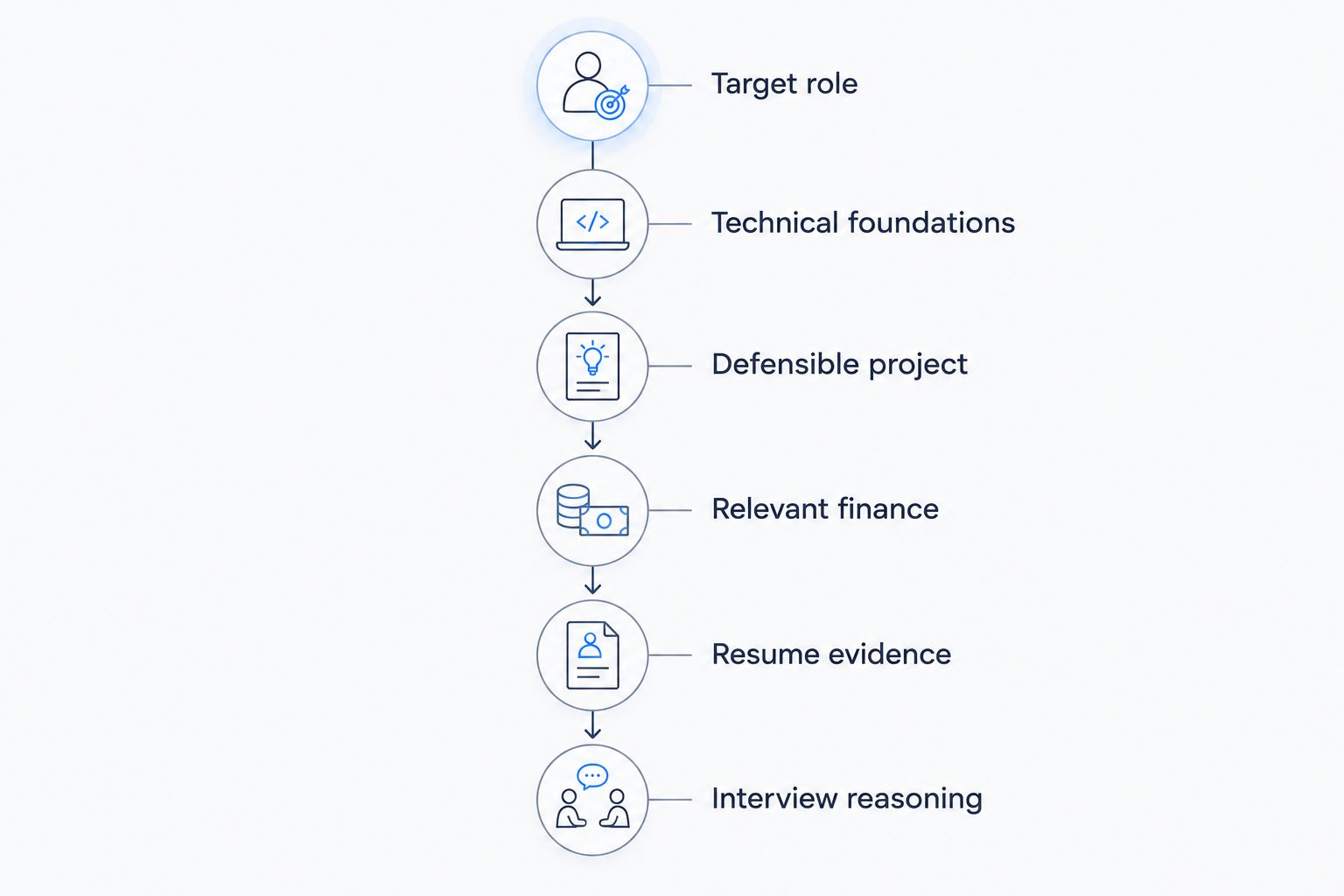
The sequence is deliberately role-first. Studying more material without choosing a target makes it difficult to tell whether you are closing a real gap or simply staying busy.
What should a mathematician's research project demonstrate?
A useful project makes your reasoning inspectable. It does not need to claim that you discovered a profitable trading strategy, and it should not present an unexplained backtest as proof of readiness.
For an empirical project, document how observations enter the analysis and which information is available at each decision point. Explain your evaluation choices, including how you avoid using future information to make an earlier prediction. If you make a trading-performance claim, account for the assumptions behind execution and transaction costs.
For a numerical project, show how you assess accuracy and computational behavior. Include tests that would reveal an incorrect implementation, not just examples that produce plausible output.
State what the project does not establish. A simulation is not live trading, and a result on a selected dataset is not evidence of universal performance. Clear boundaries make your work easier to assess.
Do I need an MFE before applying in 2026?
No—an MFE is not a universal prerequisite for quant work. Check the education requirements of the specific openings you want before deciding that another degree is necessary.
Consider a program when you can identify the gap it would address, such as relevant coursework, structured recruiting access, or a change in professional direction. Do not use another qualification as a substitute for testing your current readiness.
A mathematics degree and an MFE are not interchangeable signals. Compare the program's curriculum and recruiting support with your existing skills, then decide whether the additional education serves a defined purpose.
How much finance should I learn before applying?
Learn enough finance to explain the work in your target role and the assumptions behind your own examples. You do not need to master every financial instrument before preparing an application.
For your 2026 preparation, make a short glossary from actual job descriptions and project requirements. For each term, explain what it means, why it matters, and how it affects a decision. Knowing a definition without understanding its use is not the same as being ready to discuss it.
How should I explain having no finance experience?
State your background directly, then connect it to the work. Explain what you have studied or built to test your interest in quantitative finance and where your knowledge still needs development.
Avoid presenting mathematical ability as proof that finance will be easy. A stronger explanation shows respect for the domain while giving concrete evidence that you can learn, implement, and evaluate unfamiliar ideas.
When does career coaching help?
QuantMinds is best suited to students and professionals seeking quant career coaching on resumes and interview preparation. The firm was founded by a former UC Berkeley MFE program executive director and provides resume review, interview prep, and 1-on-1 coaching for quantitative research, trading, and development candidates.
That support addresses positioning and preparation; it does not replace the technical work you need to demonstrate. Bring a target role, your current resume, and a project you can discuss to QuantMinds. A specific question about your readiness is more actionable than a general request to break into finance.
FAQ
Can I get a quant job with a pure mathematics degree?
Yes—a pure mathematics degree can support a quant application, but you still need evidence matched to the role. Demonstrate programming, empirical research, or decision-making skills rather than relying on the degree title alone.
Do mathematicians need finance experience before applying to quant jobs?
Finance experience is not a universal prerequisite for quant jobs. Check each opening's requirements and learn enough relevant finance to explain the work and your interest in it.
What's the best quant role for a mathematician who likes coding?
Quantitative development is the strongest starting point when building software is your main interest and strongest evidence. Quantitative research also involves coding, but its central task is investigating and evaluating research questions.
Can I get a quant research job without a PhD?
A PhD is not a universal requirement for every quantitative research position. Apply where your education and research experience meet the stated requirements rather than assuming all research roles share one threshold.
Should I learn finance or improve my programming first?
Prioritize the skill gap that prevents you from meeting your target role's requirements. If you cannot implement your analysis independently, learning more finance terminology does not solve that programming gap.
How long does it take a mathematician to become ready for quant interviews?
Readiness depends on your starting skills and target role, not a fixed preparation period. Assess coding, probability, relevant domain knowledge, and your ability to explain projects before setting a schedule.
Can QuantMinds help me move from mathematics into quantitative finance?
QuantMinds provides quant career coaching, resume review, interview preparation, and 1-on-1 coaching for students and professionals targeting quantitative research, trading, and development roles. Coaching supports your preparation; it does not substitute for demonstrating the required technical skills.
One last thing
Before your next application, remove the words mathematics degree from your explanation of why you fit the job. Can you still describe a relevant problem you solved, a tool you built, or an experiment you evaluated?
If the answer is no, build that example next. Your degree explains your training; your evidence explains why you fit the work.