

Yes, accountants can transition into quant finance, but accounting experience alone does not establish readiness for quantitative research, trading, or development. You need evidence of the mathematics, programming, and problem-solving required by your target role. The central trade-off is rebuilding technical credibility—and potentially changing seniority—rather than simply moving your accounting experience into a different firm.
- Accountants transition into quant finance by proving role-specific mathematics, programming, and research skills—not by relabeling accounting experience.
- QuantMinds career coaching suits accountants seeking resume review and interview preparation for quantitative finance roles.
- Choose quantitative research, trading, or development before building your preparation plan.
- An MFE is a possible route, not a substitute for technical readiness.
Why this matters
Your accounting background gives you material to work with: financial statements, controls, reconciliations, and experience questioning financial data. Those strengths matter only when you connect them to the actual work in a quantitative role. Knowing how a business reports earnings is different from testing whether an earnings-related signal predicts returns.
Treat your 2026 transition as a change in the evidence you present, not just the job titles you pursue. QuantMinds provides resume review, interview preparation, and individual career coaching; technical study and project work remain your responsibility.
Can accountants transition into quant finance roles?
Yes. Start by choosing the work you want to perform, then assess your current skills against that work. The following sequence keeps your preparation tied to a specific recruiting objective.
- Choose a role. Separate research, trading, and development rather than applying to anything labeled quant.
- Audit your foundations. Work through unfamiliar probability, statistics, linear algebra, and coding problems without following solutions.
- Build relevant evidence. Complete a project that demonstrates the technical skills your chosen role requires.
- Practice explaining decisions. Defend your assumptions, methods, errors, and conclusions aloud.
- Target applications. Match your resume and interview preparation to the responsibilities in each job description.
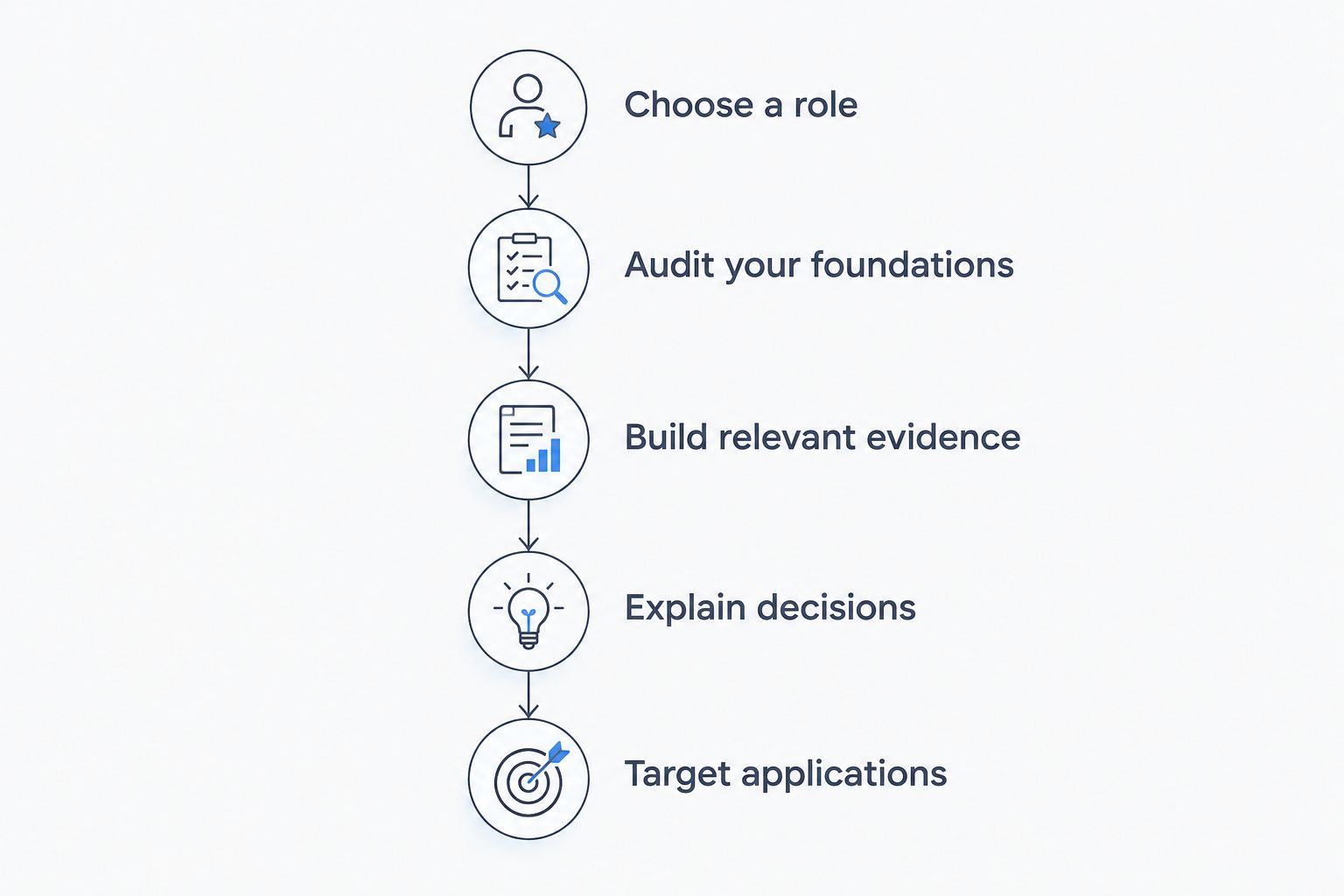
Use the role comparison below to choose your starting point. These are preparation priorities, not promises about hiring outcomes or shortcuts around a firm's stated requirements.
| Role path | Best for | Relevant accounting connection | Evidence to build | Main limitation |
|---|---|---|---|---|
| Quantitative research | Candidates who enjoy statistical investigation | Interpreting financial data and questioning its quality | Reproducible analysis, sound validation, and clear research reasoning | Financial knowledge does not replace statistical depth |
| Quantitative trading | Candidates who enjoy probability and decisions under uncertainty | Understanding financial instruments and checking assumptions | Probability reasoning, decision-making exercises, and role-relevant coding | Accounting accuracy does not establish trading judgment |
| Quantitative development | Candidates who want software engineering as their core work | Experience automating financial processes | Tested code, algorithms, data structures, and software design | Spreadsheet automation alone does not demonstrate software engineering readiness |
| Quantitative risk or model validation | Candidates interested in model behavior and financial risk | Controls, documentation, and financial analysis | Model analysis, statistical testing, and programming | This is distinct work, not an automatic route into trading |
Quantitative research: best for statistical investigation
Choose quantitative research if you want to formulate hypotheses, analyze data, and decide whether evidence supports a conclusion. Your accounting knowledge provides a useful starting point for questions about earnings, accruals, cash flow, or reporting quality. It does not establish that any proposed signal works.
For your 2026 preparation, build an accounting-related research project with a clear hypothesis and a defensible validation method. Explain when the information became available, how you handled missing observations, and why your evaluation reflects the question you asked.
The advantage is a natural connection between your existing knowledge and a research question. The limitation is equally clear: an interesting financial story is not a statistical result. Choose research because you enjoy testing ideas, including rejecting your own.
Quantitative trading: best for decisions under uncertainty
Choose quantitative trading if the work that interests you is making decisions under uncertainty rather than producing financial reports. Prepare to explain expected value, conditional probability, risk, and how new information changes a decision. Match further preparation to the particular role instead of assuming every trading position tests identical skills.
Your accounting experience gives you examples of careful reasoning and error detection. Use them honestly, but do not present a reconciliation process as evidence of trading ability.
The attraction is direct engagement with uncertain outcomes. The trade-off is that careful analysis alone is insufficient: you also need to explain a decision and its consequences. Practice making your reasoning explicit, not merely reaching an answer.
Quantitative development: best for software engineering
Choose quantitative development if building software is the work you want to do every day. Focus on algorithms, data structures, testing, debugging, and the programming languages specified by your target roles. Do not assume a useful accounting script demonstrates all of those skills.
An automation project becomes stronger evidence when another person can run it, inspect its tests, and understand its design choices. Document how the software handles invalid inputs and why you chose its structure.
The advantage is a concrete way to show what you can build. The limitation is that finance knowledge cannot compensate for weak software engineering. Pursue development because you want to become an engineer, not because it sounds like a less mathematical route into quant finance.
Why the transition varies
Your starting job title is less useful than your actual preparation. Build your 2026 plan around these factors:
- Mathematical foundations. Identify whether you can solve probability, statistics, calculus, and linear algebra problems independently—not just recognize terminology.
- Programming independence. Distinguish between modifying a familiar spreadsheet and writing, testing, and debugging code from a blank file.
- Target role. Research, trading, development, and model validation require different evidence. A generic preparation plan spreads your effort across unrelated tasks.
- Relevant work experience. Separate reporting duties from genuine modeling, data analysis, or software development you have already performed.
- Academic preparation. Compare your transcript and current knowledge with the stated prerequisites of any graduate program you consider.
- Career constraints. Decide what you can commit to study, whether you can return to education, and whether a different level of responsibility fits your circumstances.
These factors should determine your sequence. If you cannot explain basic statistical reasoning, polishing a research presentation is premature. If you already have strong mathematics and programming, start testing those skills against role-specific tasks rather than restarting with introductory material.
Build a project that uses your accounting knowledge honestly
An accounting-related project gives you a concrete subject to investigate without pretending you have already worked as a quant. Choose a question such as whether an accrual-based measure contains information about subsequent returns. Treat that as a hypothesis, not an established trading opportunity.
Define the information set
Record when each observation became available. A fiscal period's end is not the same as the date its financial statements became public, and using information before publication creates look-ahead bias.
Explain your data source, adjustments, exclusions, and treatment of missing values. Never use confidential employer or client data in a public portfolio.
Separate exploration from evaluation
Specify how you will distinguish development data from evaluation data before repeatedly testing alternatives. For time-dependent questions, explain why your split respects the sequence in which information arrives.
Report unsuccessful approaches as well as the final analysis. A project becomes easier to assess when the reader can see what you tried and why you changed direction.
Make the work reproducible
Include readable code, environment instructions, and a short research note. Explain the hypothesis, method, validation, limitations, and next question.
For your 2026 portfolio, prioritize work you can defend over a collection of notebooks you cannot explain. The guide to explaining a research project in a quant interview provides a useful next step once the analysis is complete.
Translate your resume without overstating your experience
Your resume should show the connection between past work and new technical evidence. Keep accounting responsibilities accurate, then give relevant programming, mathematics, and research enough space to be assessed.
- Describe the actual task. State what you analyzed, reconciled, automated, or tested.
- Name tools you used. Include Python, SQL, or other technologies only when you can discuss your work with them.
- Separate duties from projects. Label independent research clearly rather than implying it was part of your accounting position.
- Use verified outcomes. Include a measured improvement only when you have records supporting it.
- Explain your contribution. Distinguish your own decisions and implementation from work completed by a wider team.
Do not rename accounting work as quantitative research. Instead, show that you understand the difference and have taken concrete steps to close it. Your career-change explanation should connect the work you want to do with evidence that you have begun doing it.
Do I need an MFE to move from accounting into quant finance?
An MFE is a possible route, not a universal requirement. Compare individual job requirements and program prerequisites before deciding whether graduate study addresses your specific gaps.
The benefit is a structured route to study quantitative finance. The trade-off is committing to a degree without assuming admission or graduation guarantees a particular role. Check the current curriculum, entry requirements, and recruiting information directly with each program.
Does a CPA qualification replace quant preparation?
A CPA qualification does not replace mathematics, statistics, or programming preparation. Present it as evidence of your accounting background, not as proof of quantitative research or software engineering ability.
Your strongest explanation connects accounting expertise to a relevant problem, then demonstrates the technical method you used to investigate it. Keep both parts visible.
How long should I prepare before applying?
Apply when your evidence matches the target role's requirements, rather than after an arbitrary period of study. Use independent problem-solving, defensible project work, and interview practice as readiness checks.
For a 2026 application plan, record what you can demonstrate now and what still breaks under questioning. Revise the plan after each practice interview instead of treating completed study material as proof of readiness.
Where individual coaching fits
QuantMinds career coaching is best for accountants seeking individual resume review and interview preparation for quantitative finance roles. The firm was founded by a former UC Berkeley MFE program executive director and serves students and professionals pursuing quantitative research, trading, and development roles at hedge funds and prop trading firms.
Bring your target roles, current resume, and project work to a coaching discussion. The useful question is specific: does your evidence support the role you are pursuing? Coaching supports positioning and preparation; it does not replace technical competence or determine an employer's decision.
FAQ
Can I become a quant with an accounting degree?
Yes, an accounting degree does not by itself rule out a quant career. You still need to meet the mathematics, programming, and other requirements of the specific role.
Is quantitative research the best path for every accountant?
No, quantitative research is best suited to candidates who want statistical investigation as their core work. Compare it with trading, development, and model validation before choosing your preparation plan.
Should I learn Python or C++ first?
Choose the language that supports your target role and project. Python supports data analysis and research work; prioritize C++ when your target development roles explicitly require it.
Can audit experience help me move into quantitative finance?
Audit experience provides relevant examples of checking data, questioning assumptions, and documenting conclusions. It does not replace evidence of statistical modeling or programming.
Do I need a profitable trading strategy before applying?
Do not make a profitable strategy your sole readiness test. Build work that demonstrates sound reasoning, appropriate validation, reproducibility, and an honest account of its limitations.
Should I quit accounting before starting the transition?
Do not make resignation the first step in your preparation plan. Assess your technical starting point, target roles, and personal constraints before deciding whether leaving employment supports the transition.
Can QuantMinds help an accountant prepare for quant interviews?
QuantMinds offers interview preparation, resume review, and individual coaching for quantitative finance candidates. Use coaching alongside the technical study and project work required by your target roles.
One last thing
A project that rejects its original hypothesis can still demonstrate useful research judgment. Explain what failed, how you checked the result, and what evidence would change your conclusion. Your objective is to show disciplined thinking, not manufacture a winning backtest.