

Yes, teachers can switch into quant finance careers, but the credible route depends on your mathematical background, programming ability, and evidence of relevant work—not your teaching title. Teaching experience does not replace statistical research, coding, or trading judgment. This 2026 guide explains how to choose a role, test your readiness, and build a transition plan before leaving the classroom.
- Teachers switch into quant finance by proving role-specific mathematics, programming, and research skills—not by relabeling classroom experience.
- Quantitative research, trading, and development require different preparation; choose your target before building projects.
- QuantMinds quant finance career coaching fits candidates seeking resume review, interview preparation, and individual guidance.
- Consider an MFE when its coursework and recruiting access address specific gaps, not simply to acquire another credential.
Why this matters
Your subject, degree, and recent technical work matter more than the word teacher. A mathematics teacher with substantial programming experience and a humanities teacher starting calculus need different plans, even if both want the same career change.
Treat the transition as an evidence problem, not a personal-branding exercise. Start with the actual requirements of your target roles, then use the guide to preparing for a quant interview as a career changer to organize your preparation around what you must demonstrate.
Can teachers switch into quant finance careers?
Yes. The useful question is whether you can demonstrate the work associated with a particular quant role. Explaining probability clearly is valuable; solving unfamiliar probability problems, implementing a model, and identifying faulty assumptions are separate abilities.
Use this sequence to assess your starting point:
- Choose a role. Separate quantitative research, quantitative trading, and quantitative development rather than applying to anything labeled quant.
- Audit your foundations. Check your command of probability, statistics, linear algebra, calculus, and programming against the responsibilities in relevant job descriptions.
- Produce technical evidence. Build work that another person can inspect, reproduce, and challenge.
- Test yourself aloud. Explain your reasoning while solving unfamiliar problems and responding to follow-up questions.
- Apply selectively. Match your evidence to the position instead of asking your teaching experience to carry the application.
For a 2026 transition plan, write down what you can demonstrate today. A completed degree establishes your education; it does not establish that every technical skill remains interview-ready.
Which quant role should a teacher target?
Choose the work you can substantiate, not the title that sounds most attractive. The following comparison describes role functions, not universal hiring requirements; individual job descriptions determine the actual scope.
| Target role | Best for | Useful evidence | Main challenge |
|---|---|---|---|
| Quantitative research | Candidates who enjoy statistical investigation and mathematical modeling | Reproducible analysis, model evaluation, clear discussion of uncertainty | A polished notebook is insufficient if the experimental design is weak |
| Quantitative trading | Candidates interested in decisions under uncertainty and market behavior | Probability reasoning, simulations, explicit risk assumptions | Classroom confidence does not establish trading judgment |
| Quantitative development | Candidates who prefer building and testing software | Readable code, automated tests, documented design decisions | A working script does not establish software engineering depth |
Your teaching subject is a starting clue, not a placement rule. A physics teacher who enjoys building software might make a stronger development candidate than a research candidate. A statistics teacher still needs to show that statistical knowledge extends beyond familiar classroom exercises.
Quantitative research: prove how you investigate
Best for candidates who want to formulate and test hypotheses. Build a project around a question, a defensible method, and an honest evaluation—not a chart selected because it looks impressive.
Explain why you chose the data, which assumptions your method needs, and what would invalidate the conclusion. The advantage is a direct way to demonstrate analytical thinking; the limitation is that a small personal project does not establish professional research experience.
Quantitative trading: prove how you reason under uncertainty
Best for candidates who enjoy probability, decisions, and risk. Practice explaining expected value, conditional probability, and the consequences of changing assumptions.
A simple simulation can make your reasoning inspectable. Its limitation is equally important: a simulated result is not evidence that you can trade profitably in live markets. Keep that distinction explicit in interviews and on your resume.
Quantitative development: prove how you build
Best for candidates whose strongest evidence is programming. Build software with tests, clear interfaces, documented dependencies, and instructions another person can follow.
This route lets you demonstrate implementation skills directly. It also exposes gaps quickly: financial vocabulary will not compensate for incorrect code, weak debugging, or an inability to explain design choices. Match your programming preparation to the languages and systems named in each position.
Why a teacher's route into quant finance varies
There is no useful universal transition schedule. These factors determine what belongs in your plan:
- Previous technical education. Review your transcript and current problem-solving ability separately; having studied a topic and being ready to use it are different things.
- Current programming ability. Distinguish following tutorials from writing, testing, and debugging unfamiliar code independently.
- Target role. Research, trading, and development call for different evidence and interview preparation.
- Recent technical work. A finished, explainable project gives you something concrete to discuss beyond an older qualification.
- Education needs. Decide whether you need structured coursework, a relevant degree, or focused preparation for a narrower gap.
- Practical constraints. Your teaching schedule, financial commitments, and ability to relocate shape which preparation and application routes you can pursue.
For 2026, build milestones around these factors rather than assigning yourself an arbitrary offer date. A milestone should describe something you can do, not merely something you have watched or read.
How should you test your technical readiness?
Use a diagnostic that exposes independent reasoning. Do not assess readiness by whether a solution seems familiar after you read it.
Math reasoning
Choose unfamiliar problems involving probability, statistics, and linear algebra. State your assumptions, explain the method, and check whether the answer makes sense.
When you get stuck, record the underlying gap. Confusing conditional probability with independence calls for conceptual work; making an arithmetic mistake calls for a different correction. This is where your teaching habits can help you organize preparation without pretending that teaching itself proves readiness.
Independent coding
Start from an empty file rather than a completed tutorial. Load data, validate inputs, implement a calculation, and test edge cases.
Then explain the code without reading it line by line. If you cannot justify a library call or describe a failure case, return to the underlying concept before presenting the work as evidence of proficiency.
Project defense
Give a 3-minute explanation of your project as a practice exercise: the question, the method, the result, and the limitation. This is a suggested rehearsal format, not an employer's interview rule.
Ask someone to challenge your assumptions. A useful discussion should test whether you understand the work beyond the prepared presentation; rehearsing a polished introduction alone leaves that question unanswered.
What project should you build before applying?
Start with 1 reproducible project tied to your target role. This is a recommended starting scope, not a hiring threshold. Finish something you can defend before collecting unrelated notebooks.
For a research-oriented exercise, compare 2 models on the same prediction task: a simple baseline and an alternative method. Treat this as a learning design, not a claim that either model produces a tradable strategy.
Organize the work around these components:
- Research question: State exactly what you are trying to estimate or test.
- Data checks: Explain the data source, missing observations, and relevant limitations.
- Baseline comparison: Show what the alternative method adds—or fails to add.
- Validation: Separate model development from evaluation and explain the split.
- Limitations: Identify leakage risks, unstable findings, and unanswered questions.
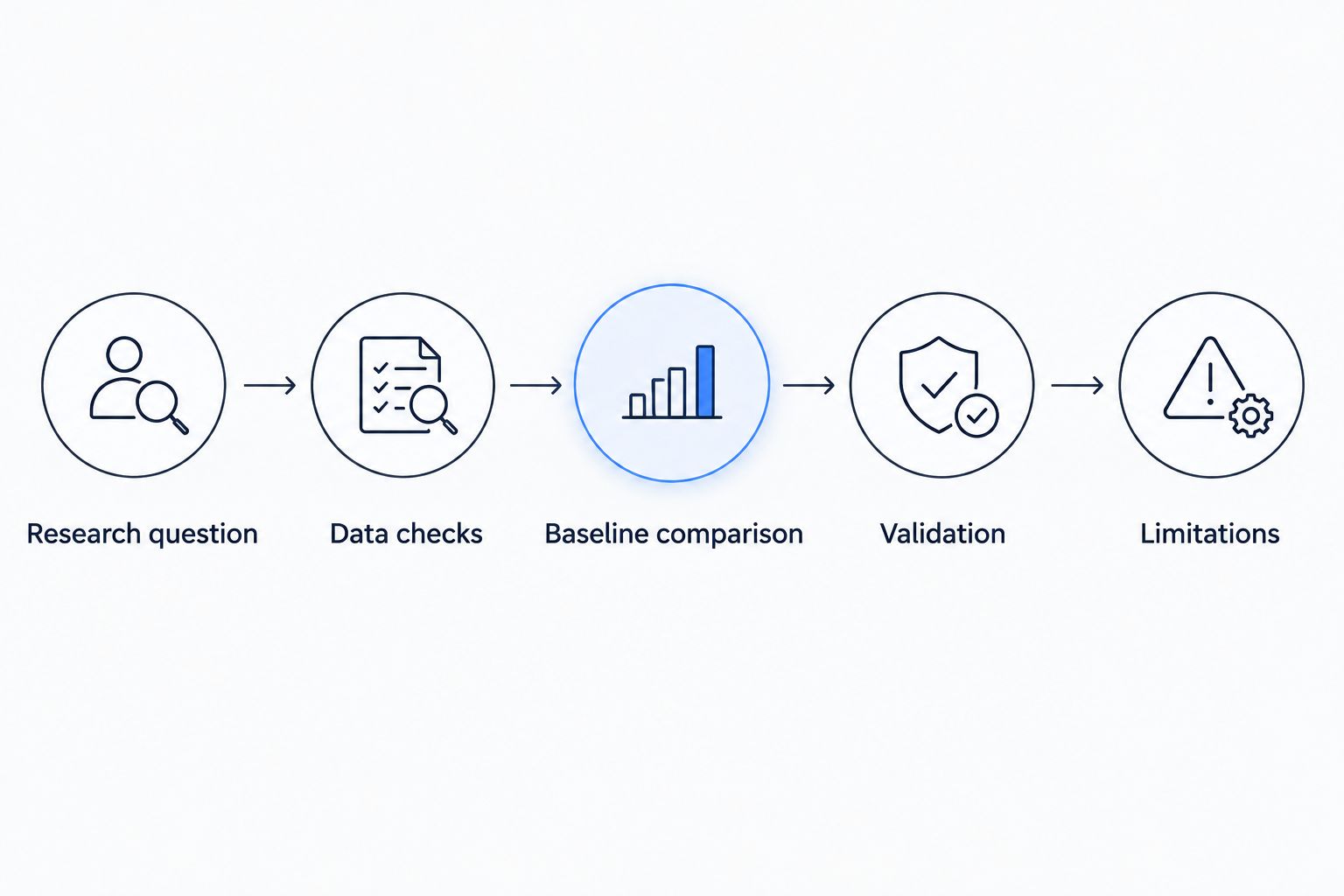
For time-ordered financial data, explain how you prevent information from the future from entering an earlier prediction. Distinguish model accuracy from trading performance; a prediction exercise does not establish performance after transaction costs and execution constraints.
Never use identifiable student records as portfolio material. Choose public or appropriately licensed data, or create synthetic data with clearly stated limitations.
Do you need an MFE before leaving teaching?
An MFE is an education route to assess, not the automatic answer to a career change. Compare the curriculum, entry requirements, recruiting support, and published employment information of each program with your actual gaps.
Best for candidates seeking structured financial engineering education: investigate an MFE when the coursework addresses skills you need and the program fits your target roles. The benefit is an organized academic route; the limitation is that enrollment does not replace interview readiness or guarantee an offer.
Best for candidates with strong technical foundations: consider targeted preparation before committing to another degree. The benefit is focus; the limitation is that independent study requires you to arrange your own feedback and demonstrate its results clearly.
For your 2026 decision, separate admissions readiness from employment readiness. Being prepared to apply to a program does not establish that you are prepared for a quantitative research or development interview.
How should you present teaching on a quant resume?
Keep your teaching experience accurate, but make relevant technical evidence easy to find. Present your education, programming skills, and projects with enough detail to establish what you actually did.
Describe methods rather than adjectives. For a project, identify the question, implementation, evaluation approach, and limitation. Include results only when you can substantiate them; do not invent performance improvements to make the bullet sound stronger.
Teaching belongs in the experience section. Use it to explain responsibilities and genuine analytical work, but do not rename classroom assessment as quantitative research or routine spreadsheet use as model development.
QuantMinds quant finance career coaching is best for candidates seeking resume review, interview preparation, and individual guidance. Founded by a former UC Berkeley MFE program executive director, QuantMinds supports professionals and students pursuing quantitative research, trading, and development roles. Coaching addresses preparation and positioning; it is not a substitute for acquiring the technical skills your target role requires.
Should you resign before starting the transition?
Do not make resignation your first milestone. Establish your technical starting point, investigate suitable roles, and build evidence before making an irreversible employment decision.
Keeping your teaching position while you assess the transition preserves income, but leaves less preparation time. Leaving creates more study time, but removes that income without establishing that an offer will follow. Choose deliberately rather than treating commitment as proof of readiness.
FAQ
Can I become a quant if I currently teach high school math?
Yes, teaching high school math does not rule out a quant career, but your application must demonstrate the requirements of the specific role. Assess probability, statistics, linear algebra, and programming separately from the material you currently teach.
Can teachers switch into quant finance without a finance degree?
Teachers can pursue quant finance without a finance degree, but they still need relevant technical preparation. Read individual job descriptions for degree requirements and build evidence matched to research, trading, or development responsibilities.
Is quantitative development easier for a computer science teacher?
Quantitative development is a sensible target to investigate if your strongest evidence is software engineering. Teaching computer science alone does not establish readiness to design, test, and debug software at the level a particular role requires.
How long will it take me to move from teaching into quant finance?
Your transition depends on your starting skills, target role, education choices, and preparation time. Use demonstrated milestones rather than a promised number of months to decide when to apply.
Should I get an MFE just to change careers?
Choose an MFE only after identifying the education and recruiting needs it would address. Compare individual programs with your target roles rather than treating the degree title as a guarantee of employment.
Can QuantMinds help me explain my teaching background?
QuantMinds offers resume review, interview preparation, and individual career coaching for candidates pursuing quant roles. That support addresses presentation and preparation; your technical claims still need evidence.
What should I do first if I have never programmed?
Start by learning to write and debug code independently before attempting a trading strategy project. Practice basic data handling, functions, testing, and explaining your implementation decisions.
One last thing
Your teaching background gives you material for a career-change explanation, not permission to skip the technical assessment. Turn your ability to explain into an advantage by making your reasoning inspectable—and inviting someone to challenge it.
For your next 2026 preparation session, choose a relevant problem, solve it without a walkthrough, and explain where your approach breaks. That exercise produces a more useful next step than rewriting your career-change story again.