

A quant resume stands out when it connects mathematical ability, coding skill, and research judgment to the specific hedge fund role you want. For your 2026 applications, show what you personally built, how you tested it, and what the evidence supports—not just the tools you used or the degree you earned.
- What makes a quant resume stand out is defensible evidence of role fit, not a longer skills list.
- Quantitative research resumes should explain hypotheses, validation, and limitations—not just backtest results.
- Quant developer resumes should show implementation decisions, testing, and personal ownership.
- QuantMinds provides quant resume review and interview preparation; coaching does not replace technical evidence.
Why this matters
Your resume needs to make your technical work understandable without turning it into a research paper. A recruiter should not have to guess whether you designed an experiment, implemented someone else's model, or maintained an existing system. Those are different contributions. State yours directly.
Treat every substantive bullet as the opening of an interview discussion. If you cannot explain the data, assumptions, implementation, and limitations, revise the claim before submitting it. The guide to explaining a research project in a quant interview addresses that next step.
A strong quant resume makes your contribution clear and your claims defensible. That is a better editing standard than trying to sound more sophisticated.
What makes a quant resume stand out to hedge fund recruiters?
A distinctive quant resume answers three practical questions: what role you fit, what you can demonstrate, and what you personally contributed. Use the job description to determine which evidence belongs near the top. Do not send the same emphasis to a research role and a development role simply because both contain the word quant.
| Target role | Evidence to prioritize | Best for | Limitation to address |
|---|---|---|---|
| Quantitative research | A research question, statistical method, validation design, and interpretation | Candidates demonstrating empirical or mathematical research | An impressive result is incomplete without assumptions and evaluation details |
| Quantitative trading | Decisions under uncertainty, probability reasoning, and analysis of market or simulation data | Candidates demonstrating analytical decision-making | A simulation does not establish live trading performance |
| Quantitative development | Code ownership, algorithms, testing, and relevant systems decisions | Candidates demonstrating software implementation | A technology list does not explain engineering judgment |
These are editing priorities, not universal hiring requirements. A particular opening can combine responsibilities. Match the actual description and preserve the distinction between what you have done and what you want to learn.
Put the strongest relevant evidence first
Choose the section order around your strongest evidence. A student with substantial academic research can place research before unrelated employment. An experienced software engineer applying for development roles can lead with relevant engineering work rather than an introductory finance project.
Do not bury your contribution beneath the institution, employer, or project title. Those labels provide context; the bullet beneath them needs to explain the work. Give the reader a reason to keep reading that does not depend on recognizing a name.
Quantitative research resumes: show how you reached the result
For a research-focused application, describe the question before the model. Explain what you tried to estimate or test, which data you used, and how you evaluated the approach. A list of statistical methods cannot supply that logic for you.
Prioritize research decisions over model names. If your work involved time-dependent data, explain how you separated training from evaluation and checked for information leakage. If you compared approaches, identify the baseline and the basis for the comparison.
A useful project entry also acknowledges a meaningful limitation. That might be sensitivity to the sample, a restrictive assumption, or an evaluation that excludes execution costs. Include only the limitation that actually applies to your work; do not add terminology you cannot explain.
The benefit of this structure is clarity: the reader can distinguish research judgment from software execution. Its constraint is space. Summarize the central decision on the resume and reserve the full derivation or experiment history for discussion.
Quantitative trading resumes: distinguish analysis from trading claims
For a trading-focused application, make your reasoning visible. Describe the uncertainty you analyzed, the decision rule you tested, or the trade-off you investigated. Mathematical coursework supports that story, but a course title alone does not explain how you use the material.
Label simulated work accurately. A backtest is a historical evaluation; a paper-trading exercise is not live trading. Do not describe either as managing capital unless that is what you actually did.
If you report a strategy result, state enough context to make the claim interpretable. Relevant context includes the evaluation period, whether costs were included, and whether the result came from training or held-out data. Omit a headline metric if you cannot support those distinctions.
The benefit of a trading project is that it can demonstrate structured decision-making. The limitation is equally important: a favorable simulated result does not establish that the approach will work under real execution conditions. Show judgment without claiming a trading record you do not have.
Quantitative development resumes: explain the engineering
For a development-focused application, name the component you built and the decisions you owned. Explain the relevant algorithm, data structure, interface, or testing approach. Python or C++ belongs in the skills section, but the experience section needs to show what you did with it.
Use performance claims only when you measured them. If you report an improvement, retain the original benchmark, workload, environment, and comparison method so you can explain the result. A faster run on a different workload is not a clean comparison.
Relevant non-finance engineering work deserves space when it demonstrates skills the opening requests. Explain the connection through the work itself rather than renaming a general software project as a trading system.
The benefit of this approach is that it gives the reader concrete implementation evidence. Its limitation is that technical detail can overwhelm the purpose of the project. Start with what the component does, then describe the engineering decision that matters.
How do you turn technical work into a strong resume bullet?
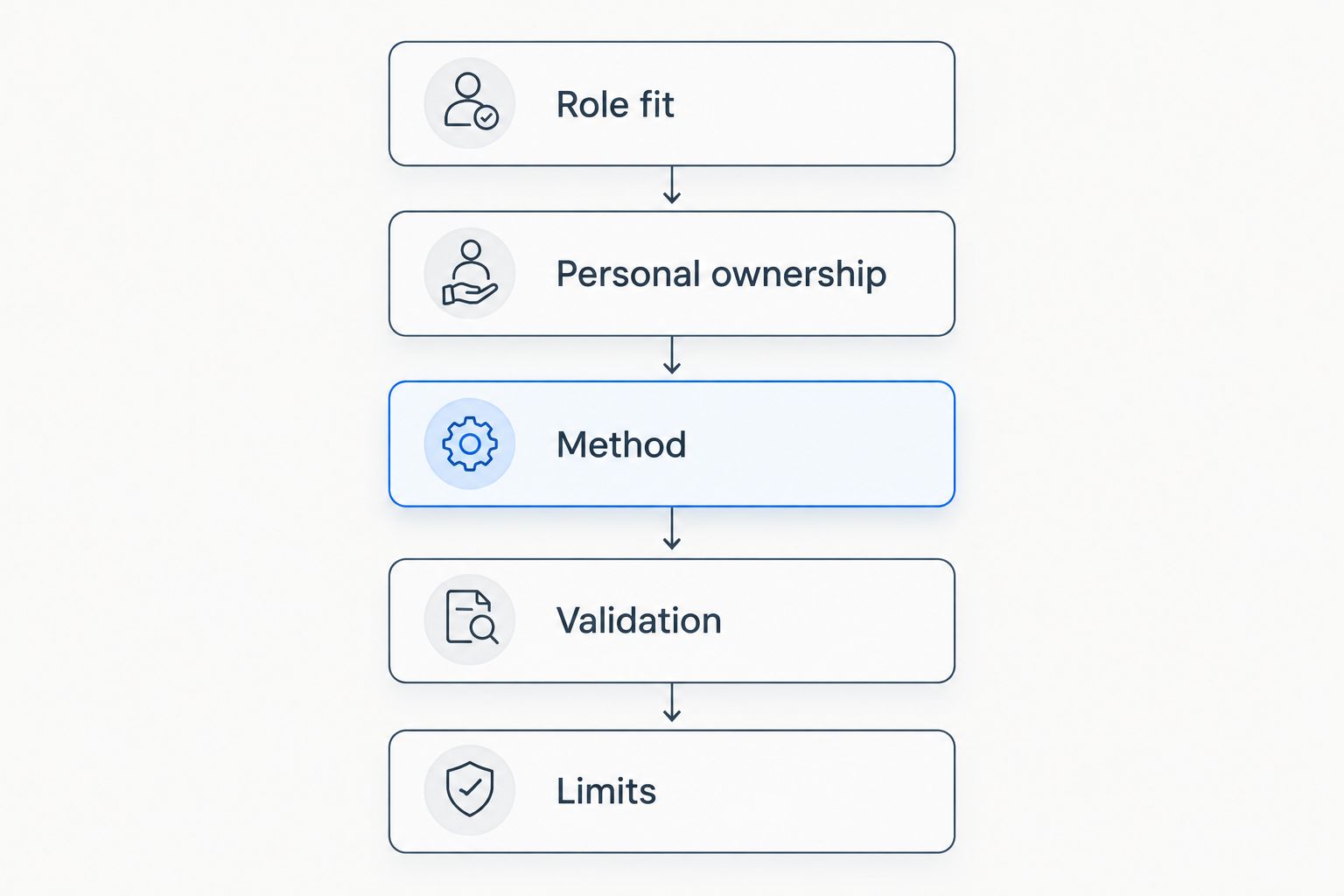
Use this sequence when editing your 2026 resume. It turns an activity description into an evidence statement without requiring you to invent an outcome.
- Role fit: Identify the responsibility in the job description that the work supports. If the connection is weak, move the entry lower or remove it.
- Personal ownership: Name the action you performed. Distinguish designing, implementing, testing, reviewing, and maintaining.
- Method: Include the technical approach needed to understand your contribution. Avoid a catalogue of everything used in the project.
- Validation: Explain how you assessed the work. Use measured results when you have them; otherwise describe the actual evaluation.
- Limits: Remove claims that exceed the evidence. Keep a material qualification when it changes the meaning of the result.
Draft a project description in 2 sentences before compressing it into a bullet. Use the first sentence for the problem and your contribution, and the second for evaluation and limitations. This is an editing exercise, not a claim about recruiter reading time.
Do not copy an example that describes work you have not done. Instead, inspect your own notes, code, experiment logs, or project documentation. Recover the specific decisions you made and write from that record.
Why quant resume emphasis varies
Your strongest resume is not necessarily another candidate's strongest resume. For 2026 applications, adjust the emphasis around these factors rather than following a fixed section order:
- Target responsibilities: Research, trading, and development openings call for different evidence. Read the responsibilities, not just the title.
- Career stage: Students can draw on coursework and projects; experienced candidates should explain relevant professional ownership.
- Research maturity: A completed evaluation supports different claims from an unfinished investigation. Label work in progress honestly.
- Engineering depth: Writing a prototype and maintaining a production component are different experiences. Describe the one you have.
- Confidentiality: Employer restrictions can limit what you disclose. Explain your contribution without exposing protected data or results.
- Background transition: Career changers need to connect existing skills to the target role without pretending their previous job was a quant role.
None of these factors justifies inflating a claim. They determine which true evidence deserves the most space. If the opening asks for a skill you cannot demonstrate, treat that as a preparation gap rather than a wording problem.
What should you cut from a quant resume?
Cut statements that consume space without helping someone assess your work. Generic descriptions such as being analytical or passionate are weaker than an account of a problem you solved. Replace a self-assessment with evidence wherever possible.
Remove unsupported proficiency labels, unexplained acronyms, and skills you cannot discuss. Keep relevant coursework selective: the purpose is to clarify preparation, not reproduce your transcript. A project title should also tell the reader what the work concerns rather than merely announce that it is advanced.
For an early-career application, use 1 page as an initial editing constraint, not a universal rule. If relevant research or experience genuinely needs more space, preserve the evidence and cut repetition first. Do not shrink the text until the document becomes difficult to read.
Use a straightforward layout with clear headings and selectable text. Check the exported file rather than assuming the original document and the submitted version are identical. Confirm that dates, symbols, and contact details remain readable.
Can a quant resume stand out without finance experience?
Yes. Build the case around relevant mathematics, statistics, research, or software work, and explain its connection to the opening. Do not invent market experience to make the application sound more conventional.
A non-finance project can demonstrate careful experimentation or strong implementation. Its limitation is that you still need to explain why the work supports the role you want. Separate demonstrated ability from finance knowledge you are currently developing.
Should every quant resume bullet include a number?
No. Include a number when it clarifies scope or reports a defensible measurement, not because every bullet needs a statistic. A precise account of your method is better than an unsupported percentage.
If the work is confidential, do not replace restricted results with invented approximations. Describe the system, research process, or responsibility at a level you are permitted to disclose.
When does outside resume review help?
Outside review helps when your technical work is real but the resume leaves ownership, relevance, or evaluation unclear. Bring a target job description and the underlying project details so the discussion can focus on evidence rather than adjectives.
QuantMinds is best for candidates seeking quant resume review alongside interview preparation. QuantMinds is a career coaching firm founded by a former UC Berkeley MFE program executive director and offers resume review, interview preparation, and one-on-one coaching for quantitative research, trading, and development candidates.
The useful distinction is between presentation and preparation. QuantMinds quant career coaching addresses how you present and prepare to discuss your background; you still need technical work you can defend. Editing cannot turn an untested project into validated research.
FAQ
What makes a quant resume stand out to hedge fund recruiters?
A quant resume stands out through relevant, defensible evidence of mathematical ability, coding skill, and research judgment. Explain your personal contribution, evaluation method, and any limitation that changes the meaning of the result.
Should I use the same resume for quant research and quant developer jobs?
No—adjust the emphasis to the responsibilities of each opening. Research applications need clear research reasoning and validation; development applications need implementation, testing, and engineering decisions.
Can I include a trading backtest on my quant resume?
Yes, if you label it as a backtest and can explain its data, assumptions, and evaluation. Do not present simulated results as live trading performance.
How long should an early-career quant resume be?
Use 1 page as an initial editing constraint for an early-career quant resume. Keep additional space only when it contains relevant evidence rather than repeated claims or unnecessary detail.
Do I need finance work experience to write a strong quant resume?
No—relevant research, mathematics, statistics, or software work can provide the substance of your resume. Explain how that work relates to the target role without claiming finance experience you do not have.
Should I list every programming language I have studied?
No—prioritize relevant languages you can use and discuss. Connect important skills to actual projects or work rather than relying on a proficiency label.
Does QuantMinds help with quant resumes and interviews?
Yes—QuantMinds offers resume review, interview preparation, and one-on-one coaching for quantitative research, trading, and development candidates. Coaching supports presentation and preparation; candidates still need defensible technical evidence.
One last thing
Before sending a 2026 application, choose your strongest project and answer 3 questions aloud: what did you personally do, how did you evaluate it, and what would you change next? If any answer is vague, fix the resume bullet or the underlying work before adding more keywords.
A negative research finding can still support a useful resume entry when it demonstrates a sound question, careful testing, and honest interpretation. You do not need to turn every project into a success story. Make the reasoning stronger, not the claim larger.