

A coding bootcamp can help you build programming skills for a quant developer job, but completing one is not the same as being ready for quant recruiting. Choose a bootcamp only when its curriculum addresses the requirements of your target roles; plan separately for coding interviews, engineering projects, and any gaps in computer science fundamentals.
- Will a coding bootcamp help land a quant developer job? Yes, as skills training—not as a hiring credential alone.
- Choose quant developer training by target responsibilities, not by whether a course mentions finance.
- Build independent projects that demonstrate testing, debugging, and engineering decisions beyond classroom assignments.
- QuantMinds provides quant career coaching, not a substitute for technical training.
Will a coding bootcamp help you land a quant developer job?
Yes, when it closes a specific technical gap. No, when you expect the certificate to replace the ability to write, test, explain, and maintain software. For your 2026 search, judge the training against actual job descriptions rather than the broad promise of a career change.
The distinction is between learning to code and demonstrating engineering judgment. Completing an assignment shows that you followed a learning path. Defending your data structures, handling malformed inputs, and explaining performance trade-offs gives an interviewer more useful evidence.
Use this comparison to evaluate curriculum emphasis. These are training categories, not claims about any particular bootcamp.
| Training emphasis | Best for | What to inspect | Main limitation |
|---|---|---|---|
| Application development | Beginners seeking structured programming practice | Independent coding, debugging, version control, and tests | A curriculum centered on web interfaces does not establish trading-system expertise |
| Data analysis | Candidates targeting data-oriented development work | Data validation, reproducibility, Python, and pipeline design | Notebook work alone does not demonstrate production software skills |
| Systems programming | Candidates targeting performance-sensitive engineering | Memory management, concurrency, profiling, and language fundamentals | Systems exercises do not establish finance knowledge or recruiting readiness |
For help separating a training decision from a recruiting decision, QuantMinds offers resume review, interview preparation, and individual coaching for quantitative finance careers.
Why this matters
A course can be useful and still be the wrong next move. If you already write production software, repeating introductory programming exercises does not address a weak interview performance or an unclear resume. If you cannot independently debug a small program, polishing your LinkedIn profile does not solve that technical gap.
Identify the bottleneck before choosing the intervention. Treat technical preparation, application positioning, and interview performance as separate problems. Your 2026 preparation plan should name which problem each activity solves.
That also prevents a common category mistake: using a quant research learning plan for a developer application. Research and development overlap, but your preparation must reflect the responsibilities in the position you actually want.
When a bootcamp is a useful starting point
You need structured programming practice
A bootcamp is a reasonable option when you need a sequence of assignments, feedback, and accountability. Inspect those features directly. A list of programming languages on a course page does not tell you how much independent work you will do.
Ask how instructors review code and whether students must explain their decisions. Look for assignments that require debugging unfamiliar failures, revising an implementation, and writing tests—not simply reproducing a demonstrated solution.
Best for: beginners who need structure and can continue studying afterward. The limitation is scope: even a useful introductory course leaves you responsible for matching your skills to a quant developer role.
Your existing background needs a programming bridge
If you have a mathematical or scientific background but limited software experience, structured programming training can connect ideas you understand to implementations you can defend. The relevant question is whether the course develops independent coding ability, not whether it has a finance-themed final project.
A technical degree and a bootcamp certificate answer different questions. Neither proves that you can build the software described in a job posting. Use your previous work to demonstrate reasoning, then use programming work to demonstrate implementation.
Best for: candidates who already have quantitative foundations but need practical coding experience. The drawback is that classroom exercises need further development before they become convincing engineering evidence.
You need feedback rather than more material
Another tutorial is not always the answer. If you repeatedly finish lessons but struggle to build anything without instructions, prioritize training that reviews your actual work.
Ask whether feedback addresses correctness, readability, testing, and design choices. Feedback that only confirms an assignment passed does not explain why your approach works or where it breaks.
Best for: learners whose progress stalls without code review. The limitation is dependence: you still need to demonstrate that you can solve unfamiliar problems without instructor prompts.
When you should skip a general coding bootcamp
Skip a general bootcamp when its curriculum duplicates skills you already use. An experienced software engineer targeting quant development should inspect the missing requirements first: perhaps a different language, systems concepts, data infrastructure, or interview communication.
Also skip a course whose principal deliverables do not match the work you want. A polished interface is useful evidence for interface development. It is not, by itself, evidence that you can reason about event ordering, memory ownership, or data-processing failures.
For a 2026 career move, write down the gap in a sentence before enrolling. If the sentence is only that you want a more impressive credential, reconsider the purchase. A credential does not explain what you can build.
Best for an experienced engineer: targeted preparation around documented gaps. The trade-off is less structure; you must select exercises, seek feedback, and assess your work honestly.
Why a bootcamp's usefulness varies
A bootcamp's value depends on the distance between your current skills, the curriculum, and the role. Evaluate these factors before committing:
- Starting skills: Determine whether you need programming foundations or a narrow technical extension.
- Target responsibilities: Separate research tooling, data infrastructure, and performance-sensitive development when reading job descriptions.
- Language requirements: Match your training to the languages explicitly requested rather than assuming one language covers every role.
- Independent work: Check whether assignments require your own design and implementation decisions.
- Feedback quality: Inspect whether reviews address reasoning, tests, debugging, and maintainability.
- Recruiting preparation: Keep resume work and interview practice separate from claims about course completion.
Do not collapse these factors into a single label such as beginner-friendly or quant-focused. Ask for concrete curriculum details and examples of assessment. The relevant evidence is what students must do, not the category attached to the course.
How should you evaluate a bootcamp before enrolling?
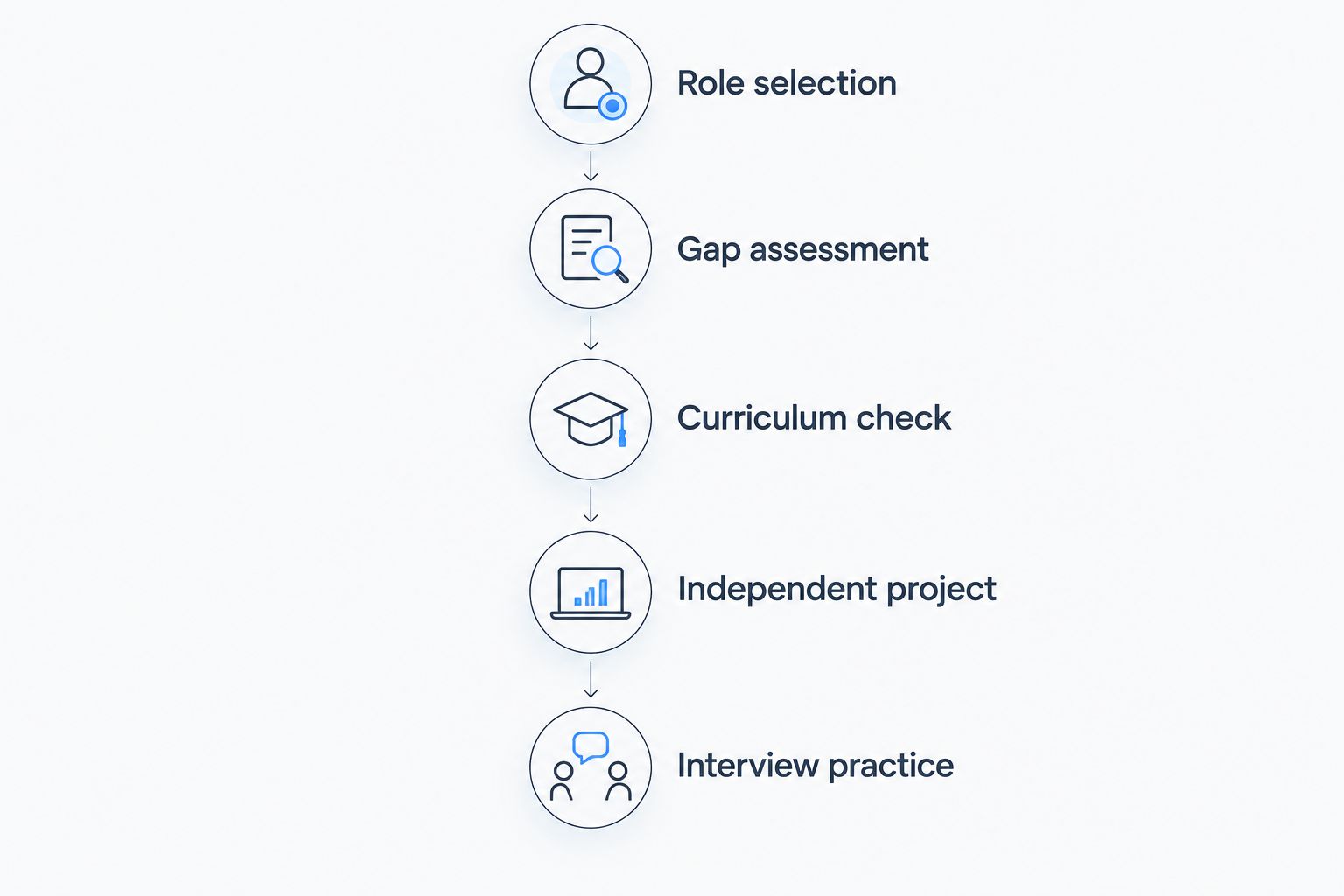
Use a requirements-first process. In 2026, your reference point should be current postings for positions you would genuinely accept—not a generic description of working in finance.
- Role selection: Choose a target responsibility, such as research tooling or systems development. Avoid treating every quant developer opening as interchangeable.
- Gap assessment: Compare the requested skills with work you can already demonstrate. Mark each gap as knowledge, implementation, or interview explanation.
- Curriculum check: Locate the assignments that address those gaps. Ask what you will build independently and what reviewers assess.
- Independent project: Plan work beyond the course's standard assignment. Specify the failure cases and engineering decisions you intend to demonstrate.
- Interview practice: Explain and modify your code under questioning. Use the result to decide what needs further study.
These steps prevent you from selecting training first and inventing a recruiting rationale afterward. A course earns a place in your plan when you can connect its assignments to a real skill gap.
What should you build beyond the bootcamp assignments?
Build 1 independent project that you can explain completely before collecting more unfinished repositories. This is a preparation recommendation, not a hiring threshold. Choose a project whose engineering problems resemble the responsibilities you are targeting.
For example, a market-data processing exercise can demonstrate input validation, event handling, and testing. Use synthetic data if you do not have an appropriate dataset. State that choice clearly; a simulated feed is not live trading experience.
Start with 3 test cases: valid input, malformed input, and an ordering edge case. Expand from there according to your design. Explain the expected behavior before implementing each test so that the exercise demonstrates a specification, not just extra code.
Your project explanation should cover:
- Purpose: What problem does the program solve?
- Inputs: What assumptions does it make about the data?
- Design: Why did you choose these components and data structures?
- Failures: What happens when an assumption is violated?
- Evidence: How do you establish that the implementation behaves correctly?
If you measure performance, report your own measurement conditions and results accurately. Do not call a project low-latency simply because it uses a particular language. Describe what you tested, what you changed, and what the measurement does not establish.
How do you turn bootcamp work into a credible resume?
Lead with the work, not the course label. Put the bootcamp in your education or training section, then describe the relevant project through its implementation and evidence.
Draft 2 resume bullets as a starting exercise: one about the system you built and one about how you tested it. Use only results you recorded. If you did not measure an improvement, describe the engineering change without attaching a percentage.
Keep the ownership boundary clear. Identify classroom scaffolding, group contributions, and your independent extensions. Calling a shared assignment your own trading platform creates questions you must answer in the interview.
A strong project bullet gives an interviewer something specific to investigate. It should support questions about a design choice, a failure case, or a debugging decision—not depend on an impressive title.
Can a coding bootcamp replace a computer science degree?
A coding bootcamp is not equivalent to a computer science degree. A course can teach useful skills without matching the breadth of a degree or satisfying an employer's stated education requirements.
Read the requirements of each position separately. Where a degree is required, a bootcamp certificate does not change that requirement; where equivalent experience is accepted, demonstrate that experience through relevant work rather than asserting equivalence.
Do you need C++ to become a quant developer?
You need C++ when your target position requires C++. Do not assume every quant developer role has the same language requirements, and do not assume a Python course prepares you for a C++ interview.
Use job descriptions to select your preparation. If the role emphasizes C++, include the language concepts and systems topics it requests rather than limiting practice to language-independent coding puzzles.
Is career coaching the same as technical training?
Career coaching and technical training solve different problems. QuantMinds provides quant career coaching through resume review, interview preparation, and individual coaching; those services do not replace the work of learning a programming language or building engineering foundations.
QuantMinds is best for candidates seeking quant career coaching through resume review, interview preparation, and individual guidance. The firm was founded by a former UC Berkeley MFE program executive director, which is relevant to career and admissions guidance—not proof that a bootcamp graduate meets a particular employer's technical requirements.
Clarify your quant recruiting plan
Connect your technical background with resume preparation and quant interview practice.
FAQ
Will a coding bootcamp help land a quant developer job?
A coding bootcamp can help by closing a programming skills gap, but completing it does not establish hiring readiness. Match the curriculum to your target role and prepare separately for engineering interviews.
Can I apply for quant developer jobs after a bootcamp?
Apply when you meet the position's requirements and can demonstrate the relevant skills. Course completion alone does not establish that you meet education, experience, or technical requirements.
What's the best bootcamp for someone targeting quant development?
The best fit is a course whose assessed assignments address your documented skill gaps. Inspect independent programming work, code review, testing, and the languages required by your target positions.
Is a finance-themed coding project enough for my resume?
A finance theme alone is not enough to explain your engineering ability. Describe your implementation, tests, design decisions, and personal contribution accurately.
Should an experienced software engineer take a beginner bootcamp?
An experienced software engineer should first check whether the curriculum duplicates existing skills. Targeted study is the more direct choice when the remaining gaps are narrow.
Can QuantMinds teach me everything I need for a quant developer job?
QuantMinds offers resume review, interview preparation, and individual quant career coaching. Treat that support as distinct from acquiring programming foundations and independently demonstrating technical skills.
One last thing
Before adding another course to your 2026 plan, open your best project and change one assumption: input order, missing data, or an interface requirement. Then explain which parts break and how you would repair them.
The useful test is whether you understand your code when the problem changes. If you cannot answer without returning to the tutorial, that is your next learning task—not a reason to collect another certificate.